
Homework Answers

Add Answer to:
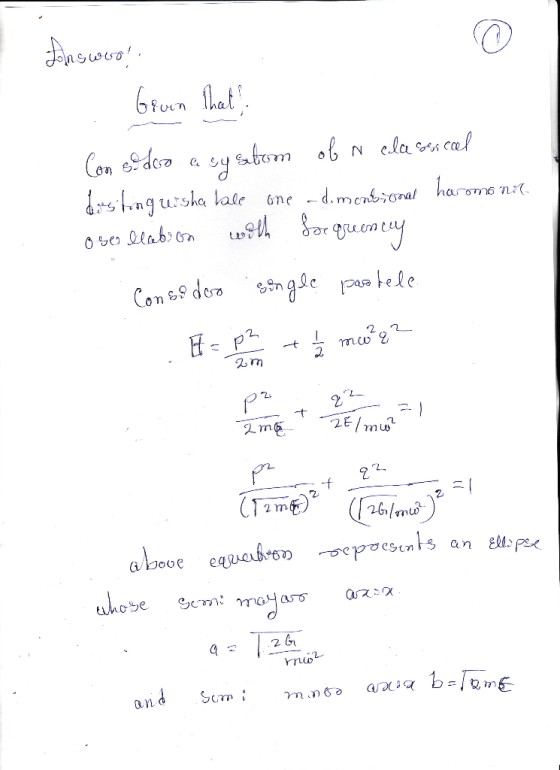
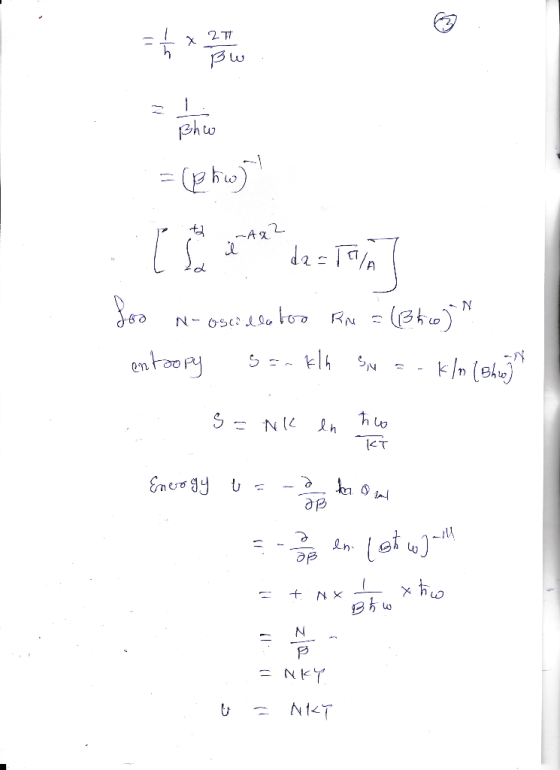
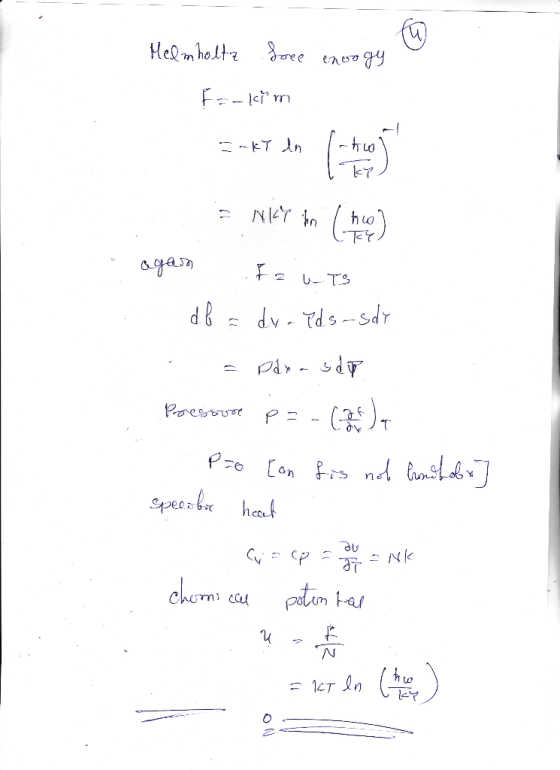
1: Consider a system of N classical distinguishable one-dimensional harmonic oscillators with fre...
1. Consider the system of $N$ classical harmonic oscillators. (a) Using microcanonical ensemble, compute the number...
1. Consider the system of $N$ classical harmonic oscillators. (a) Using microcanonical ensemble, compute the number of accessible state $Omega(E,N)$, where $E$ is the total energy of the system. (b) Find the expression for the heat capacity $C(T)$ as a function of the temperature, and draw its graph. (c) Using canonical ensemble, compute the partition function $Z(T,N)$ of the system. (d) Repeat b) in canonical ensemble. 2. Repeat Problem 1 for the system of $N$ (distinguishable) quantum harmonic oscillators.
1. (10 pts) Consider a system of N classical, independent harmonic oscil- lators. In the microcanonical...
 1. (10 pts) Consider a system of N classical, independent harmonic oscil- lators. In the microcanonical ensemble, calculate Ω(E) and Ω(B) exactly. From them, calculate the entropy S(E, N) and temperature T in the large N limit. 2. (10 points) Consider the same system as in problem 1. Calculate the average energy and entropy starting from the canonical ensemble.
Question no 6.1, statistical physics by Reif Volume 5 Problems 6.1 Phase space of a classical harmonic oscillator The en...
 Question no 6.1,
statistical physics by Reif Volume 5
Problems 6.1 Phase space of a classical harmonic oscillator The energy of a one-dimensional harmonic oscillator, whose position coordinate is x and whose momentum is p, is given by where the first term on the right is its kinetic and the second term its potential energy. Here m denotes the mass of the osellating particle and a the spring constant of the restoring force acting on the particle. Consider an ensemble...
Question no 6.1,
statistical physics by Reif Volume 5
Problems 6.1 Phase space of a classical harmonic oscillator The energy of a one-dimensional harmonic oscillator, whose position coordinate is x and whose momentum is p, is given by where the first term on the right is its kinetic and the second term its potential energy. Here m denotes the mass of the osellating particle and a the spring constant of the restoring force acting on the particle. Consider an ensemble...
(b) For a system of N independent harmonic oscillators at temperature T, all having a common...
 (b) For a system of N independent harmonic oscillators at temperature T, all having a common vibrational unit of energy, the partition function is Z = ZN. For large values of N, the system's internal energy is given by U = Ne %3D eBe For large N, calculate the system's heat capacity C. 3. This problem involves a collection of N independent harmonic oscillators, all having a common angular frequency w (such as in an Einstein solid or in the...
1. The two dimensional Harmonic Oscillator has the Hamiltonian n, n'>denotes the state In> of the...
 Please solve with the
explanations of notations
1. The two dimensional Harmonic Oscillator has the Hamiltonian n, n'>denotes the state In> of the x-oscillator and In'> of the y-oscillator. This system is perturbed with the potential energy: Hi-Kix y. The perturbation removes the The perturbation removes the degeneracy of the states | 1,0> and |0,1> a) In first order perturbation theory find the two nondegenerate eigenstates of the full b) Find the corresponding energy eigenvalues. На Hamiltonian as normalized linear...
Please solve with the
explanations of notations
1. The two dimensional Harmonic Oscillator has the Hamiltonian n, n'>denotes the state In> of the x-oscillator and In'> of the y-oscillator. This system is perturbed with the potential energy: Hi-Kix y. The perturbation removes the The perturbation removes the degeneracy of the states | 1,0> and |0,1> a) In first order perturbation theory find the two nondegenerate eigenstates of the full b) Find the corresponding energy eigenvalues. На Hamiltonian as normalized linear...
Consider one dimensional lattice of N particles having a spin of 1 /2 with an associated magnetic...
 Consider one dimensional lattice of N particles having a spin of 1 /2 with an associated magnetic moment μ The spins are kept in a magnetic field with magnetic induction B along the z direction. The spin can point either up, t, or down, , relative to the z axis. The energy of particle with spin down is e B and that of particle with spin up is ε--B. We assume that the system is isolated from. its environment so...
1. Consider a spin-0 particle of mass m and charge q moving in a symmetric three-dimensional harm...
 1. Consider a spin-0 particle of mass m and charge q moving in a symmetric three-dimensional harmonic oscillator potential with natural frequency W.Att-0 an external magnetic field is turned on which is uniform in space but oscillates with temporal frequency W as follows. E(t)-Bo sin(at) At time t>0, the perturbation is turned off. Assuming that the system starts off at t-0 in the ground state, apply time-dependent perturbation theory to estimate the probability that the system ends up in an...
2. Microcanonical ensemble: One-dimensional chain. (24 pts.) Consider a one-dimensional chain consisting of N segments as illus- trated in Figure 1. Let the length of each segment be a when the...
 2. Microcanonical ensemble: One-dimensional chain. (24 pts.) Consider a one-dimensional chain consisting of N segments as illus- trated in Figure 1. Let the length of each segment be a when the long dimension of the segment is parallel to the chain and 0 when the long dimension is normal to the chain direction. Each segment has just two non-degenerate states: long dimension parallel to the chain or perpen- dicular to the chain. Now consider a macrostate of the chain in...
1. Consider one-dimensional harmonic oscillator H w(aaand its energy eigenstates are denoted as ln) , n...
 1. Consider one-dimensional harmonic oscillator H w(aaand its energy eigenstates are denoted as ln) , n E No. The state of system is given by n-0 (a) Find Z. (b) Calculate the von Neumann entropy. (c) Evaluate mean energy.
8.4 The Two-Dimensional Central-Force Problem The 2D harmonic oscillator is a 2D central force pr...
 8.4 The Two-Dimensional Central-Force Problem The 2D harmonic oscillator is a 2D central force problem (as discussed in TZD Many physical systems involve a particle that moves under the influence of a central force; that is, a force that always points exactly toward, or away from, a force center O. In classical mechanics a famous example of a central force is the force of the sun on a planet. In atomic physics the most obvious example is the hydrogen atom,...
 1. (10 pts) Consider a system of N classical, independent harmonic oscil- lators. In the microcanonical ensemble, calculate Ω(E) and Ω(B) exactly. From them, calculate the entropy S(E, N) and temperature T in the large N limit. 2. (10 points) Consider the same system as in problem 1. Calculate the average energy and entropy starting from the canonical ensemble.
 Question no 6.1,
statistical physics by Reif Volume 5
Problems 6.1 Phase space of a classical harmonic oscillator The energy of a one-dimensional harmonic oscillator, whose position coordinate is x and whose momentum is p, is given by where the first term on the right is its kinetic and the second term its potential energy. Here m denotes the mass of the osellating particle and a the spring constant of the restoring force acting on the particle. Consider an ensemble...
Question no 6.1,
statistical physics by Reif Volume 5
Problems 6.1 Phase space of a classical harmonic oscillator The energy of a one-dimensional harmonic oscillator, whose position coordinate is x and whose momentum is p, is given by where the first term on the right is its kinetic and the second term its potential energy. Here m denotes the mass of the osellating particle and a the spring constant of the restoring force acting on the particle. Consider an ensemble...
 (b) For a system of N independent harmonic oscillators at temperature T, all having a common vibrational unit of energy, the partition function is Z = ZN. For large values of N, the system's internal energy is given by U = Ne %3D eBe For large N, calculate the system's heat capacity C. 3. This problem involves a collection of N independent harmonic oscillators, all having a common angular frequency w (such as in an Einstein solid or in the...
 Please solve with the
explanations of notations
1. The two dimensional Harmonic Oscillator has the Hamiltonian n, n'>denotes the state In> of the x-oscillator and In'> of the y-oscillator. This system is perturbed with the potential energy: Hi-Kix y. The perturbation removes the The perturbation removes the degeneracy of the states | 1,0> and |0,1> a) In first order perturbation theory find the two nondegenerate eigenstates of the full b) Find the corresponding energy eigenvalues. На Hamiltonian as normalized linear...
Please solve with the
explanations of notations
1. The two dimensional Harmonic Oscillator has the Hamiltonian n, n'>denotes the state In> of the x-oscillator and In'> of the y-oscillator. This system is perturbed with the potential energy: Hi-Kix y. The perturbation removes the The perturbation removes the degeneracy of the states | 1,0> and |0,1> a) In first order perturbation theory find the two nondegenerate eigenstates of the full b) Find the corresponding energy eigenvalues. На Hamiltonian as normalized linear...
 Consider one dimensional lattice of N particles having a spin of 1 /2 with an associated magnetic moment μ The spins are kept in a magnetic field with magnetic induction B along the z direction. The spin can point either up, t, or down, , relative to the z axis. The energy of particle with spin down is e B and that of particle with spin up is ε--B. We assume that the system is isolated from. its environment so...
 1. Consider a spin-0 particle of mass m and charge q moving in a symmetric three-dimensional harmonic oscillator potential with natural frequency W.Att-0 an external magnetic field is turned on which is uniform in space but oscillates with temporal frequency W as follows. E(t)-Bo sin(at) At time t>0, the perturbation is turned off. Assuming that the system starts off at t-0 in the ground state, apply time-dependent perturbation theory to estimate the probability that the system ends up in an...
 2. Microcanonical ensemble: One-dimensional chain. (24 pts.) Consider a one-dimensional chain consisting of N segments as illus- trated in Figure 1. Let the length of each segment be a when the long dimension of the segment is parallel to the chain and 0 when the long dimension is normal to the chain direction. Each segment has just two non-degenerate states: long dimension parallel to the chain or perpen- dicular to the chain. Now consider a macrostate of the chain in...
 1. Consider one-dimensional harmonic oscillator H w(aaand its energy eigenstates are denoted as ln) , n E No. The state of system is given by n-0 (a) Find Z. (b) Calculate the von Neumann entropy. (c) Evaluate mean energy.
 8.4 The Two-Dimensional Central-Force Problem The 2D harmonic oscillator is a 2D central force problem (as discussed in TZD Many physical systems involve a particle that moves under the influence of a central force; that is, a force that always points exactly toward, or away from, a force center O. In classical mechanics a famous example of a central force is the force of the sun on a planet. In atomic physics the most obvious example is the hydrogen atom,...
Most questions answered within 3 hours.
-
Where is the error in this code sequence?
String s1 = "Hello";
String s2 = "ello";...
asked 11 months ago -
Financial data for Joel de Paris, Inc., for last year
follow:
Joel de Paris, Inc.
Balance...
asked 11 months ago -
Consider this reaction:
Al2(SO4)3 (aq)+ BaCl3
(aq) Al2Cl6 (aq)- +
3BaSO4(s) . What is the...
asked 11 months ago -
Suppose that Savneet is considering increasing her
recent random sample from 20 car rentals to 40...
asked 11 months ago -
Trucks arrive at an unloading terminal at an average rate of 120
per hour.
Trucks arrive...
asked 11 months ago -
Why are methanol and ethanol completely soluble in water while
octanol is not very little soluble....
asked 11 months ago -
A facilities manager at a university reads in a research report
that the mean amount of...
asked 11 months ago -
When the CuSO4 is rehydrated by adding water to the anhydrous
compound, is this an endothermic...
asked 11 months ago -
A ray of sunlight is passing from diamond into crown glass; the
angle of incidence is...
asked 11 months ago -
A block of mass 0.249 kg is placed on top of a light, vertical
spring of...
asked 11 months ago -
how do the kidneys compensate in the presences of acidosis
a) trigger hyperventilate
b) reserve acid...
asked 11 months ago -
Question 501 pts
The rental rate of capital to the firm increases. Which of the
following...
asked 11 months ago