
Homework Answers
Add Answer to:
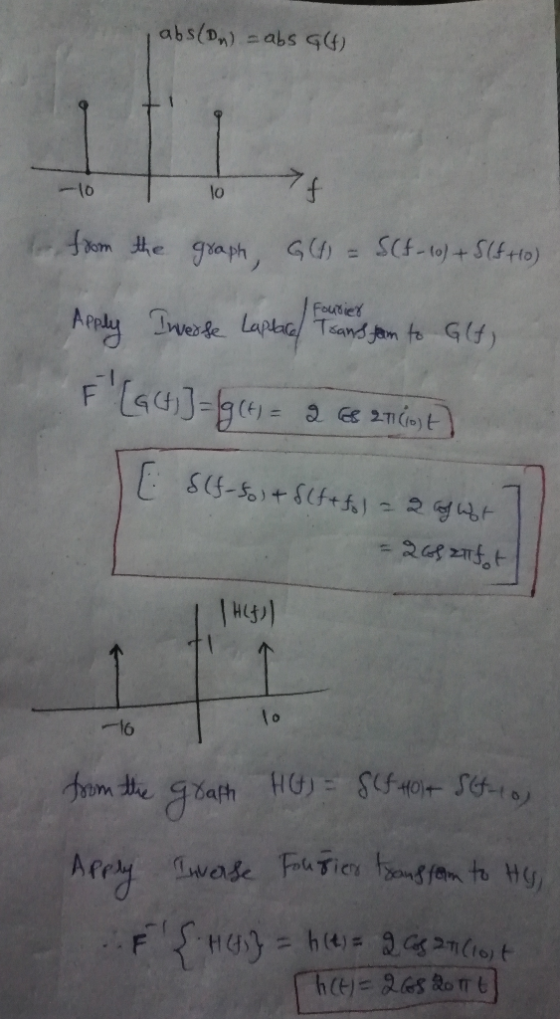
Consider the following, two-sided magnitude spectra for the signals g(t) and h(t). Write down the...
4. Consider the following two diastercomers: Both compounds generate 'H NMR spectra with the following signals:...
 4. Consider the following two diastercomers: Both compounds generate 'H NMR spectra with the following signals: A multiplet between 7.20-7.63 ppm with an integration of 5H Two separate doublets between 5.70-6.50 ppm, each with an integration of 1H A singlet around 1.30 ppm with an integration of 9H Despite the similarities, how could you differentiate between the H NMR spectra of these isomers? 5. Assign each set of protons to their appropriate signals in the 'H NMR spectrum shown below....
Prob 5 (continued): with message signal m(t): m(t) 10 cos(20mt) + 6 sin(60rt) (8 points) Write...
 Prob 5 (continued): with message signal m(t): m(t) 10 cos(20mt) + 6 sin(60rt) (8 points) Write an equation (do not spend time simplifying! can be in terms of both sin0 and cos0 functions) for the LSB-SSB signal if the message signal is modulated by carrier at 100 Hz: e. (6 points) Sketch the double-sided magnitude spectrum for the LSB-SSB signal (you do not necessarily need the equation from part (d) to draw this, you can go off your knowledge of...
7. Single sideband (SSB) signals can be generated in two ways. In this problem you will...
 7. Single sideband (SSB) signals can be generated in two ways. In this problem you will verify that both methods give the same answer A. Selective filtering: Here, the DSB-SC signal g(t) is first generated which is filtered to get the USB signal g(t) m(t) QUSB(t) 2 cos(wet) Figure 3: Generation of SSB signals (a) Consider the message signal m(t) rad/sec. Draw the spectra of the signals m(t), g(t) and øUSB(t) in figure 3. cos(t) and a carrier frequency of...
One of the most important classes of time dependent signals are periodic signals. Periodic signals satisfy tho following signal equations, x(t) X(t) x(t+nt) for n 2,3. The periodic signals to b...
 One of the most important classes of time dependent signals are periodic signals. Periodic signals satisfy tho following signal equations, x(t) X(t) x(t+nt) for n 2,3. The periodic signals to be observed in this laboratory assignment are shown below. In all the examples A represents the amplitude of the signal and may be given as the measurement from 0 to the peak value A, Apk or can be given as the measurement between A and -A which defines a peak-to-peak...
Plz explain 9. The impulse response of a continuous-time LTI system is obtained by plying two signals, f(t) and g(t). h(t) = f(t) g(t) where f(t) = sine(t), g(t) = 5 sine(5). (a) Accurately sketch th...
 Plz explain
9. The impulse response of a continuous-time LTI system is obtained by plying two signals, f(t) and g(t). h(t) = f(t) g(t) where f(t) = sine(t), g(t) = 5 sine(5). (a) Accurately sketch the frequency response H() of the system. (b) What kind of system is H) (LPF, HPF, BPF, BSF, or none of these)? (c) Can this system be implemented with a finite order differential equa tion Explain.
9. The impulse response of a continuous-time LTI system...
Plz explain
9. The impulse response of a continuous-time LTI system is obtained by plying two signals, f(t) and g(t). h(t) = f(t) g(t) where f(t) = sine(t), g(t) = 5 sine(5). (a) Accurately sketch the frequency response H() of the system. (b) What kind of system is H) (LPF, HPF, BPF, BSF, or none of these)? (c) Can this system be implemented with a finite order differential equa tion Explain.
9. The impulse response of a continuous-time LTI system...
Two waves are traveling simultaneously down a long Slinky. They can be represented by the following...
 Two waves are traveling simultaneously down a long Slinky. They can be represented by the following equations. 41(x, t) = 0.00260 sin(6.00x – 330t) 42(x, t) = 0.00260 sin(7.20x – 250t) Distances are measured in meters and time in seconds. (a) Write the expression for the resulting wave. (Use the following as necessary: x and t. Do not include units in your answer.) W = (b) What are the phase and group velocities in m/s)? (Enter the magnitudes.) phase velocity...
5. Consider a CT system with transfer function This system is called an integrutor because t by h...
 the subject is in digital signal processing
5. Consider a CT system with transfer function This system is called an integrutor because t by he d to the ingent t y)-x(r)dr. Discretize the above system using the bilinear transform. (a) What is the transfer function H'(:) of the resulting DT system b) If xin] is the input and yin] is the output of the resulting DT system, write the (c) Obtain an expression for the frequency response H'(o) of the...
the subject is in digital signal processing
5. Consider a CT system with transfer function This system is called an integrutor because t by he d to the ingent t y)-x(r)dr. Discretize the above system using the bilinear transform. (a) What is the transfer function H'(:) of the resulting DT system b) If xin] is the input and yin] is the output of the resulting DT system, write the (c) Obtain an expression for the frequency response H'(o) of the...
Problem 5. Consider the following second order linear differential equation f"(t)-f'(t) +f(t) kt ...
 Problem 5. Consider the following second order linear differential equation f"(t)-f'(t) +f(t) kt which models a forced oscillation in a damping material. For example, imagine moving your hand back and forth underwater. Write this equation as a set of coupled first order equations by doing the following: ·Define a new function g = f'(t). This gives you one of the two coupled equations. . Use the given ODE, g, and its derivatives to write the second first order equation. Both...
1. Consider the two waveforms f(t) and g(t) shown in the figures below. (a) Characterize both...
 1. Consider the two waveforms f(t) and g(t) shown in the figures below. (a) Characterize both functions by expressing each in a suitable mathematical functional form. Write the resultant equation next to the equal sign for each function (b) Using direct integration, compute the convolution integral using the functions you defined in part (a). (c) Sketch the resultant function or use a plotting package of your choice to plot your result for h(t). What do you observe about the relative...
I. The state vector φ(t) at time t can be decomposed on the {I +), l-)} basis: Write down the sys...
 I. The state vector φ(t) at time t can be decomposed on the {I +), l-)} basis: Write down the system of coupled differential equations which the components c+ (t) and c() satisfy 2. Let |φ(1-0)) be decomposed on the {lx+), lx-) basis. Show that c+(1)-(Ηφ(t)) is written as sin with Ω 2VA2+B2. Here f.Ω is the energy difference of the two levels. Show that c+(1) (as well as c (t)) satisfies the differential equation c) 0. We assume that...
 4. Consider the following two diastercomers: Both compounds generate 'H NMR spectra with the following signals: A multiplet between 7.20-7.63 ppm with an integration of 5H Two separate doublets between 5.70-6.50 ppm, each with an integration of 1H A singlet around 1.30 ppm with an integration of 9H Despite the similarities, how could you differentiate between the H NMR spectra of these isomers? 5. Assign each set of protons to their appropriate signals in the 'H NMR spectrum shown below....
 Prob 5 (continued): with message signal m(t): m(t) 10 cos(20mt) + 6 sin(60rt) (8 points) Write an equation (do not spend time simplifying! can be in terms of both sin0 and cos0 functions) for the LSB-SSB signal if the message signal is modulated by carrier at 100 Hz: e. (6 points) Sketch the double-sided magnitude spectrum for the LSB-SSB signal (you do not necessarily need the equation from part (d) to draw this, you can go off your knowledge of...
 7. Single sideband (SSB) signals can be generated in two ways. In this problem you will verify that both methods give the same answer A. Selective filtering: Here, the DSB-SC signal g(t) is first generated which is filtered to get the USB signal g(t) m(t) QUSB(t) 2 cos(wet) Figure 3: Generation of SSB signals (a) Consider the message signal m(t) rad/sec. Draw the spectra of the signals m(t), g(t) and øUSB(t) in figure 3. cos(t) and a carrier frequency of...
 One of the most important classes of time dependent signals are periodic signals. Periodic signals satisfy tho following signal equations, x(t) X(t) x(t+nt) for n 2,3. The periodic signals to be observed in this laboratory assignment are shown below. In all the examples A represents the amplitude of the signal and may be given as the measurement from 0 to the peak value A, Apk or can be given as the measurement between A and -A which defines a peak-to-peak...
 Plz explain
9. The impulse response of a continuous-time LTI system is obtained by plying two signals, f(t) and g(t). h(t) = f(t) g(t) where f(t) = sine(t), g(t) = 5 sine(5). (a) Accurately sketch the frequency response H() of the system. (b) What kind of system is H) (LPF, HPF, BPF, BSF, or none of these)? (c) Can this system be implemented with a finite order differential equa tion Explain.
9. The impulse response of a continuous-time LTI system...
Plz explain
9. The impulse response of a continuous-time LTI system is obtained by plying two signals, f(t) and g(t). h(t) = f(t) g(t) where f(t) = sine(t), g(t) = 5 sine(5). (a) Accurately sketch the frequency response H() of the system. (b) What kind of system is H) (LPF, HPF, BPF, BSF, or none of these)? (c) Can this system be implemented with a finite order differential equa tion Explain.
9. The impulse response of a continuous-time LTI system...
 Two waves are traveling simultaneously down a long Slinky. They can be represented by the following equations. 41(x, t) = 0.00260 sin(6.00x – 330t) 42(x, t) = 0.00260 sin(7.20x – 250t) Distances are measured in meters and time in seconds. (a) Write the expression for the resulting wave. (Use the following as necessary: x and t. Do not include units in your answer.) W = (b) What are the phase and group velocities in m/s)? (Enter the magnitudes.) phase velocity...
 the subject is in digital signal processing
5. Consider a CT system with transfer function This system is called an integrutor because t by he d to the ingent t y)-x(r)dr. Discretize the above system using the bilinear transform. (a) What is the transfer function H'(:) of the resulting DT system b) If xin] is the input and yin] is the output of the resulting DT system, write the (c) Obtain an expression for the frequency response H'(o) of the...
the subject is in digital signal processing
5. Consider a CT system with transfer function This system is called an integrutor because t by he d to the ingent t y)-x(r)dr. Discretize the above system using the bilinear transform. (a) What is the transfer function H'(:) of the resulting DT system b) If xin] is the input and yin] is the output of the resulting DT system, write the (c) Obtain an expression for the frequency response H'(o) of the...
 Problem 5. Consider the following second order linear differential equation f"(t)-f'(t) +f(t) kt which models a forced oscillation in a damping material. For example, imagine moving your hand back and forth underwater. Write this equation as a set of coupled first order equations by doing the following: ·Define a new function g = f'(t). This gives you one of the two coupled equations. . Use the given ODE, g, and its derivatives to write the second first order equation. Both...
 1. Consider the two waveforms f(t) and g(t) shown in the figures below. (a) Characterize both functions by expressing each in a suitable mathematical functional form. Write the resultant equation next to the equal sign for each function (b) Using direct integration, compute the convolution integral using the functions you defined in part (a). (c) Sketch the resultant function or use a plotting package of your choice to plot your result for h(t). What do you observe about the relative...
 I. The state vector φ(t) at time t can be decomposed on the {I +), l-)} basis: Write down the system of coupled differential equations which the components c+ (t) and c() satisfy 2. Let |φ(1-0)) be decomposed on the {lx+), lx-) basis. Show that c+(1)-(Ηφ(t)) is written as sin with Ω 2VA2+B2. Here f.Ω is the energy difference of the two levels. Show that c+(1) (as well as c (t)) satisfies the differential equation c) 0. We assume that...
Most questions answered within 3 hours.
-
Where is the error in this code sequence?
String s1 = "Hello";
String s2 = "ello";...
asked 10 months ago -
Financial data for Joel de Paris, Inc., for last year
follow:
Joel de Paris, Inc.
Balance...
asked 10 months ago -
Consider this reaction:
Al2(SO4)3 (aq)+ BaCl3
(aq) Al2Cl6 (aq)- +
3BaSO4(s) . What is the...
asked 10 months ago -
Suppose that Savneet is considering increasing her
recent random sample from 20 car rentals to 40...
asked 10 months ago -
Trucks arrive at an unloading terminal at an average rate of 120
per hour.
Trucks arrive...
asked 10 months ago -
Why are methanol and ethanol completely soluble in water while
octanol is not very little soluble....
asked 10 months ago -
A facilities manager at a university reads in a research report
that the mean amount of...
asked 10 months ago -
When the CuSO4 is rehydrated by adding water to the anhydrous
compound, is this an endothermic...
asked 10 months ago -
A ray of sunlight is passing from diamond into crown glass; the
angle of incidence is...
asked 10 months ago -
A block of mass 0.249 kg is placed on top of a light, vertical
spring of...
asked 10 months ago -
how do the kidneys compensate in the presences of acidosis
a) trigger hyperventilate
b) reserve acid...
asked 10 months ago -
Question 501 pts
The rental rate of capital to the firm increases. Which of the
following...
asked 10 months ago