Utility maximization with more than two goods Suppose that there four goods Q, R, X and Y , avail...
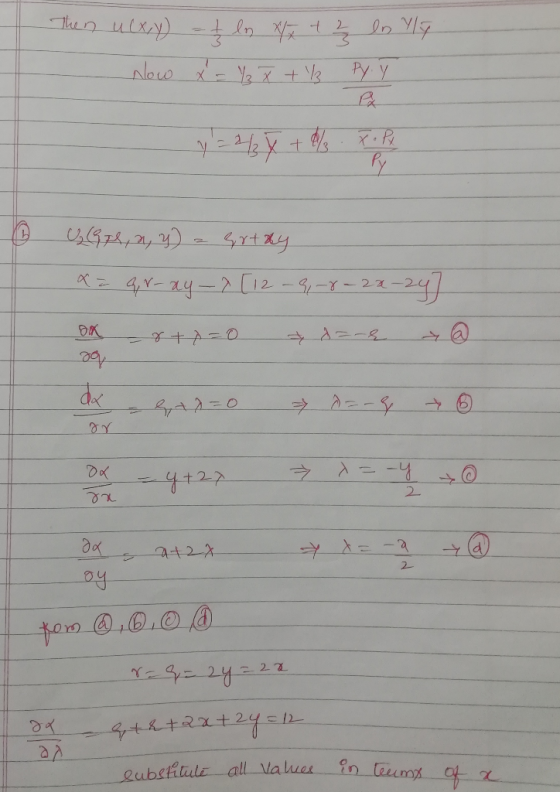
Utility maximization with more than two goods Suppose that there four goods Q, R, X and Y , available in arbitrary non-negative quantities (so the the consumption set is R 4 +). A typical consumption bundle is therefore a vector (q, r, x, y), where q ≥ 0 is the quantity of good Q, r ≥ 0 is the quantity of good R, x ≥ 0 is the quantity of good X, and y ≥ 0 is the quantity of good Y . The consumer has a total wealth of w = 12, and the each of the goods has a strictly positive price. In particular, let pQ = 1 be the price of good Q, pR = 1 be the price of good R, pX = 2 be the price of good X, and pY = 2 be the price of good Y . In the following three questions, you are asked to study the utility maximization problem for the consumer for three different utility functions. Your final solution for each part should indicate the quantity of goods Q, R, X, and Y that the consumer will purchase at the given prices and wealth when the consumer’s preferences can be represented by the respective utility function (i.e., utility function u1 for part 1, u2 for part 2, or u3 for part 3). Please carefully show the reasoning behind all of your answers.
(a) Suppose that the consumer’s preferences over consumption bundles can be represented by the following utility function: u1(q, r, x, y) = min{qr, xy}. Formulate and solve the consumer’s utility maximization problem.
(b) Instead, now suppose that the consumer’s preferences over consumption bundles can be represented by the following utility function: u2(q, r, x, y) = qr + xy. Formulate and solve the consumer’s utility maximization problem.
Homework Answers



Add Answer to:
Utility maximization with more than two goods Suppose that there four goods Q, R, X and Y , avail...
Utility maximization with more than two goods Suppose that there four goods Q, R, X and...
Utility maximization with more than two goods Suppose that there four goods Q, R, X and Y , available in arbitrary non-negative quantities (so the the consumption set is R 4 +). A typical consumption bundle is therefore a vector (q, r, x, y), where q ≥ 0 is the quantity of good Q, r ≥ 0 is the quantity of good R, x ≥ 0 is the quantity of good X, and y ≥ 0 is the quantity of...
Suppose that there two goods X and Y, available in arbitrary non- negative quantities (so the...
 Suppose that there two goods X and Y, available in arbitrary non- negative quantities (so the the consumption set is R2). The consumer has preferences over consumption bundles that are strongly monotone, strictly convex, and represented by the following (differentiable) utility function: u(x, y)-y+2aVT, where z is the quantity of good X, and y is the quantity of good Y, and a 20 is a utility parameter The consumer has strictly positive wealth w > 0. The price of good...
Suppose that there two goods, X and Y , available in arbitrary nonnegative quantities (so the the...
Suppose that there two goods, X and Y , available in arbitrary nonnegative quantities (so the the consumption set is R 2 +). The consumer has preferences over consumption bundles that are monotone, strictly convex, and represented by the following (differentiable) utility function: u(x, y) = α √ x + (1 − α) √ y, where x is the quantity of good X, y is the quantity of good Y , and α ≥ 0 is a utility parameter. The...
What is the utility maximization for u1(q, r, x, y) = min{qr, xy} where w=12, py=2, Price of q=1 ...
what is the utility maximization for u1(q, r, x, y) = min{qr, xy} where w=12, py=2, Price of q=1 price of x=2 and price of r =1
What is and MRS for this utility maximization u1(q, r, x, y) = min{qr, xy} where w=12, py=2, Pric...
what is and MRS for this utility maximization u1(q, r, x, y) = min{qr, xy} where w=12, py=2, Price of q=1 price of x=2 and price of r =1
Sally consumes two goods, X and Y. Her preferences over consumption bundles are repre- sented by the utility function r...
 Sally consumes two goods, X and Y. Her preferences over consumption bundles are repre- sented by the utility function r, y)- .5,2 where denotes the quantity of good X and y denotes the quantity of good Y. The current market price for X is px 10 while the market price for Y is Pr = $5. Sally's current income is $500. (a) Write the expression for Sally's budget constraint. (1 point) (b) Find the optimal consumption bundle that Sally will...
Suppose a consumer’s preferences for two goods, X and Y, can be described by a utility...
Suppose a consumer’s preferences for two goods, X and Y, can be described by a utility function which takes the form:U= min(XY) which simply means the consumer’s utility is equal to the smaller of either X or Y.Draw and explain a simple set of indifference curves representing these preferences.
Suppose a consumer’s preferences are represented by the utility function U(X,Y) = X2*Y. Therefore, MUx =...
Suppose a consumer’s preferences are represented by the utility function U(X,Y) = X2*Y. Therefore, MUx = 2XY • MUy = X2 Also, suppose the consumer has $32 to spend (M = $32), PY = 1, and that they spend all of their money on goods X and Y. Also, assume the consumer maximizes their utility subject to their budget constraint. Complete the following table: Px Quantity Demanded of X $1 $2 $3
Utility Maximization with Substitutes Carol needs to decide how to spend her wealth on fish and...
Utility Maximization with Substitutes Carol needs to decide how to spend her wealth on fish and chicken. For Carol, 1 lb of fish is equivalent to 2 lb of chicken. Her preferences can be represented by the utility function u(x, y) = 2x +y where x is the quantity of fish (in lbs) and y is the quantity of chicken (in lbs). The consumption set is R 2 +. (a) Draw two typical indifference curves for Carol, one corresponding to...
Utility Maximization with Non-Monotone Preferences Suppose there are two goods, coffee (C) and tea (T). The...
Utility Maximization with Non-Monotone Preferences Suppose there are two goods, coffee (C) and tea (T). The consumption set is R 2 +, so both goods can be consumed in arbitrary non-negative quantities. Abdul owns 2000 grams of coffee but does not own any tea. He has no other wealth. The price of coffee is pC = 2 (in Dhs per gram) and the price of tea is pT > 0 (in Dhs per gram). Abdul can sell coffee to earn...
 Suppose that there two goods X and Y, available in arbitrary non- negative quantities (so the the consumption set is R2). The consumer has preferences over consumption bundles that are strongly monotone, strictly convex, and represented by the following (differentiable) utility function: u(x, y)-y+2aVT, where z is the quantity of good X, and y is the quantity of good Y, and a 20 is a utility parameter The consumer has strictly positive wealth w > 0. The price of good...
 Sally consumes two goods, X and Y. Her preferences over consumption bundles are repre- sented by the utility function r, y)- .5,2 where denotes the quantity of good X and y denotes the quantity of good Y. The current market price for X is px 10 while the market price for Y is Pr = $5. Sally's current income is $500. (a) Write the expression for Sally's budget constraint. (1 point) (b) Find the optimal consumption bundle that Sally will...
Most questions answered within 3 hours.
-
Where is the error in this code sequence?
String s1 = "Hello";
String s2 = "ello";...
asked 11 months ago -
Financial data for Joel de Paris, Inc., for last year
follow:
Joel de Paris, Inc.
Balance...
asked 11 months ago -
Consider this reaction:
Al2(SO4)3 (aq)+ BaCl3
(aq) Al2Cl6 (aq)- +
3BaSO4(s) . What is the...
asked 11 months ago -
Suppose that Savneet is considering increasing her
recent random sample from 20 car rentals to 40...
asked 11 months ago -
Trucks arrive at an unloading terminal at an average rate of 120
per hour.
Trucks arrive...
asked 11 months ago -
Why are methanol and ethanol completely soluble in water while
octanol is not very little soluble....
asked 11 months ago -
A facilities manager at a university reads in a research report
that the mean amount of...
asked 11 months ago -
When the CuSO4 is rehydrated by adding water to the anhydrous
compound, is this an endothermic...
asked 11 months ago -
A ray of sunlight is passing from diamond into crown glass; the
angle of incidence is...
asked 11 months ago -
A block of mass 0.249 kg is placed on top of a light, vertical
spring of...
asked 11 months ago -
how do the kidneys compensate in the presences of acidosis
a) trigger hyperventilate
b) reserve acid...
asked 11 months ago -
Question 501 pts
The rental rate of capital to the firm increases. Which of the
following...
asked 11 months ago