What are the issue and court decision for TC Summ. 2016-10, Fisher v. Commissioner?
What are the issue and court decision for TC Summ. 2016-10, Fisher v. Commissioner?
Homework Answers
In Fisher v. Commissioner, T.C. Summary Opinion 2016-10, an attorney discovered that just because you say you're writing a book does not make all of your "research expense" deductible.
The taxpayer was a practicing attorney with three small children. At the request of a client, she was asked to travel to the Czech Republic. Because no day care was available, she chose to bring the kids along. Worried about what to do with the children on such a long trip, the taxpayer decided to write a children's travel guide to the Czech Republic that, she hoped, would "keep the kids busy."After the trip was over, the taxpayer decided to expand her vision for her children's book into a series of travel guides to locations throughout the U.S. and abroad. Before traveling to any destination, the taxpayer would write a rough draft of the travel guide, and then fill in the more interesting details while on her trip.She took the kids to Disney World as well as several European cities, arguing that the trips constituted "research." In all, she developed four "prototype books," and while she was able to sell a few of the unpublished prototypes to friends and family who requested them, the taxpayer was never able to get any of the books formally published.
On her tax returns for the three years under issue, the taxpayer reported a total of $479 of income from the book-writing activity, but $72,000 of expenses, largely in the form of travel and meals while conducting "research." As you might imagine, this $71,500 loss helped to offset the taxpayer's income as a practicing attorney and reduced her overall tax burden.
The IRS came calling, however, and denied all but $479 of the expenses (allowing the taxpayer to reduce income from the activity to zero, but not below), arguing that the book-writing activity was not entered into for profit.
The tax law will only permit you to deduct a loss from an activity if it is entered into with the intent of making a profit. If no such intent is shown, the activity is classified as a "hobby,' and expenses may only be deducted to the extent of any income derived from the activity.
In Fisher, the IRS argued that the taxpayer had no profit motive with the book-writing activity, and thus was not eligible to deduct a loss. Citing the hobby loss rules of Section 183, the IRS noted the lack of income, the elements of personal recreation inherent in the activity, and the taxpayer's use of the resulting losses to offset income from her day job. These same factors often serve to deny losses for taxpayers involved in multi-level marketing programs such as Beachbody, Rodan & Fields, and Silpada.
The Tax Court sided with the IRS, but interestingly, refused to apply the hobby loss factors of Section 183. Instead, the Service took a more direct approach to denying the book-writing deductions, concluding that while the activity might eventually evolve into a for-profit business, it certainly hadn't done so during the years at issue. During that period, the taxpayer had not hired an agent, had not finalized any of her books, and had not yet submitted any proposals to a publishing company. As a result, the court concluded that her activity for the three years could best be described as "research in connection with a business she had in mind," and because there was no business, no deductions were allowed.
Add Answer to:
What are the issue and court decision for TC Summ. 2016-10, Fisher v. Commissioner?
provide facts and outcome on the Richard C. Mathews v. Commissioner tax court case what was...
provide facts and outcome on the Richard C. Mathews v. Commissioner tax court case what was the ruling in the case, what was the petitioner take the commissioner to court? the case occurred in december 2018.
provide facts and outcome on teri jordan v commissioner tax court case.
provide facts and outcome on teri jordan v commissioner tax court case.
The Commissioner of Internal Revenue ("Commissioner") appeals the Tax Court's decision that he abused his discretion...
The Commissioner of Internal Revenue ("Commissioner") appeals the Tax Court's decision that he abused his discretion in requiring Jim Turin & Sons, Inc. ("taxpayer"), to use the accrual method of accounting to compute its federal taxes for the tax years at issue. In particular, the Commissioner contests the Tax Court's finding that emulsified asphalt is not "merchandise," as that term is used in 26 C.F.R.S 1.471-1. The Tax Court had jurisdiction pursuant to 26 U.S.C.SS 6213, 6214, and 7442. We...
The Commissioner of Internal Revenue ("Commissioner") appeals the Tax Court's decision that he abused his discretion...
The Commissioner of Internal Revenue ("Commissioner") appeals the Tax Court's decision that he abused his discretion in requiring Jim Turin & Sons, Inc. ("taxpayer"), to use the accrual method of accounting to compute its federal taxes for the tax years at issue. In particular, the Commissioner contests the Tax Court's finding that emulsified asphalt is not "merchandise," as that term is used in 26 C.F.R.S 1.471-1. The Tax Court had jurisdiction pursuant to 26 U.S.C.SS 6213, 6214, and 7442. We...
Explain whether you decided if the Tax Court case, Intermountain LUmber Co. v. Commissioner, 65 T.C....
Explain whether you decided if the Tax Court case, Intermountain LUmber Co. v. Commissioner, 65 T.C. 1025 (1976) was correctly decided.
Roddy was researching an issue and found a favorable tax court decision that addresses his issue....
 Roddy was researching an issue and found a favorable tax court decision that addresses his issue. He also determined that there was a nonacquiescence for the case. Who issued the nonacquiescence? What is it? What does it mean and how would it affect Roddy's reliance on the court case?
What issue did the Court consider in Matrixx Initiatives, Inc. v. Siracusano? a. The Court reviewed...
What issue did the Court consider in Matrixx Initiatives, Inc. v. Siracusano? a. The Court reviewed the scienter of Siracusano in the case. b. The Court examined whether Matrixx elected not to disclose the reports of adverse events with the drug Zicam because they understood their likely effect on the market thus meeting the materiality requirement under Section 10(b) of the Securities Act of 1934. c. The Court determined whether the drug Zicam caused anosmia. d. The Court studied the...
Which citation refers to a Fourth Circuit Court of Appeals decision? Select one 40 TC. 1018....
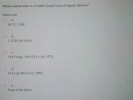 Which citation refers to a Fourth Circuit Court of Appeals decision? Select one 40 TC. 1018. 2 TCM 205 (1951) C. 354 F.Supp. 1003 (D. Ct. Ga, 1972). d. 914 F.2d 396 (CA-3, 1990). None of the above.
What is the difference between a Tax Court regular decision and a Tax Court memorandum decision?...
What is the difference between a Tax Court regular decision and a Tax Court memorandum decision? Whst are the similarities?
Court case- Worceter V Geogeria Historical Context- What was happenibg at the time? (Names, Terms, Events)...
Court case- Worceter V Geogeria Historical Context- What was happenibg at the time? (Names, Terms, Events) Contitutional Issue Decision Impact (U.S. history question)
 Roddy was researching an issue and found a favorable tax court decision that addresses his issue. He also determined that there was a nonacquiescence for the case. Who issued the nonacquiescence? What is it? What does it mean and how would it affect Roddy's reliance on the court case?
 Which citation refers to a Fourth Circuit Court of Appeals decision? Select one 40 TC. 1018. 2 TCM 205 (1951) C. 354 F.Supp. 1003 (D. Ct. Ga, 1972). d. 914 F.2d 396 (CA-3, 1990). None of the above.
Most questions answered within 3 hours.
-
Where is the error in this code sequence?
String s1 = "Hello";
String s2 = "ello";...
asked 11 months ago -
Financial data for Joel de Paris, Inc., for last year
follow:
Joel de Paris, Inc.
Balance...
asked 11 months ago -
Consider this reaction:
Al2(SO4)3 (aq)+ BaCl3
(aq) Al2Cl6 (aq)- +
3BaSO4(s) . What is the...
asked 11 months ago -
Suppose that Savneet is considering increasing her
recent random sample from 20 car rentals to 40...
asked 11 months ago -
Trucks arrive at an unloading terminal at an average rate of 120
per hour.
Trucks arrive...
asked 11 months ago -
Why are methanol and ethanol completely soluble in water while
octanol is not very little soluble....
asked 11 months ago -
A facilities manager at a university reads in a research report
that the mean amount of...
asked 11 months ago -
When the CuSO4 is rehydrated by adding water to the anhydrous
compound, is this an endothermic...
asked 11 months ago -
A ray of sunlight is passing from diamond into crown glass; the
angle of incidence is...
asked 11 months ago -
A block of mass 0.249 kg is placed on top of a light, vertical
spring of...
asked 11 months ago -
how do the kidneys compensate in the presences of acidosis
a) trigger hyperventilate
b) reserve acid...
asked 11 months ago -
Question 501 pts
The rental rate of capital to the firm increases. Which of the
following...
asked 11 months ago