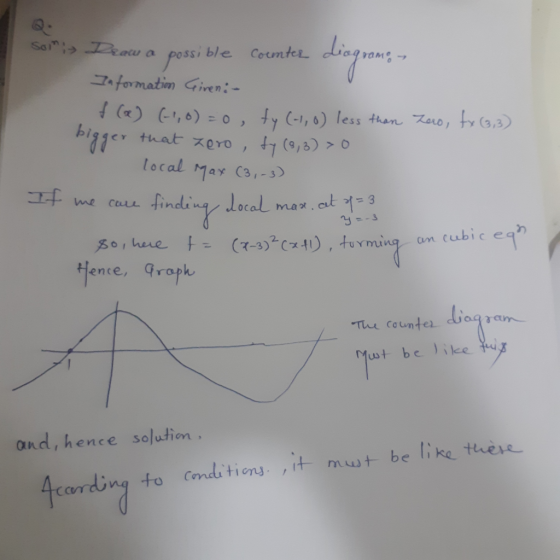
Draw a possible counter diagram of f such that fx (-1,0) =0 , fy(-1,0) less than zero , fx(3,3)= ...
draw a possible counter diagram of f such that fx (-1,0) =0 , fy(-1,0) less than zero , fx(3,3)= bigger that zero , fy(3,3) bigger than zero, and f has alocal max at ( 3, -3)
Homework Answers
Add Answer to:
Draw a possible counter diagram of f such that fx (-1,0) =0 , fy(-1,0) less than zero , fx(3,3)= ...
An F statistic can have what values? 1). less than or equal to zero 2). greater...
An F statistic can have what values? 1). less than or equal to zero 2). greater than or equal to zero 3). greater than zero 4). greater than or less than zero less than zero
10. Let f(x)- x+1, when x<0 x21, when x20 Calculate Sro(x) Graph fx) near zero and...
 10. Let f(x)- x+1, when x<0 x21, when x20 Calculate Sro(x) Graph fx) near zero and then graph Sce)(x) near zero. So)(x) fx) lim So (x) = x 0 lim So)(x) x0+ limSt (x) x0 Based on the graph of f(x) and a limit calculation, deternmine if f(x) is continuous at x=0. Based on the graph of So)(x) and the limit calculations above, classify what kind of discontinuity point S(o) (x) has at x-0 Does f '(0) exist? If yes,...
8.) (10 Points) Given the contour diagram z = f(x,y). 2 1 2 3 4 -2...
 8.) (10 Points) Given the contour diagram z = f(x,y). 2 1 2 3 4 -2 R a. Find i. f(-1,1) 11. a value of x for which f(x, 1) = 3 iii. a value of y for which f(0,y) = -2 b. The given graph has a local maximum value. At which point (x,y) does this occur? c. Determine the sign (positive or negative) of the following partial derivatives. i. (1,0) ii. fy(0,1)
The graph of z = f (x, y) is shown below. In each part, determine whether the given partial derivatives are positive, negative, or zero. (Note that the function is symmetric about 0 in both the x- and y- directions.)
Problem #7:The graph of z = f (x, y) is shown below. In each part, determine whether the given partial derivatives are positive, negative, or zero. (Note that the function is symmetric about 0 in both the x- and y- directions.)(a) fx(2, 2) and fxx(2, 2)(b) fy(2, 2) and fyy(2, 2)(c) fx(−2, 0) and fxx(−2, 0)(d) fy(−2, 0) and fyy(−2, 0)(A) zero, positive (B) negative, negative (C) negative, zero (D) zero, negative (E) positive, negative (F) zero, zero (G) positive, positive (H) positive, zero (I) negative, positive Problem...
1. A 200 kg crate is pushed across a floor by a force F = 250...
 1. A 200 kg crate is pushed across a floor by a force F = 250 newtons at an angle 0 = 53 below horizontal. The floor exerts a 50 newton frictional force on the crate opposing the motion. a. Draw a labeled free body diagram showing the forces acting on the trunk. (+2) b. Below, write Newtons's 2nd Law (F = må) in the horizontal (x) and vertical (v) direction, using the names of the forces from your free...
6. Design a 2-bit binary counter that counts, 0, 1, 2, 3, 0,. Use the 74LS374 IC, which has eight D flip-flops on it. They are positive-edge triggered, but it will not matter at all here You may draw...
 6. Design a 2-bit binary counter that counts, 0, 1, 2, 3, 0,. Use the 74LS374 IC, which has eight D flip-flops on it. They are positive-edge triggered, but it will not matter at all here You may draw a state diagram and then fill in the table Present State Q(t) Next State (D(t) - Q(t+1)) Q1(t) Qo(t) 7. Design a BCD binary counter that counts from 0 to 9 then back to 0 and repeat, displaying the count on...
Try to show all of the following steps for the problem below: Draw a free-body diagram...
Try to show all of the following steps for the problem below: Draw a free-body diagram for at least one object (or system) with vectors showing all forces on that object. Draw a coordinate system for each free-body diagram and label the axes clearly. Write Newton’s Second Law in component form for each object (that is: write ∑Fx = max , ∑Fy = may , etc) Write down any constraints for the system based on what you know about its...
The diagram below is for C. 2p C 1 C2 p 0 2i C 1 2s C 2 21-0 11. The bond order of the ground state is 12. C would be(more or less) stable than ground state C 13. Label the orbital marked above B...
 The diagram below is for C. 2p C 1 C2 p 0 2i C 1 2s C 2 21-0 11. The bond order of the ground state is 12. C would be(more or less) stable than ground state C 13. Label the orbital marked above Below is the molecular orbital diagram for LiF 4 0 2s located on F 2s
The diagram below is for C. 2p C 1 C2 p 0 2i C 1 2s C 2 21-0 11....
The diagram below is for C. 2p C 1 C2 p 0 2i C 1 2s C 2 21-0 11. The bond order of the ground state is 12. C would be(more or less) stable than ground state C 13. Label the orbital marked above Below is the molecular orbital diagram for LiF 4 0 2s located on F 2s
The diagram below is for C. 2p C 1 C2 p 0 2i C 1 2s C 2 21-0 11....
Design a counter that counts in the sequence 0, 3, 4, 1, 2, 5 repeatedly. Use D flip-flops. Treat the unused states as don't cares. Draw the logic diagram. Does this circuit self-correct for all unused states? Be sure the work for this final step is visib
Design a counter that counts in the sequence 0, 3, 4, 1, 2, 5 repeatedly. Use D flip-flops. Treat the unused states as don't cares. Draw the logic diagram. Does this circuit self-correct for all unused states? Be sure the work for this final step is visible, don't just guess.
2.34. Probability integral transformation. Consider a random variable X with cumulative function Fx(x), 0-x-00, Now define a new random variable U to be a particular function of X, namely, U = Fx(X)...
 2.34. Probability integral transformation. Consider a random variable X with cumulative function Fx(x), 0-x-00, Now define a new random variable U to be a particular function of X, namely, U = Fx(X) For example, if FX(x)-1-e-Ax, then U = 1-e-Ax = g(X). Show [at least for reasonably smooth Fx(x)] that the random variable U has a constant density function on the interval O to 1 and is zero elsewhere. Hint: Con vince yourself graphically thatgg (u)- u and assume that...
 10. Let f(x)- x+1, when x<0 x21, when x20 Calculate Sro(x) Graph fx) near zero and then graph Sce)(x) near zero. So)(x) fx) lim So (x) = x 0 lim So)(x) x0+ limSt (x) x0 Based on the graph of f(x) and a limit calculation, deternmine if f(x) is continuous at x=0. Based on the graph of So)(x) and the limit calculations above, classify what kind of discontinuity point S(o) (x) has at x-0 Does f '(0) exist? If yes,...
 8.) (10 Points) Given the contour diagram z = f(x,y). 2 1 2 3 4 -2 R a. Find i. f(-1,1) 11. a value of x for which f(x, 1) = 3 iii. a value of y for which f(0,y) = -2 b. The given graph has a local maximum value. At which point (x,y) does this occur? c. Determine the sign (positive or negative) of the following partial derivatives. i. (1,0) ii. fy(0,1)
 1. A 200 kg crate is pushed across a floor by a force F = 250 newtons at an angle 0 = 53 below horizontal. The floor exerts a 50 newton frictional force on the crate opposing the motion. a. Draw a labeled free body diagram showing the forces acting on the trunk. (+2) b. Below, write Newtons's 2nd Law (F = må) in the horizontal (x) and vertical (v) direction, using the names of the forces from your free...
 6. Design a 2-bit binary counter that counts, 0, 1, 2, 3, 0,. Use the 74LS374 IC, which has eight D flip-flops on it. They are positive-edge triggered, but it will not matter at all here You may draw a state diagram and then fill in the table Present State Q(t) Next State (D(t) - Q(t+1)) Q1(t) Qo(t) 7. Design a BCD binary counter that counts from 0 to 9 then back to 0 and repeat, displaying the count on...
 The diagram below is for C. 2p C 1 C2 p 0 2i C 1 2s C 2 21-0 11. The bond order of the ground state is 12. C would be(more or less) stable than ground state C 13. Label the orbital marked above Below is the molecular orbital diagram for LiF 4 0 2s located on F 2s
The diagram below is for C. 2p C 1 C2 p 0 2i C 1 2s C 2 21-0 11....
The diagram below is for C. 2p C 1 C2 p 0 2i C 1 2s C 2 21-0 11. The bond order of the ground state is 12. C would be(more or less) stable than ground state C 13. Label the orbital marked above Below is the molecular orbital diagram for LiF 4 0 2s located on F 2s
The diagram below is for C. 2p C 1 C2 p 0 2i C 1 2s C 2 21-0 11....
 2.34. Probability integral transformation. Consider a random variable X with cumulative function Fx(x), 0-x-00, Now define a new random variable U to be a particular function of X, namely, U = Fx(X) For example, if FX(x)-1-e-Ax, then U = 1-e-Ax = g(X). Show [at least for reasonably smooth Fx(x)] that the random variable U has a constant density function on the interval O to 1 and is zero elsewhere. Hint: Con vince yourself graphically thatgg (u)- u and assume that...
Most questions answered within 3 hours.
-
Where is the error in this code sequence?
String s1 = "Hello";
String s2 = "ello";...
asked 11 months ago -
Financial data for Joel de Paris, Inc., for last year
follow:
Joel de Paris, Inc.
Balance...
asked 11 months ago -
Consider this reaction:
Al2(SO4)3 (aq)+ BaCl3
(aq) Al2Cl6 (aq)- +
3BaSO4(s) . What is the...
asked 11 months ago -
Suppose that Savneet is considering increasing her
recent random sample from 20 car rentals to 40...
asked 11 months ago -
Trucks arrive at an unloading terminal at an average rate of 120
per hour.
Trucks arrive...
asked 11 months ago -
Why are methanol and ethanol completely soluble in water while
octanol is not very little soluble....
asked 11 months ago -
A facilities manager at a university reads in a research report
that the mean amount of...
asked 11 months ago -
When the CuSO4 is rehydrated by adding water to the anhydrous
compound, is this an endothermic...
asked 11 months ago -
A ray of sunlight is passing from diamond into crown glass; the
angle of incidence is...
asked 11 months ago -
A block of mass 0.249 kg is placed on top of a light, vertical
spring of...
asked 11 months ago -
how do the kidneys compensate in the presences of acidosis
a) trigger hyperventilate
b) reserve acid...
asked 11 months ago -
Question 501 pts
The rental rate of capital to the firm increases. Which of the
following...
asked 11 months ago