
Homework Answers


Add Answer to:
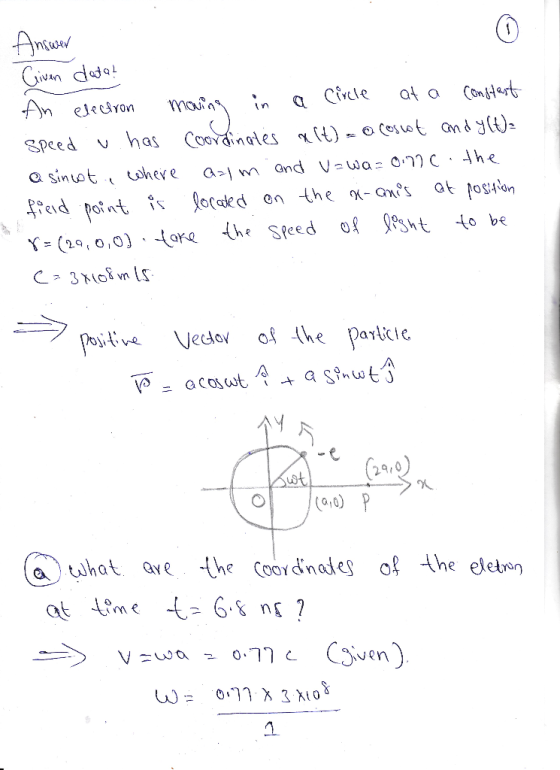
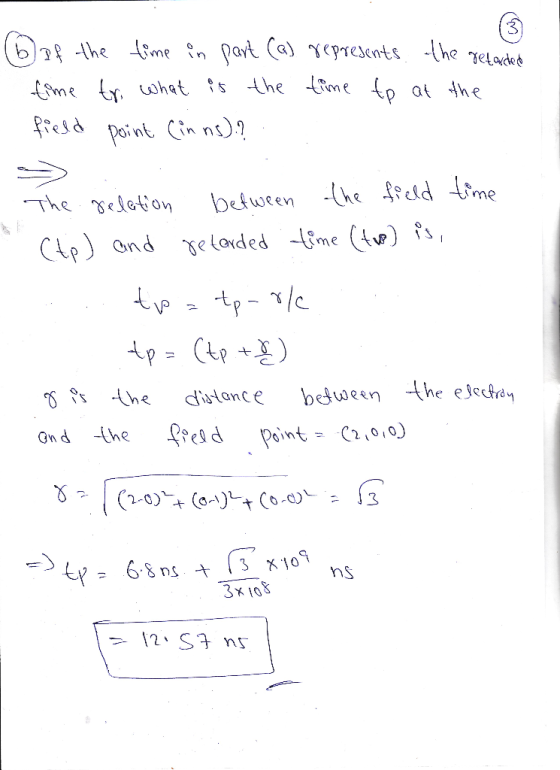
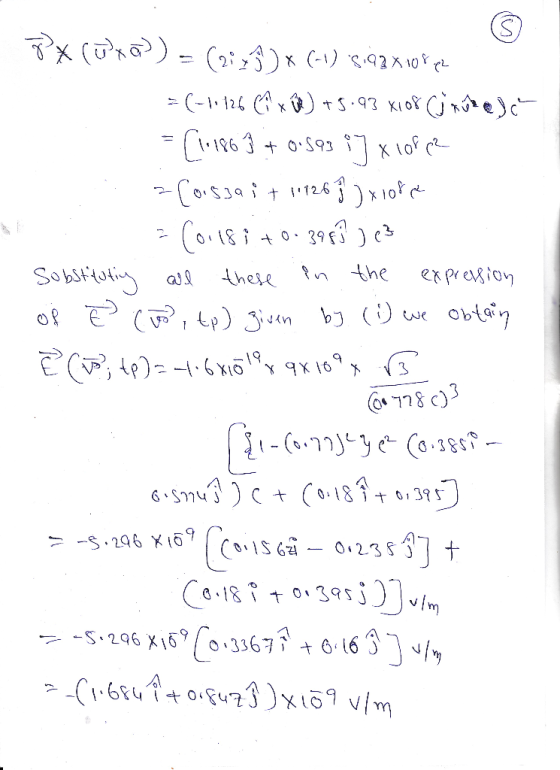
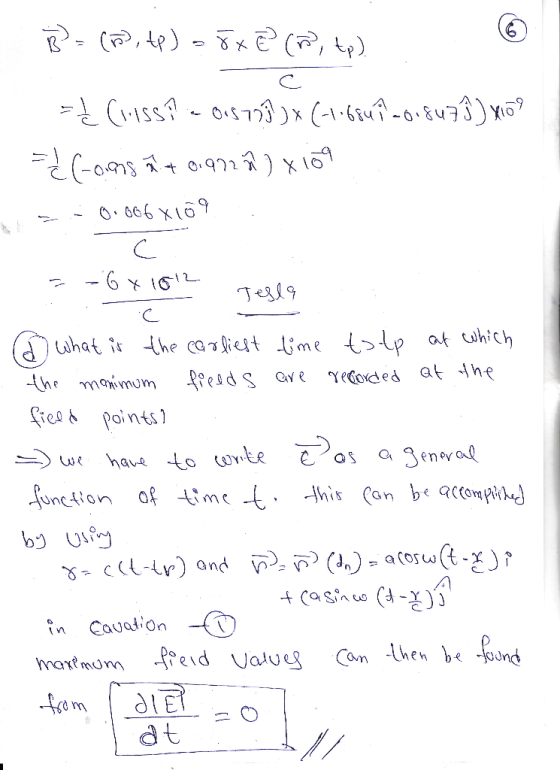
Problem 3) An electron moving in a circle at a constant speed v has coordinates a(t) a cosut and ...
an electron moving perpendicular to a uniform magnetic field of 0.22 T moves in a circle...
an electron moving perpendicular to a uniform magnetic field of 0.22 T moves in a circle with a speed of 1.5×10^7 m/s. what is the radius of the circle? (e= 1.60×10^-10^-19 C, M electron =9.11×10^-31 kg)
Now Safiya and Amy try a homework problem. Consider an electron moving with a speed of...
 Now Safiya and Amy try a homework problem.
Consider an electron moving with a speed of 6.90 106 m/s at right angles to a constant
magnetic field, with B = 1.7 T. What is the radius of the
circular path of the electron?
r = _________ m
Now Safiya and Amy try a homework problem.
Consider an electron moving with a speed of 6.90 106 m/s at right angles to a constant
magnetic field, with B = 1.7 T. What is the radius of the
circular path of the electron?
r = _________ m
5. Consider an object of mass m moving with constant speed v in a circle of...
5. Consider an object of mass m moving with constant speed v in a circle of radius r. What is the algebraic expression for the centripetal acceleration ac of the object in terms of its speed v and radius r? (Use any variable stated in this part.) ac =
A particle of mass m moves in a circle of radius R at a constant speed...
 A particle of mass m moves in a circle of radius
R at a constant speed v, as shown below. The
motion begins at point Q at time t = 0. Determine
the angular momentum of the particle about the axis perpendicular
to the page through point P as a function of time. (Use
any variable or symbol stated above along with the following as
necessary: t.)
A particle of mass m moves in a circle of radius
R at a constant speed v, as shown below. The
motion begins at point Q at time t = 0. Determine
the angular momentum of the particle about the axis perpendicular
to the page through point P as a function of time. (Use
any variable or symbol stated above along with the following as
necessary: t.)
2. An electron moves in a circle of radius r = 5.66 x 10⁻¹¹ m with...
 2. An electron moves in a circle of radius r = 5.66 x 10⁻¹¹ m with a speed 2.09 x 10 m/s. Treat the circular path as a current loop with a constant current equal to the ratio of the electrons charge magnitude to the period of the motion. If the circle lies in a uniform magnetic field of magnitude B = 6.39 mT, what is the maximum possible magnitude of the torque, T, produced on the loop by the...
Charge +q moving upward with speed V 18, A slight twist on the previous problem: Suppose...
 Charge +q moving upward with speed V 18, A slight twist on the previous problem: Suppose that the magnetic field is uniform within an infinitely long cylindrical region of radius R, points into the paper, and has Cylindrical region of radius R poeby for magnitude given by: iudBo for t <o B(t)B Bo eat fort>0 where a is a positive constant with units t. At t-0, a point charge +Q of mass M is placed a distance r>R above (and...
Constants An electron at point A in the figure (Figure 1) has a speed vo of...
 Constants An electron at point A in the figure (Figure 1) has a speed vo of 1.20x10 m/s. Part A Find the magnitude of the magnetic field that will cause the electron to follow the semicircular path from A to B. VO AEVO 2 ? B = Figure < 1 of 1 > Submit Request Answer Part B Find the direction of the magnetic field that will cause the electron to follow the semicircular path from A to B. out...
3. An object moves at constant speed v in a circle of radius r. How many...
 3. An object moves at constant speed v in a circle of radius r. How many times greateriless is the acceleration (a) if v is doubled, (b) if r is doubled? What happens to the acceleration as r-oo? as r→0? Why can't a car turn a corner instantaneously (in no time)-how great would the acceleration have to be?
a) An electron is traveling through a uniform electric field. The field is constant and given...
 a) An electron is traveling through a uniform electric field.
The field is constant and given by
At t=0 , the electron is at the origin and traveling in the x
direction with a speed of 1.40 m/s .
What is its position 1.70 s later?
x= _____________m
y=_____________m
b) An electron moves in a circle of radius r around a very long
uniformly charged wire in a vacuum chamber, as shown in the
figure.(Figure 1) The charge density on...
a) An electron is traveling through a uniform electric field.
The field is constant and given by
At t=0 , the electron is at the origin and traveling in the x
direction with a speed of 1.40 m/s .
What is its position 1.70 s later?
x= _____________m
y=_____________m
b) An electron moves in a circle of radius r around a very long
uniformly charged wire in a vacuum chamber, as shown in the
figure.(Figure 1) The charge density on...
An electron is moving horizontally to the right with speed 3 106 m/s. What is the...
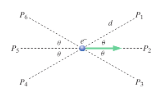 An electron is moving horizontally to the right with speed 3
106
m/s. What is the magnetic field due to this moving electron at the
indicated locations in the figure? Each location is d = 7
cm from the electron, and the angle θ = 32°. Give both
magnitude and direction of the magnetic field at each
location.
--P Ps We were unable to transcribe this imageTSelect P1 P2 TSelect T-Select P3 P4 TSelect TSelect Ps T-Select P6
--P Ps...
An electron is moving horizontally to the right with speed 3
106
m/s. What is the magnetic field due to this moving electron at the
indicated locations in the figure? Each location is d = 7
cm from the electron, and the angle θ = 32°. Give both
magnitude and direction of the magnetic field at each
location.
--P Ps We were unable to transcribe this imageTSelect P1 P2 TSelect T-Select P3 P4 TSelect TSelect Ps T-Select P6
--P Ps...
 Now Safiya and Amy try a homework problem.
Consider an electron moving with a speed of 6.90 106 m/s at right angles to a constant
magnetic field, with B = 1.7 T. What is the radius of the
circular path of the electron?
r = _________ m
Now Safiya and Amy try a homework problem.
Consider an electron moving with a speed of 6.90 106 m/s at right angles to a constant
magnetic field, with B = 1.7 T. What is the radius of the
circular path of the electron?
r = _________ m
 A particle of mass m moves in a circle of radius
R at a constant speed v, as shown below. The
motion begins at point Q at time t = 0. Determine
the angular momentum of the particle about the axis perpendicular
to the page through point P as a function of time. (Use
any variable or symbol stated above along with the following as
necessary: t.)
A particle of mass m moves in a circle of radius
R at a constant speed v, as shown below. The
motion begins at point Q at time t = 0. Determine
the angular momentum of the particle about the axis perpendicular
to the page through point P as a function of time. (Use
any variable or symbol stated above along with the following as
necessary: t.)
 2. An electron moves in a circle of radius r = 5.66 x 10⁻¹¹ m with a speed 2.09 x 10 m/s. Treat the circular path as a current loop with a constant current equal to the ratio of the electrons charge magnitude to the period of the motion. If the circle lies in a uniform magnetic field of magnitude B = 6.39 mT, what is the maximum possible magnitude of the torque, T, produced on the loop by the...
 Charge +q moving upward with speed V 18, A slight twist on the previous problem: Suppose that the magnetic field is uniform within an infinitely long cylindrical region of radius R, points into the paper, and has Cylindrical region of radius R poeby for magnitude given by: iudBo for t <o B(t)B Bo eat fort>0 where a is a positive constant with units t. At t-0, a point charge +Q of mass M is placed a distance r>R above (and...
 Constants An electron at point A in the figure (Figure 1) has a speed vo of 1.20x10 m/s. Part A Find the magnitude of the magnetic field that will cause the electron to follow the semicircular path from A to B. VO AEVO 2 ? B = Figure < 1 of 1 > Submit Request Answer Part B Find the direction of the magnetic field that will cause the electron to follow the semicircular path from A to B. out...
 3. An object moves at constant speed v in a circle of radius r. How many times greateriless is the acceleration (a) if v is doubled, (b) if r is doubled? What happens to the acceleration as r-oo? as r→0? Why can't a car turn a corner instantaneously (in no time)-how great would the acceleration have to be?
 a) An electron is traveling through a uniform electric field.
The field is constant and given by
At t=0 , the electron is at the origin and traveling in the x
direction with a speed of 1.40 m/s .
What is its position 1.70 s later?
x= _____________m
y=_____________m
b) An electron moves in a circle of radius r around a very long
uniformly charged wire in a vacuum chamber, as shown in the
figure.(Figure 1) The charge density on...
a) An electron is traveling through a uniform electric field.
The field is constant and given by
At t=0 , the electron is at the origin and traveling in the x
direction with a speed of 1.40 m/s .
What is its position 1.70 s later?
x= _____________m
y=_____________m
b) An electron moves in a circle of radius r around a very long
uniformly charged wire in a vacuum chamber, as shown in the
figure.(Figure 1) The charge density on...
 An electron is moving horizontally to the right with speed 3
106
m/s. What is the magnetic field due to this moving electron at the
indicated locations in the figure? Each location is d = 7
cm from the electron, and the angle θ = 32°. Give both
magnitude and direction of the magnetic field at each
location.
--P Ps We were unable to transcribe this imageTSelect P1 P2 TSelect T-Select P3 P4 TSelect TSelect Ps T-Select P6
--P Ps...
An electron is moving horizontally to the right with speed 3
106
m/s. What is the magnetic field due to this moving electron at the
indicated locations in the figure? Each location is d = 7
cm from the electron, and the angle θ = 32°. Give both
magnitude and direction of the magnetic field at each
location.
--P Ps We were unable to transcribe this imageTSelect P1 P2 TSelect T-Select P3 P4 TSelect TSelect Ps T-Select P6
--P Ps...
Most questions answered within 3 hours.
-
Where is the error in this code sequence?
String s1 = "Hello";
String s2 = "ello";...
asked 11 months ago -
Financial data for Joel de Paris, Inc., for last year
follow:
Joel de Paris, Inc.
Balance...
asked 11 months ago -
Consider this reaction:
Al2(SO4)3 (aq)+ BaCl3
(aq) Al2Cl6 (aq)- +
3BaSO4(s) . What is the...
asked 11 months ago -
Suppose that Savneet is considering increasing her
recent random sample from 20 car rentals to 40...
asked 11 months ago -
Trucks arrive at an unloading terminal at an average rate of 120
per hour.
Trucks arrive...
asked 11 months ago -
Why are methanol and ethanol completely soluble in water while
octanol is not very little soluble....
asked 11 months ago -
A facilities manager at a university reads in a research report
that the mean amount of...
asked 11 months ago -
When the CuSO4 is rehydrated by adding water to the anhydrous
compound, is this an endothermic...
asked 11 months ago -
A ray of sunlight is passing from diamond into crown glass; the
angle of incidence is...
asked 11 months ago -
A block of mass 0.249 kg is placed on top of a light, vertical
spring of...
asked 11 months ago -
how do the kidneys compensate in the presences of acidosis
a) trigger hyperventilate
b) reserve acid...
asked 11 months ago -
Question 501 pts
The rental rate of capital to the firm increases. Which of the
following...
asked 11 months ago