
Homework Answers

Add Answer to:
2. For (a) PH6 and (b) PF6 G) Determine the symmetry of the () Det termine the symmetry of the co...
TaHs has been predicted to have Cav symmetry. Determine the symmetries of the ligand group orbita...
 TaHs has been predicted to have Cav symmetry. Determine the symmetries of the ligand group orbitals constructed from the 1s orbitals on each of the H atoms in this molecule. Describe using only words (not an MO diagram) which Hs group orbitals can interact with the s, p, and d valence atomic orbitals on the central Ta atom based solely on symmetry 2.
TaHs has been predicted to have Cav symmetry. Determine the symmetries of the ligand group orbitals constructed...
TaHs has been predicted to have Cav symmetry. Determine the symmetries of the ligand group orbitals constructed from the 1s orbitals on each of the H atoms in this molecule. Describe using only words (not an MO diagram) which Hs group orbitals can interact with the s, p, and d valence atomic orbitals on the central Ta atom based solely on symmetry 2.
TaHs has been predicted to have Cav symmetry. Determine the symmetries of the ligand group orbitals constructed...
2) HO adopts C2v symmetry (a) Create SALCs for the H atoms and, using the Czv character table on the attached sheet, derive representations for each SALC and then assign the appropriate symmetry....
 2) HO adopts C2v symmetry (a) Create SALCs for the H atoms and, using the Czv character table on the attached sheet, derive representations for each SALC and then assign the appropriate symmetry. (b) Assign the symmetry for the orbitals on the central O atom, again using the character table (c) Create a reasonable MO diagram for H O and label appropriately (02s:-32 eV O2p:-16 eV, Hls 4 cV) You may assume the s-orbital on O is functionally non-bonding. (d)...
In 1984, the first organometallic compounds with H2 as an ?2 ligand were synthesized: M(CO)3(PR3)2(H2) with...
In 1984, the first organometallic compounds with H2 as an ?2 ligand were synthesized: M(CO)3(PR3)2(H2) with M = Mo or W and R = cyclohexyl or isopropyl. These complexes illustrate back-bonding with H2 as a ligand. a. Draw a structure for this molecule (just use R for the substituents on the P atoms). Because the R groups are very bulky, assume that the two PR3 ligands are in a trans configuration. Only one isomer is then possible. Show that this...
Answer all questions completely on a separate piece of paper. Make sure you show all work...
 Answer all questions completely on a separate piece of paper. Make sure you show all work for full credit and put a box around all answers. Use correct units and significant figures. 1. (10 points) For each of the following molecules, determine: if the molecule is polar The hybridization for all central atoms draw the hybridized bonding structure (just show bonding orbitals) f. KrOF4 g. PF6 h. HCN i. CH3OCH3 j. XeF4 a. PH3 b. CH&NH2 с. СОС d. N...
2. (3 pts) Determine the symmetry elements and assign the point group of: a. trans-1,2-dichloroethylene b....
 2. (3 pts) Determine the symmetry elements and assign the point group of: a. trans-1,2-dichloroethylene b. H30+ c. formaldehyde, H2CO
Part A 25.0 cm, m 9.00 g, R= 0.100 2, and B 0.550 T Determine the...
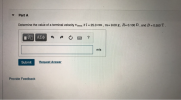 Part A 25.0 cm, m 9.00 g, R= 0.100 2, and B 0.550 T Determine the value of a terminal velocity Uterm if l m/s Request Answer Submit Provide Feedback
Lewis Dot Structures describe the connectivity of the atoms in a species. a) Determine the centra...
 Lewis Dot Structures describe the connectivity of the atoms in a species. a) Determine the central atom (least electronegative) Hydrogen will not be a central atom. b) Draw the skeleton. c) Determine the total number of valence shell electrons d) Place the electrons around the terminal atoms to satisfy the octet rule (Be). Hydrogen ok with two electrons. If there are electrons left over then place them around the central atoms as lone pair electrons. Some atoms (period 3 and...
1. Consider three 1-g samples of matter: (a) oxygen-16, (b) oxygen-17, and (c) carbon-12. Rank them...
1. Consider three 1-g samples of matter: (a) oxygen-16, (b) oxygen-17, and (c) carbon-12. Rank them in terms of the number of atoms, from most to least. 2. Consider these atoms: (a) copper, Cu; (b) neon, Ne; (c) hydrogen, H. Rank them, from smallest to largest , in terms of size. 3. The isotope 12-carbon has a mass of 12.000amu, and the isotope 13-carbon has a mass of 13.003amu . Given that 98.93{\rm \\%} of all carbon atoms found in...
Determine whether the series is absolutely convergent, conditionally convergent or divergent. 2"m! (b) Σ(-1)". 5 •...
 Determine whether the series is absolutely convergent,
conditionally convergent or divergent.
2"m! (b) Σ(-1)". 5 • 8 • 11 •• (3η + 2) (c) Στ (1 + Ae η =1 1 (- 2)" (-1)" (e) Σ (- 1)"e" (f) Σ (g) Σ (n + 1)! η 1 η 2 mln (2017)
Determine whether the series is absolutely convergent,
conditionally convergent or divergent.
2"m! (b) Σ(-1)". 5 • 8 • 11 •• (3η + 2) (c) Στ (1 + Ae η =1 1 (- 2)" (-1)" (e) Σ (- 1)"e" (f) Σ (g) Σ (n + 1)! η 1 η 2 mln (2017)
 TaHs has been predicted to have Cav symmetry. Determine the symmetries of the ligand group orbitals constructed from the 1s orbitals on each of the H atoms in this molecule. Describe using only words (not an MO diagram) which Hs group orbitals can interact with the s, p, and d valence atomic orbitals on the central Ta atom based solely on symmetry 2.
TaHs has been predicted to have Cav symmetry. Determine the symmetries of the ligand group orbitals constructed...
TaHs has been predicted to have Cav symmetry. Determine the symmetries of the ligand group orbitals constructed from the 1s orbitals on each of the H atoms in this molecule. Describe using only words (not an MO diagram) which Hs group orbitals can interact with the s, p, and d valence atomic orbitals on the central Ta atom based solely on symmetry 2.
TaHs has been predicted to have Cav symmetry. Determine the symmetries of the ligand group orbitals constructed...
 2) HO adopts C2v symmetry (a) Create SALCs for the H atoms and, using the Czv character table on the attached sheet, derive representations for each SALC and then assign the appropriate symmetry. (b) Assign the symmetry for the orbitals on the central O atom, again using the character table (c) Create a reasonable MO diagram for H O and label appropriately (02s:-32 eV O2p:-16 eV, Hls 4 cV) You may assume the s-orbital on O is functionally non-bonding. (d)...
 Answer all questions completely on a separate piece of paper. Make sure you show all work for full credit and put a box around all answers. Use correct units and significant figures. 1. (10 points) For each of the following molecules, determine: if the molecule is polar The hybridization for all central atoms draw the hybridized bonding structure (just show bonding orbitals) f. KrOF4 g. PF6 h. HCN i. CH3OCH3 j. XeF4 a. PH3 b. CH&NH2 с. СОС d. N...
 2. (3 pts) Determine the symmetry elements and assign the point group of: a. trans-1,2-dichloroethylene b. H30+ c. formaldehyde, H2CO
 Part A 25.0 cm, m 9.00 g, R= 0.100 2, and B 0.550 T Determine the value of a terminal velocity Uterm if l m/s Request Answer Submit Provide Feedback
 Lewis Dot Structures describe the connectivity of the atoms in a species. a) Determine the central atom (least electronegative) Hydrogen will not be a central atom. b) Draw the skeleton. c) Determine the total number of valence shell electrons d) Place the electrons around the terminal atoms to satisfy the octet rule (Be). Hydrogen ok with two electrons. If there are electrons left over then place them around the central atoms as lone pair electrons. Some atoms (period 3 and...
 Determine whether the series is absolutely convergent,
conditionally convergent or divergent.
2"m! (b) Σ(-1)". 5 • 8 • 11 •• (3η + 2) (c) Στ (1 + Ae η =1 1 (- 2)" (-1)" (e) Σ (- 1)"e" (f) Σ (g) Σ (n + 1)! η 1 η 2 mln (2017)
Determine whether the series is absolutely convergent,
conditionally convergent or divergent.
2"m! (b) Σ(-1)". 5 • 8 • 11 •• (3η + 2) (c) Στ (1 + Ae η =1 1 (- 2)" (-1)" (e) Σ (- 1)"e" (f) Σ (g) Σ (n + 1)! η 1 η 2 mln (2017)
Most questions answered within 3 hours.
-
Where is the error in this code sequence?
String s1 = "Hello";
String s2 = "ello";...
asked 11 months ago -
Financial data for Joel de Paris, Inc., for last year
follow:
Joel de Paris, Inc.
Balance...
asked 11 months ago -
Consider this reaction:
Al2(SO4)3 (aq)+ BaCl3
(aq) Al2Cl6 (aq)- +
3BaSO4(s) . What is the...
asked 11 months ago -
Suppose that Savneet is considering increasing her
recent random sample from 20 car rentals to 40...
asked 11 months ago -
Trucks arrive at an unloading terminal at an average rate of 120
per hour.
Trucks arrive...
asked 11 months ago -
Why are methanol and ethanol completely soluble in water while
octanol is not very little soluble....
asked 11 months ago -
A facilities manager at a university reads in a research report
that the mean amount of...
asked 11 months ago -
When the CuSO4 is rehydrated by adding water to the anhydrous
compound, is this an endothermic...
asked 11 months ago -
A ray of sunlight is passing from diamond into crown glass; the
angle of incidence is...
asked 11 months ago -
A block of mass 0.249 kg is placed on top of a light, vertical
spring of...
asked 11 months ago -
how do the kidneys compensate in the presences of acidosis
a) trigger hyperventilate
b) reserve acid...
asked 11 months ago -
Question 501 pts
The rental rate of capital to the firm increases. Which of the
following...
asked 11 months ago