
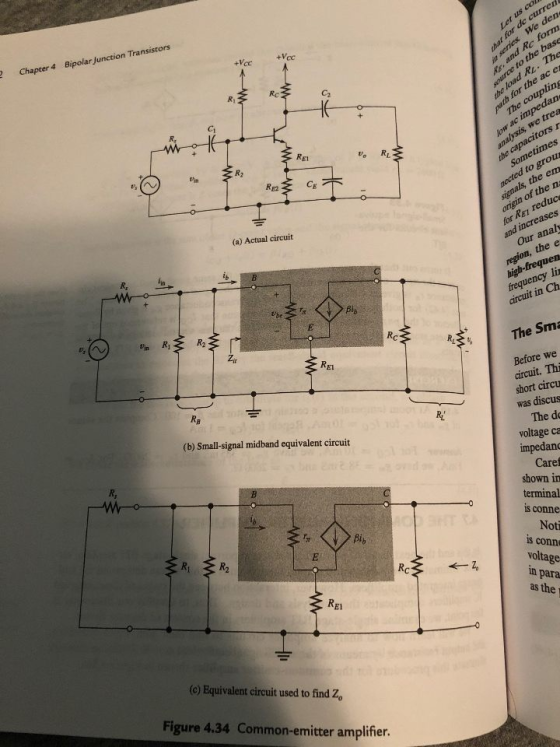
to g CE (a) Actual circuit RE1 circuit. short circu was discus The do voltage ca (b) Small-signal midband equivalent circuit Caret shown in is conne Noti s conn voltage in para as the (c) Equivalent circuit used to find Z Figure 4.34 Common-emitter amplifier
Homework Answers


Add Answer to:
IlI) The Common-Emitter (C-E) is one of 3 configurations of amplifier circuits. Figure 4.34 (a) o...
4. Design a npn BJT C-E amplifier circuit for the following specifications and given values: Voltage...
 4. Design a npn BJT C-E amplifier circuit for the following specifications and given values: Voltage Gain Input resistance Load resistance Supply voltage Av = -60 Ri = 5k92 RL = 6k2 Vcc= 16V Assume Re is fully bypassed. The input source internal resistance Rs = 0.12. B=120 and VBE= 0.65V. Draw the actual circuit and its ac equivalent circuit
Can I get help with part g through part r, please? Given the following Common-Emitter Amplifier...
 Can I get help with part g through part r, please?
Given the following Common-Emitter Amplifier with Voltage-Divider Bias: The transistor is a Silicon device with B160 (Beta 160) and transistor r.= 30 kn: 20 V 34.7k LAL = Vou 35.10 31.1k LRE $3900 03 - Find the following quantities in parts a through where means Quiescent DC): a) Thevenin Voltage and Thevenin Resistance Re b) Base Current la Collector Current le d) Emitter Current le e) Transistor Collector-Emitter Quiescent...
Can I get help with part g through part r, please?
Given the following Common-Emitter Amplifier with Voltage-Divider Bias: The transistor is a Silicon device with B160 (Beta 160) and transistor r.= 30 kn: 20 V 34.7k LAL = Vou 35.10 31.1k LRE $3900 03 - Find the following quantities in parts a through where means Quiescent DC): a) Thevenin Voltage and Thevenin Resistance Re b) Base Current la Collector Current le d) Emitter Current le e) Transistor Collector-Emitter Quiescent...
1.0 kn. RE-390 Ω, r-15 Ω. and ßac-75. 5. For a common-emitter amplifier, Rc Assuming that Rg is completely bypassed at the operating frequency, the voltage gain is (a) 66.7 (d) 75 (b) 2.56 (c) 2....
 1.0 kn. RE-390 Ω, r-15 Ω. and ßac-75. 5. For a common-emitter amplifier, Rc Assuming that Rg is completely bypassed at the operating frequency, the voltage gain is (a) 66.7 (d) 75 (b) 2.56 (c) 2.47 6. In the circuit of Question 5, if the frequency is reduced to the point where Xctbypass) RE, the voltage gain (a) remains the same (b) is less (c) is greater 7. In a common-emitter amplifier with voltage-divider bias, Rimlbase) 68 k2, Ri 33...
Avec Úvo SRE L V II. (5pt) Consider the above-right common-collector or emitter-follower BJT amplifier circuit....
 Avec Úvo SRE L V II. (5pt) Consider the above-right common-collector or emitter-follower BJT amplifier circuit. Given: ß= 100, RE = 10 k1, Vcc = 20 V, RB = 5 k1, R1 = 10 kl, and Ry = 2 k1. (a) (1pt) Find the Q-point, i.e. Ibo, Ico, and VCEO; (b) (1pt) draw the small-signal equivalent circuit assuming that the capacitors (C, and Cy) are short circuits for the small signal; (c) (1pt) solve for the voltage gain, Av; (d)...
Consider the common-emitter amplifier in the following figure, with = 100, VA = 100V, C= 25fF,...
 Consider the common-emitter amplifier in the following figure,
with = 100,
VA = 100V, C= 25fF,
C= 10fF.
a) Draw the small-signal model of this circuit. Apply Miller’s
theorem to split C to input and
output nodes. Calculate the time constants at the input and output
nodes, in and
out.
b) Based on the time constants from part a), calculate the input
and output pole frequencies, fin and fout.
What is the dominant pole of this amplifier?
We were unable...
Consider the common-emitter amplifier in the following figure,
with = 100,
VA = 100V, C= 25fF,
C= 10fF.
a) Draw the small-signal model of this circuit. Apply Miller’s
theorem to split C to input and
output nodes. Calculate the time constants at the input and output
nodes, in and
out.
b) Based on the time constants from part a), calculate the input
and output pole frequencies, fin and fout.
What is the dominant pole of this amplifier?
We were unable...
2.34. Consider the common-emitter amplifier on the right. (a)Draw a small-signal equivalent circuit using the T-model without the B1 Cci output resistance (b)Find an expression for the input resistan...
 2.34. Consider the common-emitter amplifier on the right. (a)Draw a small-signal equivalent circuit using the T-model without the B1 Cci output resistance (b)Find an expression for the input resistance Rin. (c)Find an expression for the output resistance Ro. (d) Find an expression for the lower cut-off frequency Vi Re sig 82 C, (RE-R) in associated with Cci. (d)Find expressions for the two gains vo/v, and v/Vsig CI.
2.34. Consider the common-emitter amplifier on the right. (a)Draw a small-signal equivalent circuit...
2.34. Consider the common-emitter amplifier on the right. (a)Draw a small-signal equivalent circuit using the T-model without the B1 Cci output resistance (b)Find an expression for the input resistance Rin. (c)Find an expression for the output resistance Ro. (d) Find an expression for the lower cut-off frequency Vi Re sig 82 C, (RE-R) in associated with Cci. (d)Find expressions for the two gains vo/v, and v/Vsig CI.
2.34. Consider the common-emitter amplifier on the right. (a)Draw a small-signal equivalent circuit...
Question 4 (25 Marks) (5) 1. Derive the Dynamic Emitter Resistance, re that is used in...
 Question 4 (25 Marks) (5) 1. Derive the Dynamic Emitter Resistance, re that is used in the re-model small-signal analysis of BJT. 2. The circuit in Figure 7 shows the multistage cascade of two single transistors with B=100. Given the value of Vpp=12 V, R1=120 kN, R2=40 kN, R3=100 ks, Ra=30 kn, RE1=3.9 kN, Rez=4.5 kN, Rc1=6.5 kN, Rc2=8 ks, (2) (4) (a) Identify the transistor configuration for all stages. (b) Determine the d.c collector current (Ici and I cz)...
can you do 4.83 Ar- Q Sea 100 V, what does the gain become? age at...
 can
you do 4.83
Ar- Q Sea 100 V, what does the gain become? age at the collector. (b) Replacing the transistor by its T model, da the small-signal equivalent circuit of the a plifier. Analyze the resulting circuit to dete mine the voltage gain t/ 04.81 Consider the CE amplifier circuit of Fig. 4.43(a). It is required to design the circuit (i.e., find values for I and Rc) to meet the following specifications: (a) R,5kn (b) the voltage gain...
can
you do 4.83
Ar- Q Sea 100 V, what does the gain become? age at the collector. (b) Replacing the transistor by its T model, da the small-signal equivalent circuit of the a plifier. Analyze the resulting circuit to dete mine the voltage gain t/ 04.81 Consider the CE amplifier circuit of Fig. 4.43(a). It is required to design the circuit (i.e., find values for I and Rc) to meet the following specifications: (a) R,5kn (b) the voltage gain...
Please show a detail explanation on the solution. Thanks in advance 4.117 The amplifier of Fig....
 Please show a detail explanation on the solution. Thanks in
advance
4.117 The amplifier of Fig. P4.117 consists of two identical common-e that the input resistance of the second stage, R2, constitutes the load resistance of the first stage mitter amplifiers connected in cascade. Observe = 6.8 kΩ and β= 100, determine the dc collector current and de collector voltage of each transistor (b) Draw the small-signal equivalent circuit of the entire amplifier and give the values of al its...
Please show a detail explanation on the solution. Thanks in
advance
4.117 The amplifier of Fig. P4.117 consists of two identical common-e that the input resistance of the second stage, R2, constitutes the load resistance of the first stage mitter amplifiers connected in cascade. Observe = 6.8 kΩ and β= 100, determine the dc collector current and de collector voltage of each transistor (b) Draw the small-signal equivalent circuit of the entire amplifier and give the values of al its...
An amplifier circuit using a bipolar transistor is shown in Figure Q5. (a) State, with a valid re...
 An amplifier circuit using a bipolar transistor is shown in
Figure Q5.
(a) State, with a valid reason, whether this amplifier is an
emitter follower
or a common emitter configuration.
(b) Redraw Figure Q5 as a large signal equivalent circuit. Show
that:
(c) Show that the input voltage, vISAT to produce the onset of
saturation for
T1 is given by:
(d), confirm, by calculation, that
T1 is in saturation.
(e) Calculate the current in the lamp when T1 is in...
An amplifier circuit using a bipolar transistor is shown in
Figure Q5.
(a) State, with a valid reason, whether this amplifier is an
emitter follower
or a common emitter configuration.
(b) Redraw Figure Q5 as a large signal equivalent circuit. Show
that:
(c) Show that the input voltage, vISAT to produce the onset of
saturation for
T1 is given by:
(d), confirm, by calculation, that
T1 is in saturation.
(e) Calculate the current in the lamp when T1 is in...
 4. Design a npn BJT C-E amplifier circuit for the following specifications and given values: Voltage Gain Input resistance Load resistance Supply voltage Av = -60 Ri = 5k92 RL = 6k2 Vcc= 16V Assume Re is fully bypassed. The input source internal resistance Rs = 0.12. B=120 and VBE= 0.65V. Draw the actual circuit and its ac equivalent circuit
 Can I get help with part g through part r, please?
Given the following Common-Emitter Amplifier with Voltage-Divider Bias: The transistor is a Silicon device with B160 (Beta 160) and transistor r.= 30 kn: 20 V 34.7k LAL = Vou 35.10 31.1k LRE $3900 03 - Find the following quantities in parts a through where means Quiescent DC): a) Thevenin Voltage and Thevenin Resistance Re b) Base Current la Collector Current le d) Emitter Current le e) Transistor Collector-Emitter Quiescent...
Can I get help with part g through part r, please?
Given the following Common-Emitter Amplifier with Voltage-Divider Bias: The transistor is a Silicon device with B160 (Beta 160) and transistor r.= 30 kn: 20 V 34.7k LAL = Vou 35.10 31.1k LRE $3900 03 - Find the following quantities in parts a through where means Quiescent DC): a) Thevenin Voltage and Thevenin Resistance Re b) Base Current la Collector Current le d) Emitter Current le e) Transistor Collector-Emitter Quiescent...
 1.0 kn. RE-390 Ω, r-15 Ω. and ßac-75. 5. For a common-emitter amplifier, Rc Assuming that Rg is completely bypassed at the operating frequency, the voltage gain is (a) 66.7 (d) 75 (b) 2.56 (c) 2.47 6. In the circuit of Question 5, if the frequency is reduced to the point where Xctbypass) RE, the voltage gain (a) remains the same (b) is less (c) is greater 7. In a common-emitter amplifier with voltage-divider bias, Rimlbase) 68 k2, Ri 33...
 Avec Úvo SRE L V II. (5pt) Consider the above-right common-collector or emitter-follower BJT amplifier circuit. Given: ß= 100, RE = 10 k1, Vcc = 20 V, RB = 5 k1, R1 = 10 kl, and Ry = 2 k1. (a) (1pt) Find the Q-point, i.e. Ibo, Ico, and VCEO; (b) (1pt) draw the small-signal equivalent circuit assuming that the capacitors (C, and Cy) are short circuits for the small signal; (c) (1pt) solve for the voltage gain, Av; (d)...
 Consider the common-emitter amplifier in the following figure,
with = 100,
VA = 100V, C= 25fF,
C= 10fF.
a) Draw the small-signal model of this circuit. Apply Miller’s
theorem to split C to input and
output nodes. Calculate the time constants at the input and output
nodes, in and
out.
b) Based on the time constants from part a), calculate the input
and output pole frequencies, fin and fout.
What is the dominant pole of this amplifier?
We were unable...
Consider the common-emitter amplifier in the following figure,
with = 100,
VA = 100V, C= 25fF,
C= 10fF.
a) Draw the small-signal model of this circuit. Apply Miller’s
theorem to split C to input and
output nodes. Calculate the time constants at the input and output
nodes, in and
out.
b) Based on the time constants from part a), calculate the input
and output pole frequencies, fin and fout.
What is the dominant pole of this amplifier?
We were unable...
 2.34. Consider the common-emitter amplifier on the right. (a)Draw a small-signal equivalent circuit using the T-model without the B1 Cci output resistance (b)Find an expression for the input resistance Rin. (c)Find an expression for the output resistance Ro. (d) Find an expression for the lower cut-off frequency Vi Re sig 82 C, (RE-R) in associated with Cci. (d)Find expressions for the two gains vo/v, and v/Vsig CI.
2.34. Consider the common-emitter amplifier on the right. (a)Draw a small-signal equivalent circuit...
2.34. Consider the common-emitter amplifier on the right. (a)Draw a small-signal equivalent circuit using the T-model without the B1 Cci output resistance (b)Find an expression for the input resistance Rin. (c)Find an expression for the output resistance Ro. (d) Find an expression for the lower cut-off frequency Vi Re sig 82 C, (RE-R) in associated with Cci. (d)Find expressions for the two gains vo/v, and v/Vsig CI.
2.34. Consider the common-emitter amplifier on the right. (a)Draw a small-signal equivalent circuit...
 Question 4 (25 Marks) (5) 1. Derive the Dynamic Emitter Resistance, re that is used in the re-model small-signal analysis of BJT. 2. The circuit in Figure 7 shows the multistage cascade of two single transistors with B=100. Given the value of Vpp=12 V, R1=120 kN, R2=40 kN, R3=100 ks, Ra=30 kn, RE1=3.9 kN, Rez=4.5 kN, Rc1=6.5 kN, Rc2=8 ks, (2) (4) (a) Identify the transistor configuration for all stages. (b) Determine the d.c collector current (Ici and I cz)...
 can
you do 4.83
Ar- Q Sea 100 V, what does the gain become? age at the collector. (b) Replacing the transistor by its T model, da the small-signal equivalent circuit of the a plifier. Analyze the resulting circuit to dete mine the voltage gain t/ 04.81 Consider the CE amplifier circuit of Fig. 4.43(a). It is required to design the circuit (i.e., find values for I and Rc) to meet the following specifications: (a) R,5kn (b) the voltage gain...
can
you do 4.83
Ar- Q Sea 100 V, what does the gain become? age at the collector. (b) Replacing the transistor by its T model, da the small-signal equivalent circuit of the a plifier. Analyze the resulting circuit to dete mine the voltage gain t/ 04.81 Consider the CE amplifier circuit of Fig. 4.43(a). It is required to design the circuit (i.e., find values for I and Rc) to meet the following specifications: (a) R,5kn (b) the voltage gain...
 Please show a detail explanation on the solution. Thanks in
advance
4.117 The amplifier of Fig. P4.117 consists of two identical common-e that the input resistance of the second stage, R2, constitutes the load resistance of the first stage mitter amplifiers connected in cascade. Observe = 6.8 kΩ and β= 100, determine the dc collector current and de collector voltage of each transistor (b) Draw the small-signal equivalent circuit of the entire amplifier and give the values of al its...
Please show a detail explanation on the solution. Thanks in
advance
4.117 The amplifier of Fig. P4.117 consists of two identical common-e that the input resistance of the second stage, R2, constitutes the load resistance of the first stage mitter amplifiers connected in cascade. Observe = 6.8 kΩ and β= 100, determine the dc collector current and de collector voltage of each transistor (b) Draw the small-signal equivalent circuit of the entire amplifier and give the values of al its...
 An amplifier circuit using a bipolar transistor is shown in
Figure Q5.
(a) State, with a valid reason, whether this amplifier is an
emitter follower
or a common emitter configuration.
(b) Redraw Figure Q5 as a large signal equivalent circuit. Show
that:
(c) Show that the input voltage, vISAT to produce the onset of
saturation for
T1 is given by:
(d), confirm, by calculation, that
T1 is in saturation.
(e) Calculate the current in the lamp when T1 is in...
An amplifier circuit using a bipolar transistor is shown in
Figure Q5.
(a) State, with a valid reason, whether this amplifier is an
emitter follower
or a common emitter configuration.
(b) Redraw Figure Q5 as a large signal equivalent circuit. Show
that:
(c) Show that the input voltage, vISAT to produce the onset of
saturation for
T1 is given by:
(d), confirm, by calculation, that
T1 is in saturation.
(e) Calculate the current in the lamp when T1 is in...
Most questions answered within 3 hours.
-
Where is the error in this code sequence?
String s1 = "Hello";
String s2 = "ello";...
asked 10 months ago -
Financial data for Joel de Paris, Inc., for last year
follow:
Joel de Paris, Inc.
Balance...
asked 10 months ago -
Consider this reaction:
Al2(SO4)3 (aq)+ BaCl3
(aq) Al2Cl6 (aq)- +
3BaSO4(s) . What is the...
asked 10 months ago -
Suppose that Savneet is considering increasing her
recent random sample from 20 car rentals to 40...
asked 10 months ago -
Trucks arrive at an unloading terminal at an average rate of 120
per hour.
Trucks arrive...
asked 10 months ago -
Why are methanol and ethanol completely soluble in water while
octanol is not very little soluble....
asked 10 months ago -
A facilities manager at a university reads in a research report
that the mean amount of...
asked 10 months ago -
When the CuSO4 is rehydrated by adding water to the anhydrous
compound, is this an endothermic...
asked 10 months ago -
A ray of sunlight is passing from diamond into crown glass; the
angle of incidence is...
asked 10 months ago -
A block of mass 0.249 kg is placed on top of a light, vertical
spring of...
asked 10 months ago -
how do the kidneys compensate in the presences of acidosis
a) trigger hyperventilate
b) reserve acid...
asked 10 months ago -
Question 501 pts
The rental rate of capital to the firm increases. Which of the
following...
asked 10 months ago