Classify bifurcations for the system x '= a(1 − x) − xy^2 , y' = xy^2 − (a + k)y, where a > 0 ...
Classify bifurcations for the system x '= a(1 − x) − xy^2 , y' = xy^2 − (a + k)y, where a > 0 and k > 0 are parameters, and sketch the bifurcation curve in the a − k space.
Homework Answers

Add Answer to:
Classify bifurcations for the system x '= a(1 − x) − xy^2 , y' = xy^2 − (a + k)y, where a > 0 ...
1) Consider the surface x2 + 3y2-2z2-1 (a) What are the cross sections(traces) in x k,y k, z k Sketch for (b) Sketch th...
 1) Consider the surface x2 + 3y2-2z2-1 (a) What are the cross sections(traces) in x k,y k, z k Sketch for (b) Sketch the surface in space. 2) Draw the quadric surface whose equation is described by z2 +y2 - 221 (a) What are the cross sections(traces) inx-k,y k,z k Sketch for (b) Sketch the surface in space. a) Sketch the region bounded by the paraboloids z-22 + y2 and z - 3) 2 b) Draw the xy, xz, yz...
049 marks A) Classify and sketch the quadric sarface 2x1 +3y +x in the space zso, . y=1 B) Sketch the lower half of the curve 049 marks A) Classify and sketch the quadric sarface 2x1 +3y +x in t...
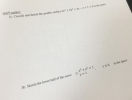 049 marks A) Classify and sketch the quadric sarface 2x1 +3y +x in the space zso, . y=1 B) Sketch the lower half of the curve
049 marks A) Classify and sketch the quadric sarface 2x1 +3y +x in the space zso, . y=1 B) Sketch the lower half of the curve
049 marks A) Classify and sketch the quadric sarface 2x1 +3y +x in the space zso, . y=1 B) Sketch the lower half of the curve
x'=r (1 - 2 / 2 x where r and K are positive constants, is called...
 x'=r (1 - 2 / 2 x where r and K are positive constants, is called the logistic equation. It is used in a number of scientific disciplines, but primarily (and historically) in population dynamics where z(t) is the size (numbers or density) of individuals in a biological population. For application to population dynamics ä(t) cannot be negative. If the solution (t) vanishes at some time, then we interpret this biologically as population extinction. (a) Draw the phase line portrait...
( xy 7. CHALLENGE: fxy(x, y) = 0< < 2, 0 <y <1 otherwise 0 Find...
 ( xy 7. CHALLENGE: fxy(x, y) = 0< < 2, 0 <y <1 otherwise 0 Find P(X+Y < 1) HINT: consider the region of the XY plane where the inequality is true.
1. (1.5 points) Sketch the following vector fields: (B) B(x,y)=(z-y,2). (C) Vf where f(x,y) = xy
 1. (1.5 points) Sketch the following vector fields: (B) B(x,y)=(z-y,2). (C) Vf where f(x,y) = xy
1. (1.5 points) Sketch the following vector fields: (B) B(x,y)=(z-y,2). (C) Vf where f(x,y) = xy
1. (1.5 points) Sketch the following vector fields: (B) B(x,y)=(z-y,2). (C) Vf where f(x,y) = xy
For each problem, sketch all of the qualitatively different vector fields that occur as the parameter...
 For each problem, sketch all of the qualitatively different vector fields that occur as the parameter u is varied. Find the values of u at which bifurcation occur, and classify the bifurcations. Finally, sketch the bifurcation diagram or the steady states x* vs the parameter u. 1. ** = 5 – ļe-x? 2. espe= ux - T H > 0.
Given the joint probability density function f(x ,y )=k (xy+ 1) for 0<x <1--and--0<y<1 , find...
Given the joint probability density function f(x ,y )=k (xy+ 1) for 0<x <1--and--0<y<1 , find the correlation- r (X,Y) .
6. [5 marks] Find and classify all stationary points of f(x,y) xy+2xy 7. [6 marks] Sketch the region of integration...
 6. [5 marks] Find and classify all stationary points of f(x,y) xy+2xy 7. [6 marks] Sketch the region of integration and evaluate the iterated integral 2 r2 JC 10 (y+xy-2) dxdy.
6. [5 marks] Find and classify all stationary points of f(x,y) xy+2xy 7. [6 marks] Sketch the region of integration and evaluate the iterated integral 2 r2 JC 10 (y+xy-2) dxdy.
6. [5 marks] Find and classify all stationary points of f(x,y) xy+2xy 7. [6 marks] Sketch the region of integration and evaluate the iterated integral 2 r2 JC 10 (y+xy-2) dxdy.
3. a) Classify each ODE by order and linearity: y" – 3xy' + xy = 0...
 3. a) Classify each ODE by order and linearity: y" – 3xy' + xy = 0 b) y(4) + 2xy" - x?y' - xy' + sin y = 0 c) 2.5** 12.5x = sint
3. Verify Stokes' Theorem for the vector field F(x, y, z)= (x2)ĩ+(y2)]+(-xy)k where S is the...
 3. Verify Stokes' Theorem for the vector field F(x, y, z)= (x2)ĩ+(y2)]+(-xy)k where S is the surface of the cone +y parametrized by (u,v)-(ucos v, u sin v, hu) x2+y2 a at height h above the xy-plane Z = a V 0<vsa, OSvs 2n, and as is the curve parametrized by ē(f) =(acost,asint, h), 0sis27 as x2+ a
3. Verify Stokes' Theorem for the vector field F(x, y, z)= (x2)ĩ+(y2)]+(-xy)k where S is the surface of the cone +y parametrized...
3. Verify Stokes' Theorem for the vector field F(x, y, z)= (x2)ĩ+(y2)]+(-xy)k where S is the surface of the cone +y parametrized by (u,v)-(ucos v, u sin v, hu) x2+y2 a at height h above the xy-plane Z = a V 0<vsa, OSvs 2n, and as is the curve parametrized by ē(f) =(acost,asint, h), 0sis27 as x2+ a
3. Verify Stokes' Theorem for the vector field F(x, y, z)= (x2)ĩ+(y2)]+(-xy)k where S is the surface of the cone +y parametrized...
 1) Consider the surface x2 + 3y2-2z2-1 (a) What are the cross sections(traces) in x k,y k, z k Sketch for (b) Sketch the surface in space. 2) Draw the quadric surface whose equation is described by z2 +y2 - 221 (a) What are the cross sections(traces) inx-k,y k,z k Sketch for (b) Sketch the surface in space. a) Sketch the region bounded by the paraboloids z-22 + y2 and z - 3) 2 b) Draw the xy, xz, yz...
 049 marks A) Classify and sketch the quadric sarface 2x1 +3y +x in the space zso, . y=1 B) Sketch the lower half of the curve
049 marks A) Classify and sketch the quadric sarface 2x1 +3y +x in the space zso, . y=1 B) Sketch the lower half of the curve
049 marks A) Classify and sketch the quadric sarface 2x1 +3y +x in the space zso, . y=1 B) Sketch the lower half of the curve
 x'=r (1 - 2 / 2 x where r and K are positive constants, is called the logistic equation. It is used in a number of scientific disciplines, but primarily (and historically) in population dynamics where z(t) is the size (numbers or density) of individuals in a biological population. For application to population dynamics ä(t) cannot be negative. If the solution (t) vanishes at some time, then we interpret this biologically as population extinction. (a) Draw the phase line portrait...
 ( xy 7. CHALLENGE: fxy(x, y) = 0< < 2, 0 <y <1 otherwise 0 Find P(X+Y < 1) HINT: consider the region of the XY plane where the inequality is true.
 1. (1.5 points) Sketch the following vector fields: (B) B(x,y)=(z-y,2). (C) Vf where f(x,y) = xy
1. (1.5 points) Sketch the following vector fields: (B) B(x,y)=(z-y,2). (C) Vf where f(x,y) = xy
1. (1.5 points) Sketch the following vector fields: (B) B(x,y)=(z-y,2). (C) Vf where f(x,y) = xy
 For each problem, sketch all of the qualitatively different vector fields that occur as the parameter u is varied. Find the values of u at which bifurcation occur, and classify the bifurcations. Finally, sketch the bifurcation diagram or the steady states x* vs the parameter u. 1. ** = 5 – ļe-x? 2. espe= ux - T H > 0.
 6. [5 marks] Find and classify all stationary points of f(x,y) xy+2xy 7. [6 marks] Sketch the region of integration and evaluate the iterated integral 2 r2 JC 10 (y+xy-2) dxdy.
6. [5 marks] Find and classify all stationary points of f(x,y) xy+2xy 7. [6 marks] Sketch the region of integration and evaluate the iterated integral 2 r2 JC 10 (y+xy-2) dxdy.
6. [5 marks] Find and classify all stationary points of f(x,y) xy+2xy 7. [6 marks] Sketch the region of integration and evaluate the iterated integral 2 r2 JC 10 (y+xy-2) dxdy.
 3. a) Classify each ODE by order and linearity: y" – 3xy' + xy = 0 b) y(4) + 2xy" - x?y' - xy' + sin y = 0 c) 2.5** 12.5x = sint
 3. Verify Stokes' Theorem for the vector field F(x, y, z)= (x2)ĩ+(y2)]+(-xy)k where S is the surface of the cone +y parametrized by (u,v)-(ucos v, u sin v, hu) x2+y2 a at height h above the xy-plane Z = a V 0<vsa, OSvs 2n, and as is the curve parametrized by ē(f) =(acost,asint, h), 0sis27 as x2+ a
3. Verify Stokes' Theorem for the vector field F(x, y, z)= (x2)ĩ+(y2)]+(-xy)k where S is the surface of the cone +y parametrized...
3. Verify Stokes' Theorem for the vector field F(x, y, z)= (x2)ĩ+(y2)]+(-xy)k where S is the surface of the cone +y parametrized by (u,v)-(ucos v, u sin v, hu) x2+y2 a at height h above the xy-plane Z = a V 0<vsa, OSvs 2n, and as is the curve parametrized by ē(f) =(acost,asint, h), 0sis27 as x2+ a
3. Verify Stokes' Theorem for the vector field F(x, y, z)= (x2)ĩ+(y2)]+(-xy)k where S is the surface of the cone +y parametrized...
Most questions answered within 3 hours.
-
Where is the error in this code sequence?
String s1 = "Hello";
String s2 = "ello";...
asked 10 months ago -
Financial data for Joel de Paris, Inc., for last year
follow:
Joel de Paris, Inc.
Balance...
asked 10 months ago -
Consider this reaction:
Al2(SO4)3 (aq)+ BaCl3
(aq) Al2Cl6 (aq)- +
3BaSO4(s) . What is the...
asked 10 months ago -
Suppose that Savneet is considering increasing her
recent random sample from 20 car rentals to 40...
asked 10 months ago -
Trucks arrive at an unloading terminal at an average rate of 120
per hour.
Trucks arrive...
asked 10 months ago -
Why are methanol and ethanol completely soluble in water while
octanol is not very little soluble....
asked 10 months ago -
A facilities manager at a university reads in a research report
that the mean amount of...
asked 10 months ago -
When the CuSO4 is rehydrated by adding water to the anhydrous
compound, is this an endothermic...
asked 10 months ago -
A ray of sunlight is passing from diamond into crown glass; the
angle of incidence is...
asked 10 months ago -
A block of mass 0.249 kg is placed on top of a light, vertical
spring of...
asked 10 months ago -
how do the kidneys compensate in the presences of acidosis
a) trigger hyperventilate
b) reserve acid...
asked 10 months ago -
Question 501 pts
The rental rate of capital to the firm increases. Which of the
following...
asked 10 months ago