![8.1. Let Y(t) = tx(1/t). (a) What is the distribution of Y(t)? (b) Compute Cov(Y(s), Y()) (c) Argue that {Y(t), t 2 0] is als](http://img.homeworklib.com/images/0dcfdacd-45c1-4f31-884c-6027f4f666ff.png?x-oss-process=image/resize,w_560)
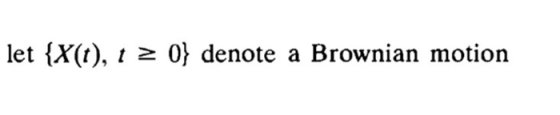
8.1. Let Y(t) = tx(1/t). (a) What is the distribution of Y(t)? (b) Compute Cov(Y(s), Y()) (c) Argue that {Y(t), t 2 0] is also Brownian motion (d) Let Using (c) present an argument that
Homework Answers

Add Answer to:
Let {X(t), 1 2 0} denote a Brownian motion 8.1. Let Y(t) = tx(1/t). (a) What is the distributio...
In the following questions, let Bt denote a Brownian motion with Bo = 0. (a) Show...
 In the following questions, let Bt denote a Brownian motion with Bo = 0. (a) Show that if random variables X and Y are independent then they are 1. uncorrelated, Cov(X, Y) -0. (b) Let X have distribution P(X-1)- P(X 0) P(X- -1)-1/3, and Y-İX . Show that X and Y are uncorrelated, but not independent. (c) Let (X, Y) be a Gaussian vector. Show that if X and Y are uncorrelated then they are independent.
8.2. Let W()-X(at)la for a >0. Verify that W(t is also Brownian motion 8.2. Let W()-X(at)la for a >0. Verify that W(t is also Brownian motion
 8.2. Let W()-X(at)la for a >0. Verify that W(t is also Brownian motion
8.2. Let W()-X(at)la for a >0. Verify that W(t is also Brownian motion
8.2. Let W()-X(at)la for a >0. Verify that W(t is also Brownian motion
Let Wt denote a standard Brownian motion. Evaluate the following expectation
1. Let Wt denote a standard Brownian motion. Evaluate the following expectationE[|Wt+t Wt|],where | · | denote absolute value. V [(Wt -Ws)2]. 2. Let Wt denote a Brownian motion. Derive the stochastic dierential equation for dXt andgroup the drift and diusion coecients together for the following stochastic processes:(a) Xt = Wt2(b) Xt =t+eWt(c) Xt = Wt3 3tWt(d) Xt = et+Wt(e) Xt = e2t sin(Wt)(f) Xt =eWt2t
In the following questions, let Bt denote a Brownian motion with B0 = 0.
 In the following questions, let Bt denote a Brownian motion with
B0 = 0.
Let Xn, n-0, 1, 2, denote a biased random walk given by X0 0 and Xn+1 = Xn+Yn+1, where {Yn} are i.i.d. random variables with N(-1,1) distribution. Show that MnX +2nXn +n(n - 1) is a martingale.
Let Xn, n-0, 1, 2, denote a biased random walk given by X0 0 and Xn+1 = Xn+Yn+1, where {Yn} are i.i.d. random variables with N(-1,1) distribution. Show that...
In the following questions, let Bt denote a Brownian motion with
B0 = 0.
Let Xn, n-0, 1, 2, denote a biased random walk given by X0 0 and Xn+1 = Xn+Yn+1, where {Yn} are i.i.d. random variables with N(-1,1) distribution. Show that MnX +2nXn +n(n - 1) is a martingale.
Let Xn, n-0, 1, 2, denote a biased random walk given by X0 0 and Xn+1 = Xn+Yn+1, where {Yn} are i.i.d. random variables with N(-1,1) distribution. Show that...
8.19. Consider Brownian motion with reflecting barriers of -B and A, A >0, B> 0. Let p,(x) denote the density function of X, (a) Compute a differential equation satisfied by p.(x) (b) Obtai...
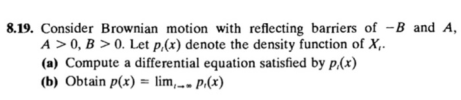 8.19. Consider Brownian motion with reflecting barriers of -B and A, A >0, B> 0. Let p,(x) denote the density function of X, (a) Compute a differential equation satisfied by p.(x) (b) Obtain p(x)im,_. p.(x)
8.19. Consider Brownian motion with reflecting barriers of -B and A, A >0, B> 0. Let p,(x) denote the density function of X, (a) Compute a differential equation satisfied by p.(x) (b) Obtain p(x)im,_. p.(x)
8.19. Consider Brownian motion with reflecting barriers of -B and A, A >0, B> 0. Let p,(x) denote the density function of X, (a) Compute a differential equation satisfied by p.(x) (b) Obtain p(x)im,_. p.(x)
X(t).12 0 is a standard Brownian motion. Find the distribution of X(t) . 2. Assume that X(t).12 0 is a standard Brownian motion. Find the distribution of X(t) . 2. Assume that
 X(t).12 0 is a standard Brownian motion. Find the distribution of X(t) . 2. Assume that
X(t).12 0 is a standard Brownian motion. Find the distribution of X(t) . 2. Assume that
X(t).12 0 is a standard Brownian motion. Find the distribution of X(t) . 2. Assume that
In the following questions, let Bt denote a Brownian motion with B0 = 0.
 In the following questions, let Bt denote a Brownian motion with
B0 = 0.
Consider a discrete time risk model U-2 + Σ Y" where {Yi) are iid random variables with N(2,1) distribution. Derive the lower bound for the survival probability, P(Un 〉 0, for all n 0, 1, 2, ). Justify your arguments.
Consider a discrete time risk model U-2 + Σ Y" where {Yi) are iid random variables with N(2,1) distribution. Derive the lower bound for the survival...
In the following questions, let Bt denote a Brownian motion with
B0 = 0.
Consider a discrete time risk model U-2 + Σ Y" where {Yi) are iid random variables with N(2,1) distribution. Derive the lower bound for the survival probability, P(Un 〉 0, for all n 0, 1, 2, ). Justify your arguments.
Consider a discrete time risk model U-2 + Σ Y" where {Yi) are iid random variables with N(2,1) distribution. Derive the lower bound for the survival...
In the following questions, let Bt denote a Brownian motion with B0 = 0.
 In the following questions, let Bt denote a Brownian motion with
B0 = 0.
Consider a discrete time risk model U-2 + Σ Y" where {Yi) are iid random variables with N(2,1) distribution. Derive the lower bound for the survival probability, P(Un 〉 0, for all n 0, 1, 2, ). Justify your arguments.
Consider a discrete time risk model U-2 + Σ Y" where {Yi) are iid random variables with N(2,1) distribution. Derive the lower bound for the survival...
In the following questions, let Bt denote a Brownian motion with
B0 = 0.
Consider a discrete time risk model U-2 + Σ Y" where {Yi) are iid random variables with N(2,1) distribution. Derive the lower bound for the survival probability, P(Un 〉 0, for all n 0, 1, 2, ). Justify your arguments.
Consider a discrete time risk model U-2 + Σ Y" where {Yi) are iid random variables with N(2,1) distribution. Derive the lower bound for the survival...
t2s points). Let B(t) be Brownian motion and let zu) with drift u0. For any B()+ ut be Brownian motion t 0, let T be the first time Z(t) hits a. a) Show that T, is a random time for Z(t) and for...
 t2s points). Let B(t) be Brownian motion and let zu) with drift u0. For any B()+ ut be Brownian motion t 0, let T be the first time Z(t) hits a. a) Show that T, is a random time for Z(t) and for B(t). b) Show P(T, 0o)1. c) Use martingale methods to compute E [e-m] for any θ > 0 r>
t2s points). Let B(t) be Brownian motion and let zu) with drift u0. For any B()+ ut be...
t2s points). Let B(t) be Brownian motion and let zu) with drift u0. For any B()+ ut be Brownian motion t 0, let T be the first time Z(t) hits a. a) Show that T, is a random time for Z(t) and for B(t). b) Show P(T, 0o)1. c) Use martingale methods to compute E [e-m] for any θ > 0 r>
t2s points). Let B(t) be Brownian motion and let zu) with drift u0. For any B()+ ut be...
3. Let W(t be standard Brownian motion and let to > 0. Consider the random variable Min(to) min{W(s) 0 s< to}. Co...
 3. Let W(t be standard Brownian motion and let to > 0. Consider the random variable Min(to) min{W(s) 0 s< to}. Compute the cumulative distribution function of Min(to)
3. Let W(t be standard Brownian motion and let to > 0. Consider the random variable Min(to) min{W(s) 0 s
3. Let W(t be standard Brownian motion and let to > 0. Consider the random variable Min(to) min{W(s) 0 s< to}. Compute the cumulative distribution function of Min(to)
3. Let W(t be standard Brownian motion and let to > 0. Consider the random variable Min(to) min{W(s) 0 s
 In the following questions, let Bt denote a Brownian motion with Bo = 0. (a) Show that if random variables X and Y are independent then they are 1. uncorrelated, Cov(X, Y) -0. (b) Let X have distribution P(X-1)- P(X 0) P(X- -1)-1/3, and Y-İX . Show that X and Y are uncorrelated, but not independent. (c) Let (X, Y) be a Gaussian vector. Show that if X and Y are uncorrelated then they are independent.
 8.2. Let W()-X(at)la for a >0. Verify that W(t is also Brownian motion
8.2. Let W()-X(at)la for a >0. Verify that W(t is also Brownian motion
8.2. Let W()-X(at)la for a >0. Verify that W(t is also Brownian motion
 In the following questions, let Bt denote a Brownian motion with
B0 = 0.
Let Xn, n-0, 1, 2, denote a biased random walk given by X0 0 and Xn+1 = Xn+Yn+1, where {Yn} are i.i.d. random variables with N(-1,1) distribution. Show that MnX +2nXn +n(n - 1) is a martingale.
Let Xn, n-0, 1, 2, denote a biased random walk given by X0 0 and Xn+1 = Xn+Yn+1, where {Yn} are i.i.d. random variables with N(-1,1) distribution. Show that...
In the following questions, let Bt denote a Brownian motion with
B0 = 0.
Let Xn, n-0, 1, 2, denote a biased random walk given by X0 0 and Xn+1 = Xn+Yn+1, where {Yn} are i.i.d. random variables with N(-1,1) distribution. Show that MnX +2nXn +n(n - 1) is a martingale.
Let Xn, n-0, 1, 2, denote a biased random walk given by X0 0 and Xn+1 = Xn+Yn+1, where {Yn} are i.i.d. random variables with N(-1,1) distribution. Show that...
 8.19. Consider Brownian motion with reflecting barriers of -B and A, A >0, B> 0. Let p,(x) denote the density function of X, (a) Compute a differential equation satisfied by p.(x) (b) Obtain p(x)im,_. p.(x)
8.19. Consider Brownian motion with reflecting barriers of -B and A, A >0, B> 0. Let p,(x) denote the density function of X, (a) Compute a differential equation satisfied by p.(x) (b) Obtain p(x)im,_. p.(x)
8.19. Consider Brownian motion with reflecting barriers of -B and A, A >0, B> 0. Let p,(x) denote the density function of X, (a) Compute a differential equation satisfied by p.(x) (b) Obtain p(x)im,_. p.(x)
 X(t).12 0 is a standard Brownian motion. Find the distribution of X(t) . 2. Assume that
X(t).12 0 is a standard Brownian motion. Find the distribution of X(t) . 2. Assume that
X(t).12 0 is a standard Brownian motion. Find the distribution of X(t) . 2. Assume that
 In the following questions, let Bt denote a Brownian motion with
B0 = 0.
Consider a discrete time risk model U-2 + Σ Y" where {Yi) are iid random variables with N(2,1) distribution. Derive the lower bound for the survival probability, P(Un 〉 0, for all n 0, 1, 2, ). Justify your arguments.
Consider a discrete time risk model U-2 + Σ Y" where {Yi) are iid random variables with N(2,1) distribution. Derive the lower bound for the survival...
In the following questions, let Bt denote a Brownian motion with
B0 = 0.
Consider a discrete time risk model U-2 + Σ Y" where {Yi) are iid random variables with N(2,1) distribution. Derive the lower bound for the survival probability, P(Un 〉 0, for all n 0, 1, 2, ). Justify your arguments.
Consider a discrete time risk model U-2 + Σ Y" where {Yi) are iid random variables with N(2,1) distribution. Derive the lower bound for the survival...
 In the following questions, let Bt denote a Brownian motion with
B0 = 0.
Consider a discrete time risk model U-2 + Σ Y" where {Yi) are iid random variables with N(2,1) distribution. Derive the lower bound for the survival probability, P(Un 〉 0, for all n 0, 1, 2, ). Justify your arguments.
Consider a discrete time risk model U-2 + Σ Y" where {Yi) are iid random variables with N(2,1) distribution. Derive the lower bound for the survival...
In the following questions, let Bt denote a Brownian motion with
B0 = 0.
Consider a discrete time risk model U-2 + Σ Y" where {Yi) are iid random variables with N(2,1) distribution. Derive the lower bound for the survival probability, P(Un 〉 0, for all n 0, 1, 2, ). Justify your arguments.
Consider a discrete time risk model U-2 + Σ Y" where {Yi) are iid random variables with N(2,1) distribution. Derive the lower bound for the survival...
 t2s points). Let B(t) be Brownian motion and let zu) with drift u0. For any B()+ ut be Brownian motion t 0, let T be the first time Z(t) hits a. a) Show that T, is a random time for Z(t) and for B(t). b) Show P(T, 0o)1. c) Use martingale methods to compute E [e-m] for any θ > 0 r>
t2s points). Let B(t) be Brownian motion and let zu) with drift u0. For any B()+ ut be...
t2s points). Let B(t) be Brownian motion and let zu) with drift u0. For any B()+ ut be Brownian motion t 0, let T be the first time Z(t) hits a. a) Show that T, is a random time for Z(t) and for B(t). b) Show P(T, 0o)1. c) Use martingale methods to compute E [e-m] for any θ > 0 r>
t2s points). Let B(t) be Brownian motion and let zu) with drift u0. For any B()+ ut be...
 3. Let W(t be standard Brownian motion and let to > 0. Consider the random variable Min(to) min{W(s) 0 s< to}. Compute the cumulative distribution function of Min(to)
3. Let W(t be standard Brownian motion and let to > 0. Consider the random variable Min(to) min{W(s) 0 s
3. Let W(t be standard Brownian motion and let to > 0. Consider the random variable Min(to) min{W(s) 0 s< to}. Compute the cumulative distribution function of Min(to)
3. Let W(t be standard Brownian motion and let to > 0. Consider the random variable Min(to) min{W(s) 0 s
Most questions answered within 3 hours.
-
Where is the error in this code sequence?
String s1 = "Hello";
String s2 = "ello";...
asked 11 months ago -
Financial data for Joel de Paris, Inc., for last year
follow:
Joel de Paris, Inc.
Balance...
asked 11 months ago -
Consider this reaction:
Al2(SO4)3 (aq)+ BaCl3
(aq) Al2Cl6 (aq)- +
3BaSO4(s) . What is the...
asked 11 months ago -
Suppose that Savneet is considering increasing her
recent random sample from 20 car rentals to 40...
asked 11 months ago -
Trucks arrive at an unloading terminal at an average rate of 120
per hour.
Trucks arrive...
asked 11 months ago -
Why are methanol and ethanol completely soluble in water while
octanol is not very little soluble....
asked 11 months ago -
A facilities manager at a university reads in a research report
that the mean amount of...
asked 11 months ago -
When the CuSO4 is rehydrated by adding water to the anhydrous
compound, is this an endothermic...
asked 11 months ago -
A ray of sunlight is passing from diamond into crown glass; the
angle of incidence is...
asked 11 months ago -
A block of mass 0.249 kg is placed on top of a light, vertical
spring of...
asked 11 months ago -
how do the kidneys compensate in the presences of acidosis
a) trigger hyperventilate
b) reserve acid...
asked 11 months ago -
Question 501 pts
The rental rate of capital to the firm increases. Which of the
following...
asked 11 months ago