
Homework Answers
Add Answer to:
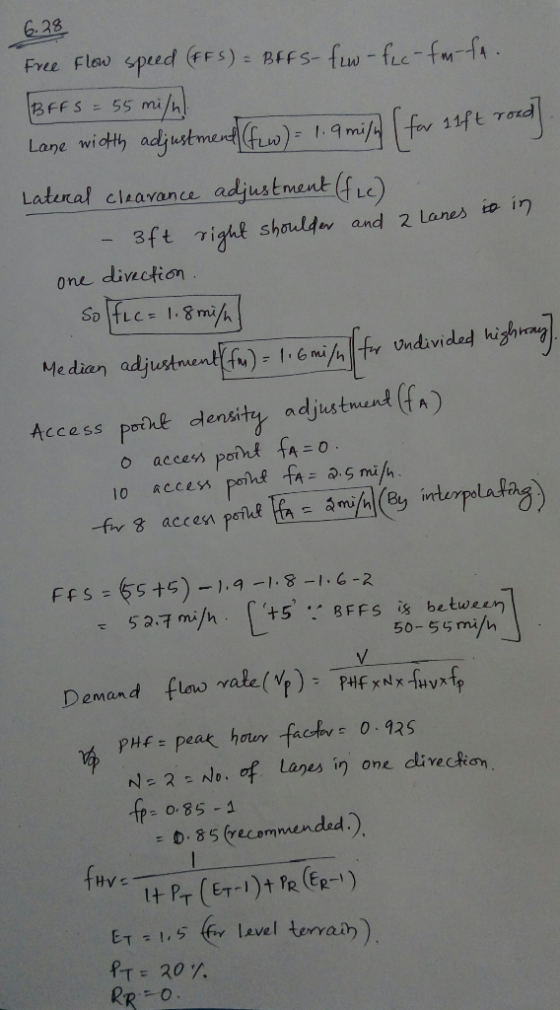
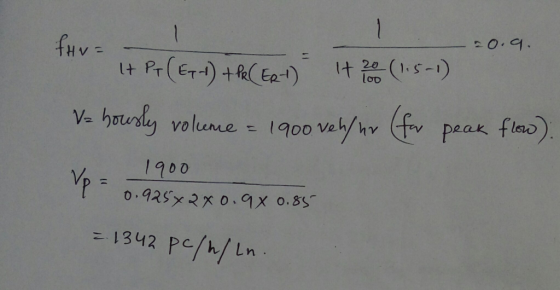
6.28 A multilane undivided highway is on level terrain and has two lanes in the northbound direct...
6.27 An undivided multilane highway segment has two 11-ft lanes in the eastbound direction with n...
 6.27 An undivided multilane highway segment has two 11-ft lanes in the eastbound direction with no shoulders and a 55 mi/h speed limit. This highway segment has 17 access points on a 0 625 mile, 4% upgrade During the highest 15 minutes of traffic flow within the peak-hour there are 720 cars, 56 single-unit trucks, and 24 tractor-trailer trucks. What are the estimated speed, density, and level of service of this upgrade?
6.27 An undivided multilane highway segment has two...
6.27 An undivided multilane highway segment has two 11-ft lanes in the eastbound direction with no shoulders and a 55 mi/h speed limit. This highway segment has 17 access points on a 0 625 mile, 4% upgrade During the highest 15 minutes of traffic flow within the peak-hour there are 720 cars, 56 single-unit trucks, and 24 tractor-trailer trucks. What are the estimated speed, density, and level of service of this upgrade?
6.27 An undivided multilane highway segment has two...
An undivided multilane highway segment has two 11-ft lanes in the eastbound direction with no shoulders...
An undivided multilane highway segment has two 11-ft lanes in the eastbound direction with no shoulders and a 55mph speed limit. This highway segment has 27 access points on a 0.625 mile,4% upgrade. The peak hour factor is 0.9,the directional peak hour volume is 2880 vehicles/hr which includes 200 single unit trucks (SUTs) and 60 tractor trailers (TTs). What are the estimated speed, density, and level of service of this upgrade?
A divided multilane highway is a recreational area (fp = 0.90) has four lanes (two lanes...
A divided multilane highway is a recreational area (fp = 0.90) has four lanes (two lanes in each direction) and is on rolling terrain. The highway has 10-ft lanes with a 6-ft right-side shoulder and a 3-ft left-side shoulder. The posted speed is 50 mi/h. Formerly there were 4 access points per mile, but recent development has increased the number of access points to 12 per mile. Before the development, the peak-hour factor was 0.95 and the directional hourly volume...
A multilane highway has four lanes (two lanes in each direction) and a measured free-flow speed...
A multilane highway has four lanes (two lanes in each direction) and a measured free-flow speed of 55 mi/h. One upgrade is 3% and 2 miles long. Trucks are not permitted on the highway, but there are 5% buses in the directional peak hour volume of 1900 vehicles with a peak hour factor of 0.80. What is the calculated density of the highway, assuming familiar drivers are in the traffic stream?
A six-lane divided highway (three lane in each direction) is on rolling terrain with two access...
A six-lane divided highway (three lane in each direction) is on rolling terrain with two access points per mile and has 10-ft. lanes, with a 5-ft. shoulder on the right side and a 3-ft. shoulder on the left side. The peak-hour factor is 0.80, and the directional peak-hour volume is 3000 vehicles per hour. There are 6% large trucks, 2% buses, and 2% recreational vehicles. A significant percentage of nonfamiliar roadway users are in the traffic stream (the driver population...
6.28 A six-lane freeway (three lanes in each direction) in rolling terrain has 10-ft lanes and...
 6.28 A six-lane freeway (three lanes in each direction) in rolling terrain has 10-ft lanes and obstructions 4 ft from the right edge of the traveled pavement. There are five ramps within three miles upstream of the segment midpoint and four ramps within three miles downstream of the segment midpoint. A directional peak-hour volume of 2000 vehicles (primarily commuters) is observed, with 600 vehicles arriving in the highest 15-min flow rate period. The traffic stream contains 12% large trucks and...
An eight-lane freeway (four lanes in each direction) is on rolling terrain and has 11-ft lanes...
 An eight-lane freeway (four lanes in each direction) is on rolling terrain and has 11-ft lanes with a 4-ft right-side shoulder. The total ramp density is 1.5 ramps per mile. The directional peak-hour traffic volume is 5400 vehicles with 400 large trucks and 6% buses. The peak- hour factor is 0.92. It has been decided that large trucks will be banned from the freeway during the peak hour. How much will the ban reduce expected traffic density and the level...
A six-lane freeway (three lanes in each direction) in rolling terrain has 10-ft lanes and obstructions...
 A six-lane freeway (three lanes in each direction) in rolling terrain has 10-ft lanes and obstructions 4 ft from the right edge of the pavement. There are 4 ramps within 6 miles. A directional peak-hour volume of 4500 veh/h is observed, with 1250 vehicles arriving in the highest 15-min flow rate period. The traffic stream contains 15% heavy vehicles. What is the density and the corresponding level of service (LOS) of the traffic stream? Do not use on the chart...
5. There is a freeway segment and its characteristics are given as below: •A six-lane urban...
5. There is a freeway segment and its characteristics are given as below: •A six-lane urban freeway (3 lanes each direction) •11-ft lanes •3-ft right-shoulder lateral clearance •3% grade •1.2 mile in length •8% of trucks and buses •4% recreational vehicles •Driver population factor (fp): 0.95 •Peak-hour volume in peak direction: 2,500 vehicles •PHF: 0.925 •Interchange density: 1.5 per mile Evaluate the freeway segment by Level-of-Service (LOS) according to the Highway Capacity Manual (Referring to Tables 6-3 ~ 6-10 in...
Traffic engineering Question 1 A northbound freeway segment is on a 4% upgrade from station 430+60...
 Traffic engineering
Question 1 A northbound freeway segment is on a 4% upgrade from station 430+60 to 397-60 and has three l 1 t-wide lanes, a 5 ft right shoulder and has a ramp density of 1 per mile in the 3 miles before and after the mid-point of this freeway segment. The peak-hour factor is 0.9 and northbound traffic during the peak hour is 2400 vehicles, with 20% heavy vehicles (and a 5090 SUT/50% TT mix). Determine the density...
Traffic engineering
Question 1 A northbound freeway segment is on a 4% upgrade from station 430+60 to 397-60 and has three l 1 t-wide lanes, a 5 ft right shoulder and has a ramp density of 1 per mile in the 3 miles before and after the mid-point of this freeway segment. The peak-hour factor is 0.9 and northbound traffic during the peak hour is 2400 vehicles, with 20% heavy vehicles (and a 5090 SUT/50% TT mix). Determine the density...
 6.27 An undivided multilane highway segment has two 11-ft lanes in the eastbound direction with no shoulders and a 55 mi/h speed limit. This highway segment has 17 access points on a 0 625 mile, 4% upgrade During the highest 15 minutes of traffic flow within the peak-hour there are 720 cars, 56 single-unit trucks, and 24 tractor-trailer trucks. What are the estimated speed, density, and level of service of this upgrade?
6.27 An undivided multilane highway segment has two...
6.27 An undivided multilane highway segment has two 11-ft lanes in the eastbound direction with no shoulders and a 55 mi/h speed limit. This highway segment has 17 access points on a 0 625 mile, 4% upgrade During the highest 15 minutes of traffic flow within the peak-hour there are 720 cars, 56 single-unit trucks, and 24 tractor-trailer trucks. What are the estimated speed, density, and level of service of this upgrade?
6.27 An undivided multilane highway segment has two...
 6.28 A six-lane freeway (three lanes in each direction) in rolling terrain has 10-ft lanes and obstructions 4 ft from the right edge of the traveled pavement. There are five ramps within three miles upstream of the segment midpoint and four ramps within three miles downstream of the segment midpoint. A directional peak-hour volume of 2000 vehicles (primarily commuters) is observed, with 600 vehicles arriving in the highest 15-min flow rate period. The traffic stream contains 12% large trucks and...
 An eight-lane freeway (four lanes in each direction) is on rolling terrain and has 11-ft lanes with a 4-ft right-side shoulder. The total ramp density is 1.5 ramps per mile. The directional peak-hour traffic volume is 5400 vehicles with 400 large trucks and 6% buses. The peak- hour factor is 0.92. It has been decided that large trucks will be banned from the freeway during the peak hour. How much will the ban reduce expected traffic density and the level...
 A six-lane freeway (three lanes in each direction) in rolling terrain has 10-ft lanes and obstructions 4 ft from the right edge of the pavement. There are 4 ramps within 6 miles. A directional peak-hour volume of 4500 veh/h is observed, with 1250 vehicles arriving in the highest 15-min flow rate period. The traffic stream contains 15% heavy vehicles. What is the density and the corresponding level of service (LOS) of the traffic stream? Do not use on the chart...
 Traffic engineering
Question 1 A northbound freeway segment is on a 4% upgrade from station 430+60 to 397-60 and has three l 1 t-wide lanes, a 5 ft right shoulder and has a ramp density of 1 per mile in the 3 miles before and after the mid-point of this freeway segment. The peak-hour factor is 0.9 and northbound traffic during the peak hour is 2400 vehicles, with 20% heavy vehicles (and a 5090 SUT/50% TT mix). Determine the density...
Traffic engineering
Question 1 A northbound freeway segment is on a 4% upgrade from station 430+60 to 397-60 and has three l 1 t-wide lanes, a 5 ft right shoulder and has a ramp density of 1 per mile in the 3 miles before and after the mid-point of this freeway segment. The peak-hour factor is 0.9 and northbound traffic during the peak hour is 2400 vehicles, with 20% heavy vehicles (and a 5090 SUT/50% TT mix). Determine the density...
Most questions answered within 3 hours.
-
Where is the error in this code sequence?
String s1 = "Hello";
String s2 = "ello";...
asked 10 months ago -
Financial data for Joel de Paris, Inc., for last year
follow:
Joel de Paris, Inc.
Balance...
asked 10 months ago -
Consider this reaction:
Al2(SO4)3 (aq)+ BaCl3
(aq) Al2Cl6 (aq)- +
3BaSO4(s) . What is the...
asked 10 months ago -
Suppose that Savneet is considering increasing her
recent random sample from 20 car rentals to 40...
asked 10 months ago -
Trucks arrive at an unloading terminal at an average rate of 120
per hour.
Trucks arrive...
asked 10 months ago -
Why are methanol and ethanol completely soluble in water while
octanol is not very little soluble....
asked 10 months ago -
A facilities manager at a university reads in a research report
that the mean amount of...
asked 10 months ago -
When the CuSO4 is rehydrated by adding water to the anhydrous
compound, is this an endothermic...
asked 10 months ago -
A ray of sunlight is passing from diamond into crown glass; the
angle of incidence is...
asked 10 months ago -
A block of mass 0.249 kg is placed on top of a light, vertical
spring of...
asked 10 months ago -
how do the kidneys compensate in the presences of acidosis
a) trigger hyperventilate
b) reserve acid...
asked 10 months ago -
Question 501 pts
The rental rate of capital to the firm increases. Which of the
following...
asked 10 months ago