BF SWINGS
Ben Floyd really enjoyed wood shop in high school, so he used an inheritance to buy some basic woodworking tools. He started out doing odd jobs, and then one day he made a porch swing for his house. Several people saw it and asked him to make one for them. Word of mouth brought him many customers. In June of 1991 he married Bobbie Ruth, a marketing graduate. Bobbie Ruth saw a chance to expand the swing business to similar products and eventually have hardware, building supply, and furniture stores. Thus, BF Swing was born. Due to his love of his work and Bobbie Ruth’s marketing ability, the business prospered. Today, they make stools and rockers as well as swings.
The company now employs about 35 people five days a week with sales close to $1.4 million dollars. Ben is concerned with production for the next few months, and he assigns you to come up with a four-week production plan. Part of his motivation is that he thinks there is too much inventory. Samir, the forman, contends that cannot be true, because the storage area is limited, and there can never be more than 500 total items in storage at any one time. Another motivation is that Lupe, the accountant, tells him that overtime costs are a large part of his total operating costs. Chan, from the personnel, thinks they ought to hire more workers to alleviate overtime.
When asked, Chan admits it will cost $1000 per worker to train them, and their wages are $400 per week. Bobbie Ruth points out that, by law, any worker laid off must be paid three weeks’ separation pay. Overtime costs are approximately double the cost of regular time in each department and that overtime work can be at most three hours a working day (Monday to Friday) and 6 hours on Saturday. Samir also reminds them that adding people might not add capacity, because additional equipment may also be needed. Ben agrees with this except in the case of sanding, assembly, and finishing, which require little or no equipment.
Therefore they conclude that hiring only make sense in these 3 departments. Thanks to Bobbie Ruth’s foresight, some data are available. The following table gives the standard processing time (in minutes) for each “operation” of the three products. It contains the expected time available in each department per worker. (Time for preventative and unexpected maintenance is already excluded.) The number of employees currently working in the department is also provided, as well as the average costs per hour (including labour and machine costs).
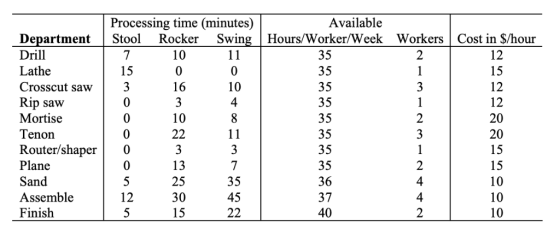
Inventory holding costs per week are $0.30, $0.80, and $0.90 per unit-week. Currently, there are 70 stools, 255 rockers, and 110 swings in inventory. The forecasted demands for products in the next four weeks are as follows:
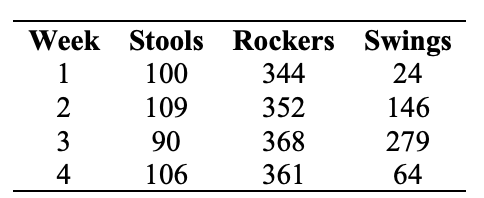
Develop a four-week production plan for BFS that minimizes the total cost (production, labor, hiring, layoffs, extra hours and storage cost).
A. Deliver the working document (Lingo or Excel) with
the solution of the problem.
B. If an optimization model is used, show the model and the
decision variables.
C. Make a summary table that indicates the amount to be produced
each month, the initial inventory and the initial inventory for
each week.
D. Also make a table of available labor in each process, those
hired, laid off extra times each week.
E. Calculate the total cost per week for each of the three products
and the total cost of all production.
Week Stools Rockers Swings 100 109 90 106 344 352 368 361 24 146 279 64 2 4
Homework Answers
![7 Bedict (ft, », ahead -s Spse Time sexics; End 121 [1] 109,0502 103, 2318 103. 3400 03. 4827 0 G156 to3. 755] se Time sesics](http://img.homeworklib.com/images/7f66a8ce-ccf1-443c-b0f2-9e3f410d9a5b.png?x-oss-process=image/resize,w_560)
Add Answer to:
BF SWINGS Ben Floyd really enjoyed wood shop in high school, so he used an inheritance to buy som...
Most questions answered within 3 hours.
-
Where is the error in this code sequence?
String s1 = "Hello";
String s2 = "ello";...
asked 11 months ago -
Financial data for Joel de Paris, Inc., for last year
follow:
Joel de Paris, Inc.
Balance...
asked 11 months ago -
Consider this reaction:
Al2(SO4)3 (aq)+ BaCl3
(aq) Al2Cl6 (aq)- +
3BaSO4(s) . What is the...
asked 11 months ago -
Suppose that Savneet is considering increasing her
recent random sample from 20 car rentals to 40...
asked 11 months ago -
Trucks arrive at an unloading terminal at an average rate of 120
per hour.
Trucks arrive...
asked 11 months ago -
Why are methanol and ethanol completely soluble in water while
octanol is not very little soluble....
asked 11 months ago -
A facilities manager at a university reads in a research report
that the mean amount of...
asked 11 months ago -
When the CuSO4 is rehydrated by adding water to the anhydrous
compound, is this an endothermic...
asked 11 months ago -
A ray of sunlight is passing from diamond into crown glass; the
angle of incidence is...
asked 11 months ago -
A block of mass 0.249 kg is placed on top of a light, vertical
spring of...
asked 11 months ago -
how do the kidneys compensate in the presences of acidosis
a) trigger hyperventilate
b) reserve acid...
asked 11 months ago -
Question 501 pts
The rental rate of capital to the firm increases. Which of the
following...
asked 11 months ago