How would you solve for "real money balances" in an overlapping generations model with endowment?...
How would you solve for "real money balances" in an overlapping generations model with endowment?
I have a utility function of U(C1,C2) = lnC1 + (B)lnC2
Homework Answers
Maximize this utility function with respect to c1 and c2 by forming a lagrangean function. This optimization will give you optimal consumption points. Then substitute the same in the real money balances equation. Real money balances would be calculated bu dividing the nominal money balances with price
Add Answer to:
How would you solve for "real money balances" in an overlapping generations model with endowment?...
Economic maths question: Posted here because i couldn't get an answer under Econ subject. How would...
Economic maths question: Posted here because i couldn't get an answer under Econ subject. How would you solve for "real money balances" in an overlapping generations model with endowment? I have a utility function of U(C1,C2) = lnC1 + (B)lnC2
Economic maths question: Posted here because i couldn't get an answer under Econ subject. How wou...
Economic maths question: Posted here because i couldn't get an answer under Econ subject. How would you solve for "real money balances" in an overlapping generations model with endowment? I have a utility function of U(C1,C2) = lnC1 + (B)lnC2
QUESTION 2 (Total: 15 marks) Consider an overlapping generations model as discussed in Chapter 7. In...
 QUESTION 2 (Total: 15 marks) Consider an overlapping generations model as discussed in Chapter 7. In which people live for 3 periods. People receive endowment y only when they are young and zero endowments during other times. The population growth rate is n>1. People can hold physical capital which yields return after two periods: each unit of capital generates X units of consumption goods after two periods and then capital disintegrates. Note it is impossible for an individual to observe...
Consider an overlapping generations model with 200 lenders and 100 borrowers born in every period. Everyone...
Consider an overlapping generations model with 200 lenders and 100 borrowers born in every period. Everyone lives for only two periods. Each lender is endowed with 20 goods when young and nothing when old. Each borrower is endowed with nothing when young and 40 goods when old. The lenders want to save 10 goods each, regardless of the rate of return on their savings. Each borrower wants to borrow 10/r goods each, where r is the gross real interest rate...
Problem 2. Consider an overlapping generations model with money, where t = 1,2,3,.... So, every period...
 Problem 2. Consider an overlapping generations model with money, where t = 1,2,3,.... So, every period t, a generation of two-period lived agents are born. Their preferences are . They are endowed with ey units of the consumption good, when young, and e° units of the consumption good, when old. Assume that ey > eo > 0. The consumption good is perishable The initial old also have a quantity M of intrinsically valueless fiat money. Trading takes place as described...
Problem 2. Consider an overlapping generations model with money, where t = 1,2,3,.... So, every period...
 Problem 2. Consider an overlapping generations model with money, where t = 1,2,3,.... So, every period t, a generation of two-period lived agents are born. Their preferences are ,+1log()log(+i). They are endowed with ey units of the consumption good, when young, and e° units of the consumption good, when old. Assume that e' > e > 0. The consumption good is perishable The initial old also have a quantity M of intrinsically valueless fiat money. Trading takes place as described...
Consider a two-period economy discussed in Chapter 9. Suppose there are only two households, and each...
 Consider a two-period economy discussed in Chapter 9. Suppose there are only two households, and each household's utility function and endowment are given as follows. u' (C1,C2) = (C122) and e' = (18,4). u? (C1,C2) = Incı + 2 Inc and e? = (3,6). el denote the allocation of endowment income for household i. For simplicity, there is no government, and therefore no tax in both periods. There is a perfectly competitive credit (financial market in which they can buy...
Suppose that instead of having a fixed income I, you have an endowment of y =...
 Suppose that instead of having a fixed income I, you have an endowment of y = 12 units of You can sell each of these units of good Y at price Pj and use the proceeds to buy good X, which good Y has a price of P Draw your budget line if P = 3 andP, = 4 Draw what happens to your budget line if P increases from 3 to 4, or if P, decreases from 4 to...
(25) Rebecca is just starting a two-day, fully-funded vacation. First thing this morning, she is given...
(25) Rebecca is just starting a two-day, fully-funded vacation. First thing this morning, she is given $1000. First thing tomorrow morning, she is given $750. This is all the money that Rebecca has access to. Rebecca has no access to credit and cannot borrow money. She can, however, save her money overnight in a savings account that pays 10% interest per day. She will spend all of her money while on vacation. (a) (5) Plot and label Rebecca’s endowment (the...
1. Alex views present and future consumption as perfect substitutes. He does, however, discount future consumption...
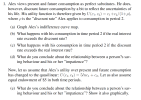 1. Alex views present and future consumption as perfect substitutes. He does, however, discount future consumption by a bit to reflect the uncertainties of his life. His utility function is therefore given by U(C1, C2) = C1+C2/(1+p), where p is the "discount rate” Alex applies to consumption in period 2. (a) Graph Alex's indifference curve map. (b) What happens with his consumption in time period 2 if the real interest rate exceeds the discount rate? (c) What happens with his...
 QUESTION 2 (Total: 15 marks) Consider an overlapping generations model as discussed in Chapter 7. In which people live for 3 periods. People receive endowment y only when they are young and zero endowments during other times. The population growth rate is n>1. People can hold physical capital which yields return after two periods: each unit of capital generates X units of consumption goods after two periods and then capital disintegrates. Note it is impossible for an individual to observe...
 Problem 2. Consider an overlapping generations model with money, where t = 1,2,3,.... So, every period t, a generation of two-period lived agents are born. Their preferences are ,+1log()log(+i). They are endowed with ey units of the consumption good, when young, and e° units of the consumption good, when old. Assume that e' > e > 0. The consumption good is perishable The initial old also have a quantity M of intrinsically valueless fiat money. Trading takes place as described...
 Consider a two-period economy discussed in Chapter 9. Suppose there are only two households, and each household's utility function and endowment are given as follows. u' (C1,C2) = (C122) and e' = (18,4). u? (C1,C2) = Incı + 2 Inc and e? = (3,6). el denote the allocation of endowment income for household i. For simplicity, there is no government, and therefore no tax in both periods. There is a perfectly competitive credit (financial market in which they can buy...
 Suppose that instead of having a fixed income I, you have an endowment of y = 12 units of You can sell each of these units of good Y at price Pj and use the proceeds to buy good X, which good Y has a price of P Draw your budget line if P = 3 andP, = 4 Draw what happens to your budget line if P increases from 3 to 4, or if P, decreases from 4 to...
 1. Alex views present and future consumption as perfect substitutes. He does, however, discount future consumption by a bit to reflect the uncertainties of his life. His utility function is therefore given by U(C1, C2) = C1+C2/(1+p), where p is the "discount rate” Alex applies to consumption in period 2. (a) Graph Alex's indifference curve map. (b) What happens with his consumption in time period 2 if the real interest rate exceeds the discount rate? (c) What happens with his...
Most questions answered within 3 hours.
-
Where is the error in this code sequence?
String s1 = "Hello";
String s2 = "ello";...
asked 11 months ago -
Financial data for Joel de Paris, Inc., for last year
follow:
Joel de Paris, Inc.
Balance...
asked 11 months ago -
Consider this reaction:
Al2(SO4)3 (aq)+ BaCl3
(aq) Al2Cl6 (aq)- +
3BaSO4(s) . What is the...
asked 11 months ago -
Suppose that Savneet is considering increasing her
recent random sample from 20 car rentals to 40...
asked 11 months ago -
Trucks arrive at an unloading terminal at an average rate of 120
per hour.
Trucks arrive...
asked 11 months ago -
Why are methanol and ethanol completely soluble in water while
octanol is not very little soluble....
asked 11 months ago -
A facilities manager at a university reads in a research report
that the mean amount of...
asked 11 months ago -
When the CuSO4 is rehydrated by adding water to the anhydrous
compound, is this an endothermic...
asked 11 months ago -
A ray of sunlight is passing from diamond into crown glass; the
angle of incidence is...
asked 11 months ago -
A block of mass 0.249 kg is placed on top of a light, vertical
spring of...
asked 11 months ago -
how do the kidneys compensate in the presences of acidosis
a) trigger hyperventilate
b) reserve acid...
asked 11 months ago -
Question 501 pts
The rental rate of capital to the firm increases. Which of the
following...
asked 11 months ago