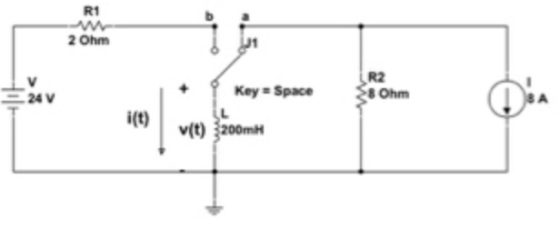
The switch has been in position "a" for a long time. At time t = 0
The switch has been in position "a" for a long time. At time t = 0, the switch moves from position a to position b. The switch is a "make-before-break" type: that is, the connection at position b is established before the connection at position a is broken, so there is no interruption of the current through the inductor.
Questions
1. Determine the initial value of the current.
2. Determine the final value of the current and the time constant.
3. Complete Solution for the Current and Voltage. 4. Determine the initial voltage across the inductor just
after the switch moves to "b".
5. Does this initial voltage make sense in terms of circuit behavior?
6.Determine the time it takes for the inductor voltage to reach 24 Volts
Homework Answers


The switch has been in position a for a long time. At t=0, it instantaneously moves...
 The switch has been in position a for a long time. At t=0, it instantaneously moves to position b. Find the following: a) (8-points) Voltage response b) (8-points) Current response c) (9-points) Evaluate how long after the switch is in position ‘b' does the voltage across the capacitor equal zero. 400 kA b a 2012 90 V + 40 V 60123 0.5 uF
Assume that the switch has been in position 1 for a long time, and then at time t=0 the switch is moved to position 2. Calculate i(t) fort > 0.
 Circuit 1. Assume that the switch has been in position 1 for a long time, and then at time t=0 the switch is moved to position 2. Calculate i(t) fort > 0. Circuit 1: Find v(0), i.e. the capacitor voltage at time 0 (in Volts). 2.4Circuit 1: What is v(t), approximately, for extremely larget, for example, for t= 10000000 s.
The switch in the given figure moves from position A to position B at t =...
 The switch in the given figure moves from position A to position B at t = 0 (please note that the switch must connect to point B before it breaks the connection at A, a make before break switch). Determine i(t) for t > 0. Also assume that the initial voltage on the capacitor is zero and / = 3.0 A. t=0 A i(t) B 10 mF I 2012 102 0.25 H The value of i(t) = [AeBtc(Dt - E°)]u(t)...
7.55 The switch in the circuit of Fig. P 7.55 has been in position a for a long time. At t- 0 the switch is moved to position b. Calculate (a) the initial voltage on the capacitor; (b) the final volt...
 The switch in the circuit of Fig. P 7.55 has been in position a for a long time. At t- 0 the switch is moved to position b. Calculate (a) the initial voltage on the capacitor; (b) the final voltage on the capacitor; (c) the time constant (in microseconds) for t > 0; and (d) the length of time (in microseconds) required for the capacitor voltage to reach zero after the switch is moved to position b.
do not use s domain method ,use only differential equation 3. In the circuit shown, switch 1 has been closed for a long time before it is opened at t 0, and switch 2 has been opened for a long time b...
 do not use s domain method ,use only differential equation
3. In the circuit shown, switch 1 has been closed for a long time before it is opened at t 0, and switch 2 has been opened for a long time before it is closed at t = 0. SW2 sw, 0.5Ω R2 1(2 A, 20 A i(t) 0.5 H a. Find the initial voltage v(O)- Vo across the capacitor and initial current through the inductor (0) lo at t...
do not use s domain method ,use only differential equation
3. In the circuit shown, switch 1 has been closed for a long time before it is opened at t 0, and switch 2 has been opened for a long time before it is closed at t = 0. SW2 sw, 0.5Ω R2 1(2 A, 20 A i(t) 0.5 H a. Find the initial voltage v(O)- Vo across the capacitor and initial current through the inductor (0) lo at t...
Consider the circuit depicted in Fig. 2. The switch SW1 has been closed for a long time before it...
 Consider the circuit depicted in Fig. 2. The switch SW1 has been closed for a long time before it is opened at time t = 0. The switch SW2 has been open for a long time before it is closed att = 0.1 (sec). i) Find the initial current I(0) flowing in the inductor and the initial voltage V(0) across the capacitor. ii) Find the voltage V(t) across the capacitor and the current I(t) through the inductor for 0 ≤ t ≤...
1. In the circuit below, the switch was at position 0 for a very long time....
 1. In the circuit below, the switch was at position 0 for a very long time. Then, it is turned from position 0 to position 1. What is the magnitude of the voltage across the inductor immediately after the switch is turned to position 1? Oo p A) V B) 2V C) 3V I,(t) ) V/2 E) V/3
Circuit Analysis II The switch in the circuit has been in position a for a long...
 Circuit Analysis II
The switch in the circuit has been in position a for a
long time. At t=0, the switch moves instantly to position b. Derive
the integrodifferential equation that governs the behavior of the
current I0 for t>0+
dc t=0
Circuit Analysis II
The switch in the circuit has been in position a for a
long time. At t=0, the switch moves instantly to position b. Derive
the integrodifferential equation that governs the behavior of the
current I0 for t>0+
dc t=0
The switch in the circuit has been closed for a long time before it is opened at t = 0
 The switch in the circuit has been closed for a long time before it is opened at t = 0a) io(t) for t ≥ 0+b) vo(t) for t ≥ 0+, where vo is the voltage drop across the 54 Ω resistor.c) The total energy stored in the 0.5 H inductor that is dissipated in the 26 Ω resistor
Continuing on from the previous scenario, assume now that the switch has been left in the...
 Continuing on from the previous scenario, assume now that the
switch has been left in the charging position for an extremely long
time before being changed to the discharging position.
(f) What is the initial discharging circuit current i.e.
instantly after the switch is thrown?
(g) Determine an expression for the discharging circuit inductor
voltage.
(h) Calculate the half life time of the discharging circuit
current.
(i) What is the inductor voltage magnitude at the time
calculated in part (h)?...
Continuing on from the previous scenario, assume now that the
switch has been left in the charging position for an extremely long
time before being changed to the discharging position.
(f) What is the initial discharging circuit current i.e.
instantly after the switch is thrown?
(g) Determine an expression for the discharging circuit inductor
voltage.
(h) Calculate the half life time of the discharging circuit
current.
(i) What is the inductor voltage magnitude at the time
calculated in part (h)?...
 The switch has been in position a for a long time. At t=0, it instantaneously moves to position b. Find the following: a) (8-points) Voltage response b) (8-points) Current response c) (9-points) Evaluate how long after the switch is in position ‘b' does the voltage across the capacitor equal zero. 400 kA b a 2012 90 V + 40 V 60123 0.5 uF
 The switch in the given figure moves from position A to position B at t = 0 (please note that the switch must connect to point B before it breaks the connection at A, a make before break switch). Determine i(t) for t > 0. Also assume that the initial voltage on the capacitor is zero and / = 3.0 A. t=0 A i(t) B 10 mF I 2012 102 0.25 H The value of i(t) = [AeBtc(Dt - E°)]u(t)...
 do not use s domain method ,use only differential equation
3. In the circuit shown, switch 1 has been closed for a long time before it is opened at t 0, and switch 2 has been opened for a long time before it is closed at t = 0. SW2 sw, 0.5Ω R2 1(2 A, 20 A i(t) 0.5 H a. Find the initial voltage v(O)- Vo across the capacitor and initial current through the inductor (0) lo at t...
do not use s domain method ,use only differential equation
3. In the circuit shown, switch 1 has been closed for a long time before it is opened at t 0, and switch 2 has been opened for a long time before it is closed at t = 0. SW2 sw, 0.5Ω R2 1(2 A, 20 A i(t) 0.5 H a. Find the initial voltage v(O)- Vo across the capacitor and initial current through the inductor (0) lo at t...
 1. In the circuit below, the switch was at position 0 for a very long time. Then, it is turned from position 0 to position 1. What is the magnitude of the voltage across the inductor immediately after the switch is turned to position 1? Oo p A) V B) 2V C) 3V I,(t) ) V/2 E) V/3
 Circuit Analysis II
The switch in the circuit has been in position a for a
long time. At t=0, the switch moves instantly to position b. Derive
the integrodifferential equation that governs the behavior of the
current I0 for t>0+
dc t=0
Circuit Analysis II
The switch in the circuit has been in position a for a
long time. At t=0, the switch moves instantly to position b. Derive
the integrodifferential equation that governs the behavior of the
current I0 for t>0+
dc t=0
 Continuing on from the previous scenario, assume now that the
switch has been left in the charging position for an extremely long
time before being changed to the discharging position.
(f) What is the initial discharging circuit current i.e.
instantly after the switch is thrown?
(g) Determine an expression for the discharging circuit inductor
voltage.
(h) Calculate the half life time of the discharging circuit
current.
(i) What is the inductor voltage magnitude at the time
calculated in part (h)?...
Continuing on from the previous scenario, assume now that the
switch has been left in the charging position for an extremely long
time before being changed to the discharging position.
(f) What is the initial discharging circuit current i.e.
instantly after the switch is thrown?
(g) Determine an expression for the discharging circuit inductor
voltage.
(h) Calculate the half life time of the discharging circuit
current.
(i) What is the inductor voltage magnitude at the time
calculated in part (h)?...
Most questions answered within 3 hours.
-
Where is the error in this code sequence?
String s1 = "Hello";
String s2 = "ello";...
asked 10 months ago -
Financial data for Joel de Paris, Inc., for last year
follow:
Joel de Paris, Inc.
Balance...
asked 10 months ago -
Consider this reaction:
Al2(SO4)3 (aq)+ BaCl3
(aq) Al2Cl6 (aq)- +
3BaSO4(s) . What is the...
asked 10 months ago -
Suppose that Savneet is considering increasing her
recent random sample from 20 car rentals to 40...
asked 10 months ago -
Trucks arrive at an unloading terminal at an average rate of 120
per hour.
Trucks arrive...
asked 10 months ago -
Why are methanol and ethanol completely soluble in water while
octanol is not very little soluble....
asked 10 months ago -
A facilities manager at a university reads in a research report
that the mean amount of...
asked 10 months ago -
When the CuSO4 is rehydrated by adding water to the anhydrous
compound, is this an endothermic...
asked 10 months ago -
A ray of sunlight is passing from diamond into crown glass; the
angle of incidence is...
asked 10 months ago -
A block of mass 0.249 kg is placed on top of a light, vertical
spring of...
asked 10 months ago -
how do the kidneys compensate in the presences of acidosis
a) trigger hyperventilate
b) reserve acid...
asked 10 months ago -
Question 501 pts
The rental rate of capital to the firm increases. Which of the
following...
asked 10 months ago