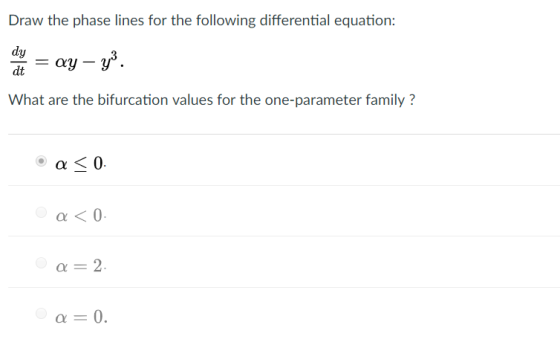
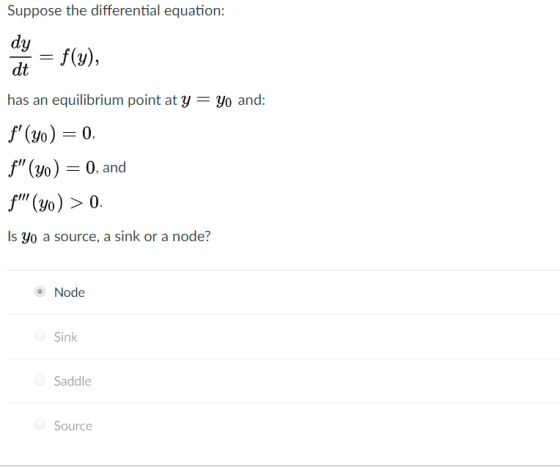
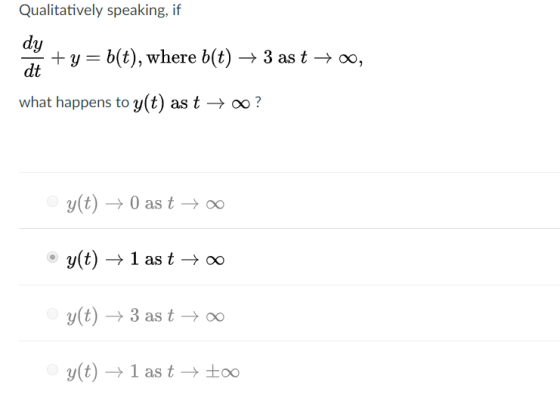
pls choose the answer like a,b,c,d for these 5 multichoice question don't mind what i choose
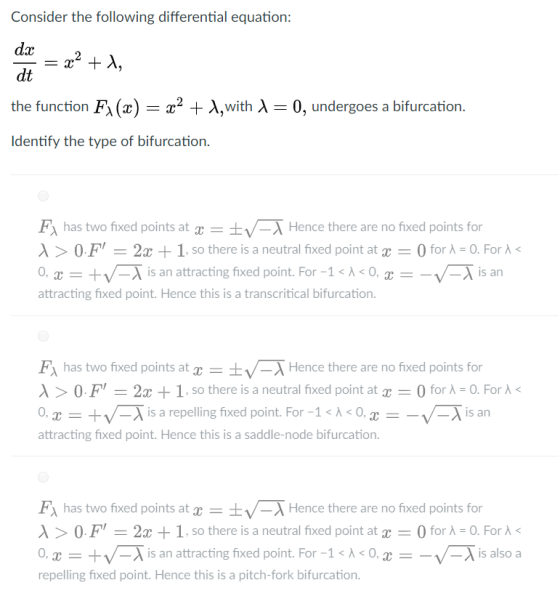
Consider the following differential equation: dt the function FA(x) -22 A, with A0, undergoes a bifurcation. Identify the type of bifurca tion. F has two fixed points at x-±V Hence there are no fixed points for λ > 0 Æ,-20 + 1, so there is a neutral fixed point at X 0 for λ-o For λ
Homework Answers
Add Answer to:
Pls choose the answer like a,b,c,d for these 5 multichoice question don't mind what i choose
pls choose the answer like a,b,c,d for these 5 multichoice question don't mind what i choose...
 pls choose the answer like a,b,c,d for these 5 multichoice
question don't mind what i choose
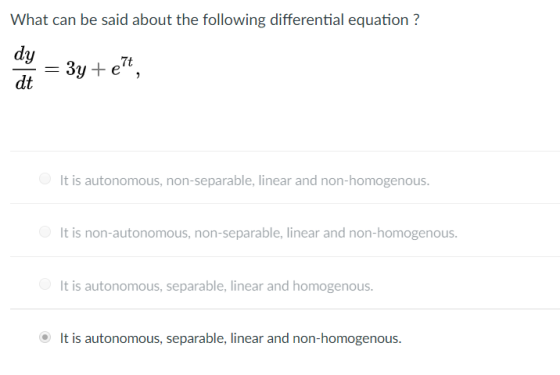
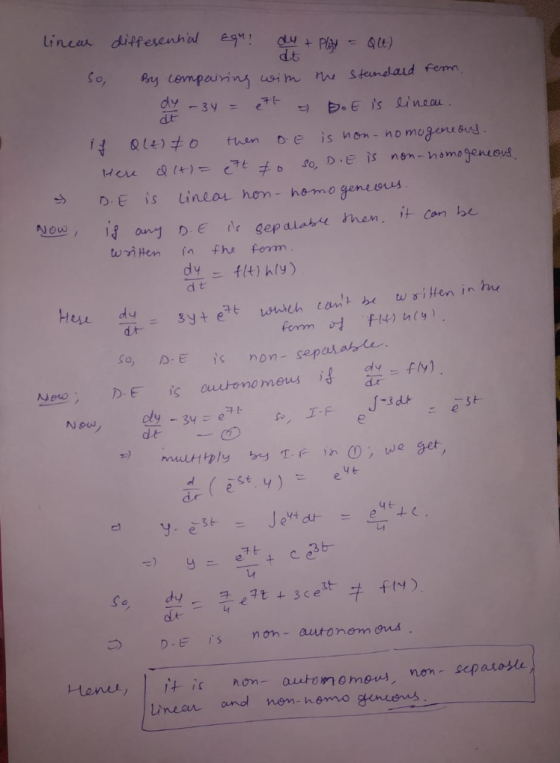
What can be said about the following differential equation? dy 7t It is autonomous, non-separable, linear and non-homogenous It is non-autonomous, non-separable, linear and non-homogenous It is autonomous, separable, linear and homogenous It is autonomous, separable, linear and non-homogenous. Consider the following differential equation: dt the function FA(x) -22 A, with A0, undergoes a bifurcation. Identify the type of bifurca tion. F has two...
pls choose the answer like a,b,c,d for these 5 multichoice
question don't mind what i choose
What can be said about the following differential equation? dy 7t It is autonomous, non-separable, linear and non-homogenous It is non-autonomous, non-separable, linear and non-homogenous It is autonomous, separable, linear and homogenous It is autonomous, separable, linear and non-homogenous. Consider the following differential equation: dt the function FA(x) -22 A, with A0, undergoes a bifurcation. Identify the type of bifurca tion. F has two...
can i have a step by step of 1, 3, and 5 please In Problems 1-6,...
 can i have a step by step of 1, 3, and 5 please
In Problems 1-6, determine whether the given equation is separable, linear, neither or both. dx 1. +xt = ex 2. 2dy +sin x y = 0 dt dx 3. 3t e'+ y ln t 4. (t+ \ dt yt - y dy Srortar dr 5. 3r = de vorla (d) dx TU6. x +Px = sin t dt 03
can i have a step by step of 1, 3, and 5 please
In Problems 1-6, determine whether the given equation is separable, linear, neither or both. dx 1. +xt = ex 2. 2dy +sin x y = 0 dt dx 3. 3t e'+ y ln t 4. (t+ \ dt yt - y dy Srortar dr 5. 3r = de vorla (d) dx TU6. x +Px = sin t dt 03
Problem 3. Consider the following continuous differential equation dx dt = αx − 2xy dy dt...
Problem 3. Consider the following continuous differential equation dx dt = αx − 2xy dy dt = 3xy − y 3a (5 pts): Find the steady states of the system. 3b (15 pts): Linearize the model about each of the fixed points and determine the type of stability. 3b (15 pts): Draw the phase portrait for this system, including nullclines, flow trajectories, and all fixed points. Problem 2 (25 pts): Two-dimensional linear ODEs For the following linear systems, identify the...
(1 point) An object of mass 5 kg is given an upward initial velocity of 16...
 (1 point) An object of mass 5 kg is given an upward initial velocity of 16 m/sec and then allowed to fall under the influence of gravity. Assume that the force in newtons due to air resistance is -50, where v is the velocity of the object in m/sec. Assume gravitational constant is g = 9.8m/seca. Set up the differential equation for this scenario: v' = m/sec Solve the differential equation for the equation of motion: The equation is both...
Differential Equations Need Help! Will Rate! Question 1 (35) 1. Build the characteristic polynomial for the DE z',-4x,-52-0 and find two particular solutions. Here, x' = dx/dt, x" = d2x/dt...
 Differential Equations Need Help! Will Rate!
Question 1 (35) 1. Build the characteristic polynomial for the DE z',-4x,-52-0 and find two particular solutions. Here, x' = dx/dt, x" = d2x/dt2. (15) 2. Verify that the two solutions are linearly independent. (5) 3. Build the general solution to the DE as a linear combination of these two solutions. (5) 4. Using the general solution, calculate the solution for the same DE with the initial conditions z(0) 5, x(0) 3. (10) Question...
Differential Equations Need Help! Will Rate!
Question 1 (35) 1. Build the characteristic polynomial for the DE z',-4x,-52-0 and find two particular solutions. Here, x' = dx/dt, x" = d2x/dt2. (15) 2. Verify that the two solutions are linearly independent. (5) 3. Build the general solution to the DE as a linear combination of these two solutions. (5) 4. Using the general solution, calculate the solution for the same DE with the initial conditions z(0) 5, x(0) 3. (10) Question...
Requesting the solution to the problem below from Ordinary Differential Equations and Dynamical Systems, Gerald Teschl....
 Requesting the solution to the problem below from Ordinary
Differential Equations and Dynamical Systems, Gerald Teschl.
Thanks.
Additional materials:
Problem 7.2 (Volterra principle). Show that for any orbit of the Volterra- Lotka system (7.3), the time average over one period 1 1 T | (0)2 = 1, T | g(t)dt =1 is independent of the orbit. (Hint: Integrate log(r(t)) over one period.) 7.1. Examples from ecology In this section we want to consider a model from ecology. It describes two...
Requesting the solution to the problem below from Ordinary
Differential Equations and Dynamical Systems, Gerald Teschl.
Thanks.
Additional materials:
Problem 7.2 (Volterra principle). Show that for any orbit of the Volterra- Lotka system (7.3), the time average over one period 1 1 T | (0)2 = 1, T | g(t)dt =1 is independent of the orbit. (Hint: Integrate log(r(t)) over one period.) 7.1. Examples from ecology In this section we want to consider a model from ecology. It describes two...
#20 please and specifically c.) .... but with the initial conditions only being A= (1,-1) and D=(-1,2). For A, I got x(...
 #20 please and specifically c.) .... but with the initial
conditions only being A= (1,-1) and D=(-1,2). For A, I got
x(t)=e^(-4t) and y(t) = -e^(-4t). For D, I got x(t)=
3/4*e^(4t)-7/4*e^(-4t) and y(t)=1/4*e^(4t)+7/4*e^(-4t)
295 3.3 Phase Portraits for Linear Systems with Real Eigenvalues 20. The slope field for the system y 3 dx =2x +6y dt dy = 2x - 2y dt is shown to the right. (a) Determine the type of the equilibrium point at the origin. x...
#20 please and specifically c.) .... but with the initial
conditions only being A= (1,-1) and D=(-1,2). For A, I got
x(t)=e^(-4t) and y(t) = -e^(-4t). For D, I got x(t)=
3/4*e^(4t)-7/4*e^(-4t) and y(t)=1/4*e^(4t)+7/4*e^(-4t)
295 3.3 Phase Portraits for Linear Systems with Real Eigenvalues 20. The slope field for the system y 3 dx =2x +6y dt dy = 2x - 2y dt is shown to the right. (a) Determine the type of the equilibrium point at the origin. x...
I need help with these! 3. (1 point) a) Compute the general solution of the differential equation y"5 12y" 0 b) Determine the test function Y (t) with the fewest terms to be used to obtain...
 I need help with these!
3. (1 point) a) Compute the general solution of the differential equation y"5 12y" 0 b) Determine the test function Y (t) with the fewest terms to be used to obtain a particular solution of the following equation via the method if undetermined coefficients. Do not attempt to determine the coefficients.5y 12y"2 10e-tesin(V3t) Spring 2011) 4. (1 point) Compute the general solution of the following differential equations dz dy dt ii)(1y iv) (z cos(y) +...
I need help with these!
3. (1 point) a) Compute the general solution of the differential equation y"5 12y" 0 b) Determine the test function Y (t) with the fewest terms to be used to obtain a particular solution of the following equation via the method if undetermined coefficients. Do not attempt to determine the coefficients.5y 12y"2 10e-tesin(V3t) Spring 2011) 4. (1 point) Compute the general solution of the following differential equations dz dy dt ii)(1y iv) (z cos(y) +...
Its question 15 that i am stuck with. I want to know how the model looks like and how to make it. 8.2 HC 15. As shown i...
 Its question 15 that i am stuck with.
I want to know how the model looks like and how to make it.
8.2 HC 15. As shown in Figure 8.2.6 two large connected mixing tanks A and B initially contain 100 1liters of brine. Liquid is pumped in and out of the tanks as indicated in the figure; the mixture pumped between and out ofa tank is assumed to be well-stirred. (a) Construct a mathematical model in the form of...
Its question 15 that i am stuck with.
I want to know how the model looks like and how to make it.
8.2 HC 15. As shown in Figure 8.2.6 two large connected mixing tanks A and B initially contain 100 1liters of brine. Liquid is pumped in and out of the tanks as indicated in the figure; the mixture pumped between and out ofa tank is assumed to be well-stirred. (a) Construct a mathematical model in the form of...
Consider the differential equation dy -0.5y (y – 4) dt Question 1 Why is the given...
 Consider the differential equation dy -0.5y (y – 4) dt Question 1 Why is the given differential equation considered autonomous?" The derivative of the unknown function(y) is described only in terms of y, not t. The derivative of the unknown function (y) is a first derivative, not a second derivative. The derivative of the unknown function(y) is described only with linear factors such as -0.5y and (y-4), not curves such as sin(y) or 1/y. Question 2 As a step toward...
 pls choose the answer like a,b,c,d for these 5 multichoice
question don't mind what i choose
What can be said about the following differential equation? dy 7t It is autonomous, non-separable, linear and non-homogenous It is non-autonomous, non-separable, linear and non-homogenous It is autonomous, separable, linear and homogenous It is autonomous, separable, linear and non-homogenous. Consider the following differential equation: dt the function FA(x) -22 A, with A0, undergoes a bifurcation. Identify the type of bifurca tion. F has two...
pls choose the answer like a,b,c,d for these 5 multichoice
question don't mind what i choose
What can be said about the following differential equation? dy 7t It is autonomous, non-separable, linear and non-homogenous It is non-autonomous, non-separable, linear and non-homogenous It is autonomous, separable, linear and homogenous It is autonomous, separable, linear and non-homogenous. Consider the following differential equation: dt the function FA(x) -22 A, with A0, undergoes a bifurcation. Identify the type of bifurca tion. F has two...
 can i have a step by step of 1, 3, and 5 please
In Problems 1-6, determine whether the given equation is separable, linear, neither or both. dx 1. +xt = ex 2. 2dy +sin x y = 0 dt dx 3. 3t e'+ y ln t 4. (t+ \ dt yt - y dy Srortar dr 5. 3r = de vorla (d) dx TU6. x +Px = sin t dt 03
can i have a step by step of 1, 3, and 5 please
In Problems 1-6, determine whether the given equation is separable, linear, neither or both. dx 1. +xt = ex 2. 2dy +sin x y = 0 dt dx 3. 3t e'+ y ln t 4. (t+ \ dt yt - y dy Srortar dr 5. 3r = de vorla (d) dx TU6. x +Px = sin t dt 03
 (1 point) An object of mass 5 kg is given an upward initial velocity of 16 m/sec and then allowed to fall under the influence of gravity. Assume that the force in newtons due to air resistance is -50, where v is the velocity of the object in m/sec. Assume gravitational constant is g = 9.8m/seca. Set up the differential equation for this scenario: v' = m/sec Solve the differential equation for the equation of motion: The equation is both...
 Differential Equations Need Help! Will Rate!
Question 1 (35) 1. Build the characteristic polynomial for the DE z',-4x,-52-0 and find two particular solutions. Here, x' = dx/dt, x" = d2x/dt2. (15) 2. Verify that the two solutions are linearly independent. (5) 3. Build the general solution to the DE as a linear combination of these two solutions. (5) 4. Using the general solution, calculate the solution for the same DE with the initial conditions z(0) 5, x(0) 3. (10) Question...
Differential Equations Need Help! Will Rate!
Question 1 (35) 1. Build the characteristic polynomial for the DE z',-4x,-52-0 and find two particular solutions. Here, x' = dx/dt, x" = d2x/dt2. (15) 2. Verify that the two solutions are linearly independent. (5) 3. Build the general solution to the DE as a linear combination of these two solutions. (5) 4. Using the general solution, calculate the solution for the same DE with the initial conditions z(0) 5, x(0) 3. (10) Question...
 Requesting the solution to the problem below from Ordinary
Differential Equations and Dynamical Systems, Gerald Teschl.
Thanks.
Additional materials:
Problem 7.2 (Volterra principle). Show that for any orbit of the Volterra- Lotka system (7.3), the time average over one period 1 1 T | (0)2 = 1, T | g(t)dt =1 is independent of the orbit. (Hint: Integrate log(r(t)) over one period.) 7.1. Examples from ecology In this section we want to consider a model from ecology. It describes two...
Requesting the solution to the problem below from Ordinary
Differential Equations and Dynamical Systems, Gerald Teschl.
Thanks.
Additional materials:
Problem 7.2 (Volterra principle). Show that for any orbit of the Volterra- Lotka system (7.3), the time average over one period 1 1 T | (0)2 = 1, T | g(t)dt =1 is independent of the orbit. (Hint: Integrate log(r(t)) over one period.) 7.1. Examples from ecology In this section we want to consider a model from ecology. It describes two...
 #20 please and specifically c.) .... but with the initial
conditions only being A= (1,-1) and D=(-1,2). For A, I got
x(t)=e^(-4t) and y(t) = -e^(-4t). For D, I got x(t)=
3/4*e^(4t)-7/4*e^(-4t) and y(t)=1/4*e^(4t)+7/4*e^(-4t)
295 3.3 Phase Portraits for Linear Systems with Real Eigenvalues 20. The slope field for the system y 3 dx =2x +6y dt dy = 2x - 2y dt is shown to the right. (a) Determine the type of the equilibrium point at the origin. x...
#20 please and specifically c.) .... but with the initial
conditions only being A= (1,-1) and D=(-1,2). For A, I got
x(t)=e^(-4t) and y(t) = -e^(-4t). For D, I got x(t)=
3/4*e^(4t)-7/4*e^(-4t) and y(t)=1/4*e^(4t)+7/4*e^(-4t)
295 3.3 Phase Portraits for Linear Systems with Real Eigenvalues 20. The slope field for the system y 3 dx =2x +6y dt dy = 2x - 2y dt is shown to the right. (a) Determine the type of the equilibrium point at the origin. x...
 I need help with these!
3. (1 point) a) Compute the general solution of the differential equation y"5 12y" 0 b) Determine the test function Y (t) with the fewest terms to be used to obtain a particular solution of the following equation via the method if undetermined coefficients. Do not attempt to determine the coefficients.5y 12y"2 10e-tesin(V3t) Spring 2011) 4. (1 point) Compute the general solution of the following differential equations dz dy dt ii)(1y iv) (z cos(y) +...
I need help with these!
3. (1 point) a) Compute the general solution of the differential equation y"5 12y" 0 b) Determine the test function Y (t) with the fewest terms to be used to obtain a particular solution of the following equation via the method if undetermined coefficients. Do not attempt to determine the coefficients.5y 12y"2 10e-tesin(V3t) Spring 2011) 4. (1 point) Compute the general solution of the following differential equations dz dy dt ii)(1y iv) (z cos(y) +...
 Its question 15 that i am stuck with.
I want to know how the model looks like and how to make it.
8.2 HC 15. As shown in Figure 8.2.6 two large connected mixing tanks A and B initially contain 100 1liters of brine. Liquid is pumped in and out of the tanks as indicated in the figure; the mixture pumped between and out ofa tank is assumed to be well-stirred. (a) Construct a mathematical model in the form of...
Its question 15 that i am stuck with.
I want to know how the model looks like and how to make it.
8.2 HC 15. As shown in Figure 8.2.6 two large connected mixing tanks A and B initially contain 100 1liters of brine. Liquid is pumped in and out of the tanks as indicated in the figure; the mixture pumped between and out ofa tank is assumed to be well-stirred. (a) Construct a mathematical model in the form of...
 Consider the differential equation dy -0.5y (y – 4) dt Question 1 Why is the given differential equation considered autonomous?" The derivative of the unknown function(y) is described only in terms of y, not t. The derivative of the unknown function (y) is a first derivative, not a second derivative. The derivative of the unknown function(y) is described only with linear factors such as -0.5y and (y-4), not curves such as sin(y) or 1/y. Question 2 As a step toward...
Most questions answered within 3 hours.
-
Where is the error in this code sequence?
String s1 = "Hello";
String s2 = "ello";...
asked 11 months ago -
Financial data for Joel de Paris, Inc., for last year
follow:
Joel de Paris, Inc.
Balance...
asked 11 months ago -
Consider this reaction:
Al2(SO4)3 (aq)+ BaCl3
(aq) Al2Cl6 (aq)- +
3BaSO4(s) . What is the...
asked 11 months ago -
Suppose that Savneet is considering increasing her
recent random sample from 20 car rentals to 40...
asked 11 months ago -
Trucks arrive at an unloading terminal at an average rate of 120
per hour.
Trucks arrive...
asked 11 months ago -
Why are methanol and ethanol completely soluble in water while
octanol is not very little soluble....
asked 11 months ago -
A facilities manager at a university reads in a research report
that the mean amount of...
asked 11 months ago -
When the CuSO4 is rehydrated by adding water to the anhydrous
compound, is this an endothermic...
asked 11 months ago -
A ray of sunlight is passing from diamond into crown glass; the
angle of incidence is...
asked 11 months ago -
A block of mass 0.249 kg is placed on top of a light, vertical
spring of...
asked 11 months ago -
how do the kidneys compensate in the presences of acidosis
a) trigger hyperventilate
b) reserve acid...
asked 11 months ago -
Question 501 pts
The rental rate of capital to the firm increases. Which of the
following...
asked 11 months ago