
Homework Answers
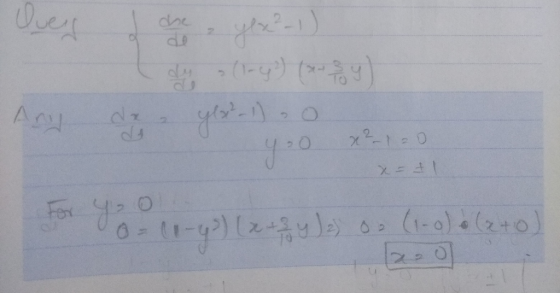
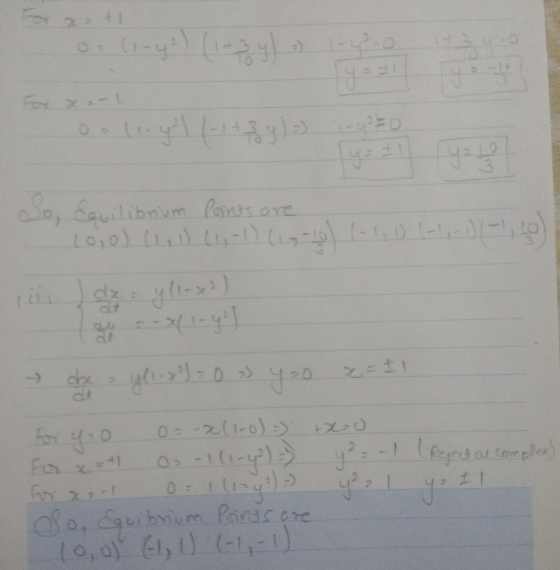
If you have any query regarding this question. You are free to ask.
Add Answer to:
E and classify all the equilibriun points of each of the folowing nonlmear systems, given that th...
1. For each of the following nonlinear systems, (a) Find all of the equilibrium points and describe the behavior of th...
 1. For each of the following nonlinear systems, (a) Find all of the equilibrium points and describe the behavior of the associated linearized system. 185 Exercises (b) Describe the phase portrait for the nonlinear system (c) Does the linearized system accurately describe the local bchavior near the equilibrium points? x' = sin x, y, = cos y (i)
1. For each of the following nonlinear systems, (a) Find all of the equilibrium points and describe the behavior of the associated...
1. For each of the following nonlinear systems, (a) Find all of the equilibrium points and describe the behavior of the associated linearized system. 185 Exercises (b) Describe the phase portrait for the nonlinear system (c) Does the linearized system accurately describe the local bchavior near the equilibrium points? x' = sin x, y, = cos y (i)
1. For each of the following nonlinear systems, (a) Find all of the equilibrium points and describe the behavior of the associated...
PLEASE HELP !!!! thanks 14. 12 points! The phase portrait (without arrows) of a non-linear syster dz 3-32, 16r dt 2 dy dt a) Mark all critical points directly on the 2 diagram, and classify them...
 PLEASE HELP !!!! thanks
14. 12 points! The phase portrait (without arrows) of a non-linear syster dz 3-32, 16r dt 2 dy dt a) Mark all critical points directly on the 2 diagram, and classify them using only the fact that this is a Hamiltonian system. -2 b) Find a Hamitonian function (or conserved quantity) H(,u) whose level curves include the curves shown above.
14. 12 points! The phase portrait (without arrows) of a non-linear syster dz 3-32, 16r dt...
PLEASE HELP !!!! thanks
14. 12 points! The phase portrait (without arrows) of a non-linear syster dz 3-32, 16r dt 2 dy dt a) Mark all critical points directly on the 2 diagram, and classify them using only the fact that this is a Hamiltonian system. -2 b) Find a Hamitonian function (or conserved quantity) H(,u) whose level curves include the curves shown above.
14. 12 points! The phase portrait (without arrows) of a non-linear syster dz 3-32, 16r dt...
Please a- c for non linear system b 3. For each of the given non-linear systems,...
 Please a- c for non linear system b
3. For each of the given non-linear systems, (a) find the equilibrium points, (b) near each equilibrium point, sketch the phase portrait of the linearized system, (c) use the information in (a) and (b) to sketch the phase portrait of the system: x' = - 4x + 4xy Sx = 2x – 2x² + 5xy ly=2y-y² – ry ly' = y - 2y2 + 2xy
Please a- c for non linear system b
3. For each of the given non-linear systems, (a) find the equilibrium points, (b) near each equilibrium point, sketch the phase portrait of the linearized system, (c) use the information in (a) and (b) to sketch the phase portrait of the system: x' = - 4x + 4xy Sx = 2x – 2x² + 5xy ly=2y-y² – ry ly' = y - 2y2 + 2xy
In each of Problems 5 through 18: (a) Determine all critical points of the given system of equati...
 #10 all parts
In each of Problems 5 through 18: (a) Determine all critical points of the given system of equations. (b) Find the corresponding linear system near each critical point. (c) Find the eigenvalues of each linear system. What conclusions can you then draw about the nonlinear system? (d) Draw a phase portrait of the nonlinear system to confirm your conclusions or to extend them in those cases where the linear system does not provide definite information about the...
#10 all parts
In each of Problems 5 through 18: (a) Determine all critical points of the given system of equations. (b) Find the corresponding linear system near each critical point. (c) Find the eigenvalues of each linear system. What conclusions can you then draw about the nonlinear system? (d) Draw a phase portrait of the nonlinear system to confirm your conclusions or to extend them in those cases where the linear system does not provide definite information about the...
1. For each of the following nonlinear systems, (a) Find all of the equilibrium points and describe the behavior of the...
 1. For each of the following nonlinear systems, (a) Find all of the equilibrium points and describe the behavior of the associated linearized system. 185 Exercises (b) Describe the phase portrait for the nonlinear system (c) Does the linearized system accurately describe the local bchavior near the equilibrium points? (iii) x' = x+ y, y, 2y
1. For each of the following nonlinear systems, (a) Find all of the equilibrium points and describe the behavior of the associated linearized system....
1. For each of the following nonlinear systems, (a) Find all of the equilibrium points and describe the behavior of the associated linearized system. 185 Exercises (b) Describe the phase portrait for the nonlinear system (c) Does the linearized system accurately describe the local bchavior near the equilibrium points? (iii) x' = x+ y, y, 2y
1. For each of the following nonlinear systems, (a) Find all of the equilibrium points and describe the behavior of the associated linearized system....
1. (This is problem 5 from the second assignment sheet, reprinted here.) Consider the nonlinear system a. Sketch the ulllines and indicate in your sketch the direction of the vector field in each...
 1. (This is problem 5 from the second assignment sheet, reprinted here.) Consider the nonlinear system a. Sketch the ulllines and indicate in your sketch the direction of the vector field in each of the regions b. Linearize the system around the equilibrium point, and use your result to classify the type of the c. Use the information from parts a and b to sketch the phase portrait of the system. 2. Sketch the phase portraits for the following systems...
Classify the critical point (0, 0) of the given linear system. Draw a phase portrait. dx/df...
 Classify the critical point (0, 0) of the given linear system. Draw a phase portrait. dx/df 3x+ y a. dx/dt -x+ 2y dx/dt =-x +3y dy/dt -2x + y dy/dt x+ y Classify the stationary point (0, 0) of the given linear system. Draw a phase portrait. dy/dt -x+y b. dx/dt =-2x-y dx/dt-2x +5/7 y dx/dt 3x-y dx/dt 3x dy/dt 3x- y dy/dt 7x- 3y dy/dt x+y dy/dt 3y
1. For each of the following nonlinear systems, (a) Find all of the equilibrium points and describe the behavior of the...
 1. For each of the following nonlinear systems, (a) Find all of the equilibrium points and describe the behavior of the associated linearized system. 185 Exercises (b) Describe the phase portrait for the nonlinear system (c) Does the linearized system accurately describe the local bchavior near the equilibrium points? We were unable to transcribe this image
1. For each of the following nonlinear systems, (a) Find all of the equilibrium points and describe the behavior of the associated linearized system....
1. For each of the following nonlinear systems, (a) Find all of the equilibrium points and describe the behavior of the associated linearized system. 185 Exercises (b) Describe the phase portrait for the nonlinear system (c) Does the linearized system accurately describe the local bchavior near the equilibrium points? We were unable to transcribe this image
1. For each of the following nonlinear systems, (a) Find all of the equilibrium points and describe the behavior of the associated linearized system....
Consider the nonlinear System of differential equations di dt dt (a) Determine all critical points of the system (b) For each critical point with nonnegative x value (20) i. Determine the linearised...
 Consider the nonlinear System of differential equations di dt dt (a) Determine all critical points of the system (b) For each critical point with nonnegative x value (20) i. Determine the linearised system and discuss whether it can be used to approximate the ii. For each critical point where the approximation is valid, determine the general solution of iii. Sketch by hand the phase portrait of each linearised system where the approximation behaviour of the non-linear system the linearised system...
Consider the system: x' = y(1 + 2x) y' = x + x2 - y2 a. Find all the equilibrium points, and lin...
Consider the system: x' = y(1 + 2x) y' = x + x2 - y2 a. Find all the equilibrium points, and linearize the system about each equilibrium point to find the type of the equilibrium point. b. Show that the system is a gradient system, and conclude that it has no periodic solutions. c. Sketch the phase portrait. Explain how you determined what the phase portrait looks like.
 1. For each of the following nonlinear systems, (a) Find all of the equilibrium points and describe the behavior of the associated linearized system. 185 Exercises (b) Describe the phase portrait for the nonlinear system (c) Does the linearized system accurately describe the local bchavior near the equilibrium points? x' = sin x, y, = cos y (i)
1. For each of the following nonlinear systems, (a) Find all of the equilibrium points and describe the behavior of the associated...
1. For each of the following nonlinear systems, (a) Find all of the equilibrium points and describe the behavior of the associated linearized system. 185 Exercises (b) Describe the phase portrait for the nonlinear system (c) Does the linearized system accurately describe the local bchavior near the equilibrium points? x' = sin x, y, = cos y (i)
1. For each of the following nonlinear systems, (a) Find all of the equilibrium points and describe the behavior of the associated...
 PLEASE HELP !!!! thanks
14. 12 points! The phase portrait (without arrows) of a non-linear syster dz 3-32, 16r dt 2 dy dt a) Mark all critical points directly on the 2 diagram, and classify them using only the fact that this is a Hamiltonian system. -2 b) Find a Hamitonian function (or conserved quantity) H(,u) whose level curves include the curves shown above.
14. 12 points! The phase portrait (without arrows) of a non-linear syster dz 3-32, 16r dt...
PLEASE HELP !!!! thanks
14. 12 points! The phase portrait (without arrows) of a non-linear syster dz 3-32, 16r dt 2 dy dt a) Mark all critical points directly on the 2 diagram, and classify them using only the fact that this is a Hamiltonian system. -2 b) Find a Hamitonian function (or conserved quantity) H(,u) whose level curves include the curves shown above.
14. 12 points! The phase portrait (without arrows) of a non-linear syster dz 3-32, 16r dt...
 Please a- c for non linear system b
3. For each of the given non-linear systems, (a) find the equilibrium points, (b) near each equilibrium point, sketch the phase portrait of the linearized system, (c) use the information in (a) and (b) to sketch the phase portrait of the system: x' = - 4x + 4xy Sx = 2x – 2x² + 5xy ly=2y-y² – ry ly' = y - 2y2 + 2xy
Please a- c for non linear system b
3. For each of the given non-linear systems, (a) find the equilibrium points, (b) near each equilibrium point, sketch the phase portrait of the linearized system, (c) use the information in (a) and (b) to sketch the phase portrait of the system: x' = - 4x + 4xy Sx = 2x – 2x² + 5xy ly=2y-y² – ry ly' = y - 2y2 + 2xy
 #10 all parts
In each of Problems 5 through 18: (a) Determine all critical points of the given system of equations. (b) Find the corresponding linear system near each critical point. (c) Find the eigenvalues of each linear system. What conclusions can you then draw about the nonlinear system? (d) Draw a phase portrait of the nonlinear system to confirm your conclusions or to extend them in those cases where the linear system does not provide definite information about the...
#10 all parts
In each of Problems 5 through 18: (a) Determine all critical points of the given system of equations. (b) Find the corresponding linear system near each critical point. (c) Find the eigenvalues of each linear system. What conclusions can you then draw about the nonlinear system? (d) Draw a phase portrait of the nonlinear system to confirm your conclusions or to extend them in those cases where the linear system does not provide definite information about the...
 1. For each of the following nonlinear systems, (a) Find all of the equilibrium points and describe the behavior of the associated linearized system. 185 Exercises (b) Describe the phase portrait for the nonlinear system (c) Does the linearized system accurately describe the local bchavior near the equilibrium points? (iii) x' = x+ y, y, 2y
1. For each of the following nonlinear systems, (a) Find all of the equilibrium points and describe the behavior of the associated linearized system....
1. For each of the following nonlinear systems, (a) Find all of the equilibrium points and describe the behavior of the associated linearized system. 185 Exercises (b) Describe the phase portrait for the nonlinear system (c) Does the linearized system accurately describe the local bchavior near the equilibrium points? (iii) x' = x+ y, y, 2y
1. For each of the following nonlinear systems, (a) Find all of the equilibrium points and describe the behavior of the associated linearized system....
 1. (This is problem 5 from the second assignment sheet, reprinted here.) Consider the nonlinear system a. Sketch the ulllines and indicate in your sketch the direction of the vector field in each of the regions b. Linearize the system around the equilibrium point, and use your result to classify the type of the c. Use the information from parts a and b to sketch the phase portrait of the system. 2. Sketch the phase portraits for the following systems...
 Classify the critical point (0, 0) of the given linear system. Draw a phase portrait. dx/df 3x+ y a. dx/dt -x+ 2y dx/dt =-x +3y dy/dt -2x + y dy/dt x+ y Classify the stationary point (0, 0) of the given linear system. Draw a phase portrait. dy/dt -x+y b. dx/dt =-2x-y dx/dt-2x +5/7 y dx/dt 3x-y dx/dt 3x dy/dt 3x- y dy/dt 7x- 3y dy/dt x+y dy/dt 3y
 1. For each of the following nonlinear systems, (a) Find all of the equilibrium points and describe the behavior of the associated linearized system. 185 Exercises (b) Describe the phase portrait for the nonlinear system (c) Does the linearized system accurately describe the local bchavior near the equilibrium points? We were unable to transcribe this image
1. For each of the following nonlinear systems, (a) Find all of the equilibrium points and describe the behavior of the associated linearized system....
1. For each of the following nonlinear systems, (a) Find all of the equilibrium points and describe the behavior of the associated linearized system. 185 Exercises (b) Describe the phase portrait for the nonlinear system (c) Does the linearized system accurately describe the local bchavior near the equilibrium points? We were unable to transcribe this image
1. For each of the following nonlinear systems, (a) Find all of the equilibrium points and describe the behavior of the associated linearized system....
 Consider the nonlinear System of differential equations di dt dt (a) Determine all critical points of the system (b) For each critical point with nonnegative x value (20) i. Determine the linearised system and discuss whether it can be used to approximate the ii. For each critical point where the approximation is valid, determine the general solution of iii. Sketch by hand the phase portrait of each linearised system where the approximation behaviour of the non-linear system the linearised system...
Most questions answered within 3 hours.
-
Where is the error in this code sequence?
String s1 = "Hello";
String s2 = "ello";...
asked 11 months ago -
Financial data for Joel de Paris, Inc., for last year
follow:
Joel de Paris, Inc.
Balance...
asked 11 months ago -
Consider this reaction:
Al2(SO4)3 (aq)+ BaCl3
(aq) Al2Cl6 (aq)- +
3BaSO4(s) . What is the...
asked 11 months ago -
Suppose that Savneet is considering increasing her
recent random sample from 20 car rentals to 40...
asked 11 months ago -
Trucks arrive at an unloading terminal at an average rate of 120
per hour.
Trucks arrive...
asked 11 months ago -
Why are methanol and ethanol completely soluble in water while
octanol is not very little soluble....
asked 11 months ago -
A facilities manager at a university reads in a research report
that the mean amount of...
asked 11 months ago -
When the CuSO4 is rehydrated by adding water to the anhydrous
compound, is this an endothermic...
asked 11 months ago -
A ray of sunlight is passing from diamond into crown glass; the
angle of incidence is...
asked 11 months ago -
A block of mass 0.249 kg is placed on top of a light, vertical
spring of...
asked 11 months ago -
how do the kidneys compensate in the presences of acidosis
a) trigger hyperventilate
b) reserve acid...
asked 11 months ago -
Question 501 pts
The rental rate of capital to the firm increases. Which of the
following...
asked 11 months ago