
Homework Answers
Add Answer to:
4. Consider the sample space S 1,2,3,...), and assume that outcomes have the probabilities P(i)- ...
A discrete random variable ? has the sample space ?x = {1,2,3}, with given probabilities of...
A discrete random variable ? has the sample space ?x = {1,2,3}, with given probabilities of ?x(1) = 0.3, ?x(2) = 0.4, and ?x(3) = 0.3. Compute the expectation ?[(? − ?)2]
Need help with this Problem 4 A discrete random variable X follows the geometric distribution with...
 Need help with this
Problem 4 A discrete random variable X follows the geometric distribution with parameter p, written X ~Geom(p), if its distribution function is fx(x) = p(1-p)"-1, xe(1, 2, 3, . . .} The Geometric distribution is used to model the number of flips needed before a coin with probability p of showing Heads actually shows Heads. a) Show that Ix(z) is indeed a probability inass function, i.e., the sum over all possible values of z is one...
Need help with this
Problem 4 A discrete random variable X follows the geometric distribution with parameter p, written X ~Geom(p), if its distribution function is fx(x) = p(1-p)"-1, xe(1, 2, 3, . . .} The Geometric distribution is used to model the number of flips needed before a coin with probability p of showing Heads actually shows Heads. a) Show that Ix(z) is indeed a probability inass function, i.e., the sum over all possible values of z is one...
A discrete random variable X follows the geometric distribution with parameter p, written X ∼ Geom(p),...
 A discrete random variable X follows the geometric distribution
with parameter p, written X ∼ Geom(p), if its distribution function
is
A discrete random variable X follows the geometric distribution with parameter p, written X Geom(p), if its distribution function is 1x(z) = p(1-P)"-1, ze(1, 2, 3, ). The Geometric distribution is used to model the number of flips needed before a coin with probability p of showing Heads actually shows Heads. a) Show that fx(x) is indeed a probability...
A discrete random variable X follows the geometric distribution
with parameter p, written X ∼ Geom(p), if its distribution function
is
A discrete random variable X follows the geometric distribution with parameter p, written X Geom(p), if its distribution function is 1x(z) = p(1-P)"-1, ze(1, 2, 3, ). The Geometric distribution is used to model the number of flips needed before a coin with probability p of showing Heads actually shows Heads. a) Show that fx(x) is indeed a probability...
Consider the Markov chain with state space S = {0,1,2,...} and transition probabilities I p, j=i+1...
 Consider the Markov chain with state space S = {0,1,2,...} and transition probabilities I p, j=i+1 pſi,j) = { q, j=0 10, otherwise where p,q> 0 and p+q = 1.1 This example was discussed in class a few lectures ago; it counts the lengths of runs of heads in a sequence of independent coin tosses. 1) Show that the chain is irreducible.2 2) Find P.(To =n) for n=1,2,...3 What is the name of this distribution? 3) Is the chain recurrent?...
2. Let S be the sample space of a single toss of a fair coin. Define the sequence of random varia...
 2. Let S be the sample space of a single toss of a fair coin. Define the sequence of random variables X, on S as follows: (I Ifs-T (a) Are X1.x2 . Convergent almost surely? (b) Find P((s E S : limx,(s)-1)).
2. Let S be the sample space of a single toss of a fair coin. Define the sequence of random variables X, on S as follows: (I Ifs-T (a) Are X1.x2 . Convergent almost surely? (b) Find P((s...
2. Let S be the sample space of a single toss of a fair coin. Define the sequence of random variables X, on S as follows: (I Ifs-T (a) Are X1.x2 . Convergent almost surely? (b) Find P((s E S : limx,(s)-1)).
2. Let S be the sample space of a single toss of a fair coin. Define the sequence of random variables X, on S as follows: (I Ifs-T (a) Are X1.x2 . Convergent almost surely? (b) Find P((s...
Problem 1. A biased coin with probability plandin with a Heads is lipped 4 times. (a) Define the basic random varia...
 Problem 1. A biased coin with probability plandin with a Heads is lipped 4 times. (a) Define the basic random variables and give the sample space and assign probabilities to the outcomes. (b) Let X be the total number of Heads in the four flips Draw a Venn diagrain showing the five events X = ii 0,1,2,3,4 as well as the sample space and the outcomes. Is X a random variable? c) Are the events X 1 and X 2...
3 Probability and Statistics [10 pts] Consider a sample of data S obtained by flipping a...
 3 Probability and Statistics [10 pts] Consider a sample of data S obtained by flipping a coin five times. X,,i e..,5) is a random variable that takes a value 0 when the outcome of coin flip i turned up heads, and 1 when it turned up tails. Assume that the outcome of each of the flips does not depend on the outcomes of any of the other flips. The sample obtained S - (Xi, X2,X3, X, Xs) (1, 1,0,1,0 (a)...
(1) Consider the probability space 2 [0, 1. We define the probability of an event A Ω to be its length, we define a sequence random variables as follows: When n is odd Xn (u) 0 otherwise while, when...
 (1) Consider the probability space 2 [0, 1. We define the probability of an event A Ω to be its length, we define a sequence random variables as follows: When n is odd Xn (u) 0 otherwise while, when n is even otherwise (a) Compute the PMF and CDF of each Xn (b) Deduce that X converge in distribution (c) Show that for any n and any random variable X : Ω R. (d) Deduce that Xn does not converge...
I need help with number 3 on my number theory hw. Exercise 1. Figure out how...
 I need help with number 3 on my number theory
hw.
Exercise 1. Figure out how many solutions x2 = x (mod n) has for n = 5,6,7, and then compute how many solutions there are modulo 210. Exercise 2. (a) Find all solutions to x2 +8 = 0 (mod 11). (b) Using your answer to part (a) and Hensel's Lemma, find all solutions to x2 +8 = 0 (mod 121). Exercise 3. Solve f(x) = x3 – x2 +...
I need help with number 3 on my number theory
hw.
Exercise 1. Figure out how many solutions x2 = x (mod n) has for n = 5,6,7, and then compute how many solutions there are modulo 210. Exercise 2. (a) Find all solutions to x2 +8 = 0 (mod 11). (b) Using your answer to part (a) and Hensel's Lemma, find all solutions to x2 +8 = 0 (mod 121). Exercise 3. Solve f(x) = x3 – x2 +...
Problem 4: Consider the problem of estimating the unknown parameter p of a Bernoulli random varia...
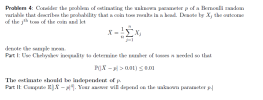 Problem 4: Consider the problem of estimating the unknown parameter p of a Bernoulli random variable that describes the probability that a coin toss results in a head. Denote by X the outcome of the jth toss of the coin and let j-1 denote the sample mean. Part I: Use Chebyshev inequality to determine the number of tosses n needed so that P( -pl> 0.01) 0.01 The estimate should be independent of p Part II: Compute ElIX -pl]. Your answer...
 Need help with this
Problem 4 A discrete random variable X follows the geometric distribution with parameter p, written X ~Geom(p), if its distribution function is fx(x) = p(1-p)"-1, xe(1, 2, 3, . . .} The Geometric distribution is used to model the number of flips needed before a coin with probability p of showing Heads actually shows Heads. a) Show that Ix(z) is indeed a probability inass function, i.e., the sum over all possible values of z is one...
Need help with this
Problem 4 A discrete random variable X follows the geometric distribution with parameter p, written X ~Geom(p), if its distribution function is fx(x) = p(1-p)"-1, xe(1, 2, 3, . . .} The Geometric distribution is used to model the number of flips needed before a coin with probability p of showing Heads actually shows Heads. a) Show that Ix(z) is indeed a probability inass function, i.e., the sum over all possible values of z is one...
 A discrete random variable X follows the geometric distribution
with parameter p, written X ∼ Geom(p), if its distribution function
is
A discrete random variable X follows the geometric distribution with parameter p, written X Geom(p), if its distribution function is 1x(z) = p(1-P)"-1, ze(1, 2, 3, ). The Geometric distribution is used to model the number of flips needed before a coin with probability p of showing Heads actually shows Heads. a) Show that fx(x) is indeed a probability...
A discrete random variable X follows the geometric distribution
with parameter p, written X ∼ Geom(p), if its distribution function
is
A discrete random variable X follows the geometric distribution with parameter p, written X Geom(p), if its distribution function is 1x(z) = p(1-P)"-1, ze(1, 2, 3, ). The Geometric distribution is used to model the number of flips needed before a coin with probability p of showing Heads actually shows Heads. a) Show that fx(x) is indeed a probability...
 Consider the Markov chain with state space S = {0,1,2,...} and transition probabilities I p, j=i+1 pſi,j) = { q, j=0 10, otherwise where p,q> 0 and p+q = 1.1 This example was discussed in class a few lectures ago; it counts the lengths of runs of heads in a sequence of independent coin tosses. 1) Show that the chain is irreducible.2 2) Find P.(To =n) for n=1,2,...3 What is the name of this distribution? 3) Is the chain recurrent?...
 2. Let S be the sample space of a single toss of a fair coin. Define the sequence of random variables X, on S as follows: (I Ifs-T (a) Are X1.x2 . Convergent almost surely? (b) Find P((s E S : limx,(s)-1)).
2. Let S be the sample space of a single toss of a fair coin. Define the sequence of random variables X, on S as follows: (I Ifs-T (a) Are X1.x2 . Convergent almost surely? (b) Find P((s...
2. Let S be the sample space of a single toss of a fair coin. Define the sequence of random variables X, on S as follows: (I Ifs-T (a) Are X1.x2 . Convergent almost surely? (b) Find P((s E S : limx,(s)-1)).
2. Let S be the sample space of a single toss of a fair coin. Define the sequence of random variables X, on S as follows: (I Ifs-T (a) Are X1.x2 . Convergent almost surely? (b) Find P((s...
 Problem 1. A biased coin with probability plandin with a Heads is lipped 4 times. (a) Define the basic random variables and give the sample space and assign probabilities to the outcomes. (b) Let X be the total number of Heads in the four flips Draw a Venn diagrain showing the five events X = ii 0,1,2,3,4 as well as the sample space and the outcomes. Is X a random variable? c) Are the events X 1 and X 2...
 3 Probability and Statistics [10 pts] Consider a sample of data S obtained by flipping a coin five times. X,,i e..,5) is a random variable that takes a value 0 when the outcome of coin flip i turned up heads, and 1 when it turned up tails. Assume that the outcome of each of the flips does not depend on the outcomes of any of the other flips. The sample obtained S - (Xi, X2,X3, X, Xs) (1, 1,0,1,0 (a)...
 (1) Consider the probability space 2 [0, 1. We define the probability of an event A Ω to be its length, we define a sequence random variables as follows: When n is odd Xn (u) 0 otherwise while, when n is even otherwise (a) Compute the PMF and CDF of each Xn (b) Deduce that X converge in distribution (c) Show that for any n and any random variable X : Ω R. (d) Deduce that Xn does not converge...
 I need help with number 3 on my number theory
hw.
Exercise 1. Figure out how many solutions x2 = x (mod n) has for n = 5,6,7, and then compute how many solutions there are modulo 210. Exercise 2. (a) Find all solutions to x2 +8 = 0 (mod 11). (b) Using your answer to part (a) and Hensel's Lemma, find all solutions to x2 +8 = 0 (mod 121). Exercise 3. Solve f(x) = x3 – x2 +...
I need help with number 3 on my number theory
hw.
Exercise 1. Figure out how many solutions x2 = x (mod n) has for n = 5,6,7, and then compute how many solutions there are modulo 210. Exercise 2. (a) Find all solutions to x2 +8 = 0 (mod 11). (b) Using your answer to part (a) and Hensel's Lemma, find all solutions to x2 +8 = 0 (mod 121). Exercise 3. Solve f(x) = x3 – x2 +...
 Problem 4: Consider the problem of estimating the unknown parameter p of a Bernoulli random variable that describes the probability that a coin toss results in a head. Denote by X the outcome of the jth toss of the coin and let j-1 denote the sample mean. Part I: Use Chebyshev inequality to determine the number of tosses n needed so that P( -pl> 0.01) 0.01 The estimate should be independent of p Part II: Compute ElIX -pl]. Your answer...
Most questions answered within 3 hours.
-
Where is the error in this code sequence?
String s1 = "Hello";
String s2 = "ello";...
asked 10 months ago -
Financial data for Joel de Paris, Inc., for last year
follow:
Joel de Paris, Inc.
Balance...
asked 10 months ago -
Consider this reaction:
Al2(SO4)3 (aq)+ BaCl3
(aq) Al2Cl6 (aq)- +
3BaSO4(s) . What is the...
asked 10 months ago -
Suppose that Savneet is considering increasing her
recent random sample from 20 car rentals to 40...
asked 10 months ago -
Trucks arrive at an unloading terminal at an average rate of 120
per hour.
Trucks arrive...
asked 10 months ago -
Why are methanol and ethanol completely soluble in water while
octanol is not very little soluble....
asked 10 months ago -
A facilities manager at a university reads in a research report
that the mean amount of...
asked 10 months ago -
When the CuSO4 is rehydrated by adding water to the anhydrous
compound, is this an endothermic...
asked 10 months ago -
A ray of sunlight is passing from diamond into crown glass; the
angle of incidence is...
asked 10 months ago -
A block of mass 0.249 kg is placed on top of a light, vertical
spring of...
asked 10 months ago -
how do the kidneys compensate in the presences of acidosis
a) trigger hyperventilate
b) reserve acid...
asked 10 months ago -
Question 501 pts
The rental rate of capital to the firm increases. Which of the
following...
asked 10 months ago