BUSINESS ANALYTICS Mr. James Hatton was the proprietor of a real estate firm specializing in inve...
BUSINESS ANALYTICS
Mr. James Hatton was the proprietor of a real estate firm specializing in investment properties in the Vancouver area. Mr. Hatton’s business had done well during the real estate boom in the Vancouver area. Just recently a prospective client who held land for speculation offered Mr. Hatton exclusive listing of three properties subject to some special restrictions which the client felt would ensure that Mr. Hatton would market the properties with due diligence. The location of these properties and the prices he wished to receive were as follows:
Location Price Dunbar $200,000 Kitsilano $400,000 Point Grey $800,000
Mr. Hatton would receive a commission of 5% on any of the properties which he sold.
The client was not yet willing to offer an exclusive listing on all three properties at once. He wished first to test Mr. Hatton’s ability to sell his type of land holding. Mr. Hatton could recall almost his exact words: “But you must sell the Dunbar property first and sell it within a month. If you cannot do that I see no reason to transfer any further listings to your agency. If you do sell the property within the one month time limit, you may choose whether or not to list exclusively the Kitsilano holding for a one month period. If you are able to sell this second property within one month you will be offered the exclusive listing of the third property.” Also, for any property Mr. Hatton agrees to market, his failure to sell within a month will cancel his right to sell that property, as well as losing any options to sell other properties. Ever since this conversation, Mr. Hatton had sought to analyze this proposition. He assessed the selling costs from his previous experience in advertising and selling similar properties in the past. These costs would be incurred even if no sales were made. Of course, these costs would not be incurred if Mr. Hatton refused a listing. Mr. Hatton also assessed his chances of sale within a month based upon his historical experience with similar parcels at the same general price level. He wrote this information in a simple table for further study.
Property Promotional Expense Prob. of Sale within One Month Dunbar $8000 .6 Kitsilano $2000 .7 Point Grey $4000 .5
Part (A) Mr. Hatton was sure that the costs, expenses and probabilities associated with the sale of each of these properties were in no way dependent upon the sale or availability of the other properties. Mr. Hatton hired a recent B.Com. Graduate to perform a full analysis of his decision problem.
Do the full decision tree analysis.
Part (B) Before Mr. Hatton had a chance to respond to the above proposal regarding the three properties, the client sold both the Dunbar and the Kitsilano properties. However, Mr. Hatton still had the option of trying to sell the Point Grey property, and the information about the Point Grey property remains the same as given in the above table. Mr. Hatton also decided to consider the possibility of doing a very quick market survey to get a better idea of the chances of a sale. The cost of such a survey would be $3000. Based upon past experience, Mr. Hatton is able to estimate that in the cases of successfully selling (within in a month) a property like the Point Grey property, there were 80% of these cases that the market survey indicated a strong real estate market, whereas in the cases of failing to sell (within in a month) a property like the Point Grey property, there were 60% of these cases that the market survey indicated a weak real estate market. Impressed with the analysis of the previous problem, Mr. Hatton asked the same B.Com. Graduate to analyze fully the new problem.
Do the full decision tree analysis.
What is the Expected Value of Sample Information (EVSI)?
What is the Expected Value of Perfect Information (EVPI)
Answer the report in the form of a "Report to Management" (Header, introduction, recommendation, and data and analysis)
Homework Answers
- Decision tress often mimic the human level thinking so its so simple to understand the data and make some good interpretations.
- Decision trees actually make you see the logic for the data to interpret(not like black box algorithms like SVM,NN,etc..)
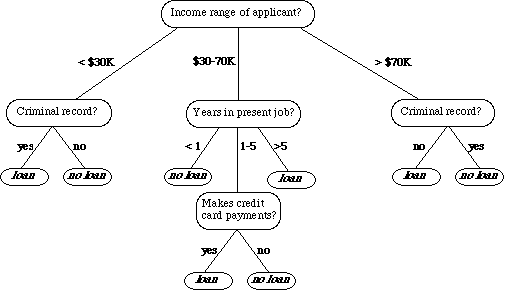
For example : if we are classifying bank loan application for a customer, the decision tree may look like this
Here we can see the logic how it is making the decision.
It’s simple and clear.
So what is the decision tree??
A decision tree is a tree where each node represents a feature(attribute), each link(branch) represents a decision(rule) and each leaf represents an outcome(categorical or continues value).
The whole idea is to create a tree like this for the entire data and process a single outcome at every leaf(or minimize the error in every leaf).

Okay so how to build this??
There are couple of algorithms there to build a decision tree , we only talk about a few which are
- CART (Classification and Regression Trees) → uses Gini Index(Classification) as metric.
- ID3 (Iterative Dichotomiser 3) → uses Entropy function and Information gain as metrics.
Lets just first build decision tree for classification problem using above algorithms,
Classification with using the ID3 algorithm.
Let’s just take a famous dataset in the machine learning world which is weather dataset(playing game Y or N based on weather condition).

We have four X values (outlook,temp,humidity and windy) being categorical and one y value (play Y or N) also being categorical.
so we need to learn the mapping (what machine learning always does) between X and y.
This is a binary classification problem, lets build the tree using the ID3 algorithm
To create a tree, we need to have a root node first and we know that nodes are features/attributes(outlook,temp,humidity and windy),
so which one do we need to pick first??
Answer: determine the attribute that best classifies the training data; use this attribute at the root of the tree. Repeat this process at for each branch.
This means we are performing top-down, greedy search through the space of possible decision trees.
okay so how do we choose the best attribute?
Answer: use the attribute with the highest information gain in ID3
In order to define information gain precisely, we begin by defining a measure commonly used in information theory, called entropy that characterizes the (im)purity of an arbitrary collection of examples.”
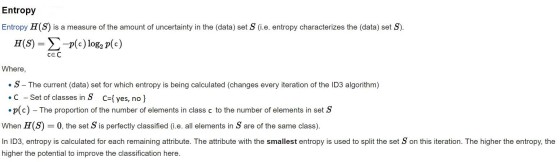
wikipedia
For a binary classification problem
- If all examples are positive or all are negative then entropy will be zero i.e, low.
- If half of the examples are of positive class and half are of negative class then entropy is one i.e, high.
Okay lets apply these metrics to our dataset to split the data(getting the root node)
Steps:
1.compute the entropy for data-set
2.for every attribute/feature:
       1.calculate entropy for all categorical values
       2.take average information entropy for the current attribute
       3.calculate gain for the current attribute
3. pick the highest gain attribute.
4. Repeat until we get the tree we desired.
Add Answer to:
BUSINESS ANALYTICS Mr. James Hatton was the proprietor of a real estate firm specializing in inve...
Real Estate Law Bob wants to sell his home and enters into a listing agreement with...
Real Estate Law Bob wants to sell his home and enters into a listing agreement with Rapheal, a real estate agent, whereby Rapheal is the only person who can sell Bob’s home. Rapheal finds Curtis, a buyer who has enough cash to purchase the property and would like to purchase the property today at the listing price. One day later, Bob’s friend, Dennis, offers to purchase the property from Bob for five thousand dollars more than the listing price. Why...
Real Estate Law Rudolph and his real estate agent, Blitzen, enter into a listing agreement whereby...
Real Estate Law Rudolph and his real estate agent, Blitzen, enter into a listing agreement whereby Blitzen may list Rudolph’s property but Rudolph may also try to find a buyer. Blitzen finds Comet, a buyer who has enough cash to purchase the property and would like to purchase the property today. One day later, Rudolph’s friend, Donner, offers to purchase the property for five thousand dollars more than the listing price. Why would Blitzen be able to get a commission...
11. Assume that in 2019 Taxpayer makes a donation to qualified public charity of real estate...
11. Assume that in 2019 Taxpayer makes a donation to qualified public charity of real estate held by Taxpayer for investment for five years and having a fair market value of $20,000 on the date of the contribution. Taxpayer's basis in the property is $30,000. How much loss or deduction would be allowable to or recognized by taxpayer as a result of this transaction? a. Taxpayer would recognize a capital loss of $10,000 that may be used to offset...
Your boss, Bonnie, is thinking of selling her real estate brokerage business, "Bon Sell-It Real Estate."...
Your boss, Bonnie, is thinking of selling her real estate brokerage business, "Bon Sell-It Real Estate." She has come to you for help sorting out all the documentation relating to the use and license of tangible and intangible property by the company. Bonnie and Aggie (the company accountant) need to have a list of the types of agreements that should be in place and the correct parties to these agreements. You have worked for Bonnie and the company for 30...
Real estate expert Mike Aubrey is a strategist! His objective is always to sell the house....
Real estate expert Mike Aubrey is a strategist! His objective is always to sell the house. He believes that ineffective sellers need a “reality check” or to realistically assess their situations. The purpose of this assignment is to identify/apply strategic concepts discussed in this class within the show’s context. The assigned episode is no longer available online, so it is summarized below. (If you are interested in viewing current episodes, click on the following link: http://www.hgtv.com/hgtv176/videos/index.html .) The following scenario...
Background Information Recently, there has been talk amongst the partners regarding the expansion of the business...
Background Information Recently, there has been talk amongst the partners regarding the expansion of the business into the home construction business. Charles, Bob and Jane support the idea but Mary is totally opposed. Charles, Bob and Jane decide to buy out Mary for $25,000. Charles and Jane are each contributing $10,000 to the buyout and Bob is contributing $5,000. They intend to implement their expansion plans by purchasing a tract of land and building a small subdivision. A financial analysis...
You are a real estate investor that has an interest in purchasing a multifamily property in...
 You are a real estate investor that has an interest in purchasing a multifamily property in Atlanta, Georgia. You received the offering brochure and you discovered that this is a 53 unit apartment complex near the Vine City MARTA station. In using your analytical skills, including your ability to analyze this market, perform a Before Tax/No Financing Analysis on this apartment complex. The market information is as follows: 26. Rents are $625 per month and will increase at a rate...
real estate case study Case Problem Allen Benedict is thinking of buying an apartment complex that...
 real estate case study
Case Problem Allen Benedict is thinking of buying an apartment complex that is offered for sale by the firm of Getz and Fowler. The price, $2.25 million, equals the property's market value. The following statement of income and expense is presented for Benedict's The St. George Apartments Prior Year's Operating Results, Presented by Getz and Fowler, Brokers 30 units, al Washer and dryer rentals Gross annual income Less operating expenses apartments, $975 per month 351,000 361,000...
real estate case study
Case Problem Allen Benedict is thinking of buying an apartment complex that is offered for sale by the firm of Getz and Fowler. The price, $2.25 million, equals the property's market value. The following statement of income and expense is presented for Benedict's The St. George Apartments Prior Year's Operating Results, Presented by Getz and Fowler, Brokers 30 units, al Washer and dryer rentals Gross annual income Less operating expenses apartments, $975 per month 351,000 361,000...
Business Law: Text and Cases 14th Edition Chapters 11 & 18 Lucy decides that it is...
Business Law: Text and Cases 14th Edition Chapters 11 & 18 Lucy decides that it is time that she and Schroeder marry. As an inducement, Lucy promises to buy Schroeder a new piano if he will marry her. He agrees. She also tells him that she wants a prenuptial agreement. She is very concerned that in the event the marriage does not work out, that Schroeder will be able to receive a portion of her real estate holdings. She is...
This is only one question the top part is the narrative and part a is the...
 This is only one question the top part is the narrative and part
a is the question , and its for finance
10. (50 Points, Total, for this Question) – After much recent success in the industry,” local entrepreneur Diana “Di” Rector wished to sell her $3 Million three-bedroom Santa Monica home and purchase a new six-bedroom and guest house Beverly Hills estate priced at $10 Million. To sell her "old" house, Di entered into a residential real estate sales...
This is only one question the top part is the narrative and part
a is the question , and its for finance
10. (50 Points, Total, for this Question) – After much recent success in the industry,” local entrepreneur Diana “Di” Rector wished to sell her $3 Million three-bedroom Santa Monica home and purchase a new six-bedroom and guest house Beverly Hills estate priced at $10 Million. To sell her "old" house, Di entered into a residential real estate sales...
 You are a real estate investor that has an interest in purchasing a multifamily property in Atlanta, Georgia. You received the offering brochure and you discovered that this is a 53 unit apartment complex near the Vine City MARTA station. In using your analytical skills, including your ability to analyze this market, perform a Before Tax/No Financing Analysis on this apartment complex. The market information is as follows: 26. Rents are $625 per month and will increase at a rate...
 real estate case study
Case Problem Allen Benedict is thinking of buying an apartment complex that is offered for sale by the firm of Getz and Fowler. The price, $2.25 million, equals the property's market value. The following statement of income and expense is presented for Benedict's The St. George Apartments Prior Year's Operating Results, Presented by Getz and Fowler, Brokers 30 units, al Washer and dryer rentals Gross annual income Less operating expenses apartments, $975 per month 351,000 361,000...
real estate case study
Case Problem Allen Benedict is thinking of buying an apartment complex that is offered for sale by the firm of Getz and Fowler. The price, $2.25 million, equals the property's market value. The following statement of income and expense is presented for Benedict's The St. George Apartments Prior Year's Operating Results, Presented by Getz and Fowler, Brokers 30 units, al Washer and dryer rentals Gross annual income Less operating expenses apartments, $975 per month 351,000 361,000...
 This is only one question the top part is the narrative and part
a is the question , and its for finance
10. (50 Points, Total, for this Question) – After much recent success in the industry,” local entrepreneur Diana “Di” Rector wished to sell her $3 Million three-bedroom Santa Monica home and purchase a new six-bedroom and guest house Beverly Hills estate priced at $10 Million. To sell her "old" house, Di entered into a residential real estate sales...
This is only one question the top part is the narrative and part
a is the question , and its for finance
10. (50 Points, Total, for this Question) – After much recent success in the industry,” local entrepreneur Diana “Di” Rector wished to sell her $3 Million three-bedroom Santa Monica home and purchase a new six-bedroom and guest house Beverly Hills estate priced at $10 Million. To sell her "old" house, Di entered into a residential real estate sales...
Most questions answered within 3 hours.
-
Where is the error in this code sequence?
String s1 = "Hello";
String s2 = "ello";...
asked 10 months ago -
Financial data for Joel de Paris, Inc., for last year
follow:
Joel de Paris, Inc.
Balance...
asked 10 months ago -
Consider this reaction:
Al2(SO4)3 (aq)+ BaCl3
(aq) Al2Cl6 (aq)- +
3BaSO4(s) . What is the...
asked 10 months ago -
Suppose that Savneet is considering increasing her
recent random sample from 20 car rentals to 40...
asked 10 months ago -
Trucks arrive at an unloading terminal at an average rate of 120
per hour.
Trucks arrive...
asked 10 months ago -
Why are methanol and ethanol completely soluble in water while
octanol is not very little soluble....
asked 10 months ago -
A facilities manager at a university reads in a research report
that the mean amount of...
asked 10 months ago -
When the CuSO4 is rehydrated by adding water to the anhydrous
compound, is this an endothermic...
asked 10 months ago -
A ray of sunlight is passing from diamond into crown glass; the
angle of incidence is...
asked 10 months ago -
A block of mass 0.249 kg is placed on top of a light, vertical
spring of...
asked 10 months ago -
how do the kidneys compensate in the presences of acidosis
a) trigger hyperventilate
b) reserve acid...
asked 10 months ago -
Question 501 pts
The rental rate of capital to the firm increases. Which of the
following...
asked 10 months ago