
Homework Answers
Add Answer to:
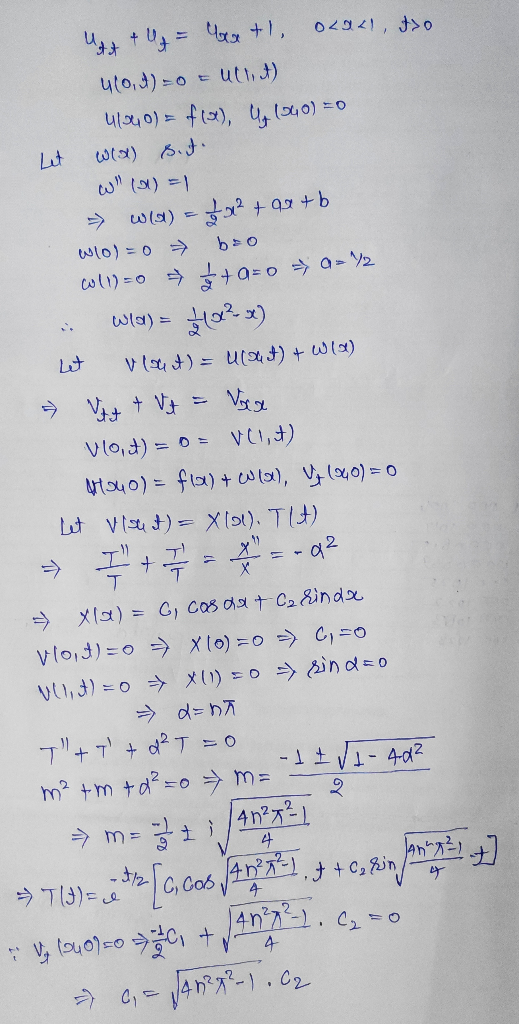
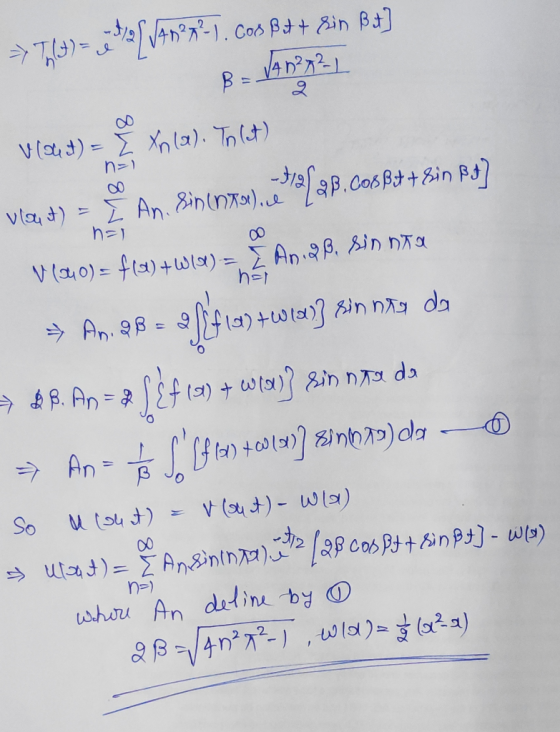
Solve the following problem u(0, t) 0, u(1,t)-0, t> 0 a(x,0) = f(x), 0 < x < 1 lu (x, 0) = 0, 0
2. Use eigenfunction expansion to solve the following IBVP: u,(x, t) ="-(x,t) + (t-1)sin(m), 0 0 ...
 2. Use eigenfunction expansion to solve the following IBVP: u,(x, t) ="-(x,t) + (t-1)sin(m), 0
Problem 2.7.26. Solve the parabolic problem ubject to the nonhomogeneous boundary conditions u(t,0)-1 and u(t,1)or 0 and the initial condition u(0,x)(x for xE(0,1) for some given function f:(0,1) R....
 Problem 2.7.26. Solve the parabolic problem ubject to the nonhomogeneous boundary conditions u(t,0)-1 and u(t,1)or 0 and the initial condition u(0,x)(x for xE(0,1) for some given function f:(0,1) R.
Problem 2.7.26. Solve the parabolic problem ubject to the nonhomogeneous boundary conditions u(t,0)-1 and u(t,1)or 0 and the initial condition u(0,x)(x for xE(0,1) for some given function f:(0,1) R.
Problem 2.7.26. Solve the parabolic problem ubject to the nonhomogeneous boundary conditions u(t,0)-1 and u(t,1)or 0 and the initial condition u(0,x)(x for xE(0,1) for some given function f:(0,1) R.
8. Find a Green's function for Lu u" +4u, 0< x<T, u(0) = u(#) = 0....
 8. Find a Green's function for Lu u" +4u, 0< x<T, u(0) = u(#) = 0. 9. Find the general solution of ut+ cu f(x,t)
8. Find a Green's function for Lu u" +4u, 0
8. Find a Green's function for Lu u" +4u, 0< x<T, u(0) = u(#) = 0. 9. Find the general solution of ut+ cu f(x,t)
8. Find a Green's function for Lu u" +4u, 0
4. Solve the initial, boundary value problem by the Fourier integral method te = kurz, 0<x<oo, t>0, us(0,t) = 0, u(x, t) bounded as T-100 0S$ 0, >4 f(x)-( 4 u(z,0)=f(x), 4. Solve...
 4. Solve the initial, boundary value problem by the Fourier integral method te = kurz, 0<x<oo, t>0, us(0,t) = 0, u(x, t) bounded as T-100 0S$ 0, >4 f(x)-( 4 u(z,0)=f(x),
4. Solve the initial, boundary value problem by the Fourier integral method te = kurz, 04 f(x)-( 4 u(z,0)=f(x),
4. Solve the initial, boundary value problem by the Fourier integral method te = kurz, 0<x<oo, t>0, us(0,t) = 0, u(x, t) bounded as T-100 0S$ 0, >4 f(x)-( 4 u(z,0)=f(x),
4. Solve the initial, boundary value problem by the Fourier integral method te = kurz, 04 f(x)-( 4 u(z,0)=f(x),
6. Solve the following boundary value problem: 1 U = 34xx, 0 < x < 1,t>...
 6. Solve the following boundary value problem: 1 U = 34xx, 0 < x < 1,t> 0; u(0,t) = u(1,t) = 0; u(x,0) = 7 sin nx - sin 31x
1. For differentiable vector functions u and v, prove: u'(t) X v(t)+ u(t) X v'(t) lu(t) X v(t)] 2. For the diff...
 1. For differentiable vector functions u and v, prove: u'(t) X v(t)+ u(t) X v'(t) lu(t) X v(t)] 2. For the differentiable vector function u and real-valued function f, prove: lu(f(t)))= f(t)u' (f (t))
1. For differentiable vector functions u and v, prove: u'(t) X v(t)+ u(t) X v'(t) lu(t) X v(t)] 2. For the differentiable vector function u and real-valued function f, prove: lu(f(t)))= f(t)u' (f (t))
1. For differentiable vector functions u and v, prove: u'(t) X v(t)+ u(t) X v'(t) lu(t) X v(t)] 2. For the differentiable vector function u and real-valued function f, prove: lu(f(t)))= f(t)u' (f (t))
3. Consider the following Neumann problem for the heat equation: 14(0,t)=14(L,t)=0, t>0 u(x,0)- f...
 3. Consider the following Neumann problem for the heat equation: 14(0,t)=14(L,t)=0, t>0 u(x,0)- f(x),0<x<L (a) Give a short physical interpretation of this problem. (b) Given the following initial condition, 2 *2 2 solve the initial boundary value problem for u(x,t.
3. Consider the following Neumann problem for the heat equation: 14(0,t)=14(L,t)=0, t>0 u(x,0)- f(x),0
3. Consider the following Neumann problem for the heat equation: 14(0,t)=14(L,t)=0, t>0 u(x,0)- f(x),0<x<L (a) Give a short physical interpretation of this problem. (b) Given the following initial condition, 2 *2 2 solve the initial boundary value problem for u(x,t.
3. Consider the following Neumann problem for the heat equation: 14(0,t)=14(L,t)=0, t>0 u(x,0)- f(x),0
EXERCISE 3.20 Consider the problem ut =u" + u for u(0,t) u(1, t) 0, u(x,0) f(x). ze(0, 1), t>0, S...
 partial differential equations
EXERCISE 3.20 Consider the problem ut =u" + u for u(0,t) u(1, t) 0, u(x,0) f(x). ze(0, 1), t>0, Show that dt and conclude that Use this estimate to bound the difference between two solutions in terms of the difference between the initial functions. Does this problem have a unique solution for each initial function f?
EXERCISE 3.20 Consider the problem ut =u" + u for u(0,t) u(1, t) 0, u(x,0) f(x). ze(0, 1), t>0, Show that...
partial differential equations
EXERCISE 3.20 Consider the problem ut =u" + u for u(0,t) u(1, t) 0, u(x,0) f(x). ze(0, 1), t>0, Show that dt and conclude that Use this estimate to bound the difference between two solutions in terms of the difference between the initial functions. Does this problem have a unique solution for each initial function f?
EXERCISE 3.20 Consider the problem ut =u" + u for u(0,t) u(1, t) 0, u(x,0) f(x). ze(0, 1), t>0, Show that...
3. Consider the follo 2 lu The boundary conditions are: u(0,y, t) - u(x, 0,t) - 0, ou (a, y, t) =...
 *Note: Please answer all parts, and explain all workings. Thank
you!
3. Consider the follo 2 lu The boundary conditions are: u(0,y, t) - u(x, 0,t) - 0, ou (a, y, t) = (x, b, t) = 0 ay The initial conditions are: at t-0,11-4 (x,y)--Yo(x,y) . ot a) Assume u(x,y,t) - X(x)Y(y)T(t), derive the eigenvalue problems: a) Apply the boundary conditions and derive all the possible eigenvalues for λι, λ2 and corresponding eigen-functions, Xm,Yn b) for any combination of...
*Note: Please answer all parts, and explain all workings. Thank
you!
3. Consider the follo 2 lu The boundary conditions are: u(0,y, t) - u(x, 0,t) - 0, ou (a, y, t) = (x, b, t) = 0 ay The initial conditions are: at t-0,11-4 (x,y)--Yo(x,y) . ot a) Assume u(x,y,t) - X(x)Y(y)T(t), derive the eigenvalue problems: a) Apply the boundary conditions and derive all the possible eigenvalues for λι, λ2 and corresponding eigen-functions, Xm,Yn b) for any combination of...
Solve the heat flow problem: au t> 0, ди (x, t) = 2 (x, t), 0<x<...
 Solve the heat flow problem: au t> 0, ди (x, t) = 2 (x, t), 0<x< 1, ot дх2 uz(0, t) = uz(1,t) = 0, t>0, u(x,0) = 1- x, 0 < x < 1.
 2. Use eigenfunction expansion to solve the following IBVP: u,(x, t) ="-(x,t) + (t-1)sin(m), 0
 Problem 2.7.26. Solve the parabolic problem ubject to the nonhomogeneous boundary conditions u(t,0)-1 and u(t,1)or 0 and the initial condition u(0,x)(x for xE(0,1) for some given function f:(0,1) R.
Problem 2.7.26. Solve the parabolic problem ubject to the nonhomogeneous boundary conditions u(t,0)-1 and u(t,1)or 0 and the initial condition u(0,x)(x for xE(0,1) for some given function f:(0,1) R.
Problem 2.7.26. Solve the parabolic problem ubject to the nonhomogeneous boundary conditions u(t,0)-1 and u(t,1)or 0 and the initial condition u(0,x)(x for xE(0,1) for some given function f:(0,1) R.
 8. Find a Green's function for Lu u" +4u, 0< x<T, u(0) = u(#) = 0. 9. Find the general solution of ut+ cu f(x,t)
8. Find a Green's function for Lu u" +4u, 0
8. Find a Green's function for Lu u" +4u, 0< x<T, u(0) = u(#) = 0. 9. Find the general solution of ut+ cu f(x,t)
8. Find a Green's function for Lu u" +4u, 0
 4. Solve the initial, boundary value problem by the Fourier integral method te = kurz, 0<x<oo, t>0, us(0,t) = 0, u(x, t) bounded as T-100 0S$ 0, >4 f(x)-( 4 u(z,0)=f(x),
4. Solve the initial, boundary value problem by the Fourier integral method te = kurz, 04 f(x)-( 4 u(z,0)=f(x),
4. Solve the initial, boundary value problem by the Fourier integral method te = kurz, 0<x<oo, t>0, us(0,t) = 0, u(x, t) bounded as T-100 0S$ 0, >4 f(x)-( 4 u(z,0)=f(x),
4. Solve the initial, boundary value problem by the Fourier integral method te = kurz, 04 f(x)-( 4 u(z,0)=f(x),
 6. Solve the following boundary value problem: 1 U = 34xx, 0 < x < 1,t> 0; u(0,t) = u(1,t) = 0; u(x,0) = 7 sin nx - sin 31x
 1. For differentiable vector functions u and v, prove: u'(t) X v(t)+ u(t) X v'(t) lu(t) X v(t)] 2. For the differentiable vector function u and real-valued function f, prove: lu(f(t)))= f(t)u' (f (t))
1. For differentiable vector functions u and v, prove: u'(t) X v(t)+ u(t) X v'(t) lu(t) X v(t)] 2. For the differentiable vector function u and real-valued function f, prove: lu(f(t)))= f(t)u' (f (t))
1. For differentiable vector functions u and v, prove: u'(t) X v(t)+ u(t) X v'(t) lu(t) X v(t)] 2. For the differentiable vector function u and real-valued function f, prove: lu(f(t)))= f(t)u' (f (t))
 3. Consider the following Neumann problem for the heat equation: 14(0,t)=14(L,t)=0, t>0 u(x,0)- f(x),0<x<L (a) Give a short physical interpretation of this problem. (b) Given the following initial condition, 2 *2 2 solve the initial boundary value problem for u(x,t.
3. Consider the following Neumann problem for the heat equation: 14(0,t)=14(L,t)=0, t>0 u(x,0)- f(x),0
3. Consider the following Neumann problem for the heat equation: 14(0,t)=14(L,t)=0, t>0 u(x,0)- f(x),0<x<L (a) Give a short physical interpretation of this problem. (b) Given the following initial condition, 2 *2 2 solve the initial boundary value problem for u(x,t.
3. Consider the following Neumann problem for the heat equation: 14(0,t)=14(L,t)=0, t>0 u(x,0)- f(x),0
 partial differential equations
EXERCISE 3.20 Consider the problem ut =u" + u for u(0,t) u(1, t) 0, u(x,0) f(x). ze(0, 1), t>0, Show that dt and conclude that Use this estimate to bound the difference between two solutions in terms of the difference between the initial functions. Does this problem have a unique solution for each initial function f?
EXERCISE 3.20 Consider the problem ut =u" + u for u(0,t) u(1, t) 0, u(x,0) f(x). ze(0, 1), t>0, Show that...
partial differential equations
EXERCISE 3.20 Consider the problem ut =u" + u for u(0,t) u(1, t) 0, u(x,0) f(x). ze(0, 1), t>0, Show that dt and conclude that Use this estimate to bound the difference between two solutions in terms of the difference between the initial functions. Does this problem have a unique solution for each initial function f?
EXERCISE 3.20 Consider the problem ut =u" + u for u(0,t) u(1, t) 0, u(x,0) f(x). ze(0, 1), t>0, Show that...
 *Note: Please answer all parts, and explain all workings. Thank
you!
3. Consider the follo 2 lu The boundary conditions are: u(0,y, t) - u(x, 0,t) - 0, ou (a, y, t) = (x, b, t) = 0 ay The initial conditions are: at t-0,11-4 (x,y)--Yo(x,y) . ot a) Assume u(x,y,t) - X(x)Y(y)T(t), derive the eigenvalue problems: a) Apply the boundary conditions and derive all the possible eigenvalues for λι, λ2 and corresponding eigen-functions, Xm,Yn b) for any combination of...
*Note: Please answer all parts, and explain all workings. Thank
you!
3. Consider the follo 2 lu The boundary conditions are: u(0,y, t) - u(x, 0,t) - 0, ou (a, y, t) = (x, b, t) = 0 ay The initial conditions are: at t-0,11-4 (x,y)--Yo(x,y) . ot a) Assume u(x,y,t) - X(x)Y(y)T(t), derive the eigenvalue problems: a) Apply the boundary conditions and derive all the possible eigenvalues for λι, λ2 and corresponding eigen-functions, Xm,Yn b) for any combination of...
 Solve the heat flow problem: au t> 0, ди (x, t) = 2 (x, t), 0<x< 1, ot дх2 uz(0, t) = uz(1,t) = 0, t>0, u(x,0) = 1- x, 0 < x < 1.
Most questions answered within 3 hours.
-
Where is the error in this code sequence?
String s1 = "Hello";
String s2 = "ello";...
asked 10 months ago -
Financial data for Joel de Paris, Inc., for last year
follow:
Joel de Paris, Inc.
Balance...
asked 10 months ago -
Consider this reaction:
Al2(SO4)3 (aq)+ BaCl3
(aq) Al2Cl6 (aq)- +
3BaSO4(s) . What is the...
asked 10 months ago -
Suppose that Savneet is considering increasing her
recent random sample from 20 car rentals to 40...
asked 10 months ago -
Trucks arrive at an unloading terminal at an average rate of 120
per hour.
Trucks arrive...
asked 10 months ago -
Why are methanol and ethanol completely soluble in water while
octanol is not very little soluble....
asked 10 months ago -
A facilities manager at a university reads in a research report
that the mean amount of...
asked 10 months ago -
When the CuSO4 is rehydrated by adding water to the anhydrous
compound, is this an endothermic...
asked 10 months ago -
A ray of sunlight is passing from diamond into crown glass; the
angle of incidence is...
asked 10 months ago -
A block of mass 0.249 kg is placed on top of a light, vertical
spring of...
asked 10 months ago -
how do the kidneys compensate in the presences of acidosis
a) trigger hyperventilate
b) reserve acid...
asked 10 months ago -
Question 501 pts
The rental rate of capital to the firm increases. Which of the
following...
asked 10 months ago