Chapter 10.9, Problem 1Q. How do you calculate the P2/P1 and (1+1/e1 )/(1+1/e2 ) for part b on pr...
Chapter 10.9, Problem 1Q. How do you calculate the P2/P1 and (1+1/e1 )/(1+1/e2 ) for part b on problem 9.1 in Chapter 10? Please show calculation.
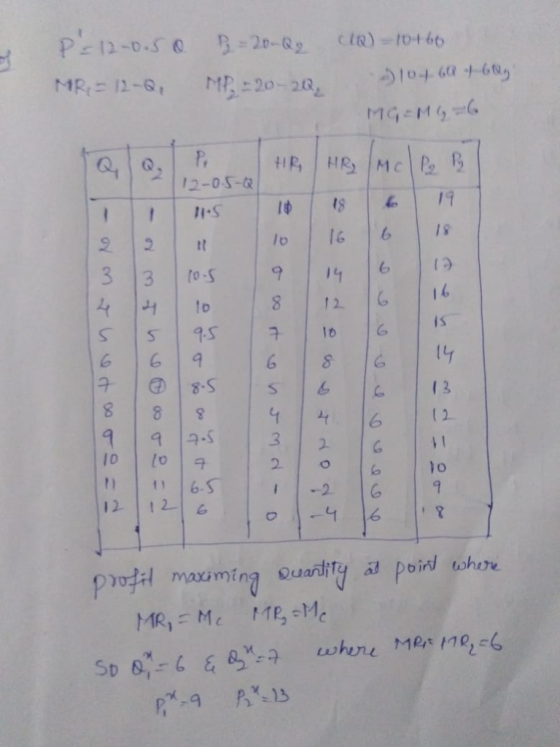
The Jam Factory makes boutique jams that it sells in specialty stores in two different cities. In City 1, the daily inverse demand function is p1 = 12 - 0.5Q1 and the marginal revenue function is MR1 = 12 - Q1. In City 2, the inverse demand and marginal revenue functions are p2 = 20 - Q2 and MR2 = 20 - 2Q2. The firm’s cost function is C(Q) = 10 + 6Q, where Q = Q1 + Q2. Thus, the firm’s marginal cost of production is 6 per unit. a. Create a spreadsheet with columns for Q1, Q2, p1, p2, MR1, MR2, and MC. Put the values 1 to 12 in increments of 1 in the Q1 column and put the same values in the Q2 column. Fill in the appropriate formulas in the other cells, noting that the MC column has the value 6 for each quantity. The Jam Factory price discriminates by charging a different price in each city. Find the profit-maximizing quantities and prices. Verify that the marginal revenues are the same in each city at the profit-maximizing quantities. Determine the firm’s profit.
a. Create a spreadsheet with columns for Q1, Q2, p1, p2, MR1, MR2, and MC. Put the values 1 to 12 in increments of 1 in the Q1 column and put the same values in the Q2 column. Fill in the appropriate formulas in the other cells, noting that the MC column has the value 6 for each quantity. The Jam Factory price discriminates by charging a different price in each city. Find the profit-maximizing quantities and prices. Verify that the marginal revenues are the same in each city at the profit-maximizing quantities. Determine the firm’s profit.
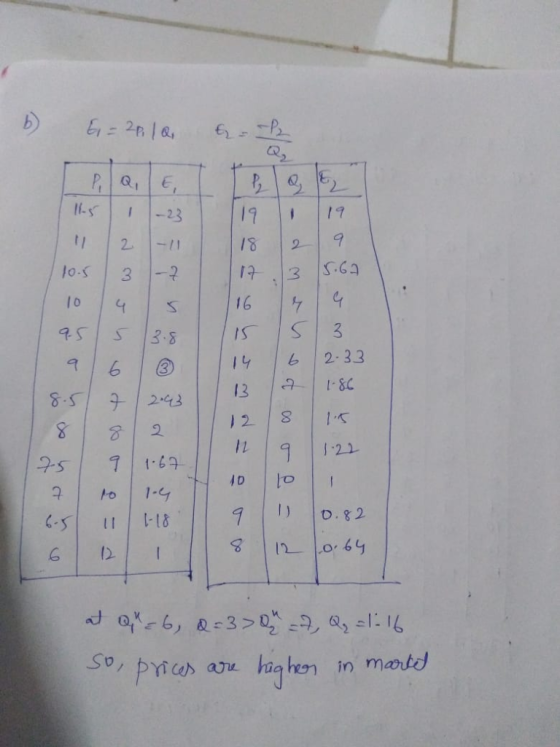
b. Add two columns to your spreadsheet showing the price elasticity of demand in each city for each price-quantity combination. Verify that your results are consistent with Equation 10.5: (Hint: The price elasticity of demand for City 1 is ε1 = -2p1/Q1 and for City 2 is ε2 = -p2/Q2. )
Homework Answers
Add Answer to:
Chapter 10.9, Problem 1Q. How do you calculate the P2/P1 and (1+1/e1 )/(1+1/e2 ) for part b on pr...
Given market demand of D and a short-run supply of s2 in the diagram below, this...
 Given market demand of D and a short-run supply of s2 in the diagram below, this fim would Market Firm MC ATC AVC Pt MR1 P2 MR2 Q1 Q 1 q2 O A. Increase its price to P1 in order to earn a normal profit and remain in the industry. ⓔ B, face a marginal revenue schedule of MRI and produce q2 to maximize its profits. O C. face a marginal revenue schedule of MR1 and produce q1 to maximize...
A monopolist is deciding how to allocate output between two geographically separated markets (East Coast and...
 A monopolist is deciding how to allocate output between two
geographically separated markets (East Coast and Midwest). Demand
and marginal revenue for the two markets are:
What are price, output, profits, marginal revenues, and
deadweight loss if the monopolist can price discriminate? (round
all answers to two decimal places)
P1 20-Q1 MR1 20-2Q1 P2 25-2Q2 MR2 = 25 - 4Q2 The monopolist's total cost is C 5+5 (Q1+Q2) In market 1, the price is $ 12.5 and the quantity is...
A monopolist is deciding how to allocate output between two
geographically separated markets (East Coast and Midwest). Demand
and marginal revenue for the two markets are:
What are price, output, profits, marginal revenues, and
deadweight loss if the monopolist can price discriminate? (round
all answers to two decimal places)
P1 20-Q1 MR1 20-2Q1 P2 25-2Q2 MR2 = 25 - 4Q2 The monopolist's total cost is C 5+5 (Q1+Q2) In market 1, the price is $ 12.5 and the quantity is...
Two firms compete by choosing price. Their demand functions are; Q1=80−P1+P2 and Q2=80+P1+P2. where P1 and...
Two firms compete by choosing price. Their demand functions are; Q1=80−P1+P2 and Q2=80+P1+P2. where P1 and P2 are the prices charged by each firm, respectively, and Q1 and Q2 are the resulting demands. Note that the demand for each good depends only on the difference in prices; if the two firms colluded and set the same price, they could make that price as high as they wanted, and earn infinite profits. Marginal costs are zero. Suppose the two firms set...
A monopoly book publisher with a constant marginal cost (and average cost) of MC = 1...
A monopoly book publisher with a constant marginal cost (and average cost) of MC = 1 sells a novel in only two countries and faces a linear inverse demand function of p1 = 6 - .5Q1 in Country 1 and p2 = 9 – Q2 in Country 2. What price would a profit-maximizing monopoly charge in each country with and without a ban against shipments between the countries?
Hello, could you solve Question3 - Part 3 (the third question) please, Thank you very much!...
 Hello, could you solve
Question3 - Part 3 (the third question) please, Thank you very
much!
Question 3 A monopolist can produce at a constant average and marginal cost of ATC- MC demand demand curve given by Q-53-P. $5. It faces a market 1. Calculate the profit maximizing price and quantity for this monopolist. Also calculte its profits. 2. Suppose a secod firm enters the market. Let Q1 be the output of the first firm and Q2 be the output...
Hello, could you solve
Question3 - Part 3 (the third question) please, Thank you very
much!
Question 3 A monopolist can produce at a constant average and marginal cost of ATC- MC demand demand curve given by Q-53-P. $5. It faces a market 1. Calculate the profit maximizing price and quantity for this monopolist. Also calculte its profits. 2. Suppose a secod firm enters the market. Let Q1 be the output of the first firm and Q2 be the output...
QUESTION 1 Identify several cartels in the world and determine to what extent they are successful....
QUESTION 1 Identify several cartels in the world and determine to what extent they are successful. The ability of oligopolistic firms to engage successfully in collusion depends on a number of factors. Identify and examine at least FIVE (5) of these factors QUESTION 2 Muhibah Group manufactures smart phones that can be sold directly to retail outlets or to the Mother Company for further processing and eventual sale by them as a completely different model. The demand function for each...
Reference the following information about the market demand function for questions 1 to 15. These questions...
Reference the following information about the market demand function for questions 1 to 15. These questions are on different types of market structures – monopoly, perfect competition, Cournot oligopoly market, and the Stackelberg oligopoly market. The market demand function is given the following equation: P = 1600 – Q where Q is the industry’s output level. Suppose initially this market is served by a single firm. Let the total cost function of this firm be given the function C(Q) =...
Tables Charts Review Normal BUAD 632 Reading Comprehension #2 1) Perfectly competitive firms are said to...
 Tables Charts Review Normal BUAD 632 Reading Comprehension #2 1) Perfectly competitive firms are said to be "small." Which of the following best describes this smallness? A) The individual firm must have fewer than 10 employees. B) The individual firm faces a downward-sloping demand curve. C) The individual firm has assets of less than $2 million. D) The individual firm is unable to affect market price through its output decisions. 2) Assume a perfectly competitive firm is producing a level...
PART 1 Costs & Revenue Price MC The INDUSTRY is the price maker The SINGLE FIRM...
 PART 1 Costs & Revenue Price MC The INDUSTRY is the price maker The SINGLE FIRM IS a price taker S ATC ARMR D Q Q Quantity Output Price Costs Revenue The INDUSTRY is the TSINGLES a proto MC pro NOIVAL proft in the US ATC AR-MR P1 AR-MR D Q01 Q10 Output a. What type of market structure is shown in the diagram above and how did you determine this? b. What are the firm's short run profit maximizing...
 Given market demand of D and a short-run supply of s2 in the diagram below, this fim would Market Firm MC ATC AVC Pt MR1 P2 MR2 Q1 Q 1 q2 O A. Increase its price to P1 in order to earn a normal profit and remain in the industry. ⓔ B, face a marginal revenue schedule of MRI and produce q2 to maximize its profits. O C. face a marginal revenue schedule of MR1 and produce q1 to maximize...
 A monopolist is deciding how to allocate output between two
geographically separated markets (East Coast and Midwest). Demand
and marginal revenue for the two markets are:
What are price, output, profits, marginal revenues, and
deadweight loss if the monopolist can price discriminate? (round
all answers to two decimal places)
P1 20-Q1 MR1 20-2Q1 P2 25-2Q2 MR2 = 25 - 4Q2 The monopolist's total cost is C 5+5 (Q1+Q2) In market 1, the price is $ 12.5 and the quantity is...
A monopolist is deciding how to allocate output between two
geographically separated markets (East Coast and Midwest). Demand
and marginal revenue for the two markets are:
What are price, output, profits, marginal revenues, and
deadweight loss if the monopolist can price discriminate? (round
all answers to two decimal places)
P1 20-Q1 MR1 20-2Q1 P2 25-2Q2 MR2 = 25 - 4Q2 The monopolist's total cost is C 5+5 (Q1+Q2) In market 1, the price is $ 12.5 and the quantity is...
 Hello, could you solve
Question3 - Part 3 (the third question) please, Thank you very
much!
Question 3 A monopolist can produce at a constant average and marginal cost of ATC- MC demand demand curve given by Q-53-P. $5. It faces a market 1. Calculate the profit maximizing price and quantity for this monopolist. Also calculte its profits. 2. Suppose a secod firm enters the market. Let Q1 be the output of the first firm and Q2 be the output...
Hello, could you solve
Question3 - Part 3 (the third question) please, Thank you very
much!
Question 3 A monopolist can produce at a constant average and marginal cost of ATC- MC demand demand curve given by Q-53-P. $5. It faces a market 1. Calculate the profit maximizing price and quantity for this monopolist. Also calculte its profits. 2. Suppose a secod firm enters the market. Let Q1 be the output of the first firm and Q2 be the output...
 Tables Charts Review Normal BUAD 632 Reading Comprehension #2 1) Perfectly competitive firms are said to be "small." Which of the following best describes this smallness? A) The individual firm must have fewer than 10 employees. B) The individual firm faces a downward-sloping demand curve. C) The individual firm has assets of less than $2 million. D) The individual firm is unable to affect market price through its output decisions. 2) Assume a perfectly competitive firm is producing a level...
 PART 1 Costs & Revenue Price MC The INDUSTRY is the price maker The SINGLE FIRM IS a price taker S ATC ARMR D Q Q Quantity Output Price Costs Revenue The INDUSTRY is the TSINGLES a proto MC pro NOIVAL proft in the US ATC AR-MR P1 AR-MR D Q01 Q10 Output a. What type of market structure is shown in the diagram above and how did you determine this? b. What are the firm's short run profit maximizing...
Most questions answered within 3 hours.
-
Where is the error in this code sequence?
String s1 = "Hello";
String s2 = "ello";...
asked 10 months ago -
Financial data for Joel de Paris, Inc., for last year
follow:
Joel de Paris, Inc.
Balance...
asked 10 months ago -
Consider this reaction:
Al2(SO4)3 (aq)+ BaCl3
(aq) Al2Cl6 (aq)- +
3BaSO4(s) . What is the...
asked 10 months ago -
Suppose that Savneet is considering increasing her
recent random sample from 20 car rentals to 40...
asked 10 months ago -
Trucks arrive at an unloading terminal at an average rate of 120
per hour.
Trucks arrive...
asked 10 months ago -
Why are methanol and ethanol completely soluble in water while
octanol is not very little soluble....
asked 10 months ago -
A facilities manager at a university reads in a research report
that the mean amount of...
asked 10 months ago -
When the CuSO4 is rehydrated by adding water to the anhydrous
compound, is this an endothermic...
asked 10 months ago -
A ray of sunlight is passing from diamond into crown glass; the
angle of incidence is...
asked 10 months ago -
A block of mass 0.249 kg is placed on top of a light, vertical
spring of...
asked 10 months ago -
how do the kidneys compensate in the presences of acidosis
a) trigger hyperventilate
b) reserve acid...
asked 10 months ago -
Question 501 pts
The rental rate of capital to the firm increases. Which of the
following...
asked 10 months ago