
Homework Answers
# 1 5 Determine the convergence or divergence of s, qdx. Find if conver- gent. -5...
 # 1 5 Determine the convergence or divergence of s, qdx. Find if conver- gent. -5 #2 3 Find lim n+ n4 + n3
1270) Refer to the LT table. f(t)=7. Determine tNum,a,b and n. ans:4 1271) Refer to the...
 1270) Refer to the LT table. f(t)=7. Determine tNum,a,b and n. ans:4
1271) Refer to the LT table. f(t)=4t. Determine tNum,a,b and n. ans:4
1272) Refer to the LT table. f(t)=5t^2. Determine tNum,a,b and n. ans:4
1273) Refer to the LT table. f(t)=7exp(3t). Determine tNum,a,b and n. ans:4
1274) Refer to the LT table. f(t)=8(1-exp(3t)). Determine tNum,a,b and n. ans:4
Table of Laplace Transforms le transforms of some common functions are given in Table 36-1. Instead of ansforming a function...
1270) Refer to the LT table. f(t)=7. Determine tNum,a,b and n. ans:4
1271) Refer to the LT table. f(t)=4t. Determine tNum,a,b and n. ans:4
1272) Refer to the LT table. f(t)=5t^2. Determine tNum,a,b and n. ans:4
1273) Refer to the LT table. f(t)=7exp(3t). Determine tNum,a,b and n. ans:4
1274) Refer to the LT table. f(t)=8(1-exp(3t)). Determine tNum,a,b and n. ans:4
Table of Laplace Transforms le transforms of some common functions are given in Table 36-1. Instead of ansforming a function...
Consider the following interaction >mystery01 ( 'D', 'T' ) ans-16 >mystery01( '0' , 'F' ) ans9...
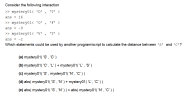 Consider the following interaction >mystery01 ( 'D', 'T' ) ans-16 >mystery01( '0' , 'F' ) ans9 >> mystery01 ( 'V' , 'T' ) ans =-2 Which statements could be used by another program/script to calculate the distance between 'S' and 'C'? (a) mystery01( s, C) (b) mystery01( C, L')+mystery01('L, 'S') (c) mystery01( S', mystery01('N, 'C)) (d) abs( mystery01('S', 'N') + mystery01( 'L', C)) (e) abs( mystery01('S', 'N')) + abs( mystery01('N, C))
Problem 2 (20 points total): 4 Consider the following system for Parts a-c. 2 N-s/m x2(t)...
 Problem 2 (20 points total): 4 Consider the following system for Parts a-c. 2 N-s/m x2(t) xz(t) 0000- 6 N/m 2 N-s/m xi(t) 2 N-s/m 6 N/m 4 kg 4 kg 00004 kg f(t) Frictionless Part 2a (8 points): Draw free body diagrams for each mass Part 2b (6 points): Write the equations of motion for each mass as differential equations in the time domain." Part 2c (6 points): Convert the equations of motion for each mass into algebraic equations...
Correct answer will get a thumbs up! 1 point) Find the Laplace transform F(s) of f(t-et-2a(t-2...
 Correct answer will get a thumbs up!
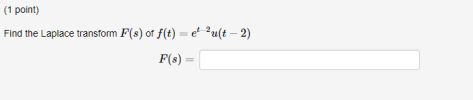
1 point) Find the Laplace transform F(s) of f(t-et-2a(t-2 F(s) =
Correct answer will get a thumbs up!
1 point) Find the Laplace transform F(s) of f(t-et-2a(t-2 F(s) =
1272) Refer to the LT table. f(t)-4t^2. Determine tNum, a, b and n. ans: 4 9...
 1272) Refer to the LT table. f(t)-4t^2. Determine tNum, a, b and n. ans: 4 9 dapbel 1273) Refer to the LT table. f(t)-3exp(4t). Determine tNum, a,b and n. ans:4 9 dapbel ANA . .. m .
please help me to solve N ans s ! (1 point) Approximate the value of the...
 please help me to solve N ans s !
(1 point) Approximate the value of the series to within an error of at most 10 . According to Equation in Theorem 9.5.2: Is-syl SbN+1 what is the smallest value of N that approximates S to within an error of at most 10-? N= S
please help me to solve N ans s !
(1 point) Approximate the value of the series to within an error of at most 10 . According to Equation in Theorem 9.5.2: Is-syl SbN+1 what is the smallest value of N that approximates S to within an error of at most 10-? N= S
2. Use the property f(t) = L-1 {r(s))-(-1)"L-1 {F(n)(s)} (-t)n and choose n = 1 to perform the fo...
 2. Use the property f(t) = L-1 {r(s))-(-1)"L-1 {F(n)(s)} (-t)n and choose n = 1 to perform the following inverse Laplace transform L-1 (F(s)): (1). F(s)=ln-s-3 V s + 1 (Answer:- (e3t-le-t) ) (2). F(s) - arctan(2s) (Answer: tsin )
2. Use the property f(t) = L-1 {r(s))-(-1)"L-1 {F(n)(s)} (-t)n and choose n = 1 to perform the following inverse Laplace transform L-1 (F(s)): (1). F(s)=ln-s-3 V s + 1 (Answer:- (e3t-le-t) ) (2). F(s) - arctan(2s) (Answer: tsin )
2. Use the property f(t) = L-1 {r(s))-(-1)"L-1 {F(n)(s)} (-t)n and choose n = 1 to perform the following inverse Laplace transform L-1 (F(s)): (1). F(s)=ln-s-3 V s + 1 (Answer:- (e3t-le-t) ) (2). F(s) - arctan(2s) (Answer: tsin )
Show that the stability criterion requires that: a) S 0 P,N T,N c) a) S 0 P,N T,N c)
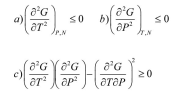 Show that the stability criterion requires
that:
a) S 0 P,N T,N c)
a) S 0 P,N T,N c)
Show that the stability criterion requires
that:
a) S 0 P,N T,N c)
a) S 0 P,N T,N c)
I N-m/rad 0200) T(C) I N-m/rad 1 kg-m2 1 N-m-s/rad 1 N-m-s/rad
 find G1(s)=theta 1(s)/ T(s)
I N-m/rad 0200) T(C) I N-m/rad 1 kg-m2 1 N-m-s/rad 1 N-m-s/rad
I N-m/rad 0200) T(C) I N-m/rad 1 kg-m2 1 N-m-s/rad 1 N-m-s/rad
find G1(s)=theta 1(s)/ T(s)
I N-m/rad 0200) T(C) I N-m/rad 1 kg-m2 1 N-m-s/rad 1 N-m-s/rad
I N-m/rad 0200) T(C) I N-m/rad 1 kg-m2 1 N-m-s/rad 1 N-m-s/rad
 # 1 5 Determine the convergence or divergence of s, qdx. Find if conver- gent. -5 #2 3 Find lim n+ n4 + n3
 1270) Refer to the LT table. f(t)=7. Determine tNum,a,b and n. ans:4
1271) Refer to the LT table. f(t)=4t. Determine tNum,a,b and n. ans:4
1272) Refer to the LT table. f(t)=5t^2. Determine tNum,a,b and n. ans:4
1273) Refer to the LT table. f(t)=7exp(3t). Determine tNum,a,b and n. ans:4
1274) Refer to the LT table. f(t)=8(1-exp(3t)). Determine tNum,a,b and n. ans:4
Table of Laplace Transforms le transforms of some common functions are given in Table 36-1. Instead of ansforming a function...
1270) Refer to the LT table. f(t)=7. Determine tNum,a,b and n. ans:4
1271) Refer to the LT table. f(t)=4t. Determine tNum,a,b and n. ans:4
1272) Refer to the LT table. f(t)=5t^2. Determine tNum,a,b and n. ans:4
1273) Refer to the LT table. f(t)=7exp(3t). Determine tNum,a,b and n. ans:4
1274) Refer to the LT table. f(t)=8(1-exp(3t)). Determine tNum,a,b and n. ans:4
Table of Laplace Transforms le transforms of some common functions are given in Table 36-1. Instead of ansforming a function...
 Consider the following interaction >mystery01 ( 'D', 'T' ) ans-16 >mystery01( '0' , 'F' ) ans9 >> mystery01 ( 'V' , 'T' ) ans =-2 Which statements could be used by another program/script to calculate the distance between 'S' and 'C'? (a) mystery01( s, C) (b) mystery01( C, L')+mystery01('L, 'S') (c) mystery01( S', mystery01('N, 'C)) (d) abs( mystery01('S', 'N') + mystery01( 'L', C)) (e) abs( mystery01('S', 'N')) + abs( mystery01('N, C))
 Problem 2 (20 points total): 4 Consider the following system for Parts a-c. 2 N-s/m x2(t) xz(t) 0000- 6 N/m 2 N-s/m xi(t) 2 N-s/m 6 N/m 4 kg 4 kg 00004 kg f(t) Frictionless Part 2a (8 points): Draw free body diagrams for each mass Part 2b (6 points): Write the equations of motion for each mass as differential equations in the time domain." Part 2c (6 points): Convert the equations of motion for each mass into algebraic equations...
 Correct answer will get a thumbs up!
1 point) Find the Laplace transform F(s) of f(t-et-2a(t-2 F(s) =
Correct answer will get a thumbs up!
1 point) Find the Laplace transform F(s) of f(t-et-2a(t-2 F(s) =
 1272) Refer to the LT table. f(t)-4t^2. Determine tNum, a, b and n. ans: 4 9 dapbel 1273) Refer to the LT table. f(t)-3exp(4t). Determine tNum, a,b and n. ans:4 9 dapbel ANA . .. m .
 please help me to solve N ans s !
(1 point) Approximate the value of the series to within an error of at most 10 . According to Equation in Theorem 9.5.2: Is-syl SbN+1 what is the smallest value of N that approximates S to within an error of at most 10-? N= S
please help me to solve N ans s !
(1 point) Approximate the value of the series to within an error of at most 10 . According to Equation in Theorem 9.5.2: Is-syl SbN+1 what is the smallest value of N that approximates S to within an error of at most 10-? N= S
 2. Use the property f(t) = L-1 {r(s))-(-1)"L-1 {F(n)(s)} (-t)n and choose n = 1 to perform the following inverse Laplace transform L-1 (F(s)): (1). F(s)=ln-s-3 V s + 1 (Answer:- (e3t-le-t) ) (2). F(s) - arctan(2s) (Answer: tsin )
2. Use the property f(t) = L-1 {r(s))-(-1)"L-1 {F(n)(s)} (-t)n and choose n = 1 to perform the following inverse Laplace transform L-1 (F(s)): (1). F(s)=ln-s-3 V s + 1 (Answer:- (e3t-le-t) ) (2). F(s) - arctan(2s) (Answer: tsin )
2. Use the property f(t) = L-1 {r(s))-(-1)"L-1 {F(n)(s)} (-t)n and choose n = 1 to perform the following inverse Laplace transform L-1 (F(s)): (1). F(s)=ln-s-3 V s + 1 (Answer:- (e3t-le-t) ) (2). F(s) - arctan(2s) (Answer: tsin )
 Show that the stability criterion requires
that:
a) S 0 P,N T,N c)
a) S 0 P,N T,N c)
Show that the stability criterion requires
that:
a) S 0 P,N T,N c)
a) S 0 P,N T,N c)
 find G1(s)=theta 1(s)/ T(s)
I N-m/rad 0200) T(C) I N-m/rad 1 kg-m2 1 N-m-s/rad 1 N-m-s/rad
I N-m/rad 0200) T(C) I N-m/rad 1 kg-m2 1 N-m-s/rad 1 N-m-s/rad
find G1(s)=theta 1(s)/ T(s)
I N-m/rad 0200) T(C) I N-m/rad 1 kg-m2 1 N-m-s/rad 1 N-m-s/rad
I N-m/rad 0200) T(C) I N-m/rad 1 kg-m2 1 N-m-s/rad 1 N-m-s/rad
Most questions answered within 3 hours.
-
Where is the error in this code sequence?
String s1 = "Hello";
String s2 = "ello";...
asked 11 months ago -
Financial data for Joel de Paris, Inc., for last year
follow:
Joel de Paris, Inc.
Balance...
asked 11 months ago -
Consider this reaction:
Al2(SO4)3 (aq)+ BaCl3
(aq) Al2Cl6 (aq)- +
3BaSO4(s) . What is the...
asked 11 months ago -
Suppose that Savneet is considering increasing her
recent random sample from 20 car rentals to 40...
asked 11 months ago -
Trucks arrive at an unloading terminal at an average rate of 120
per hour.
Trucks arrive...
asked 11 months ago -
Why are methanol and ethanol completely soluble in water while
octanol is not very little soluble....
asked 11 months ago -
A facilities manager at a university reads in a research report
that the mean amount of...
asked 11 months ago -
When the CuSO4 is rehydrated by adding water to the anhydrous
compound, is this an endothermic...
asked 11 months ago -
A ray of sunlight is passing from diamond into crown glass; the
angle of incidence is...
asked 11 months ago -
A block of mass 0.249 kg is placed on top of a light, vertical
spring of...
asked 11 months ago -
how do the kidneys compensate in the presences of acidosis
a) trigger hyperventilate
b) reserve acid...
asked 11 months ago -
Question 501 pts
The rental rate of capital to the firm increases. Which of the
following...
asked 11 months ago