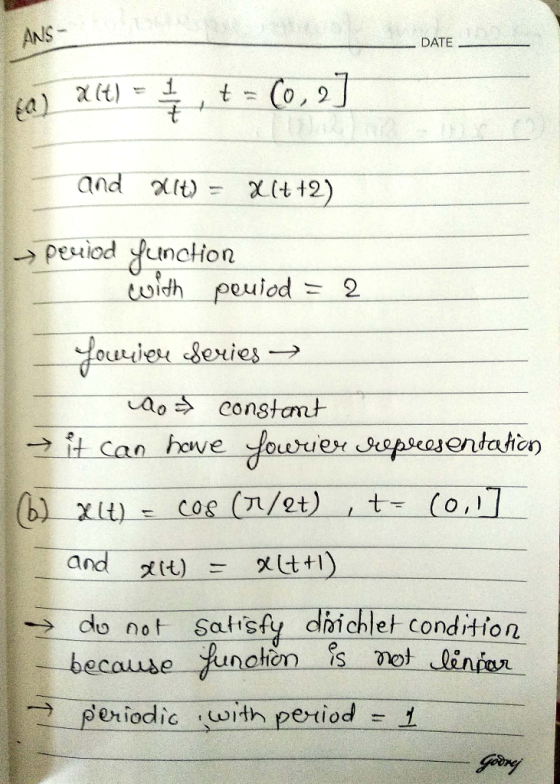
Determine if the following functions satisfy the Dirichlet conditions and have CTFS representation
![(a)-(t)-, t = (0, 2] and x(t) = z(t + 2); b) (t)cos(/2t), t -(,1 and«(t) - and (t)-x(t (e) (t) -in(ln(t),t (0,1] and z(t) - 0](http://img.homeworklib.com/images/9f5a8518-e7ab-4702-a90e-c564b0cd4659.png?x-oss-process=image/resize,w_560)
Homework Answers
Add Answer to:
Determine if the following functions satisfy the Dirichlet conditions and have CTFS representation
1. For the three following signal sets . Find the basis functions using Gram-Schmidt method. ....
 1. For the three following signal sets . Find the basis functions using Gram-Schmidt method. . Plot the corresponding signal space representation. . Find the distance between the two signals. (a) x(t) = Acos(2tht), y(t) = Asin(2T,fet), t E [0, e). [30 points] (b) (t) A cos(2m fct), y(t) A cos(2m fct+0), t E [0, Tb]. [30 points] (c) The signal set shown in Figure 1 [40 points xp V3A T/2 T To
PrOBleM: SoLuTiONS To THE WAvE EQuATION a) By direct substitution determine which of the following functions...
 PrOBleM: SoLuTiONS To THE WAvE EQuATION a) By direct substitution determine which of the following functions satisfy the wave equation 1. g(z, t)-A cos(kr - wt) where A, k, w are positive constants 2. h(z,t)-Ae-(kz-wt)2 where A, k, ω are positive constants 3. p(x, t) A sinh(kx-wt) where A, k,w are positive constants 4. q(z, t) - Ae(atut) where A,a, w are positive constants 5. An arbitrary function: f(x, t) - f(kx -wt) where k and w are positive constants....
solve for a and b 1. Plot each of the following functions and find its Fourier series representation, also determine...
 solve for a and b
1. Plot each of the following functions and find its Fourier series representation, also determine the first three One zero harmonics (a) f(t) -1<t< T= 2 where T is the period. 0t<1 J (b) f(t) -t-1<t<0 T 4 where T is the poriod = 0t1 0-2<t<-1 T = 4 where T is the period (e) g(t) 1 -1<t<1 0 1<t<2 (d) g(t) = 1- t -1<t<1;T = 4 where T is the period
1. Plot...
solve for a and b
1. Plot each of the following functions and find its Fourier series representation, also determine the first three One zero harmonics (a) f(t) -1<t< T= 2 where T is the period. 0t<1 J (b) f(t) -t-1<t<0 T 4 where T is the poriod = 0t1 0-2<t<-1 T = 4 where T is the period (e) g(t) 1 -1<t<1 0 1<t<2 (d) g(t) = 1- t -1<t<1;T = 4 where T is the period
1. Plot...
Problem 1: Solve the initial value Dirichlet problem on the half-line and find the value u(1,...
 Problem 1: Solve the initial value Dirichlet problem on the half-line and find the value u(1, 2): (8 points) tut(t, z) - trọt, c) = c+t, (t, x) R x [0, +x), u(0, 2) = cos(V), 4(0,2)=e", u(t,0) = 1+ t.
8. Let f and g be scalar functions with continuous partial derivatives, and let C and S satisfy the conditions of St...
 8. Let f and g be scalar functions with continuous partial derivatives, and let C and S satisfy the conditions of Stokes's Theorem. Verify each identity. (a) dr = Vg) N ds X (b) dr 0 (e)
8. Let f and g be scalar functions with continuous partial derivatives, and let C and S satisfy the conditions of Stokes's Theorem. Verify each identity. (a) dr = Vg) N ds X (b) dr 0 (e)
8. Let f and g be scalar functions with continuous partial derivatives, and let C and S satisfy the conditions of Stokes's Theorem. Verify each identity. (a) dr = Vg) N ds X (b) dr 0 (e)
(3) Determine by substitution which of the functions ya(t) = A e(-2+6j)t, yo(t) = B e(2+63)t,...
 (3) Determine by substitution which of the functions ya(t) = A e(-2+6j)t, yo(t) = B e(2+63)t, yo(t) =C e(-2-63)t satisfy the DE y" +4y'+40 y = 0, where A, B, C are nonzero constants. (4) Let y(t) = 0 + A e(-2-63)t + Be(-2+63)t, and use Euler's identity to show that y(t) = 0) + C e 2t sin (6t) + De-2t cos (6 t), where C =j(B-A) and D equals something similar. Then find constants C, D such that...
ONLY NUMBER 2 1. Find the CTFS coefficients of the periodic signal 1 1-4 」E [0, 1] 0 otherwise 2. In this problem you will practice using properties to derive the CTFS coefficients of 0 otherwise...
 ONLY NUMBER 2
1. Find the CTFS coefficients of the periodic signal 1 1-4 」E [0, 1] 0 otherwise 2. In this problem you will practice using properties to derive the CTFS coefficients of 0 otherwise from the CTFS coefficients of a(t) from the previous problem. (a) What is the periodic convolution of r(t) with itself? (b) How is the periodic convolution of r(t) with itself related to y(t) (c) Find the coefficients of y(t) by applying CTFS properties, selected...
ONLY NUMBER 2
1. Find the CTFS coefficients of the periodic signal 1 1-4 」E [0, 1] 0 otherwise 2. In this problem you will practice using properties to derive the CTFS coefficients of 0 otherwise from the CTFS coefficients of a(t) from the previous problem. (a) What is the periodic convolution of r(t) with itself? (b) How is the periodic convolution of r(t) with itself related to y(t) (c) Find the coefficients of y(t) by applying CTFS properties, selected...
Consider a potential problem in the half-space defined by 2 20, with Dirichlet boundary conditions on...
 Consider a potential problem in the half-space defined by 2 20, with Dirichlet boundary conditions on the plane z = 0 and at infinity). (a) Write down the appropriate Green function G(x, x'). (b) If the potential on the plane z = 0 is specified to be 0 Vinside a circle of radius a centered at the origin, and Ø = 0 outside that circle, find an integral expression for the potential at the point P specified in terms of...
need help all those questions. 10. Solve the following systems of linear differential equations: 11. Determine the Laplace transform of each of the following functions: (a) fe)-2t+1, 0StcI , 21 (b...
 need help all those questions.
10. Solve the following systems of linear differential equations: 11. Determine the Laplace transform of each of the following functions: (a) fe)-2t+1, 0StcI , 21 (b) f(t) te (c) f(t) = cos t cos 2t (Hint: Examine cos(a ± b).) Determine the inverse Laplace transform of each function: 12. (a) F(s) = 52 +9 is Demin 13. Determine L{kt cos kt + sin kt). 0, t< a 14. Determine L(cos 2t)U(t-r), where U(t-a)={ 15. Use...
need help all those questions.
10. Solve the following systems of linear differential equations: 11. Determine the Laplace transform of each of the following functions: (a) fe)-2t+1, 0StcI , 21 (b) f(t) te (c) f(t) = cos t cos 2t (Hint: Examine cos(a ± b).) Determine the inverse Laplace transform of each function: 12. (a) F(s) = 52 +9 is Demin 13. Determine L{kt cos kt + sin kt). 0, t< a 14. Determine L(cos 2t)U(t-r), where U(t-a)={ 15. Use...
Let Coo denote the set of smooth functions, ie, functions f : R → R whose nth derivative exists, ...
 Let Coo denote the set of smooth functions, ie, functions f : R → R whose nth derivative exists, for all n. Recall that this is a vector space, where "vectors" of Coo are function:s like f(t) = sin(t) or f(t) = te, or polynomials like f(t)-t2-2, or constant functions like f(t) = 5, and more The set of smooth functions f (t) which satisfy the differential equation f"(t) +2f (t) -0 for all t, is the same as the...
 1. For the three following signal sets . Find the basis functions using Gram-Schmidt method. . Plot the corresponding signal space representation. . Find the distance between the two signals. (a) x(t) = Acos(2tht), y(t) = Asin(2T,fet), t E [0, e). [30 points] (b) (t) A cos(2m fct), y(t) A cos(2m fct+0), t E [0, Tb]. [30 points] (c) The signal set shown in Figure 1 [40 points xp V3A T/2 T To
 PrOBleM: SoLuTiONS To THE WAvE EQuATION a) By direct substitution determine which of the following functions satisfy the wave equation 1. g(z, t)-A cos(kr - wt) where A, k, w are positive constants 2. h(z,t)-Ae-(kz-wt)2 where A, k, ω are positive constants 3. p(x, t) A sinh(kx-wt) where A, k,w are positive constants 4. q(z, t) - Ae(atut) where A,a, w are positive constants 5. An arbitrary function: f(x, t) - f(kx -wt) where k and w are positive constants....
 solve for a and b
1. Plot each of the following functions and find its Fourier series representation, also determine the first three One zero harmonics (a) f(t) -1<t< T= 2 where T is the period. 0t<1 J (b) f(t) -t-1<t<0 T 4 where T is the poriod = 0t1 0-2<t<-1 T = 4 where T is the period (e) g(t) 1 -1<t<1 0 1<t<2 (d) g(t) = 1- t -1<t<1;T = 4 where T is the period
1. Plot...
solve for a and b
1. Plot each of the following functions and find its Fourier series representation, also determine the first three One zero harmonics (a) f(t) -1<t< T= 2 where T is the period. 0t<1 J (b) f(t) -t-1<t<0 T 4 where T is the poriod = 0t1 0-2<t<-1 T = 4 where T is the period (e) g(t) 1 -1<t<1 0 1<t<2 (d) g(t) = 1- t -1<t<1;T = 4 where T is the period
1. Plot...
 Problem 1: Solve the initial value Dirichlet problem on the half-line and find the value u(1, 2): (8 points) tut(t, z) - trọt, c) = c+t, (t, x) R x [0, +x), u(0, 2) = cos(V), 4(0,2)=e", u(t,0) = 1+ t.
 8. Let f and g be scalar functions with continuous partial derivatives, and let C and S satisfy the conditions of Stokes's Theorem. Verify each identity. (a) dr = Vg) N ds X (b) dr 0 (e)
8. Let f and g be scalar functions with continuous partial derivatives, and let C and S satisfy the conditions of Stokes's Theorem. Verify each identity. (a) dr = Vg) N ds X (b) dr 0 (e)
8. Let f and g be scalar functions with continuous partial derivatives, and let C and S satisfy the conditions of Stokes's Theorem. Verify each identity. (a) dr = Vg) N ds X (b) dr 0 (e)
 (3) Determine by substitution which of the functions ya(t) = A e(-2+6j)t, yo(t) = B e(2+63)t, yo(t) =C e(-2-63)t satisfy the DE y" +4y'+40 y = 0, where A, B, C are nonzero constants. (4) Let y(t) = 0 + A e(-2-63)t + Be(-2+63)t, and use Euler's identity to show that y(t) = 0) + C e 2t sin (6t) + De-2t cos (6 t), where C =j(B-A) and D equals something similar. Then find constants C, D such that...
 ONLY NUMBER 2
1. Find the CTFS coefficients of the periodic signal 1 1-4 」E [0, 1] 0 otherwise 2. In this problem you will practice using properties to derive the CTFS coefficients of 0 otherwise from the CTFS coefficients of a(t) from the previous problem. (a) What is the periodic convolution of r(t) with itself? (b) How is the periodic convolution of r(t) with itself related to y(t) (c) Find the coefficients of y(t) by applying CTFS properties, selected...
ONLY NUMBER 2
1. Find the CTFS coefficients of the periodic signal 1 1-4 」E [0, 1] 0 otherwise 2. In this problem you will practice using properties to derive the CTFS coefficients of 0 otherwise from the CTFS coefficients of a(t) from the previous problem. (a) What is the periodic convolution of r(t) with itself? (b) How is the periodic convolution of r(t) with itself related to y(t) (c) Find the coefficients of y(t) by applying CTFS properties, selected...
 Consider a potential problem in the half-space defined by 2 20, with Dirichlet boundary conditions on the plane z = 0 and at infinity). (a) Write down the appropriate Green function G(x, x'). (b) If the potential on the plane z = 0 is specified to be 0 Vinside a circle of radius a centered at the origin, and Ø = 0 outside that circle, find an integral expression for the potential at the point P specified in terms of...
 need help all those questions.
10. Solve the following systems of linear differential equations: 11. Determine the Laplace transform of each of the following functions: (a) fe)-2t+1, 0StcI , 21 (b) f(t) te (c) f(t) = cos t cos 2t (Hint: Examine cos(a ± b).) Determine the inverse Laplace transform of each function: 12. (a) F(s) = 52 +9 is Demin 13. Determine L{kt cos kt + sin kt). 0, t< a 14. Determine L(cos 2t)U(t-r), where U(t-a)={ 15. Use...
need help all those questions.
10. Solve the following systems of linear differential equations: 11. Determine the Laplace transform of each of the following functions: (a) fe)-2t+1, 0StcI , 21 (b) f(t) te (c) f(t) = cos t cos 2t (Hint: Examine cos(a ± b).) Determine the inverse Laplace transform of each function: 12. (a) F(s) = 52 +9 is Demin 13. Determine L{kt cos kt + sin kt). 0, t< a 14. Determine L(cos 2t)U(t-r), where U(t-a)={ 15. Use...
 Let Coo denote the set of smooth functions, ie, functions f : R → R whose nth derivative exists, for all n. Recall that this is a vector space, where "vectors" of Coo are function:s like f(t) = sin(t) or f(t) = te, or polynomials like f(t)-t2-2, or constant functions like f(t) = 5, and more The set of smooth functions f (t) which satisfy the differential equation f"(t) +2f (t) -0 for all t, is the same as the...
Most questions answered within 3 hours.
-
Where is the error in this code sequence?
String s1 = "Hello";
String s2 = "ello";...
asked 11 months ago -
Financial data for Joel de Paris, Inc., for last year
follow:
Joel de Paris, Inc.
Balance...
asked 11 months ago -
Consider this reaction:
Al2(SO4)3 (aq)+ BaCl3
(aq) Al2Cl6 (aq)- +
3BaSO4(s) . What is the...
asked 11 months ago -
Suppose that Savneet is considering increasing her
recent random sample from 20 car rentals to 40...
asked 11 months ago -
Trucks arrive at an unloading terminal at an average rate of 120
per hour.
Trucks arrive...
asked 11 months ago -
Why are methanol and ethanol completely soluble in water while
octanol is not very little soluble....
asked 11 months ago -
A facilities manager at a university reads in a research report
that the mean amount of...
asked 11 months ago -
When the CuSO4 is rehydrated by adding water to the anhydrous
compound, is this an endothermic...
asked 11 months ago -
A ray of sunlight is passing from diamond into crown glass; the
angle of incidence is...
asked 11 months ago -
A block of mass 0.249 kg is placed on top of a light, vertical
spring of...
asked 11 months ago -
how do the kidneys compensate in the presences of acidosis
a) trigger hyperventilate
b) reserve acid...
asked 11 months ago -
Question 501 pts
The rental rate of capital to the firm increases. Which of the
following...
asked 11 months ago