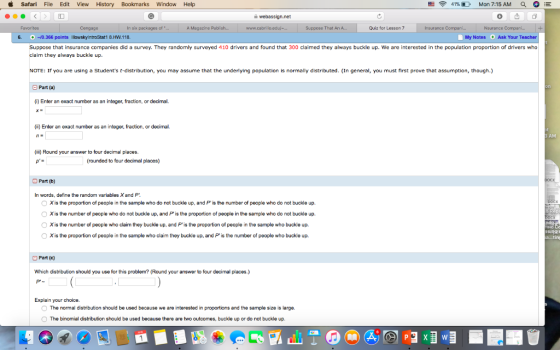
Suppose that insurance companies did a survey. They randomly
surveyed 410 drivers and found that 300 claimed they always buckle
up. We are interested in the population proportion of drivers who
claim they always buckle up.
NOTE: If you are using a Student's t-distribution, you may
assume that the underlying population is normally distributed. (In
general, you must first prove that assumption, though.)
-
Part (a)
(i) Enter an exact number as an integer, fraction, or decimal.x =
(ii) Enter an exact number as an integer, fraction, or decimal.n =
(iii) Round your answer to four decimal places.p' =
(rounded to four decimal places) -
Part (b)
In words, define the random variables X and P'.X is the proportion of people in the sample who do not buckle up, and P' is the number of people who do not buckle up.X is the number of people who do not buckle up, and P' is the proportion of people in the sample who do not buckle up. X is the number of people who claim they buckle up, and P' is the proportion of people in the sample who buckle up.X is the proportion of people in the sample who claim they buckle up, and P' is the number of people who buckle up.
-
Part (c)
Which distribution should you use for this problem? (Round your answer to four decimal places.)P' ~
,

Explain your choice.The normal distribution should be used because we are interested in proportions and the sample size is large.The binomial distribution should be used because there are two outcomes, buckle up or do not buckle up. The Student's t-distribution should be used because
≤ 10, which implies a small sample.The Student's t-distribution should be used because we do not know the standard deviation.
npq -
Part (d)
Construct a 95% confidence interval for the population proportion who claim they always buckle up.(i) State the confidence interval. (Round your answers to four decimal places.)
,

(ii) Sketch the graph.
(iii) Calculate the error bound. (Round your answer to four decimal places.)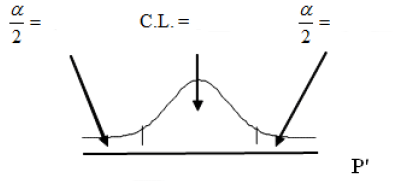
-
Part (e)
If this survey were done by telephone, list three difficulties the companies might have in obtaining random results.The individuals in the sample may not accurately reflect the population.Only people over the age of 24 would be included in the survey.Individuals may not tell the truth about buckling up.Children who do not answer the phone will not be included.Individuals may choose to participate or not participate in the phone survey.


Homework Answers
Part (a)
(i) Enter an exact number as an integer, fraction, or decimal.
x = 300
(ii) Enter an exact number as an integer, fraction, or decimal.
n = 410
(iii) Round your answer to four decimal places.
p' = x/n = 300/410 = 0.7317
q' = 1 - p' = 1 - 0.7317 = 0.2683
Part (c)
Which distribution should you use for this problem? (Round your answer to four decimal places.)
X ~ Normal (p', 
X ~ Normal ( 0.7317, 0.0219)
p' ~ ( 0.7317, 0.0219)

Which is ≤ 10, which implies a small sample.The Student's t-distribution should be used because we do not know the standard deviation.
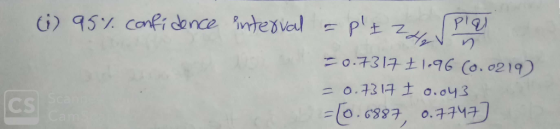
Part (d)
Add Answer to:
Suppose that insurance companies did a survey. They randomly surveyed 410 drivers and found that ...
Suppose that insurance companies did a survey. They randomly surveyed 440 drivers and found that 310...
Suppose that insurance companies did a survey. They randomly surveyed 440 drivers and found that 310 claimed they always buckle up. We are interested in the population proportion of drivers who claim they always buckle up. Part A: (i) The observed count of drivers who claimed they always buckle up in this sample is = ? (ii) The sample size = ? (iii) The observed sample proportion = ? Part B: In words, define the random variables X and p̂....
Suppose that insurance companies did a survey. They randomly surveyed 430 drivers and found that 330...
Suppose that insurance companies did a survey. They randomly surveyed 430 drivers and found that 330 claimed they always buckle up. We are interested in the population proportion of drivers who claim they always buckle up. a) x = ? b) n = ? c) p' = ? d) Which distribution should you use for this problem? (Round your answer to four decimal places.) P- (_) (_,_) e) Construct a 95% confidence interval for the population proportion who claim they...
Suppose that insurance companies did a survey. They randomly surveyed 430 drivers and found that 330...
Suppose that insurance companies did a survey. They randomly surveyed 430 drivers and found that 330 claimed they always buckle up. We are interested in the population proportion of drivers who claim they always buckle up. a) x = ? b) n = ? c) p' = ? d) Which distribution should you use for this problem? (Round your answer to four decimal places.) e) Construct a 95% confidence interval for the population proportion who claim they always buckle up....
Suppose that insurance companies did a survey. They randomly surveyed 400 drivers and found that 320...
Suppose that insurance companies did a survey. They randomly surveyed 400 drivers and found that 320 claimed they always buckle up. We are interested in the population proportion of drivers who claim they always buckle up. which distribution should you use for this problem? (Round your answer to four decimal places.) P' ~( P', ?) ? I understand its normal distribution but i'm not sure what goes after the probability
Suppose that insurance companies did a survey. They randomly surveyed 400 drivers and found that 320...
Suppose that insurance companies did a survey. They randomly surveyed 400 drivers and found that 320 claimed they always buckle up. We are interested in the population proportion of drivers who claim they always buckle up. Construct a 95% confidence interval for the population proportion who claim they always buckle up. (iii) Calculate the error bound. (Round your answer to four decimal places.)? I don't understand how to calculate the error bound
Suppose that several insurance companies conduct a survey. They randomly surveyed 400 drivers and found that...
 Suppose that several insurance companies conduct a survey. They randomly surveyed 400 drivers and found that 240 claimed to always buckle up. We are interested in the population proportion of drivers who claim to always buckle up a. (.20) n= b. (.20) p, = c. (.20) The standard deviation for p d. (.20) The z value for a 95% confidence interval is e. (.20) Construct a 95% confidence interval for the population proportion that claim to always buckle Fill in...
Insurance companies are interested in knowing the population percent of drivers who always buckle up before...
Insurance companies are interested in knowing the population percent of drivers who always buckle up before riding in a car. They randomly survey 383 drivers and find that 296 claim to always buckle up. Construct a 87% confidence interval for the population proportion that claim to always buckle up
Insurance companies are interested in knowing the population percent of drivers who always buckle up before...
Insurance companies are interested in knowing the population percent of drivers who always buckle up before riding in a car. They randomly survey 383 drivers and find that 296 claim to always buckle up. Construct a 87% confidence interval for the population proportion that claim to always buckle up.
HUITWUI Insurance companies are interested in knowing the population percent of drivers who always buckle up...
 HUITWUI Insurance companies are interested in knowing the population percent of drivers who always buckle up before riding in a car. They randomly survey 411 drivers and find that 315 claim to always buckle up. Construct a 84% confidence interval for the population proportion that claim to always buckle up. Points possible: 1
Insurance companies are interested in knowing the population percent of drivers who always buckle up before...
 Insurance companies are interested in knowing the population
percent of drivers who always buckle up before riding in a car.
They randomly survey 410 drivers and find that 304 claim to always
buckle up. Construct a 91% confidence interval for the population
proportion that claim to always buckle up
show how to solve with and without calculator
Insurance companies are interested in knowing the population percent of drivers who always buckle up before riding in a car. They randomly survey...
Insurance companies are interested in knowing the population
percent of drivers who always buckle up before riding in a car.
They randomly survey 410 drivers and find that 304 claim to always
buckle up. Construct a 91% confidence interval for the population
proportion that claim to always buckle up
show how to solve with and without calculator
Insurance companies are interested in knowing the population percent of drivers who always buckle up before riding in a car. They randomly survey...
 Suppose that several insurance companies conduct a survey. They randomly surveyed 400 drivers and found that 240 claimed to always buckle up. We are interested in the population proportion of drivers who claim to always buckle up a. (.20) n= b. (.20) p, = c. (.20) The standard deviation for p d. (.20) The z value for a 95% confidence interval is e. (.20) Construct a 95% confidence interval for the population proportion that claim to always buckle Fill in...
 HUITWUI Insurance companies are interested in knowing the population percent of drivers who always buckle up before riding in a car. They randomly survey 411 drivers and find that 315 claim to always buckle up. Construct a 84% confidence interval for the population proportion that claim to always buckle up. Points possible: 1
 Insurance companies are interested in knowing the population
percent of drivers who always buckle up before riding in a car.
They randomly survey 410 drivers and find that 304 claim to always
buckle up. Construct a 91% confidence interval for the population
proportion that claim to always buckle up
show how to solve with and without calculator
Insurance companies are interested in knowing the population percent of drivers who always buckle up before riding in a car. They randomly survey...
Insurance companies are interested in knowing the population
percent of drivers who always buckle up before riding in a car.
They randomly survey 410 drivers and find that 304 claim to always
buckle up. Construct a 91% confidence interval for the population
proportion that claim to always buckle up
show how to solve with and without calculator
Insurance companies are interested in knowing the population percent of drivers who always buckle up before riding in a car. They randomly survey...
Most questions answered within 3 hours.
-
Where is the error in this code sequence?
String s1 = "Hello";
String s2 = "ello";...
asked 11 months ago -
Financial data for Joel de Paris, Inc., for last year
follow:
Joel de Paris, Inc.
Balance...
asked 11 months ago -
Consider this reaction:
Al2(SO4)3 (aq)+ BaCl3
(aq) Al2Cl6 (aq)- +
3BaSO4(s) . What is the...
asked 11 months ago -
Suppose that Savneet is considering increasing her
recent random sample from 20 car rentals to 40...
asked 11 months ago -
Trucks arrive at an unloading terminal at an average rate of 120
per hour.
Trucks arrive...
asked 11 months ago -
Why are methanol and ethanol completely soluble in water while
octanol is not very little soluble....
asked 11 months ago -
A facilities manager at a university reads in a research report
that the mean amount of...
asked 11 months ago -
When the CuSO4 is rehydrated by adding water to the anhydrous
compound, is this an endothermic...
asked 11 months ago -
A ray of sunlight is passing from diamond into crown glass; the
angle of incidence is...
asked 11 months ago -
A block of mass 0.249 kg is placed on top of a light, vertical
spring of...
asked 11 months ago -
how do the kidneys compensate in the presences of acidosis
a) trigger hyperventilate
b) reserve acid...
asked 11 months ago -
Question 501 pts
The rental rate of capital to the firm increases. Which of the
following...
asked 11 months ago