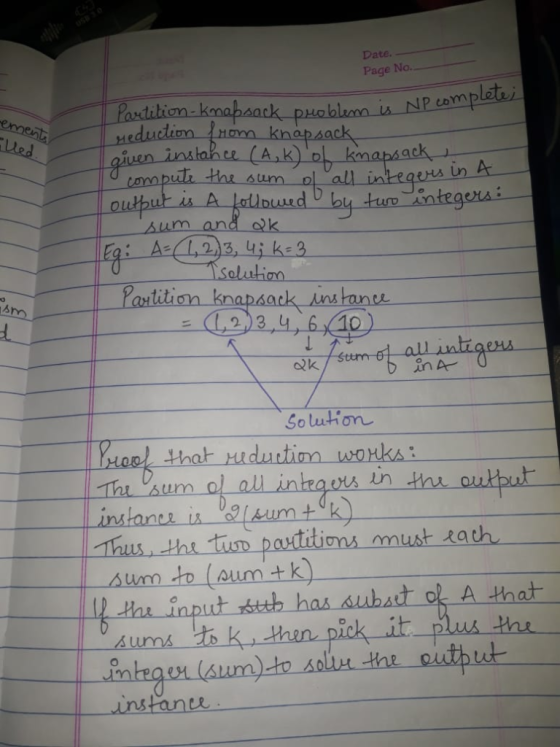
Automata and formal languages Starting with the knowledge that the Knapsack problem is NP-complet...
Automata and formal languages
Starting with the knowledge that the Knapsack problem is NP-complete, prove that the Parttion problem is NP-complete.?
Homework Answers
Add Answer to:
Automata and formal languages Starting with the knowledge that the Knapsack problem is NP-complet...
formal languages and automata Construct an NPDA for accepting the language L = {ww^R: we {a,...
 formal languages and automata
Construct an NPDA for accepting the language L = {ww^R: we {a, b}*}
formal languages and automata
Construct an NPDA for accepting the language L = {ww^R: we {a, b}*}
Formal languages and automata: Give a regular expression for L={anbm:n?2,m?1,nm?3}
Formal languages and automata: Give a regular expression for L={anbm:n?2,m?1,nm?3}
Show that the decision version of the knapsack problem is NP-complete. (Hint: In your reduction, make...
Show that the decision version of the knapsack problem is NP-complete. (Hint: In your reduction, make use of the partition problem: given n positive integers, partition them into two disjoint subsets with the same sum of their elements. The partition problem is NP-complete.)
Is the following problem NP-Complete? The Rice bowl problem is to pick the ingredients for your...
Is the following problem NP-Complete? The Rice bowl problem is to pick the ingredients for your bowl. You are given a set of ingredients I1 to In. Each ingredient Ii comes with a quality qi and a quantity si . You are also given a bowl size S and a quality goal Q. Can you select a subset of the ingredients that both fit in the bowl (the sum of their si is at most S) and have enough quality...
Introduction to Formal Languages and Automata Theory Course Study Question. Find the equivalent DFA from the...
 Introduction to Formal Languages and Automata Theory Course
Study Question.
Find the equivalent DFA from the following NFA which is represented by a transition diagram. The black state represents the final (accepting) state.
Introduction to Formal Languages and Automata Theory Course
Study Question.
Find the equivalent DFA from the following NFA which is represented by a transition diagram. The black state represents the final (accepting) state.
Formal Languages and Automata Theory Q2. Give context-free grammars that generate the following language: { w...
 Formal Languages and Automata Theory
Q2. Give context-free grammars that generate the following language: { w є {0, 1} | w contains at least three 1's)
Formal Languages and Automata Theory
Q2. Give context-free grammars that generate the following language: { w є {0, 1} | w contains at least three 1's)
Is the following problem NP-Complete? The Rice bowl problem is to pick the ingredients for your bowl. You are given a se...
Is the following problem NP-Complete? The Rice bowl problem is to pick the ingredients for your bowl. You are given a set of ingredients I1 to In. Each ingredient Ii comes with a quality qi and a quantity si . You are also given a bowl size S and a quality goal Q. Can you select a subset of the ingredients that both fit in the bowl (the sum of their si is at most S) and have enough quality...
The decision version of the Knapsack problem is as follows: Given a set of n items...
The decision version of the Knapsack problem is as follows: Given a set of n items {1, 2, …, n}, where each item j has a value v(j) and a weight w(j), and two numbers V and W, can we find a subset X of {1, 2, …, n} such that Σj∈X v(j) ≥ V and Σj∈X w(j) ≤ W? Prove formally that the Knapsack problem is NP-complete.
Formal Languages & Automata Theory 1411372 Pages 169, 170 Problems: 5, 13. 6.2 Two IMPORTANT NORMAL...
 Formal Languages & Automata Theory 1411372
Pages 169, 170
Problems: 5, 13.
6.2 Two IMPORTANT NORMAL FORMS 169 heorem 6.7 For every context-free grammar G with λ ¢ L (G), there exists an equivalent grammar G in Greibach noma or EXERCISES 5Convert the grammar / into Chomsky ormal for
Formal Languages & Automata Theory 1411372
Pages 169, 170
Problems: 5, 13.
6.2 Two IMPORTANT NORMAL FORMS 169 heorem 6.7 For every context-free grammar G with λ ¢ L (G), there exists an equivalent grammar G in Greibach noma or EXERCISES 5Convert the grammar / into Chomsky ormal for
Formal Languages & Automata Theory 1411372 Pages 133,134 Problems: 7(a,b), 8 (b,c) 5.1 CoNTEXT-FREE GRAMMARS 133...
 Formal Languages & Automata Theory 1411372
Pages 133,134
Problems: 7(a,b), 8 (b,c)
5.1 CoNTEXT-FREE GRAMMARS 133 EXERGISES 7. Find context-free grammars for the following languages (with n 2 0, m 0) (a) L = {a"b"": n < m + 3).
Formal Languages & Automata Theory 1411372
Pages 133,134
Problems: 7(a,b), 8 (b,c)
5.1 CoNTEXT-FREE GRAMMARS 133 EXERGISES 7. Find context-free grammars for the following languages (with n 2 0, m 0) (a) L = {a"b"": n < m + 3).
 formal languages and automata
Construct an NPDA for accepting the language L = {ww^R: we {a, b}*}
formal languages and automata
Construct an NPDA for accepting the language L = {ww^R: we {a, b}*}
 Introduction to Formal Languages and Automata Theory Course
Study Question.
Find the equivalent DFA from the following NFA which is represented by a transition diagram. The black state represents the final (accepting) state.
Introduction to Formal Languages and Automata Theory Course
Study Question.
Find the equivalent DFA from the following NFA which is represented by a transition diagram. The black state represents the final (accepting) state.
 Formal Languages and Automata Theory
Q2. Give context-free grammars that generate the following language: { w є {0, 1} | w contains at least three 1's)
Formal Languages and Automata Theory
Q2. Give context-free grammars that generate the following language: { w є {0, 1} | w contains at least three 1's)
 Formal Languages & Automata Theory 1411372
Pages 169, 170
Problems: 5, 13.
6.2 Two IMPORTANT NORMAL FORMS 169 heorem 6.7 For every context-free grammar G with λ ¢ L (G), there exists an equivalent grammar G in Greibach noma or EXERCISES 5Convert the grammar / into Chomsky ormal for
Formal Languages & Automata Theory 1411372
Pages 169, 170
Problems: 5, 13.
6.2 Two IMPORTANT NORMAL FORMS 169 heorem 6.7 For every context-free grammar G with λ ¢ L (G), there exists an equivalent grammar G in Greibach noma or EXERCISES 5Convert the grammar / into Chomsky ormal for
 Formal Languages & Automata Theory 1411372
Pages 133,134
Problems: 7(a,b), 8 (b,c)
5.1 CoNTEXT-FREE GRAMMARS 133 EXERGISES 7. Find context-free grammars for the following languages (with n 2 0, m 0) (a) L = {a"b"": n < m + 3).
Formal Languages & Automata Theory 1411372
Pages 133,134
Problems: 7(a,b), 8 (b,c)
5.1 CoNTEXT-FREE GRAMMARS 133 EXERGISES 7. Find context-free grammars for the following languages (with n 2 0, m 0) (a) L = {a"b"": n < m + 3).
Most questions answered within 3 hours.
-
Where is the error in this code sequence?
String s1 = "Hello";
String s2 = "ello";...
asked 11 months ago -
Financial data for Joel de Paris, Inc., for last year
follow:
Joel de Paris, Inc.
Balance...
asked 11 months ago -
Consider this reaction:
Al2(SO4)3 (aq)+ BaCl3
(aq) Al2Cl6 (aq)- +
3BaSO4(s) . What is the...
asked 11 months ago -
Suppose that Savneet is considering increasing her
recent random sample from 20 car rentals to 40...
asked 11 months ago -
Trucks arrive at an unloading terminal at an average rate of 120
per hour.
Trucks arrive...
asked 11 months ago -
Why are methanol and ethanol completely soluble in water while
octanol is not very little soluble....
asked 11 months ago -
A facilities manager at a university reads in a research report
that the mean amount of...
asked 11 months ago -
When the CuSO4 is rehydrated by adding water to the anhydrous
compound, is this an endothermic...
asked 11 months ago -
A ray of sunlight is passing from diamond into crown glass; the
angle of incidence is...
asked 11 months ago -
A block of mass 0.249 kg is placed on top of a light, vertical
spring of...
asked 11 months ago -
how do the kidneys compensate in the presences of acidosis
a) trigger hyperventilate
b) reserve acid...
asked 11 months ago -
Question 501 pts
The rental rate of capital to the firm increases. Which of the
following...
asked 11 months ago