Consider the following guessing game and rules: • You and your opponent simultaneously submit gue...
Consider the following guessing game and rules: • You and your opponent simultaneously submit guesses that must be whole numbers between 11 and 20 (inclusive). • You earn a base prize equal to the number you declare. (So if you say 12, you earn 12 dollars.) • You earn a bonus of 20 dollars if your guess is exactly one less than your opponent’s guess.
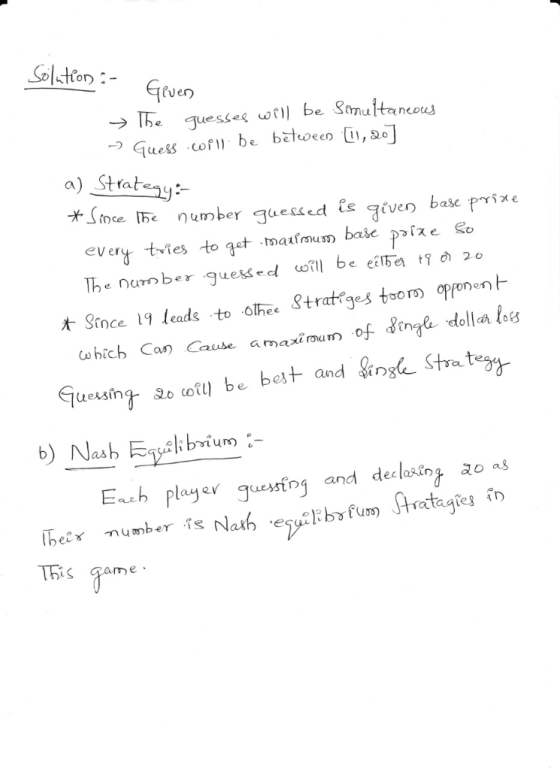
(a) Does a player in this game have any dominant or dominated strategies?
(b) What are the Nash Equilibria of this game? Justify why these are equilibria
Homework Answers
Add Answer to:
Consider the following guessing game and rules: • You and your opponent simultaneously submit gue...
Number Guessing Game Games Write program in C++. For this game, the computer will select a...
Number Guessing Game Games Write program in C++. For this game, the computer will select a random number between 1 and 100 (inclusive). The computer will then ask the (human) player to guess the number the computer has selected. After the player’s guess is input to the computer, the computer will output one of three responses, depending on the relationship of the number the player guessed to the number the computer selected: “Your guess was too low.” “Your guess was...
Question 1 a) First consider the following game, where each player plays either C (Confess) or D ...
 Question 1 a) First consider the following game, where each player plays either C (Confess) or D (Deny) and the numbers in brackets are the respective payoffs to player 1 and player 2. Player 2 Player 1 (0-12) (-12,0) In relation to the above game outline the concepts of - Dominated strategies - Best responses - Nash equilibrium/equilibria - A prisoner's dilemma b) Define what is meant by subgame perfection and how the concept of credibility can be used to...
Q2 Contribution Game Consider the following game. There are four players. Each player i (wherei 1,2,3,4)...
 Q2 Contribution Game Consider the following game. There are four players. Each player i (wherei 1,2,3,4) si multaneously and independently selects her contribution s E [0, 10]. Each player gets a benefit related to all of the players choices of s,'s, but incurs a cost related to her own contribution s In particular, the payoff to each player i is given by: ul (s1 , s2, s3, s.) = si + s2 + s3 + 84-0.5s (a) Find best response...
1. (20 points) Consider the following game: Left 7,17 10,5 4,4 Top Middle Bottom Player B...
 1. (20 points) Consider the following game: Left 7,17 10,5 4,4 Top Middle Bottom Player B Middle 21,21 14,4 7,3 Right 14,11 4,3 10,25 Player A a. Does either player have a dominant strategy? What about a dominated strategy? b. What are the Nash equilibria of this game? C. Is there one Nash equilibrium that you think is a more likely outcome than the others? If so, why? If not, why not? d. Now suppose the game looks like this:...
First part: Consider the following two-player game. The players simultaneously and independently announce an integer number...
 First part: Consider the following two-player game. The players simultaneously and independently announce an integer number between 1 and 100, and each player's payoff is the product of the two numbers announced. (a) Describe the best responses of this game. How many Nash equilibria does the game have? Explain. (b) Now, consider the following variation of the game: first, Player 1 can choose either to "Stop" or "Con- tinue". If she chooses "Stop", then the game ends with the pair...
(20 points) Exercise 3: (Midterm 2018) Consider the following normal-form game, where the pure strategies for...
 (20 points) Exercise 3: (Midterm 2018) Consider the following normal-form game, where the pure strategies for Player 1 are U, M, and D, and the pure strategies for Player 2 are L, C, and R. The first payoff in each cell of the matrix belongs to Player 1, and the second one belongs to Player 2. Player 2 IL CR u 6,8 2,6 8,2 Player 1 M 8,2 4,4 9,5 8,10 4,6 6,7 (7) a) Find the strictly dominated (pure)...
Using C programming REQUIREMENTS: This program is a letter guessing game where a simple Al opponent...
 Using C programming
REQUIREMENTS: This program is a letter guessing game where a simple Al opponent generates a secret letter for the user to guess. The user must be able to take turns guessing the secret letter, with the Al responding to the user's guesses. After successfully guessing, the user must be allowed to play again. The Al must count how many turns the user has taken. Here is an example of a game in progress where the human user...
Using C programming
REQUIREMENTS: This program is a letter guessing game where a simple Al opponent generates a secret letter for the user to guess. The user must be able to take turns guessing the secret letter, with the Al responding to the user's guesses. After successfully guessing, the user must be allowed to play again. The Al must count how many turns the user has taken. Here is an example of a game in progress where the human user...
For your Project, you will develop a simple battleship game. Battleship is a guessing game for...
For your Project, you will develop a simple battleship game. Battleship is a guessing game for two players. It is played on four grids. Two grids (one for each player) are used to mark each players' fleets of ships (including battleships). The locations of the fleet (these first two grids) are concealed from the other player so that they do not know the locations of the opponent’s ships. Players alternate turns by ‘firing torpedoes’ at the other player's ships. The...
1 Consider the following normal-form game. P2 L CR P M (a) Does Pl (player 1)...
 1 Consider the following normal-form game. P2 L CR P M (a) Does Pl (player 1) have any dominated strategies? (b) Does P2 (player 2) have any dominated strategies? (c) Suppose l2 beleves that Pl is rational, should P2 believe P1 will ever play B? (d) Suppose player P2 rales out the possibility that Pl plays B, is there a dominated ECON 306 Page 2 of 12 2018 strategy for player P2? (e) Can yoa find any more eliminated strategies...
Exercise 6 (Difficult),. Consider the following modification of the prisoner's dilemma game. A-1,...
 Exercise 6 (Difficult),. Consider the following modification of the prisoner's dilemma game. A-1,-1-9,0-6,-2 B | 0,-9 |-6-61-5-10 C1-2,-6 |-10,-51-4,-4 You should recognise the payoff's from (A, L), (A, R). (B, L). (B, R) as those in the prisoner's dilemma game studied in class. We added two strategies, one for each player. Also note that strategies A and L are still (when compared to the original prisoner's dilemma game) strictly dominated . What is the set of Nash equilibria of this...
 Question 1 a) First consider the following game, where each player plays either C (Confess) or D (Deny) and the numbers in brackets are the respective payoffs to player 1 and player 2. Player 2 Player 1 (0-12) (-12,0) In relation to the above game outline the concepts of - Dominated strategies - Best responses - Nash equilibrium/equilibria - A prisoner's dilemma b) Define what is meant by subgame perfection and how the concept of credibility can be used to...
 Q2 Contribution Game Consider the following game. There are four players. Each player i (wherei 1,2,3,4) si multaneously and independently selects her contribution s E [0, 10]. Each player gets a benefit related to all of the players choices of s,'s, but incurs a cost related to her own contribution s In particular, the payoff to each player i is given by: ul (s1 , s2, s3, s.) = si + s2 + s3 + 84-0.5s (a) Find best response...
 1. (20 points) Consider the following game: Left 7,17 10,5 4,4 Top Middle Bottom Player B Middle 21,21 14,4 7,3 Right 14,11 4,3 10,25 Player A a. Does either player have a dominant strategy? What about a dominated strategy? b. What are the Nash equilibria of this game? C. Is there one Nash equilibrium that you think is a more likely outcome than the others? If so, why? If not, why not? d. Now suppose the game looks like this:...
 First part: Consider the following two-player game. The players simultaneously and independently announce an integer number between 1 and 100, and each player's payoff is the product of the two numbers announced. (a) Describe the best responses of this game. How many Nash equilibria does the game have? Explain. (b) Now, consider the following variation of the game: first, Player 1 can choose either to "Stop" or "Con- tinue". If she chooses "Stop", then the game ends with the pair...
 (20 points) Exercise 3: (Midterm 2018) Consider the following normal-form game, where the pure strategies for Player 1 are U, M, and D, and the pure strategies for Player 2 are L, C, and R. The first payoff in each cell of the matrix belongs to Player 1, and the second one belongs to Player 2. Player 2 IL CR u 6,8 2,6 8,2 Player 1 M 8,2 4,4 9,5 8,10 4,6 6,7 (7) a) Find the strictly dominated (pure)...
 Using C programming
REQUIREMENTS: This program is a letter guessing game where a simple Al opponent generates a secret letter for the user to guess. The user must be able to take turns guessing the secret letter, with the Al responding to the user's guesses. After successfully guessing, the user must be allowed to play again. The Al must count how many turns the user has taken. Here is an example of a game in progress where the human user...
Using C programming
REQUIREMENTS: This program is a letter guessing game where a simple Al opponent generates a secret letter for the user to guess. The user must be able to take turns guessing the secret letter, with the Al responding to the user's guesses. After successfully guessing, the user must be allowed to play again. The Al must count how many turns the user has taken. Here is an example of a game in progress where the human user...
 1 Consider the following normal-form game. P2 L CR P M (a) Does Pl (player 1) have any dominated strategies? (b) Does P2 (player 2) have any dominated strategies? (c) Suppose l2 beleves that Pl is rational, should P2 believe P1 will ever play B? (d) Suppose player P2 rales out the possibility that Pl plays B, is there a dominated ECON 306 Page 2 of 12 2018 strategy for player P2? (e) Can yoa find any more eliminated strategies...
 Exercise 6 (Difficult),. Consider the following modification of the prisoner's dilemma game. A-1,-1-9,0-6,-2 B | 0,-9 |-6-61-5-10 C1-2,-6 |-10,-51-4,-4 You should recognise the payoff's from (A, L), (A, R). (B, L). (B, R) as those in the prisoner's dilemma game studied in class. We added two strategies, one for each player. Also note that strategies A and L are still (when compared to the original prisoner's dilemma game) strictly dominated . What is the set of Nash equilibria of this...
Most questions answered within 3 hours.
-
Where is the error in this code sequence?
String s1 = "Hello";
String s2 = "ello";...
asked 10 months ago -
Financial data for Joel de Paris, Inc., for last year
follow:
Joel de Paris, Inc.
Balance...
asked 10 months ago -
Consider this reaction:
Al2(SO4)3 (aq)+ BaCl3
(aq) Al2Cl6 (aq)- +
3BaSO4(s) . What is the...
asked 10 months ago -
Suppose that Savneet is considering increasing her
recent random sample from 20 car rentals to 40...
asked 10 months ago -
Trucks arrive at an unloading terminal at an average rate of 120
per hour.
Trucks arrive...
asked 10 months ago -
Why are methanol and ethanol completely soluble in water while
octanol is not very little soluble....
asked 10 months ago -
A facilities manager at a university reads in a research report
that the mean amount of...
asked 10 months ago -
When the CuSO4 is rehydrated by adding water to the anhydrous
compound, is this an endothermic...
asked 10 months ago -
A ray of sunlight is passing from diamond into crown glass; the
angle of incidence is...
asked 10 months ago -
A block of mass 0.249 kg is placed on top of a light, vertical
spring of...
asked 10 months ago -
how do the kidneys compensate in the presences of acidosis
a) trigger hyperventilate
b) reserve acid...
asked 10 months ago -
Question 501 pts
The rental rate of capital to the firm increases. Which of the
following...
asked 10 months ago