
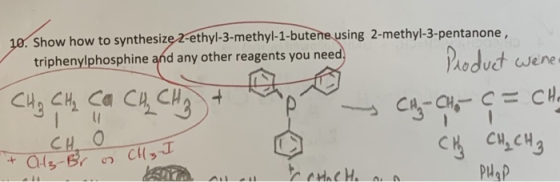
Show how to synthesize 2-ethyl-3-methyl-1-butene using 2-methyl-3-pentan triphenylphosphine and any other reagents you need one Podut vene CH O CH CH,CH 3
Homework Answers

PCC is a mild oxidising agent and oxidize the Alcohol to aldehyde. Then Grignard reagent is more reactive towards aldehyde than Ketone. Hence grigGrig reagent gives secondary alcohol with aldehyde first then protection of alcohol by ether since OH is Grignard reagent sensitive. Then reaction of ketone with Grignard reagent gives tertiary alcohol them followed by deprotection of Ether by Lewis acid.
11. Synthesis of Phosphorus ylide with methyl bromide then Wittig reaction gives required alkene.
Add Answer to:
Extra credit (10 pts) 2140 b Show how to synthesize 2-methyl-2,6-heptandiol from 5-hydroxy-2-pent...
Extra Credit: There will be no partial credit. Answers must be correct. (10 pts) Show how you would accomplish the...
 Extra Credit: There will be no partial credit. Answers must be correct. (10 pts) Show how you would accomplish the following synthetic conversion starting with ethanol as the only source of organic carbon atoms. You may use any necessary inorganic reagent and solvent. Show all reaction steps, reagents and conditions used. он ethanol OH 4-methylheptan-4-ol
1. Which Wittig reagent would be used to synthesize 2 CH-CH=P(CAH) CH=P(CHẠh. P(CH3)3 CH,CH,CH-P(CH3)3 IV 2....
 1. Which Wittig reagent would be used to synthesize 2 CH-CH=P(CAH) CH=P(CHẠh. P(CH3)3 CH,CH,CH-P(CH3)3 IV 2. What is the correct IUPAC name for the following compound? 6 eye 3. What is the correct structure for 7-methyl-4-octanone? 3 4. The products, D and E, of the following reaction sequence, S "CN HCI HCN CH.NO H20 heat would be: CH2CH2CN CH,CH,MgBe HO E ? ether Show how you would synthesize the following compound, beginning with 1-butene, Bromobenzene and any necessary additional reagents....
Using methyl iodide, CH3I, and sodium acetylide as the sources of carbon atoms, show how to synthesize meso-2,3-dibromob...
 Using methyl iodide, CH3I, and sodium acetylide as
the sources of carbon atoms, show how to synthesize
meso-2,3-dibromobutane. You may use any other needed reagents or
solvents, provided they do not supply carbon atoms to the final
product. About 5 steps are required. Please write out the formulas
of the reagents.
Free Response (10 pts each) Read instructions carefully and write out your answers in detail. 1. Using methyl iodide, CHI, and sodium acetylide, Nat:CECH, as the sources of carbon...
Using methyl iodide, CH3I, and sodium acetylide as
the sources of carbon atoms, show how to synthesize
meso-2,3-dibromobutane. You may use any other needed reagents or
solvents, provided they do not supply carbon atoms to the final
product. About 5 steps are required. Please write out the formulas
of the reagents.
Free Response (10 pts each) Read instructions carefully and write out your answers in detail. 1. Using methyl iodide, CHI, and sodium acetylide, Nat:CECH, as the sources of carbon...
Extra Credit: There will be no partial credit. Answers must be correct. (10 pts) Show how...
 Extra Credit: There will be no partial credit. Answers must be correct. (10 pts) Show how you would accomplish the following synthetic conversion starting with ethanol as the only source of organic carbon atoms. You may use any necessary inorganic reagent and solvent. Show all reaction steps, reagents and conditions used. OH ethanol 4-methylheptan-4-01
Extra Credit: There will be no partial credit. Answers must be correct. (10 pts) Show how...
 Extra Credit: There will be no partial credit. Answers must be correct. (10 pts) Show how you would accomplish the following synthetic conversion starting with ethanol as the only source of organic carbon atoms. You may use any necessary inorganic reagent and solvent. Show all reaction steps, reagents and conditions used. OH ethanol 4-methylheptan-4-ol
Extra Credit: There will be no partial credit. Answers must be correct. (10 pts) Show how...
 Extra Credit: There will be no partial credit. Answers must be correct. (10 pts) Show how you would accomplish the following synthetic conversion starting with ethanol as the only source of organic carbon atoms. You may use any necessary inorganic reagent and solvent. Show all reaction steps, reagents and conditions used. OH ethanol 4-methylheptan-4-ol
Extra Credit: There will be no partial credit. Answers must be correct. (10 pts) Show how...
 Extra Credit: There will be no partial credit. Answers must be correct. (10 pts) Show how you would accomplish the following synthetic conversion starting with ethanol as the only source of organic carbon atoms. You may use any necessary inorganic reagent and solvent. Show all reaction steps, reagents and conditions used. OH ethanol OH 4-methylheptan-4-ol
Extra Credit: There will be no partial credit. Answers must be correct. (10 pts) Show how...
 Extra Credit: There will be no partial credit. Answers must be correct. (10 pts) Show how you would accomplish the following synthetic conversion starting with ethanol as the only source of organic carbon atoms. You may use any necessary inorganic reagent and solvent. Show all reaction steps, reagents and conditions used. OH OH ethanol 4-methylheptan-4-ol
Extra Credit: There will be no partial credit. Answers must be correct. (10 pts) Show how...
 Extra Credit: There will be no partial credit. Answers must be correct. (10 pts) Show how you would accomplish the following synthetic conversion starting with ethanol as the only source of organic carbon atoms. You may use any necessary inorganic reagent and solvent. Show all reaction steps, reagents and conditions used. OH ethanol OH 4-methylheptan-4-ol
Extra Credit: There will be no partial credit. Answers must be correct. (10 pts) Show how...
 Extra Credit: There will be no partial credit. Answers must be correct. (10 pts) Show how you would accomplish the following synthetic conversion starting with ethanol as the only source of organic carbon atoms. You may use any necessary inorganic reagent and solvent. Show all reaction steps, reagents and conditions used. OH OH ethanol 4-methylheptan-4-ol
 Extra Credit: There will be no partial credit. Answers must be correct. (10 pts) Show how you would accomplish the following synthetic conversion starting with ethanol as the only source of organic carbon atoms. You may use any necessary inorganic reagent and solvent. Show all reaction steps, reagents and conditions used. он ethanol OH 4-methylheptan-4-ol
 1. Which Wittig reagent would be used to synthesize 2 CH-CH=P(CAH) CH=P(CHẠh. P(CH3)3 CH,CH,CH-P(CH3)3 IV 2. What is the correct IUPAC name for the following compound? 6 eye 3. What is the correct structure for 7-methyl-4-octanone? 3 4. The products, D and E, of the following reaction sequence, S "CN HCI HCN CH.NO H20 heat would be: CH2CH2CN CH,CH,MgBe HO E ? ether Show how you would synthesize the following compound, beginning with 1-butene, Bromobenzene and any necessary additional reagents....
 Using methyl iodide, CH3I, and sodium acetylide as
the sources of carbon atoms, show how to synthesize
meso-2,3-dibromobutane. You may use any other needed reagents or
solvents, provided they do not supply carbon atoms to the final
product. About 5 steps are required. Please write out the formulas
of the reagents.
Free Response (10 pts each) Read instructions carefully and write out your answers in detail. 1. Using methyl iodide, CHI, and sodium acetylide, Nat:CECH, as the sources of carbon...
Using methyl iodide, CH3I, and sodium acetylide as
the sources of carbon atoms, show how to synthesize
meso-2,3-dibromobutane. You may use any other needed reagents or
solvents, provided they do not supply carbon atoms to the final
product. About 5 steps are required. Please write out the formulas
of the reagents.
Free Response (10 pts each) Read instructions carefully and write out your answers in detail. 1. Using methyl iodide, CHI, and sodium acetylide, Nat:CECH, as the sources of carbon...
 Extra Credit: There will be no partial credit. Answers must be correct. (10 pts) Show how you would accomplish the following synthetic conversion starting with ethanol as the only source of organic carbon atoms. You may use any necessary inorganic reagent and solvent. Show all reaction steps, reagents and conditions used. OH ethanol 4-methylheptan-4-01
 Extra Credit: There will be no partial credit. Answers must be correct. (10 pts) Show how you would accomplish the following synthetic conversion starting with ethanol as the only source of organic carbon atoms. You may use any necessary inorganic reagent and solvent. Show all reaction steps, reagents and conditions used. OH ethanol 4-methylheptan-4-ol
 Extra Credit: There will be no partial credit. Answers must be correct. (10 pts) Show how you would accomplish the following synthetic conversion starting with ethanol as the only source of organic carbon atoms. You may use any necessary inorganic reagent and solvent. Show all reaction steps, reagents and conditions used. OH ethanol 4-methylheptan-4-ol
 Extra Credit: There will be no partial credit. Answers must be correct. (10 pts) Show how you would accomplish the following synthetic conversion starting with ethanol as the only source of organic carbon atoms. You may use any necessary inorganic reagent and solvent. Show all reaction steps, reagents and conditions used. OH ethanol OH 4-methylheptan-4-ol
 Extra Credit: There will be no partial credit. Answers must be correct. (10 pts) Show how you would accomplish the following synthetic conversion starting with ethanol as the only source of organic carbon atoms. You may use any necessary inorganic reagent and solvent. Show all reaction steps, reagents and conditions used. OH OH ethanol 4-methylheptan-4-ol
 Extra Credit: There will be no partial credit. Answers must be correct. (10 pts) Show how you would accomplish the following synthetic conversion starting with ethanol as the only source of organic carbon atoms. You may use any necessary inorganic reagent and solvent. Show all reaction steps, reagents and conditions used. OH ethanol OH 4-methylheptan-4-ol
 Extra Credit: There will be no partial credit. Answers must be correct. (10 pts) Show how you would accomplish the following synthetic conversion starting with ethanol as the only source of organic carbon atoms. You may use any necessary inorganic reagent and solvent. Show all reaction steps, reagents and conditions used. OH OH ethanol 4-methylheptan-4-ol
Most questions answered within 3 hours.
-
Where is the error in this code sequence?
String s1 = "Hello";
String s2 = "ello";...
asked 11 months ago -
Financial data for Joel de Paris, Inc., for last year
follow:
Joel de Paris, Inc.
Balance...
asked 11 months ago -
Consider this reaction:
Al2(SO4)3 (aq)+ BaCl3
(aq) Al2Cl6 (aq)- +
3BaSO4(s) . What is the...
asked 11 months ago -
Suppose that Savneet is considering increasing her
recent random sample from 20 car rentals to 40...
asked 11 months ago -
Trucks arrive at an unloading terminal at an average rate of 120
per hour.
Trucks arrive...
asked 11 months ago -
Why are methanol and ethanol completely soluble in water while
octanol is not very little soluble....
asked 11 months ago -
A facilities manager at a university reads in a research report
that the mean amount of...
asked 11 months ago -
When the CuSO4 is rehydrated by adding water to the anhydrous
compound, is this an endothermic...
asked 11 months ago -
A ray of sunlight is passing from diamond into crown glass; the
angle of incidence is...
asked 11 months ago -
A block of mass 0.249 kg is placed on top of a light, vertical
spring of...
asked 11 months ago -
how do the kidneys compensate in the presences of acidosis
a) trigger hyperventilate
b) reserve acid...
asked 11 months ago -
Question 501 pts
The rental rate of capital to the firm increases. Which of the
following...
asked 11 months ago