Show that a 20-gon is constructible using a compass and straight-edge (cos(5t) in terms if cos(t)...
Show that a 20-gon is constructible using a compass and straight-edge (cos(5t) in terms if cos(t) polynomial?
Homework Answers
![K, splittin a field of x.leatx] Re sutt: α is conshoch ble, them,i mal ot.2 co n.grv с, сトa](http://img.homeworklib.com/images/0b2af122-5a71-4d73-afc9-db2189ac9f3a.png?x-oss-process=image/resize,w_560)
Add Answer to:
Show that a 20-gon is constructible using a compass and straight-edge (cos(5t) in terms if cos(t)...
Using a compass and a straight edge only, a.) Construct a triangle ABC where side BC is of length...
 Using a compass and a straight edge only, a.) Construct a triangle ABC where side BC is of length 2, the circumradius is of length 3/2 and the median AA' is of length 2 such that A' is the midpoint of BC. Note thata segment of length 1 is posted below and must be used) b) Write out step by step instructions of how to construct the figure in part (a) c.) Prove your results
Using a compass and a...
Using a compass and a straight edge only, a.) Construct a triangle ABC where side BC is of length 2, the circumradius is of length 3/2 and the median AA' is of length 2 such that A' is the midpoint of BC. Note thata segment of length 1 is posted below and must be used) b) Write out step by step instructions of how to construct the figure in part (a) c.) Prove your results
Using a compass and a...
2. Consider the signal f(t) = 20 cos(5t) + cos(9t) sin(5t) - 7 (a) What is the highest angular frequency present in thi...
 2. Consider the signal f(t) = 20 cos(5t) + cos(9t) sin(5t) - 7 (a) What is the highest angular frequency present in this signal? What is the highest numerical frequency present in this signal? (b) What is the Nyquist frequency? rate for this signal? Did you use the angular or the numerical (c) If you sample this signal with sampling period T, which values of T may you choose to be in accordance with the Nyquist rate? Choose and fix...
Using a compass and a straight edge only, a.) Construct a triangle ABC where side BC is of length...
 Using a compass and a straight edge only,
a.) Construct a triangle ABC where side BC is of length 2, the
circumradius is of length 3/2 and the median AA' is of length 2
such that A' is the midpoint of BC. Note that a segment of length 1
is posted below and must be used)
b) Write out step by step instructions of how to construct the
figure in part (a)
c.) Prove your results
Using a compass and a straight edge only,
a.) Construct a triangle ABC where side BC is of length 2, the
circumradius is of length 3/2 and the median AA' is of length 2
such that A' is the midpoint of BC. Note that a segment of length 1
is posted below and must be used)
b) Write out step by step instructions of how to construct the
figure in part (a)
c.) Prove your results
A. By hand, find the Fourier transform of g(t)-cos(4t)+ cos(5t) Page 2 of3 B. Now assume that g(t...
 A. By hand, find the Fourier transform of g(t)-cos(4t)+ cos(5t) Page 2 of3 B. Now assume that g(t) can be observed for only a finite time, say T seconds. Then, t-T/2 what we observe is actually y(t) g (t)rect . Find (analytically) the Fourier transtorm of y(t). Write your answer in terms of sinc functions.
A. By hand, find the Fourier transform of g(t)-cos(4t)+ cos(5t) Page 2 of3 B. Now assume that g(t) can be observed for only a finite...
A. By hand, find the Fourier transform of g(t)-cos(4t)+ cos(5t) Page 2 of3 B. Now assume that g(t) can be observed for only a finite time, say T seconds. Then, t-T/2 what we observe is actually y(t) g (t)rect . Find (analytically) the Fourier transtorm of y(t). Write your answer in terms of sinc functions.
A. By hand, find the Fourier transform of g(t)-cos(4t)+ cos(5t) Page 2 of3 B. Now assume that g(t) can be observed for only a finite...
Ans =sqrt(2)cos(10^7t)cos(2.5*10^5t-pi/4) Plz show all the steps In the circuit below, assume that 1,0) = (1...
 Ans =sqrt(2)cos(10^7t)cos(2.5*10^5t-pi/4)
Plz show all the steps
In the circuit below, assume that 1,0) = (1 mA) cos25x 105) cos(107t). Find v (t). i (t) 10 uH 1000 pF Hint: from trigonometry, cos(a + b) = cos(a) cos(b)-sin(a) sin(b) cos(a-b) = cos(a) cos(b) + sin(a) sin(b) Adding these two equations removes the sin terms, giving cos(a + b) + cos(a-b) = 2 cos(a) cos(b) Therefore, a signal that is the product of two cosine waveforms at given frequen- cies can...
Ans =sqrt(2)cos(10^7t)cos(2.5*10^5t-pi/4)
Plz show all the steps
In the circuit below, assume that 1,0) = (1 mA) cos25x 105) cos(107t). Find v (t). i (t) 10 uH 1000 pF Hint: from trigonometry, cos(a + b) = cos(a) cos(b)-sin(a) sin(b) cos(a-b) = cos(a) cos(b) + sin(a) sin(b) Adding these two equations removes the sin terms, giving cos(a + b) + cos(a-b) = 2 cos(a) cos(b) Therefore, a signal that is the product of two cosine waveforms at given frequen- cies can...
Using Excel, plot the function f(t)=3*cos(500*π*t) + 5*cos(800*π*t) from 00025 to .1s at .0025s intervals. Connect...
Using Excel, plot the function f(t)=3*cos(500*π*t) + 5*cos(800*π*t) from 00025 to .1s at .0025s intervals. Connect the points with straight lines. Explain the shape of the resulting plot. Find the FFT using Microsoft Excel.
(a) Approximate the function f(x) = cos(z) using the first three non-zero terms of its Taylor...
 (a) Approximate the function f(x) = cos(z) using the first three non-zero terms of its Taylor series centered at a = 0. The potential energy of a spring system can be written as U (t) = KA2 cosa(wt), where t is time, w is the frequency of the spring, A is the amplitude and k is the spring constant. Use the Taylor approximation you obtained to show that near the beginning of the spring's trajectory, the potential energy can be...
Use the equation below to answer the following question(s) x(t) = cos(a)t)u(t) 4. Using the definition...
 Use the equation below to answer the following question(s) x(t) = cos(a)t)u(t) 4. Using the definition of the Laplace Transform, what is the Laplace Transform of the function above? (Note Y ou must show all work in deriving the transform. You will get no points for picking the correct choice only!) ( +20) c. s2 +203 s2 +23 23
Let a system have impulse response h(t) and input x(t) given by (1257) (37704) +20 cos...
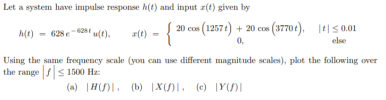 Let a system have impulse response h(t) and input x(t) given by (1257) (37704) +20 cos t0.01 20 cos C = 628 e-628t u(t), h(t) r(t) 0, else Using the same frequency scale (you can use different magnitude scales), plot the following over the range 1500 Hz (a) Hf) (b) X(f)(e) |Y(f)|
P-3.8 Consider the signal ob d x (t) = 10 + 20 cos(21 (100)t + )...
 P-3.8 Consider the signal ob d x (t) = 10 + 20 cos(21 (100)t + ) + 10 cos(21 (250)t) L (a) Using Euler's relation, the signal x(t) defined above can be expressed as a sum of complex exponential signals using the finite Fourier synthesis summation (3.37) Determine values for fo, N, and all the complex amplitudes, az. It is not necessary to evaluate any integrals to obtain ak. (b) Is the signal x(t) periodic? If so, what is the...
 Using a compass and a straight edge only, a.) Construct a triangle ABC where side BC is of length 2, the circumradius is of length 3/2 and the median AA' is of length 2 such that A' is the midpoint of BC. Note thata segment of length 1 is posted below and must be used) b) Write out step by step instructions of how to construct the figure in part (a) c.) Prove your results
Using a compass and a...
Using a compass and a straight edge only, a.) Construct a triangle ABC where side BC is of length 2, the circumradius is of length 3/2 and the median AA' is of length 2 such that A' is the midpoint of BC. Note thata segment of length 1 is posted below and must be used) b) Write out step by step instructions of how to construct the figure in part (a) c.) Prove your results
Using a compass and a...
 2. Consider the signal f(t) = 20 cos(5t) + cos(9t) sin(5t) - 7 (a) What is the highest angular frequency present in this signal? What is the highest numerical frequency present in this signal? (b) What is the Nyquist frequency? rate for this signal? Did you use the angular or the numerical (c) If you sample this signal with sampling period T, which values of T may you choose to be in accordance with the Nyquist rate? Choose and fix...
 Using a compass and a straight edge only,
a.) Construct a triangle ABC where side BC is of length 2, the
circumradius is of length 3/2 and the median AA' is of length 2
such that A' is the midpoint of BC. Note that a segment of length 1
is posted below and must be used)
b) Write out step by step instructions of how to construct the
figure in part (a)
c.) Prove your results
Using a compass and a straight edge only,
a.) Construct a triangle ABC where side BC is of length 2, the
circumradius is of length 3/2 and the median AA' is of length 2
such that A' is the midpoint of BC. Note that a segment of length 1
is posted below and must be used)
b) Write out step by step instructions of how to construct the
figure in part (a)
c.) Prove your results
 A. By hand, find the Fourier transform of g(t)-cos(4t)+ cos(5t) Page 2 of3 B. Now assume that g(t) can be observed for only a finite time, say T seconds. Then, t-T/2 what we observe is actually y(t) g (t)rect . Find (analytically) the Fourier transtorm of y(t). Write your answer in terms of sinc functions.
A. By hand, find the Fourier transform of g(t)-cos(4t)+ cos(5t) Page 2 of3 B. Now assume that g(t) can be observed for only a finite...
A. By hand, find the Fourier transform of g(t)-cos(4t)+ cos(5t) Page 2 of3 B. Now assume that g(t) can be observed for only a finite time, say T seconds. Then, t-T/2 what we observe is actually y(t) g (t)rect . Find (analytically) the Fourier transtorm of y(t). Write your answer in terms of sinc functions.
A. By hand, find the Fourier transform of g(t)-cos(4t)+ cos(5t) Page 2 of3 B. Now assume that g(t) can be observed for only a finite...
 Ans =sqrt(2)cos(10^7t)cos(2.5*10^5t-pi/4)
Plz show all the steps
In the circuit below, assume that 1,0) = (1 mA) cos25x 105) cos(107t). Find v (t). i (t) 10 uH 1000 pF Hint: from trigonometry, cos(a + b) = cos(a) cos(b)-sin(a) sin(b) cos(a-b) = cos(a) cos(b) + sin(a) sin(b) Adding these two equations removes the sin terms, giving cos(a + b) + cos(a-b) = 2 cos(a) cos(b) Therefore, a signal that is the product of two cosine waveforms at given frequen- cies can...
Ans =sqrt(2)cos(10^7t)cos(2.5*10^5t-pi/4)
Plz show all the steps
In the circuit below, assume that 1,0) = (1 mA) cos25x 105) cos(107t). Find v (t). i (t) 10 uH 1000 pF Hint: from trigonometry, cos(a + b) = cos(a) cos(b)-sin(a) sin(b) cos(a-b) = cos(a) cos(b) + sin(a) sin(b) Adding these two equations removes the sin terms, giving cos(a + b) + cos(a-b) = 2 cos(a) cos(b) Therefore, a signal that is the product of two cosine waveforms at given frequen- cies can...
 (a) Approximate the function f(x) = cos(z) using the first three non-zero terms of its Taylor series centered at a = 0. The potential energy of a spring system can be written as U (t) = KA2 cosa(wt), where t is time, w is the frequency of the spring, A is the amplitude and k is the spring constant. Use the Taylor approximation you obtained to show that near the beginning of the spring's trajectory, the potential energy can be...
 Use the equation below to answer the following question(s) x(t) = cos(a)t)u(t) 4. Using the definition of the Laplace Transform, what is the Laplace Transform of the function above? (Note Y ou must show all work in deriving the transform. You will get no points for picking the correct choice only!) ( +20) c. s2 +203 s2 +23 23
 Let a system have impulse response h(t) and input x(t) given by (1257) (37704) +20 cos t0.01 20 cos C = 628 e-628t u(t), h(t) r(t) 0, else Using the same frequency scale (you can use different magnitude scales), plot the following over the range 1500 Hz (a) Hf) (b) X(f)(e) |Y(f)|
 P-3.8 Consider the signal ob d x (t) = 10 + 20 cos(21 (100)t + ) + 10 cos(21 (250)t) L (a) Using Euler's relation, the signal x(t) defined above can be expressed as a sum of complex exponential signals using the finite Fourier synthesis summation (3.37) Determine values for fo, N, and all the complex amplitudes, az. It is not necessary to evaluate any integrals to obtain ak. (b) Is the signal x(t) periodic? If so, what is the...
Most questions answered within 3 hours.
-
Where is the error in this code sequence?
String s1 = "Hello";
String s2 = "ello";...
asked 11 months ago -
Financial data for Joel de Paris, Inc., for last year
follow:
Joel de Paris, Inc.
Balance...
asked 11 months ago -
Consider this reaction:
Al2(SO4)3 (aq)+ BaCl3
(aq) Al2Cl6 (aq)- +
3BaSO4(s) . What is the...
asked 11 months ago -
Suppose that Savneet is considering increasing her
recent random sample from 20 car rentals to 40...
asked 11 months ago -
Trucks arrive at an unloading terminal at an average rate of 120
per hour.
Trucks arrive...
asked 11 months ago -
Why are methanol and ethanol completely soluble in water while
octanol is not very little soluble....
asked 11 months ago -
A facilities manager at a university reads in a research report
that the mean amount of...
asked 11 months ago -
When the CuSO4 is rehydrated by adding water to the anhydrous
compound, is this an endothermic...
asked 11 months ago -
A ray of sunlight is passing from diamond into crown glass; the
angle of incidence is...
asked 11 months ago -
A block of mass 0.249 kg is placed on top of a light, vertical
spring of...
asked 11 months ago -
how do the kidneys compensate in the presences of acidosis
a) trigger hyperventilate
b) reserve acid...
asked 11 months ago -
Question 501 pts
The rental rate of capital to the firm increases. Which of the
following...
asked 11 months ago