What would occur if both phosphofructokinase and fructose bisphosphatase were active simultaneous...
What would occur if both phosphofructokinase and fructose bisphosphatase were active simultaneously?
- The cell would die.
- The cell would expend 4 ATP.
- There would be no net ATP consumption.
- Glycogen metabolism would be inhibited.
- The pentose phosphate pathway would be activated.
Homework Answers
Ans. The cell would die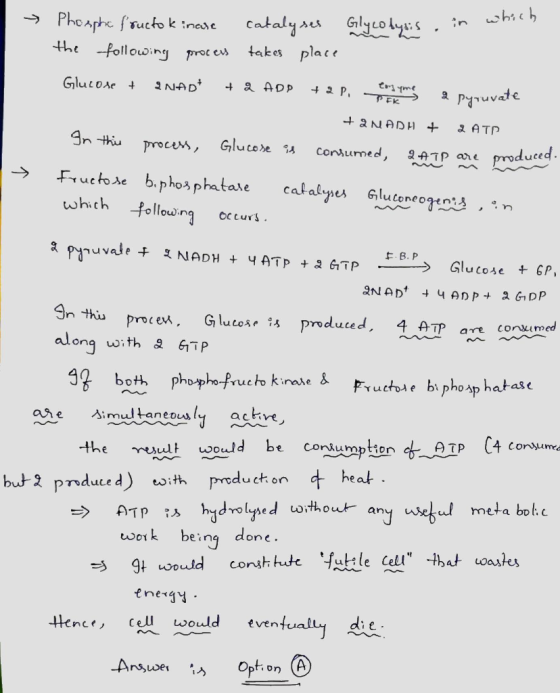
Add Answer to:
What would occur if both phosphofructokinase and fructose bisphosphatase were active simultaneous...
1.) Which of the following is the substrate or product of the reactions that comprise the...
1.) Which of the following is the substrate or product of the reactions that comprise the oxidative phase of the pentose phosphate pathway? A) glyceraldehyde-3-phosphate B) Ribulose-5-phosphate C) Seduheptulose - 7 - phosphate D) Ribose-5-phosphate 2) The regulated reactions of gluconeogenesis have/are A) Activated by molecules indicating a low energy charge in the cell B) reversible reactions C) those thare counter to regulated reactions in glycolysis D)Large positive change in G values 3) The biosynthesis of triacylglycerols in animals uses...
Steps 6 and 8 of the citric acid cycles are _____ reactions. phosphate-transfer hydrolysis oxidation–reduction carboxylation...
Steps 6 and 8 of the citric acid cycles are _____ reactions. phosphate-transfer hydrolysis oxidation–reduction carboxylation The 4-carbon intermediates of the citric acid cycle can be used for _____. gluconeogenesis fatty acid synthesis nucleotide synthesis glycolysis Additional oxaloacetate for the citric acid cycle can be generated in one step from pyruvate glyoxylate citrate acetyl-CoA ΔG°' for a reaction is 800 J · mol–1. What is ΔG at 37°C when the ratio of product to reactant concentrations is 0.6? 640 J...
QUESTION 2 (A) The pentose phosphate pathway is comprised of two phases. Why are both phases...
 QUESTION 2 (A) The pentose phosphate pathway is comprised of two phases. Why are both phases necessary for the survival of the cell? (2pts) (B) In the non-oxidative phase of the pentose phosphate pathway ribose 5-phosphate is converted to fructose 6-phosphate. Why does this pathway require so many enzymatic steps? What benefit does each step provide? (4 pts) (C) Many cancer drugs are effective because they reduce cell proliferation by reducing the amount of base material needed for cell division...
This discussion focuses on the regulation of glycolysis and gluconeogenesis by phosphofructokinase-2 and will help you...
 This discussion focuses on the regulation of glycolysis and
gluconeogenesis by phosphofructokinase-2 and will help you apply
your understanding of these pathways and their regulation to
adaptations in cancerous cells.
You have successfully completed your internship rotation
with the antibiotic group at
MethylTranspharmiX and have moved into
their Cancer Therapeutics division.
In many cancers, cells use aerobic glycolysis rather than
oxidative phosphorylation as their main energy source. This is
known as the Warburg effect, and was first described by Otto...
This discussion focuses on the regulation of glycolysis and
gluconeogenesis by phosphofructokinase-2 and will help you apply
your understanding of these pathways and their regulation to
adaptations in cancerous cells.
You have successfully completed your internship rotation
with the antibiotic group at
MethylTranspharmiX and have moved into
their Cancer Therapeutics division.
In many cancers, cells use aerobic glycolysis rather than
oxidative phosphorylation as their main energy source. This is
known as the Warburg effect, and was first described by Otto...
QUESTION 1 Which of the following processes/pathways CANNOT occur in the absence of O2? Oxidative phosphorylation...
QUESTION 1 Which of the following processes/pathways CANNOT occur in the absence of O2? Oxidative phosphorylation Substrate level phosphorylation Oxidation of NADH Photosynthesis Fermentation 1 points QUESTION 2 Phosphofructokinase (PFK-1) is one of the most regulated enzymes in metabolism. Which of the following would be expected to be an allosteric inhibitor of PFK-1? Glucose Fructose-6-phosphate Acetyl CoA AMP 1 points QUESTION 3 Which of the following is a reactant of the first reaction of glycolysis? Glucose ADP ATP...
Hi the automatic grader for my biochemistry assignment is saying im getting things wrong but i...
 Hi the automatic grader for my biochemistry assignment is saying
im getting things wrong but i cannot figure out which. Please tell
me which are wrong with corrected answers. Thanks!
DUE AT MIDNIGHT PLEASE HELP ASAP
Question 33 (2.5 points) Saved Which of the following is true regarding fatty acid synthesis? This is a mitochondrial process. The primary product of this pathway is a 12C saturated fatty acid The rate-limiting step of this pathway forms the four-carbon product, malate. The...
Hi the automatic grader for my biochemistry assignment is saying
im getting things wrong but i cannot figure out which. Please tell
me which are wrong with corrected answers. Thanks!
DUE AT MIDNIGHT PLEASE HELP ASAP
Question 33 (2.5 points) Saved Which of the following is true regarding fatty acid synthesis? This is a mitochondrial process. The primary product of this pathway is a 12C saturated fatty acid The rate-limiting step of this pathway forms the four-carbon product, malate. The...
Both questions were out of 5 points. What would be correct and good answers for both...
 Both questions were out of 5 points. What would be correct and
good answers for both questions?
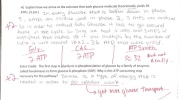
H) Explain how we arrive at the estimate that each glucose molecule theoretically yields 36 In ewany Bscose thut is lbokan den in phise 1, GAIPs are oxidite 'ond in phase 3, 3 ATPs are orided ギd-Sp in order to oaded fully Glucose i+ hus to CAC ATP Sxnth ATP 2- ATP Extra Credit: The first step in glycolysis is phosphorylation of glucose...
Both questions were out of 5 points. What would be correct and
good answers for both questions?
H) Explain how we arrive at the estimate that each glucose molecule theoretically yields 36 In ewany Bscose thut is lbokan den in phise 1, GAIPs are oxidite 'ond in phase 3, 3 ATPs are orided ギd-Sp in order to oaded fully Glucose i+ hus to CAC ATP Sxnth ATP 2- ATP Extra Credit: The first step in glycolysis is phosphorylation of glucose...
Calculate what the net ATP yield (i.e., taking into consideration both consumption and production) of glycolysis...
Calculate what the net ATP yield (i.e., taking into consideration both consumption and production) of glycolysis would be in the complete absence of pyruvate kinase (PK) A deficiency in the glycolytic enzyme PK, is one of the most common enzymatic defects of the red blood cell, with a frequency of about 51 cases per million individuals. This deficiency arises from a mutation in the PK gene that causes a less efficient (but still active) PK to be produced. There are...
QUESTION 1 Imagine you want to get rich by genetically engineering tobacco plants to produce acai...
 QUESTION 1 Imagine you want to get rich by genetically engineering tobacco plants to produce acai berry juice. To do so, you insert the genes for each of the enzymes in the hypothetical acai synthesis pathway, the first step of which is (hypothetically) conversion of glucose to fructose. The challenge is that glucose must be maintained at or above a minimum concentration or the plant will die because it can no longer make ATP. For the reaction pathway shown below,...
Can someone quick answer/check these questions? Thank you, will rate! (the answers that I have came...
Can someone quick answer/check these questions? Thank you, will rate! (the answers that I have came up with are in bold) Please help 51- Glycogenesis involves the following steps a) isomerisation b) activation c) elongation or coupling d) branching e) all of the above 52 During the breakdown of glycogen, free glucose is formed from A. the reducing end. B. the non-reducing end. C. glucose residues in an a 1-->4 linkage to the chain. D. glucose residues in an...
 QUESTION 2 (A) The pentose phosphate pathway is comprised of two phases. Why are both phases necessary for the survival of the cell? (2pts) (B) In the non-oxidative phase of the pentose phosphate pathway ribose 5-phosphate is converted to fructose 6-phosphate. Why does this pathway require so many enzymatic steps? What benefit does each step provide? (4 pts) (C) Many cancer drugs are effective because they reduce cell proliferation by reducing the amount of base material needed for cell division...
 This discussion focuses on the regulation of glycolysis and
gluconeogenesis by phosphofructokinase-2 and will help you apply
your understanding of these pathways and their regulation to
adaptations in cancerous cells.
You have successfully completed your internship rotation
with the antibiotic group at
MethylTranspharmiX and have moved into
their Cancer Therapeutics division.
In many cancers, cells use aerobic glycolysis rather than
oxidative phosphorylation as their main energy source. This is
known as the Warburg effect, and was first described by Otto...
This discussion focuses on the regulation of glycolysis and
gluconeogenesis by phosphofructokinase-2 and will help you apply
your understanding of these pathways and their regulation to
adaptations in cancerous cells.
You have successfully completed your internship rotation
with the antibiotic group at
MethylTranspharmiX and have moved into
their Cancer Therapeutics division.
In many cancers, cells use aerobic glycolysis rather than
oxidative phosphorylation as their main energy source. This is
known as the Warburg effect, and was first described by Otto...
 Hi the automatic grader for my biochemistry assignment is saying
im getting things wrong but i cannot figure out which. Please tell
me which are wrong with corrected answers. Thanks!
DUE AT MIDNIGHT PLEASE HELP ASAP
Question 33 (2.5 points) Saved Which of the following is true regarding fatty acid synthesis? This is a mitochondrial process. The primary product of this pathway is a 12C saturated fatty acid The rate-limiting step of this pathway forms the four-carbon product, malate. The...
Hi the automatic grader for my biochemistry assignment is saying
im getting things wrong but i cannot figure out which. Please tell
me which are wrong with corrected answers. Thanks!
DUE AT MIDNIGHT PLEASE HELP ASAP
Question 33 (2.5 points) Saved Which of the following is true regarding fatty acid synthesis? This is a mitochondrial process. The primary product of this pathway is a 12C saturated fatty acid The rate-limiting step of this pathway forms the four-carbon product, malate. The...
 Both questions were out of 5 points. What would be correct and
good answers for both questions?
H) Explain how we arrive at the estimate that each glucose molecule theoretically yields 36 In ewany Bscose thut is lbokan den in phise 1, GAIPs are oxidite 'ond in phase 3, 3 ATPs are orided ギd-Sp in order to oaded fully Glucose i+ hus to CAC ATP Sxnth ATP 2- ATP Extra Credit: The first step in glycolysis is phosphorylation of glucose...
Both questions were out of 5 points. What would be correct and
good answers for both questions?
H) Explain how we arrive at the estimate that each glucose molecule theoretically yields 36 In ewany Bscose thut is lbokan den in phise 1, GAIPs are oxidite 'ond in phase 3, 3 ATPs are orided ギd-Sp in order to oaded fully Glucose i+ hus to CAC ATP Sxnth ATP 2- ATP Extra Credit: The first step in glycolysis is phosphorylation of glucose...
 QUESTION 1 Imagine you want to get rich by genetically engineering tobacco plants to produce acai berry juice. To do so, you insert the genes for each of the enzymes in the hypothetical acai synthesis pathway, the first step of which is (hypothetically) conversion of glucose to fructose. The challenge is that glucose must be maintained at or above a minimum concentration or the plant will die because it can no longer make ATP. For the reaction pathway shown below,...
Most questions answered within 3 hours.
-
Where is the error in this code sequence?
String s1 = "Hello";
String s2 = "ello";...
asked 10 months ago -
Financial data for Joel de Paris, Inc., for last year
follow:
Joel de Paris, Inc.
Balance...
asked 10 months ago -
Consider this reaction:
Al2(SO4)3 (aq)+ BaCl3
(aq) Al2Cl6 (aq)- +
3BaSO4(s) . What is the...
asked 10 months ago -
Suppose that Savneet is considering increasing her
recent random sample from 20 car rentals to 40...
asked 10 months ago -
Trucks arrive at an unloading terminal at an average rate of 120
per hour.
Trucks arrive...
asked 10 months ago -
Why are methanol and ethanol completely soluble in water while
octanol is not very little soluble....
asked 10 months ago -
A facilities manager at a university reads in a research report
that the mean amount of...
asked 10 months ago -
When the CuSO4 is rehydrated by adding water to the anhydrous
compound, is this an endothermic...
asked 10 months ago -
A ray of sunlight is passing from diamond into crown glass; the
angle of incidence is...
asked 10 months ago -
A block of mass 0.249 kg is placed on top of a light, vertical
spring of...
asked 10 months ago -
how do the kidneys compensate in the presences of acidosis
a) trigger hyperventilate
b) reserve acid...
asked 10 months ago -
Question 501 pts
The rental rate of capital to the firm increases. Which of the
following...
asked 10 months ago