
Homework Answers
It is given that plate is laminated and symmetric, with its length along x-axis equal to 'a' and length along y-axis equal to 'b'. Also, the height of the composite plate is given 'H'.
Given the symmetry, we have assumed our origin of coordinate axis (0,0) such that xmax = a/2; ymax = b/2; zmax = +H/2 (downward). The figure representing the stated composite is shown below.
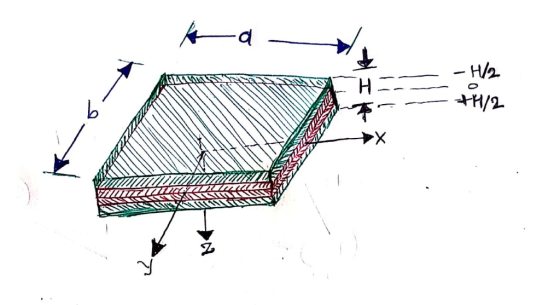
figure (1)
It is given that it follows the Kirchoff theory, which can be deduced in the following results relevant to our current laminate.
- In our figure, z=0 is an x-y plane called mid-plane. And any normal to the midplane remain straight before and after the deformation.
- The length of the normal to the midplane which is H in our present case remains constant before and after the deformation.
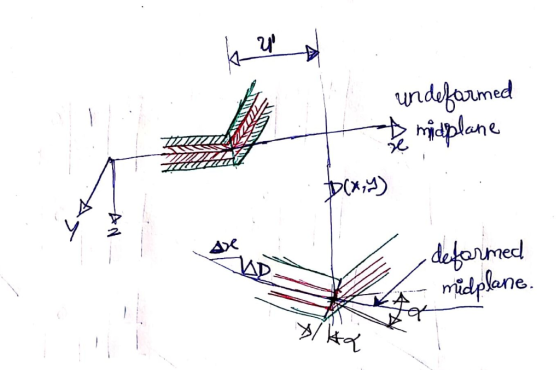
figure (2)
Boundary conditions in terms of displacement of the laminate in accordance with Kirchoff's Law
- According to the 1st deduction from the above stated Kirchoff's Law, which says "normal to un-deformed midplane remains normal to the deformed mid-plane", we can conclude that the transverse shear strain will be zero.
- In y plane or x-z plane, there is a stretching action along the x-axis and there is a bending action along the z-axis, due to which a small displacement in both directions occur.
- According to the 2nd deduction from the Kirchoff's Law, which says the length of the normal to the mid-plane does not change. This concludes that the transverse deflection at any point in the laminate is independent of its location in the z-axis. Let's say deflection of any point is defined by 'D'. Then
D(x,y,z)=D0(x,y)
Let's say deformed midplane bends by
an angle 

For small deformation,

Let's say there is a point 'P' in the midplane with the elevation z. After deformation, displacement of this point along the x-axis can be given, using the above-derived relation, as

Similarly, in x-plane or y-z plane,

So, complete displacement of point 'P' can be defined by the following equations:


Now, using the above relation, we can set the boundary conditions for the deformation using the values


and 
Add Answer to:
3) What are the boundary conditions on the positive x-face and positive y-face of the simply- sup...
3. Consider the follo 2 lu The boundary conditions are: u(0,y, t) - u(x, 0,t) - 0, ou (a, y, t) =...
 *Note: Please answer all parts, and explain all workings. Thank
you!
3. Consider the follo 2 lu The boundary conditions are: u(0,y, t) - u(x, 0,t) - 0, ou (a, y, t) = (x, b, t) = 0 ay The initial conditions are: at t-0,11-4 (x,y)--Yo(x,y) . ot a) Assume u(x,y,t) - X(x)Y(y)T(t), derive the eigenvalue problems: a) Apply the boundary conditions and derive all the possible eigenvalues for λι, λ2 and corresponding eigen-functions, Xm,Yn b) for any combination of...
*Note: Please answer all parts, and explain all workings. Thank
you!
3. Consider the follo 2 lu The boundary conditions are: u(0,y, t) - u(x, 0,t) - 0, ou (a, y, t) = (x, b, t) = 0 ay The initial conditions are: at t-0,11-4 (x,y)--Yo(x,y) . ot a) Assume u(x,y,t) - X(x)Y(y)T(t), derive the eigenvalue problems: a) Apply the boundary conditions and derive all the possible eigenvalues for λι, λ2 and corresponding eigen-functions, Xm,Yn b) for any combination of...
3. Consider the boundary value problem for y(x), -1 < x < 1: **) g” +...
 3. Consider the boundary value problem for y(x), -1 < x < 1: **) g” + Ag 0, y(-1) 0, y(1) = 0 (a) Find all positive eigenvalues for (**). (b) For each positive eigenvalue In, find a correspoding eigenfunction yn(x).
Solve equation (4) in Section 5.2 FIdywx) dxA (4) subject to the appropriate boundary conditions. The...
 Solve equation (4) in Section 5.2 FIdywx) dxA (4) subject to the appropriate boundary conditions. The beam is of length L, and wo is a constant. (a) The beam is embedded at its left end and simply supported at its right end, and w(x) wo, 0 < x < L. усх) (b) Use a graphing utility to graph the deflection curve when wo 48EI and L = 1. = y y 0.2 0.4 0.6 0.8 1,0 0.2 0.4 0.6 0.8...
Question 3: BVP with periodic boundary conditions. Part I: Solve the following boundary value problem (BVP)...
 Question 3: BVP with periodic boundary conditions. Part I: Solve the following boundary value problem (BVP) where y(x,t) is defined for 0<x<. You must show all of your work (be sure to explore all possible eigenvalues). агу д?у 4 axat2 Subject to conditions: = y(x,0) = 4 sin 6x ayi at = 0 y(0) = 0 y(T) = 0 Solution: y(x, t) = Do your work on the next page. Part II: Follow up questions. You may answer these questions...
3. This question is about non-homogeneous boundary conditions (a) Consider Laplace's equation on a rectangle, with...
 3. This question is about non-homogeneous boundary conditions (a) Consider Laplace's equation on a rectangle, with fully inhomogeneous boundary conditions =0 0 a, 0< y <b u(x, 0) fi() u(, b) f2(a) u(0, y)g (x) ua, y) = 92(r) 0 ra Homogenise the boundary conditions to convert the problem to one of the form 2 F(x, y) 0 xa,0 y < b + (x, 0)= fi() b(x, b) f2(x) b(0, y)0 (a, y) = 0 0y b 0 y sb...
Problem 2 Consider a simply supported symmetric I beam ABCD carrying a uniformly distributed load w and a concentrated...
 Problem 2 Consider a simply supported symmetric I beam ABCD carrying a uniformly distributed load w and a concentrated load F as shown in Figure 2. Young's modulus of the beam is 200 GPa F- 8 kNN 8cm 3cm 3cm w- 6 kN/m 6cm 2cm Figure 2 1) Replace the support C with the reaction force Rc, and using static equilibrium find the reactions at point A and B in terms of Ro 2) Using the boundary conditions, calculate the...
3. Consider the following problem for 0 < x < 1 uzz = f(x) with inhomogeneous boundary conditions...
 3. Consider the following problem for 0 < x < 1 uzz = f(x) with inhomogeneous boundary conditions u(0) 1, u( 2 (a) Find a Green's function G(x, zo) for this problem, and write down the solution u(z) in terms of G(x, zo) and (x) (b) Solve the problem directly (by integration) in the case when f(x). Show that this gives the same answer as in part (a).
3. Consider the following problem for 0
3. Consider the following problem for 0 < x < 1 uzz = f(x) with inhomogeneous boundary conditions u(0) 1, u( 2 (a) Find a Green's function G(x, zo) for this problem, and write down the solution u(z) in terms of G(x, zo) and (x) (b) Solve the problem directly (by integration) in the case when f(x). Show that this gives the same answer as in part (a).
3. Consider the following problem for 0
Let 12 := {(x,y): 0 < x <a, 0 <y<b}. Interpret the boundary conditions Uz(0, y,t)...
 Let 12 := {(x,y): 0 < x <a, 0 <y<b}. Interpret the boundary conditions Uz(0, y,t) = 0, u(a, y, t) = 0, wy(x, 0,t), u(x, b,t) = 0 in the context of the 2D wave equation.
3. Consider the Laplace's equation on a rectangular domain subject to the following boundary conditions that...
 3. Consider the Laplace's equation on a rectangular domain subject to the following boundary conditions that represents the steady-state heating of a plate. A temperature probe shows that (1/2, 1/4) = 0. Solve this problem using the method of separation of variables. (7) byllyy = 0 0 <I<41 and O y <21 U-(0,y)=0, 1-(41, y) = cos(2), 4(1,0) = cos(2), 4(1,2)=0. (total 25 marks
Solve equation (4) in Section 5.2 E = w(x) (4) subject to the appropriate boundary conditions....
 Solve equation (4) in Section 5.2 E = w(x) (4) subject to the appropriate boundary conditions. The beam is of length L, and wo is a constant. (a) The beam is embedded at its left end and simply supported at its right end, and w(x) = wg. 0<x<L. y(x) = (b) Use a graphing utility to graph the deflection curve when wo = 48E1 and L = 1. y + 0.2 0.4 0.6 0.8 1.0 0.2 0.4 0.6 0.8 1...
 *Note: Please answer all parts, and explain all workings. Thank
you!
3. Consider the follo 2 lu The boundary conditions are: u(0,y, t) - u(x, 0,t) - 0, ou (a, y, t) = (x, b, t) = 0 ay The initial conditions are: at t-0,11-4 (x,y)--Yo(x,y) . ot a) Assume u(x,y,t) - X(x)Y(y)T(t), derive the eigenvalue problems: a) Apply the boundary conditions and derive all the possible eigenvalues for λι, λ2 and corresponding eigen-functions, Xm,Yn b) for any combination of...
*Note: Please answer all parts, and explain all workings. Thank
you!
3. Consider the follo 2 lu The boundary conditions are: u(0,y, t) - u(x, 0,t) - 0, ou (a, y, t) = (x, b, t) = 0 ay The initial conditions are: at t-0,11-4 (x,y)--Yo(x,y) . ot a) Assume u(x,y,t) - X(x)Y(y)T(t), derive the eigenvalue problems: a) Apply the boundary conditions and derive all the possible eigenvalues for λι, λ2 and corresponding eigen-functions, Xm,Yn b) for any combination of...
 3. Consider the boundary value problem for y(x), -1 < x < 1: **) g” + Ag 0, y(-1) 0, y(1) = 0 (a) Find all positive eigenvalues for (**). (b) For each positive eigenvalue In, find a correspoding eigenfunction yn(x).
 Solve equation (4) in Section 5.2 FIdywx) dxA (4) subject to the appropriate boundary conditions. The beam is of length L, and wo is a constant. (a) The beam is embedded at its left end and simply supported at its right end, and w(x) wo, 0 < x < L. усх) (b) Use a graphing utility to graph the deflection curve when wo 48EI and L = 1. = y y 0.2 0.4 0.6 0.8 1,0 0.2 0.4 0.6 0.8...
 Question 3: BVP with periodic boundary conditions. Part I: Solve the following boundary value problem (BVP) where y(x,t) is defined for 0<x<. You must show all of your work (be sure to explore all possible eigenvalues). агу д?у 4 axat2 Subject to conditions: = y(x,0) = 4 sin 6x ayi at = 0 y(0) = 0 y(T) = 0 Solution: y(x, t) = Do your work on the next page. Part II: Follow up questions. You may answer these questions...
 3. This question is about non-homogeneous boundary conditions (a) Consider Laplace's equation on a rectangle, with fully inhomogeneous boundary conditions =0 0 a, 0< y <b u(x, 0) fi() u(, b) f2(a) u(0, y)g (x) ua, y) = 92(r) 0 ra Homogenise the boundary conditions to convert the problem to one of the form 2 F(x, y) 0 xa,0 y < b + (x, 0)= fi() b(x, b) f2(x) b(0, y)0 (a, y) = 0 0y b 0 y sb...
 Problem 2 Consider a simply supported symmetric I beam ABCD carrying a uniformly distributed load w and a concentrated load F as shown in Figure 2. Young's modulus of the beam is 200 GPa F- 8 kNN 8cm 3cm 3cm w- 6 kN/m 6cm 2cm Figure 2 1) Replace the support C with the reaction force Rc, and using static equilibrium find the reactions at point A and B in terms of Ro 2) Using the boundary conditions, calculate the...
 3. Consider the following problem for 0 < x < 1 uzz = f(x) with inhomogeneous boundary conditions u(0) 1, u( 2 (a) Find a Green's function G(x, zo) for this problem, and write down the solution u(z) in terms of G(x, zo) and (x) (b) Solve the problem directly (by integration) in the case when f(x). Show that this gives the same answer as in part (a).
3. Consider the following problem for 0
3. Consider the following problem for 0 < x < 1 uzz = f(x) with inhomogeneous boundary conditions u(0) 1, u( 2 (a) Find a Green's function G(x, zo) for this problem, and write down the solution u(z) in terms of G(x, zo) and (x) (b) Solve the problem directly (by integration) in the case when f(x). Show that this gives the same answer as in part (a).
3. Consider the following problem for 0
 Let 12 := {(x,y): 0 < x <a, 0 <y<b}. Interpret the boundary conditions Uz(0, y,t) = 0, u(a, y, t) = 0, wy(x, 0,t), u(x, b,t) = 0 in the context of the 2D wave equation.
 3. Consider the Laplace's equation on a rectangular domain subject to the following boundary conditions that represents the steady-state heating of a plate. A temperature probe shows that (1/2, 1/4) = 0. Solve this problem using the method of separation of variables. (7) byllyy = 0 0 <I<41 and O y <21 U-(0,y)=0, 1-(41, y) = cos(2), 4(1,0) = cos(2), 4(1,2)=0. (total 25 marks
 Solve equation (4) in Section 5.2 E = w(x) (4) subject to the appropriate boundary conditions. The beam is of length L, and wo is a constant. (a) The beam is embedded at its left end and simply supported at its right end, and w(x) = wg. 0<x<L. y(x) = (b) Use a graphing utility to graph the deflection curve when wo = 48E1 and L = 1. y + 0.2 0.4 0.6 0.8 1.0 0.2 0.4 0.6 0.8 1...
Most questions answered within 3 hours.
-
Where is the error in this code sequence?
String s1 = "Hello";
String s2 = "ello";...
asked 11 months ago -
Financial data for Joel de Paris, Inc., for last year
follow:
Joel de Paris, Inc.
Balance...
asked 11 months ago -
Consider this reaction:
Al2(SO4)3 (aq)+ BaCl3
(aq) Al2Cl6 (aq)- +
3BaSO4(s) . What is the...
asked 11 months ago -
Suppose that Savneet is considering increasing her
recent random sample from 20 car rentals to 40...
asked 11 months ago -
Trucks arrive at an unloading terminal at an average rate of 120
per hour.
Trucks arrive...
asked 11 months ago -
Why are methanol and ethanol completely soluble in water while
octanol is not very little soluble....
asked 11 months ago -
A facilities manager at a university reads in a research report
that the mean amount of...
asked 11 months ago -
When the CuSO4 is rehydrated by adding water to the anhydrous
compound, is this an endothermic...
asked 11 months ago -
A ray of sunlight is passing from diamond into crown glass; the
angle of incidence is...
asked 11 months ago -
A block of mass 0.249 kg is placed on top of a light, vertical
spring of...
asked 11 months ago -
how do the kidneys compensate in the presences of acidosis
a) trigger hyperventilate
b) reserve acid...
asked 11 months ago -
Question 501 pts
The rental rate of capital to the firm increases. Which of the
following...
asked 11 months ago