
Homework Answers
Add Answer to:
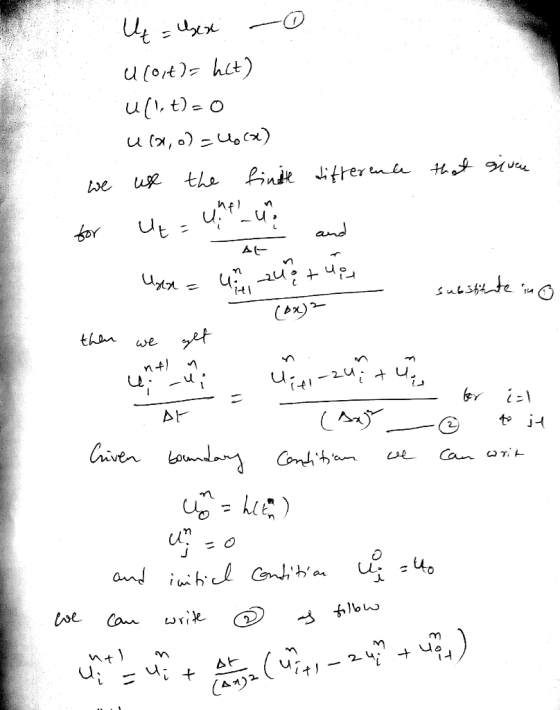
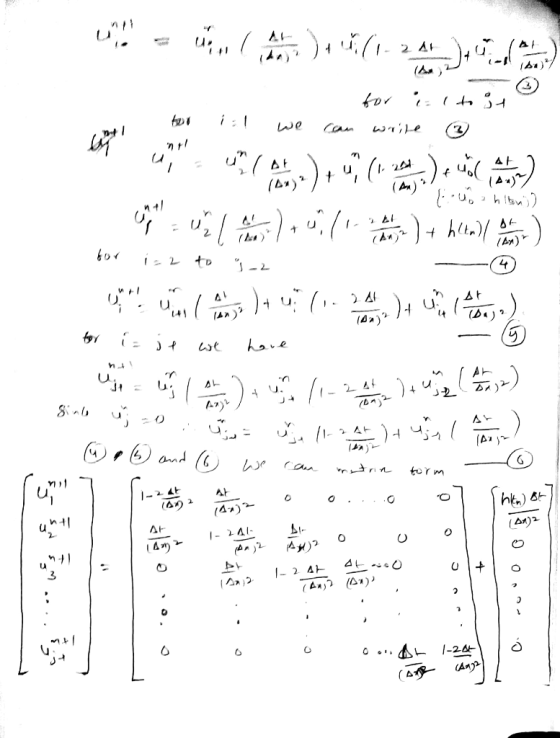
Problem Modify finte difference schene 1 (ED51) it to i (Dirichlet non-homog entous u(it) o outpu...
Problem 2. The Laguerre polynomials L (x) are orthogonal with respect to the inner product (u,u)=...
 Problem 2. The Laguerre polynomials L (x) are orthogonal with respect to the inner product (u,u)=/o e-ru (x) u(x) dx and standardized so that L" (0) = 1 . In addition to their importance in numerical analysis, the La- guerre polynomials are notable for their use in electron orbitals in atoms Use Gram-Schmidt orthogonalization along with the standardization L(0)1 to find the Laguerre polynomials of degree ns4 The Laguerre polynomials obey the TTRR (n + 1) L" +1 (x) =...
Instructions: For your lab write-up follow the instructions of LAB 1 1. (a) Modify the function e...
 Instructions: For your lab write-up follow the instructions of LAB 1 1. (a) Modify the function exvith2eqs to solve the IVP (4) for o St S40 using the MATLAB routine ode45. Call the new function LAB04exl Let [t,Y] (note the upper case Y) be the output of ode45 and y and v the unknown functions. Use the following commands to define the ODE function dYdt f(t.Y) y-Y();Y(2) Plot y(t) and e(t) in the same window (do not use subplot), and...
Problem 1 (Section 6.3) Starting with the finite difference expressions for the partial derivatives, re-derive the forward Euler method for the heat equation with an extra nonlinear term: u(0,t)- u(1...
 Problem 1 (Section 6.3) Starting with the finite difference expressions for the partial derivatives, re-derive the forward Euler method for the heat equation with an extra nonlinear term: u(0,t)- u(1t)-0 Then, find the solution over three time steps (i.e. find the twelve vawith 3 decimal digits of precision, assuming k = 1, γ=2, M = 0.01, L = 1 and N=5, with initial condition u a table to show your results. It is strongly recommended that you write a short...
Question 1 O pts (Systematic vs. Non-Systematic). For this Pause-Problem, I want you to think of...
 Question 1 O pts (Systematic vs. Non-Systematic). For this Pause-Problem, I want you to think of a study idea that you can approach first from a non- systematic perspective and second from a systematic perspective. My hint is to start with the non- systematic research first! HTML Editorga BIUA- A - I E E D T T 12pt Paragraph Non systematic: Systematic (Your Lab Study). For this Pause-Problem, look at your lab hypothesis for study one. Does it meet /not...
I just want to clarify what I need help on (as I do not need help...
 I just want to clarify what I need help on (as I do not need
help on the full question). Specifically what I want is to be able
to set the equations given to me so that I can solve for n using a
root finding algorithm (which I already have).
As I understand, I need something of the form | Tn(x) - e^x | =
epsilon machine = (x^(n+1) / (n+1)!) and all I need from there is
to...
I just want to clarify what I need help on (as I do not need
help on the full question). Specifically what I want is to be able
to set the equations given to me so that I can solve for n using a
root finding algorithm (which I already have).
As I understand, I need something of the form | Tn(x) - e^x | =
epsilon machine = (x^(n+1) / (n+1)!) and all I need from there is
to...
1) Show that if U is a non-empty open subset of the real numbers then m(U) > O. 2) Give an exa...
1) Show that if U is a non-empty open subset of the real numbers then m(U) > O. 2) Give an example of an unbounded open set with finite measure. Justify your answer, 3) If a is a single point on the number line show that m ( a ) = O. 4) Prove that if K is compact and U is open with K U then m(K) m(U). 5) show that the Cantor set C is compact and m(C)...
solve problem #1 depending on the given information Consider the following 1D second order elliptic equation with Dirichlet boundary conditions du(x) (c(x)du ) = f(x) (a $15 b), u(a) = ga, u(b) = gb...
 solve problem #1 depending on the given information
Consider the following 1D second order elliptic equation with Dirichlet boundary conditions du(x) (c(x)du ) = f(x) (a $15 b), u(a) = ga, u(b) = gb dr: where u(x) is the unknown function, ga and gb are the Dirichlet boundary values, c(x) is a given coefficient function and f(x) is a given source function. See the theorem 10.1 in the textbook for the existence and uniqueness of the solution. 1.1 Weak Formulation...
solve problem #1 depending on the given information
Consider the following 1D second order elliptic equation with Dirichlet boundary conditions du(x) (c(x)du ) = f(x) (a $15 b), u(a) = ga, u(b) = gb dr: where u(x) is the unknown function, ga and gb are the Dirichlet boundary values, c(x) is a given coefficient function and f(x) is a given source function. See the theorem 10.1 in the textbook for the existence and uniqueness of the solution. 1.1 Weak Formulation...
(a)Use Euler method to find the difference equation for the following IVP (initial value problem)...
 i really just need help with part c and d. thank you!
(a)Use Euler method to find the difference equation for the following IVP (initial value problem). Please Type your work. (Due on March 5th) dt(, yo 0.01 (b) Calculate the numerical solution for 0 s t S T using k and M T where k = and T = 9 for M 32,64, 128. Using programming languages such as Ct+, MATLAB, eto. (c) Graph those numerical solutions versus exact...
i really just need help with part c and d. thank you!
(a)Use Euler method to find the difference equation for the following IVP (initial value problem). Please Type your work. (Due on March 5th) dt(, yo 0.01 (b) Calculate the numerical solution for 0 s t S T using k and M T where k = and T = 9 for M 32,64, 128. Using programming languages such as Ct+, MATLAB, eto. (c) Graph those numerical solutions versus exact...
Please Help. I need help to understand Thank you 1. Each of the following systems is...
 Please Help. I need help to understand
Thank you
1. Each of the following systems is shown at static equilibrium, obtain their differential equations. 45 m, L m, L Fün link o fim info (A) (B) (D)
Please Help. I need help to understand
Thank you
1. Each of the following systems is shown at static equilibrium, obtain their differential equations. 45 m, L m, L Fün link o fim info (A) (B) (D)
Problem 2 Consider the causal non-linear discrete-time system characterized b difference equation...
 Please help me in this question using MATLAB and Calculations
please by hand
Problem 2 Consider the causal non-linear discrete-time system characterized b difference equation: y the following n of amplitude P (i.e If we use as input x[n] to this system (algorithim) a step functio rge after several iterations to the square root of P t implements the above recursion to compute the square n)-P uIn), then yIn] will conver roots of 25, 9, 3, and 2. How many...
Please help me in this question using MATLAB and Calculations
please by hand
Problem 2 Consider the causal non-linear discrete-time system characterized b difference equation: y the following n of amplitude P (i.e If we use as input x[n] to this system (algorithim) a step functio rge after several iterations to the square root of P t implements the above recursion to compute the square n)-P uIn), then yIn] will conver roots of 25, 9, 3, and 2. How many...
 Problem 2. The Laguerre polynomials L (x) are orthogonal with respect to the inner product (u,u)=/o e-ru (x) u(x) dx and standardized so that L" (0) = 1 . In addition to their importance in numerical analysis, the La- guerre polynomials are notable for their use in electron orbitals in atoms Use Gram-Schmidt orthogonalization along with the standardization L(0)1 to find the Laguerre polynomials of degree ns4 The Laguerre polynomials obey the TTRR (n + 1) L" +1 (x) =...
 Instructions: For your lab write-up follow the instructions of LAB 1 1. (a) Modify the function exvith2eqs to solve the IVP (4) for o St S40 using the MATLAB routine ode45. Call the new function LAB04exl Let [t,Y] (note the upper case Y) be the output of ode45 and y and v the unknown functions. Use the following commands to define the ODE function dYdt f(t.Y) y-Y();Y(2) Plot y(t) and e(t) in the same window (do not use subplot), and...
 Problem 1 (Section 6.3) Starting with the finite difference expressions for the partial derivatives, re-derive the forward Euler method for the heat equation with an extra nonlinear term: u(0,t)- u(1t)-0 Then, find the solution over three time steps (i.e. find the twelve vawith 3 decimal digits of precision, assuming k = 1, γ=2, M = 0.01, L = 1 and N=5, with initial condition u a table to show your results. It is strongly recommended that you write a short...
 Question 1 O pts (Systematic vs. Non-Systematic). For this Pause-Problem, I want you to think of a study idea that you can approach first from a non- systematic perspective and second from a systematic perspective. My hint is to start with the non- systematic research first! HTML Editorga BIUA- A - I E E D T T 12pt Paragraph Non systematic: Systematic (Your Lab Study). For this Pause-Problem, look at your lab hypothesis for study one. Does it meet /not...
 I just want to clarify what I need help on (as I do not need
help on the full question). Specifically what I want is to be able
to set the equations given to me so that I can solve for n using a
root finding algorithm (which I already have).
As I understand, I need something of the form | Tn(x) - e^x | =
epsilon machine = (x^(n+1) / (n+1)!) and all I need from there is
to...
I just want to clarify what I need help on (as I do not need
help on the full question). Specifically what I want is to be able
to set the equations given to me so that I can solve for n using a
root finding algorithm (which I already have).
As I understand, I need something of the form | Tn(x) - e^x | =
epsilon machine = (x^(n+1) / (n+1)!) and all I need from there is
to...
 solve problem #1 depending on the given information
Consider the following 1D second order elliptic equation with Dirichlet boundary conditions du(x) (c(x)du ) = f(x) (a $15 b), u(a) = ga, u(b) = gb dr: where u(x) is the unknown function, ga and gb are the Dirichlet boundary values, c(x) is a given coefficient function and f(x) is a given source function. See the theorem 10.1 in the textbook for the existence and uniqueness of the solution. 1.1 Weak Formulation...
solve problem #1 depending on the given information
Consider the following 1D second order elliptic equation with Dirichlet boundary conditions du(x) (c(x)du ) = f(x) (a $15 b), u(a) = ga, u(b) = gb dr: where u(x) is the unknown function, ga and gb are the Dirichlet boundary values, c(x) is a given coefficient function and f(x) is a given source function. See the theorem 10.1 in the textbook for the existence and uniqueness of the solution. 1.1 Weak Formulation...
 i really just need help with part c and d. thank you!
(a)Use Euler method to find the difference equation for the following IVP (initial value problem). Please Type your work. (Due on March 5th) dt(, yo 0.01 (b) Calculate the numerical solution for 0 s t S T using k and M T where k = and T = 9 for M 32,64, 128. Using programming languages such as Ct+, MATLAB, eto. (c) Graph those numerical solutions versus exact...
i really just need help with part c and d. thank you!
(a)Use Euler method to find the difference equation for the following IVP (initial value problem). Please Type your work. (Due on March 5th) dt(, yo 0.01 (b) Calculate the numerical solution for 0 s t S T using k and M T where k = and T = 9 for M 32,64, 128. Using programming languages such as Ct+, MATLAB, eto. (c) Graph those numerical solutions versus exact...
 Please Help. I need help to understand
Thank you
1. Each of the following systems is shown at static equilibrium, obtain their differential equations. 45 m, L m, L Fün link o fim info (A) (B) (D)
Please Help. I need help to understand
Thank you
1. Each of the following systems is shown at static equilibrium, obtain their differential equations. 45 m, L m, L Fün link o fim info (A) (B) (D)
 Please help me in this question using MATLAB and Calculations
please by hand
Problem 2 Consider the causal non-linear discrete-time system characterized b difference equation: y the following n of amplitude P (i.e If we use as input x[n] to this system (algorithim) a step functio rge after several iterations to the square root of P t implements the above recursion to compute the square n)-P uIn), then yIn] will conver roots of 25, 9, 3, and 2. How many...
Please help me in this question using MATLAB and Calculations
please by hand
Problem 2 Consider the causal non-linear discrete-time system characterized b difference equation: y the following n of amplitude P (i.e If we use as input x[n] to this system (algorithim) a step functio rge after several iterations to the square root of P t implements the above recursion to compute the square n)-P uIn), then yIn] will conver roots of 25, 9, 3, and 2. How many...
Most questions answered within 3 hours.
-
Where is the error in this code sequence?
String s1 = "Hello";
String s2 = "ello";...
asked 11 months ago -
Financial data for Joel de Paris, Inc., for last year
follow:
Joel de Paris, Inc.
Balance...
asked 11 months ago -
Consider this reaction:
Al2(SO4)3 (aq)+ BaCl3
(aq) Al2Cl6 (aq)- +
3BaSO4(s) . What is the...
asked 11 months ago -
Suppose that Savneet is considering increasing her
recent random sample from 20 car rentals to 40...
asked 11 months ago -
Trucks arrive at an unloading terminal at an average rate of 120
per hour.
Trucks arrive...
asked 11 months ago -
Why are methanol and ethanol completely soluble in water while
octanol is not very little soluble....
asked 11 months ago -
A facilities manager at a university reads in a research report
that the mean amount of...
asked 11 months ago -
When the CuSO4 is rehydrated by adding water to the anhydrous
compound, is this an endothermic...
asked 11 months ago -
A ray of sunlight is passing from diamond into crown glass; the
angle of incidence is...
asked 11 months ago -
A block of mass 0.249 kg is placed on top of a light, vertical
spring of...
asked 11 months ago -
how do the kidneys compensate in the presences of acidosis
a) trigger hyperventilate
b) reserve acid...
asked 11 months ago -
Question 501 pts
The rental rate of capital to the firm increases. Which of the
following...
asked 11 months ago