
Homework Answers
Add Answer to:
Name Experiment 8 CONCLUSIONS For each part of the experiment, write the balanced molecular react...
For each combination of reagents, write a balanced molecular equation. Indicate whether a reaction occurred in...
For each combination of reagents, write a balanced molecular equation. Indicate whether a reaction occurred in each case. If no reaction occurred, indicate "NR" for 'no reaction.' For reactions that did occur, write the net ionic equation for each. Classify each reaction that occurred as acid/base, redox, or a precipitation reaction. CuSO4 and NaNO3 aq (NR) CuSO4 and NaCl aq (NR) Na3PO4 and Pb(OAc)2 aq (rxn) Na2CO3 and CaCl2 aq (rxn) Na2CO3 and HCl aq (NR) HCl and NaOH (aq)...
Provide a balanced MOLECULAR AND NET ionic equations for each reaction. If no reaction occurs, write...
Provide a balanced MOLECULAR AND NET ionic equations for each reaction. If no reaction occurs, write NR. 1.)MgCl2(aq)+Fe(NO3)3(aq) 2.)MgCl2(aq)+BaCl2(aq) 3.)Fe(No3)3(aq)+BaCl2(aq) 4.)AgNO3(aq)+Na2CO3(aq) Thank you so much!!!!
In the space below, write the balanced chemical/molecular equation, the total ionic equation, and the net...
In the space below, write the balanced chemical/molecular equation, the total ionic equation, and the net ionic equation: HCl(aq) + NaOH(aq) -> NH4Cl(aq) + NaOH(aq) -> AgNO3(aq) + Na2CO3(aq) -> BaCl2(aq) + Na2CO3(aq) -> HCl(aq) + Na2CO3(aq) -> All have a reaction.
please help I dont understand how to write the Equations. Name Section Instructor Date Report for...
 please help I dont understand how to write the
Equations.
Name Section Instructor Date Report for Experiment 4 Double Displacement Reactions Complete the following table. Write your observation in the left-hand column. A - Precipitate (also list color); B - Gas evolution: C-Heat evolved; D - No reaction On the right-hand side, write the complete balanced equation. If there was no reaction observed, write "No reaction." No Evidence of reaction 1 INO reaction 2 Equation NaCl + KNO3 → No...
please help I dont understand how to write the
Equations.
Name Section Instructor Date Report for Experiment 4 Double Displacement Reactions Complete the following table. Write your observation in the left-hand column. A - Precipitate (also list color); B - Gas evolution: C-Heat evolved; D - No reaction On the right-hand side, write the complete balanced equation. If there was no reaction observed, write "No reaction." No Evidence of reaction 1 INO reaction 2 Equation NaCl + KNO3 → No...
OLCree B FOR PART D WRITE THE BALANCED MOLECULAR, COMPLETE IONIC, AND THE NET IONIC EQUATIONS FOR EACH (Note: silv...
 OLCree B FOR PART D WRITE THE BALANCED MOLECULAR, COMPLETE IONIC, AND THE NET IONIC EQUATIONS FOR EACH (Note: silver has a l+ charge and zinc has a 2+ charge when in a compound) D. la. Silver nitrate + potassium iodide yields silver iodide + potassium nitrate ) Balanced: AgNO3(aq) + Kl (aq) Ag | (s) + KNO₃(aq) Complete Ionic: Ag+ (aq) + NO3-(aq) + K+ (aq) + Haqt Ag | cs+ K+ (aq) +NO₃-caq) Net Ionic: Ag + (aq)...
Record your experimental observations and write the equations for any of the 12 ionic solution combinations...
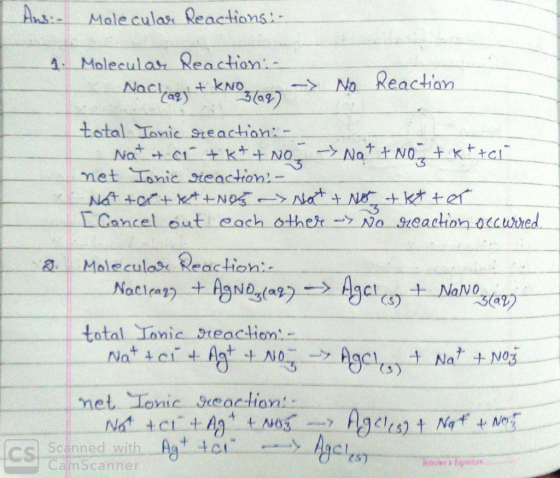
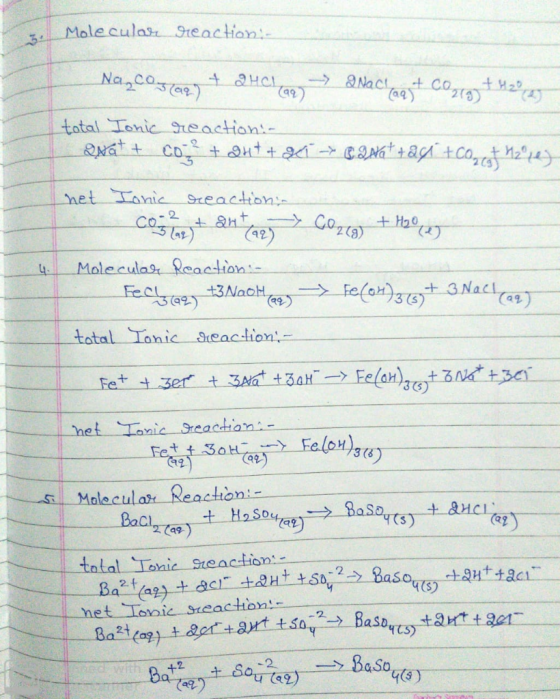
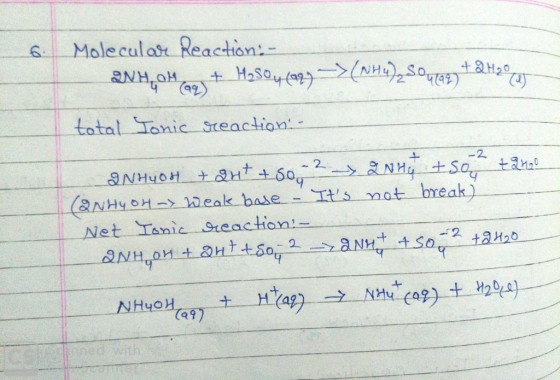
Record your experimental observations and write the equations for any of the 12 ionic solution combinations analyzed that resulted in double replacement reaction (see pg. 48 of the lab manual). Include the Evidence of a Reaction and a complete balanced equation for the double replacement reactions that occurred If no reaction occurs for the system, write "No Reaction" 1.NaCI+KNO3 2. NaCI + AgNO3 3. NaCO3+ HCI 4. NaCO3 + HCI 5.BaCI2 + H2SO4 6. NH4OH + H2SO4 7. CuSO4 +...
Write balanced molecular, complete ionic, and net ionic equations using the reactants and products below. a.)...
 Write balanced molecular, complete ionic, and net ionic equations using the reactants and products below. a.) Reactants: Li,CO, (ag) and CalSCN)2 (ag) Products: LisCN (aq) and CaCO, () Molecular equation: Complete ionic equation: Net ionic equation Products: CaPO and NaCI (ap) b.) Reactants: CaCl (aq) and NayPOs (aq) Molecular equation Complete ionic equation:
Write balanced molecular, ionic and net-ionic equations for 10 reactions (8 precipitate (P) and 2 neautralization)...
 Write balanced molecular, ionic and net-ionic equations for 10
reactions
(8 precipitate (P) and 2 neautralization)
Use the next few pages to write balanced MOLECULAR, IONIC, and NET-IONIC equations for 10 reactions that occurred during this laboratory experiment. There are more than 10 possible reactions. Choose precipitation reactions and 2 neutralization reactions. Make sure to include the physical states of all the products. Class (circle one): Precipitation or Neutralization Reaction 1. Molecular: Complete lonic: Net lonic: no I reaction/ no...
Write balanced molecular, ionic and net-ionic equations for 10
reactions
(8 precipitate (P) and 2 neautralization)
Use the next few pages to write balanced MOLECULAR, IONIC, and NET-IONIC equations for 10 reactions that occurred during this laboratory experiment. There are more than 10 possible reactions. Choose precipitation reactions and 2 neutralization reactions. Make sure to include the physical states of all the products. Class (circle one): Precipitation or Neutralization Reaction 1. Molecular: Complete lonic: Net lonic: no I reaction/ no...
else - Ionic Equations reaction below. write the molecular equation, the complete ionic equa For each reaction ioni...
 else - Ionic Equations reaction below. write the molecular equation, the complete ionic equa For each reaction ionic equation: Equation 1 Pb(NO)(aq) + Nal(aq) - Pl(s) + NaNO (aq) Molecular equation Total lonic equation Net ionic equation Equation 2 Mg(s) + HCl(aq) -- MgClaq) + Hug) Molecular equation Total lonic equation Net ionic equation Equation 3 HCl(aq) + Ba(OH).(aq) --- BaCl(aq) + H2O(1) Molecular equation Total lonic equation Net ionic equation Equation 4 Cu(s) + AgNO3(aq) + Cu(NO3)(aq) + Ag(s)...
Write balanced molecular equations for the following potential precipitation reactions. Indicate the states of reactants and...
Write balanced molecular equations for the following potential precipitation reactions. Indicate the states of reactants and products [(aq) or (s)]. (b) In those cases where a precipitate forms, write the net ionic equation. If there is no reaction, state "No reaction." (i) (NH4)2SO4 (aq) + Cr(NO3)3 (aq) → (ii) K2SO4 (aq) + AgNO3 (aq) → (iii) Cr(CH3CO2)3 (aq) + KOH (aq) → (iv) Mg(ClO3)2 (aq) + K3PO4 (aq) → Each of the following salts can be prepared from an acid...
 please help I dont understand how to write the
Equations.
Name Section Instructor Date Report for Experiment 4 Double Displacement Reactions Complete the following table. Write your observation in the left-hand column. A - Precipitate (also list color); B - Gas evolution: C-Heat evolved; D - No reaction On the right-hand side, write the complete balanced equation. If there was no reaction observed, write "No reaction." No Evidence of reaction 1 INO reaction 2 Equation NaCl + KNO3 → No...
please help I dont understand how to write the
Equations.
Name Section Instructor Date Report for Experiment 4 Double Displacement Reactions Complete the following table. Write your observation in the left-hand column. A - Precipitate (also list color); B - Gas evolution: C-Heat evolved; D - No reaction On the right-hand side, write the complete balanced equation. If there was no reaction observed, write "No reaction." No Evidence of reaction 1 INO reaction 2 Equation NaCl + KNO3 → No...
 OLCree B FOR PART D WRITE THE BALANCED MOLECULAR, COMPLETE IONIC, AND THE NET IONIC EQUATIONS FOR EACH (Note: silver has a l+ charge and zinc has a 2+ charge when in a compound) D. la. Silver nitrate + potassium iodide yields silver iodide + potassium nitrate ) Balanced: AgNO3(aq) + Kl (aq) Ag | (s) + KNO₃(aq) Complete Ionic: Ag+ (aq) + NO3-(aq) + K+ (aq) + Haqt Ag | cs+ K+ (aq) +NO₃-caq) Net Ionic: Ag + (aq)...
 Write balanced molecular, complete ionic, and net ionic equations using the reactants and products below. a.) Reactants: Li,CO, (ag) and CalSCN)2 (ag) Products: LisCN (aq) and CaCO, () Molecular equation: Complete ionic equation: Net ionic equation Products: CaPO and NaCI (ap) b.) Reactants: CaCl (aq) and NayPOs (aq) Molecular equation Complete ionic equation:
 Write balanced molecular, ionic and net-ionic equations for 10
reactions
(8 precipitate (P) and 2 neautralization)
Use the next few pages to write balanced MOLECULAR, IONIC, and NET-IONIC equations for 10 reactions that occurred during this laboratory experiment. There are more than 10 possible reactions. Choose precipitation reactions and 2 neutralization reactions. Make sure to include the physical states of all the products. Class (circle one): Precipitation or Neutralization Reaction 1. Molecular: Complete lonic: Net lonic: no I reaction/ no...
Write balanced molecular, ionic and net-ionic equations for 10
reactions
(8 precipitate (P) and 2 neautralization)
Use the next few pages to write balanced MOLECULAR, IONIC, and NET-IONIC equations for 10 reactions that occurred during this laboratory experiment. There are more than 10 possible reactions. Choose precipitation reactions and 2 neutralization reactions. Make sure to include the physical states of all the products. Class (circle one): Precipitation or Neutralization Reaction 1. Molecular: Complete lonic: Net lonic: no I reaction/ no...
 else - Ionic Equations reaction below. write the molecular equation, the complete ionic equa For each reaction ionic equation: Equation 1 Pb(NO)(aq) + Nal(aq) - Pl(s) + NaNO (aq) Molecular equation Total lonic equation Net ionic equation Equation 2 Mg(s) + HCl(aq) -- MgClaq) + Hug) Molecular equation Total lonic equation Net ionic equation Equation 3 HCl(aq) + Ba(OH).(aq) --- BaCl(aq) + H2O(1) Molecular equation Total lonic equation Net ionic equation Equation 4 Cu(s) + AgNO3(aq) + Cu(NO3)(aq) + Ag(s)...
Most questions answered within 3 hours.
-
Where is the error in this code sequence?
String s1 = "Hello";
String s2 = "ello";...
asked 11 months ago -
Financial data for Joel de Paris, Inc., for last year
follow:
Joel de Paris, Inc.
Balance...
asked 11 months ago -
Consider this reaction:
Al2(SO4)3 (aq)+ BaCl3
(aq) Al2Cl6 (aq)- +
3BaSO4(s) . What is the...
asked 11 months ago -
Suppose that Savneet is considering increasing her
recent random sample from 20 car rentals to 40...
asked 11 months ago -
Trucks arrive at an unloading terminal at an average rate of 120
per hour.
Trucks arrive...
asked 11 months ago -
Why are methanol and ethanol completely soluble in water while
octanol is not very little soluble....
asked 11 months ago -
A facilities manager at a university reads in a research report
that the mean amount of...
asked 11 months ago -
When the CuSO4 is rehydrated by adding water to the anhydrous
compound, is this an endothermic...
asked 11 months ago -
A ray of sunlight is passing from diamond into crown glass; the
angle of incidence is...
asked 11 months ago -
A block of mass 0.249 kg is placed on top of a light, vertical
spring of...
asked 11 months ago -
how do the kidneys compensate in the presences of acidosis
a) trigger hyperventilate
b) reserve acid...
asked 11 months ago -
Question 501 pts
The rental rate of capital to the firm increases. Which of the
following...
asked 11 months ago