Question 1. (4 marks) Estimating the time of a victim’s death during homicide investigations is a...
Question 1. (4 marks) Estimating the time of a victim’s death
during homicide investigations is a complex problem that cannot be
solved by analysising simple equations or functions of one
variable. However, many mathematical texts examine time of death
estimation based around analysis of Newton’s Law of Cooling. Such
analysis is based on implicit simplifying assumptions that: the
only dependent variable of interest in determining the time of
death is the victim’s body temperature, T(t); the victim’s baseline
body temperature when alive, T0, is known; and the air temperature
of the victim’s surroundings, Ts, is constant. Here we will examine
such a problem.
(a) Assume that immediately following death, a victim’s body begins
to cool from a standard healthy body temperature of 37◦ Celsius.
Further, assume that experimental work has determined that the rate
constant in Newton’s Law of Cooling for a human body is
approximately k = 0.1947 when time t is measured in hours.
Determine a function derived from Newton’s Law of Cooling, T(t),
that models the temperature of a victim’s body t hours after death,
assuming that the temperature of the body’s surroundings is a
constant 18◦ Celsius
. (b) If the temperature of the victim’s body is now 25◦, how long ago was their time of death?
(c) If the victim’s body temperature at death had instead been 36.3◦ Celsius (within the range of normal body temperatures for a healthy adult), what time of death would be estimated via a Newton’s Law of Cooling model? By what duration does this estimate differ to the time that you determined in part (b)?
(d) In reality, how might the modelling assumptions made to address this problem be violated?
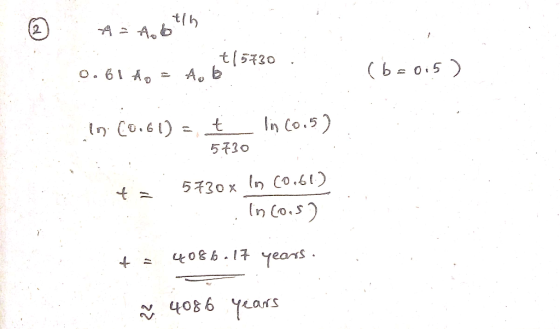
Question 2. (3 marks)A hair sample from a Coptic mummy was found to
contain 61% of the relative proportion of carbon-14 found in living
matter and the atmosphere. Approximately how long before the
carbon-14 measurements were made had the mummy been buried? (The
half-life of carbon-14 is 5730 years.)
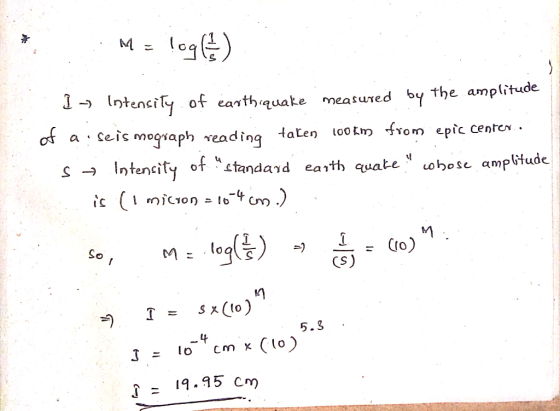
Question 3. (3 marks) The most desctructive earthquake in
contemporary Australian history occurred in Newcastle, NSW, in
1989. The earthquake had a magnitude of 5.6.
(a) Assuming seismograph readings were taken 100km from the
epicentre of the earthquake, what was the corresponding intensity
of the earthquake (measured by the amplitude of a seismograph
reading in centimetres)?
Homework Answers
Add Answer to:
Question 1. (4 marks) Estimating the time of a victim’s death during homicide investigations is a...
1. Estimating the time of a victim’s death during homicide investigations is a complex problem th...
1. Estimating the time of a victim’s death during homicide investigations is a complex problem that cannot be solved by analysising simple equations or functions of one variable. However, many mathematical texts examine time of death estimation based around analysis of Newton’s Law of Cooling. Such analysis is based on implicit simplifying assumptions that: the only dependent variable of interest in determining the time of death is the victim’s body temperature, T(t); the victim’s baseline body temperature when alive, T0,...
Suppose that a death body is found inside a room that is kept at a constant 65 F. The body's temp...
 Suppose that a death body is found inside a room that is kept at a constant 65 F. The body's temperature was first measured to be 800 F at 7:00 am, and an hour later 785' F. Assume that the person was healthy before she/he died and had a body temperature of 98.6 F.Use the Newton's Law of Cooling Model to determine the time when the person died. (a) Write the corresponding initial value problem describing the situation (b) Find...
Answer in python code 1. Suppose someone, whose temperature is originally 37 ̊C, is murdered in...
Answer in python code 1. Suppose someone, whose temperature is originally 37 ̊C, is murdered in a room that has constant temperature 25 ̊C. The temperature is measured as 28 ̊C when the body is found and at 27 ̊C 1 h later. How long ago was the murder committed from discovery of the body? For the modeling of this question use Newton’s Law of cooling. Newton’s Law of Heating and Cooling states that the rate of change of the...
Newton’s Law of Cooling states that the temperature of an object changes in time according to...
Newton’s Law of Cooling states that the temperature of an object changes in time according to the equation dT =k(E−T)dt where T(t) is the temperature of the object, E is the temperature of the environment surrounding the object and k is a constant that is determined by the physical properties of the object. The value k can be expressed as k = hA , ρV cp where h is the heat-transfer coefficient (a measure of how quickly heat escapes the...
You happen to find yourself employed as an expert mathematical consultant for a new Australian TV show called "Numer4ls". The producer wants an episode in which the lead character uses h...
 You happen to find yourself employed as an expert mathematical consultant for a new Australian TV show called "Numer4ls". The producer wants an episode in which the lead character uses his mathematical skills to solve a murder mystery by accurately determining the time of death of the victim, which in this case will be made more complicated by a varying ambient temperature, and will therefore involve a lot of maths written in liquid chalk on glass panels, and some computer...
Question 1 (4 points) The ability of people to walk on glowing wood coals without getting...
 Question 1 (4 points) The ability of people to walk on glowing wood coals without getting burned is explained by the fact that: U a) Wood coals contain a relatively low quantity of heat. u b) Wood coals are extinguished by the moisture in people's feet. JC) Neurolinguistic programming blocks the transmission of heat. J 0 The temperature of wood coals is very low. u el Wood coals form a crust that blocks the transmission of heat. Question 4 (4...
 Suppose that a death body is found inside a room that is kept at a constant 65 F. The body's temperature was first measured to be 800 F at 7:00 am, and an hour later 785' F. Assume that the person was healthy before she/he died and had a body temperature of 98.6 F.Use the Newton's Law of Cooling Model to determine the time when the person died. (a) Write the corresponding initial value problem describing the situation (b) Find...
 You happen to find yourself employed as an expert mathematical consultant for a new Australian TV show called "Numer4ls". The producer wants an episode in which the lead character uses his mathematical skills to solve a murder mystery by accurately determining the time of death of the victim, which in this case will be made more complicated by a varying ambient temperature, and will therefore involve a lot of maths written in liquid chalk on glass panels, and some computer...
 Question 1 (4 points) The ability of people to walk on glowing wood coals without getting burned is explained by the fact that: U a) Wood coals contain a relatively low quantity of heat. u b) Wood coals are extinguished by the moisture in people's feet. JC) Neurolinguistic programming blocks the transmission of heat. J 0 The temperature of wood coals is very low. u el Wood coals form a crust that blocks the transmission of heat. Question 4 (4...
Most questions answered within 3 hours.
-
Where is the error in this code sequence?
String s1 = "Hello";
String s2 = "ello";...
asked 11 months ago -
Financial data for Joel de Paris, Inc., for last year
follow:
Joel de Paris, Inc.
Balance...
asked 11 months ago -
Consider this reaction:
Al2(SO4)3 (aq)+ BaCl3
(aq) Al2Cl6 (aq)- +
3BaSO4(s) . What is the...
asked 11 months ago -
Suppose that Savneet is considering increasing her
recent random sample from 20 car rentals to 40...
asked 11 months ago -
Trucks arrive at an unloading terminal at an average rate of 120
per hour.
Trucks arrive...
asked 11 months ago -
Why are methanol and ethanol completely soluble in water while
octanol is not very little soluble....
asked 11 months ago -
A facilities manager at a university reads in a research report
that the mean amount of...
asked 11 months ago -
When the CuSO4 is rehydrated by adding water to the anhydrous
compound, is this an endothermic...
asked 11 months ago -
A ray of sunlight is passing from diamond into crown glass; the
angle of incidence is...
asked 11 months ago -
A block of mass 0.249 kg is placed on top of a light, vertical
spring of...
asked 11 months ago -
how do the kidneys compensate in the presences of acidosis
a) trigger hyperventilate
b) reserve acid...
asked 11 months ago -
Question 501 pts
The rental rate of capital to the firm increases. Which of the
following...
asked 11 months ago