
Homework Answers
Add Answer to:
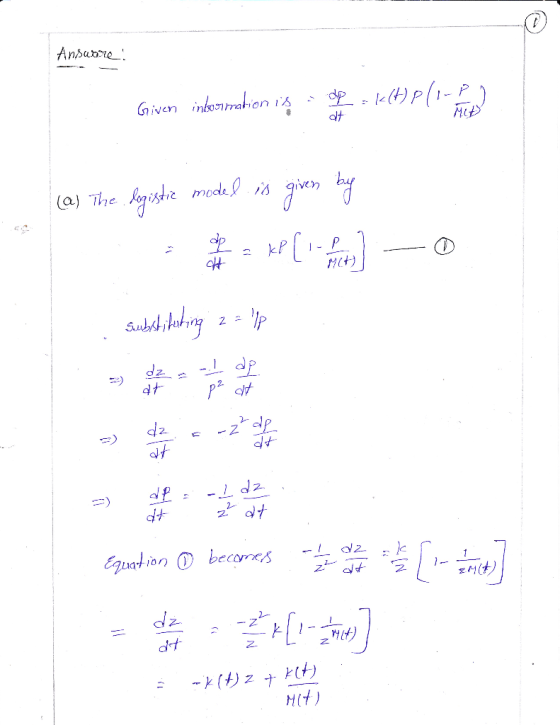
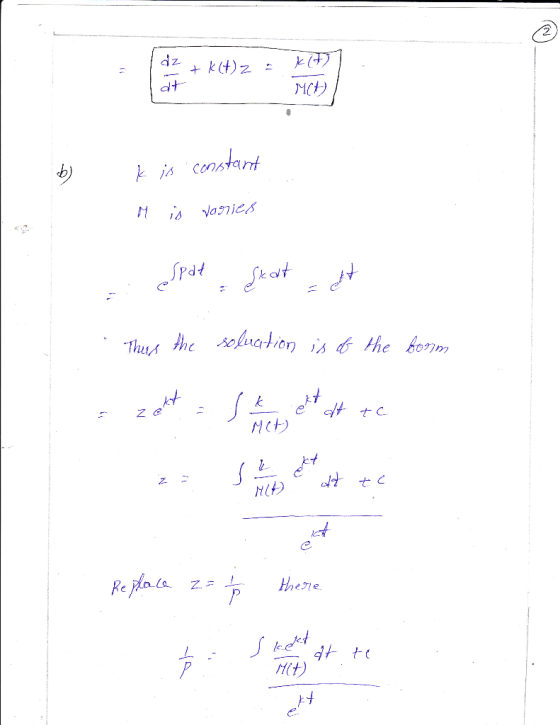
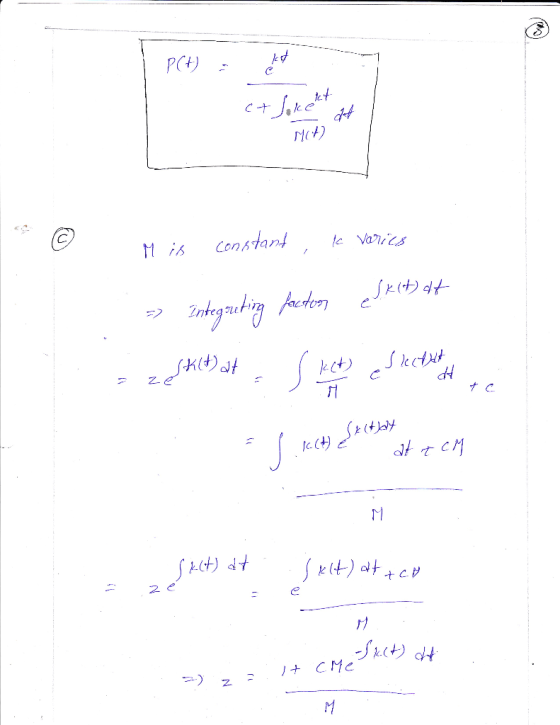
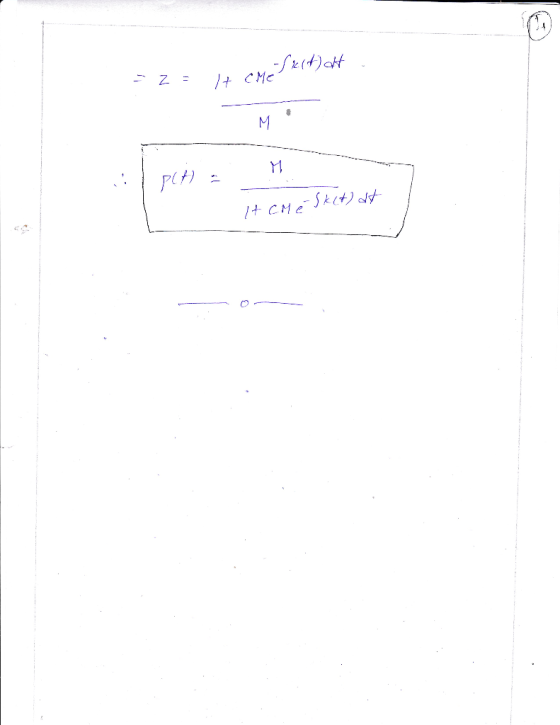
We go back to the logistic model for population dynamics (without harvesting), but we now allow t...
POPULATION MODELS: PLEASE ANSWSER ASAP: ALL 3 AND WILL RATE U ASAP. The logistic growth model...
 POPULATION MODELS: PLEASE
ANSWSER ASAP: ALL 3 AND WILL RATE U ASAP.
The logistic growth model describes population growth when
resources are constrained. It
is an extension to the exponential growth model that includes an
additional term introducing
the carrying capacity of the habitat.
The differential equation for this model is:
dP/dt=kP(t)(1-P(t)/M)
Where P(t) is the population (or population density) at time t,
k > 0 is a growth constant,
and M is the carrying capacity of the habitat. This...
POPULATION MODELS: PLEASE
ANSWSER ASAP: ALL 3 AND WILL RATE U ASAP.
The logistic growth model describes population growth when
resources are constrained. It
is an extension to the exponential growth model that includes an
additional term introducing
the carrying capacity of the habitat.
The differential equation for this model is:
dP/dt=kP(t)(1-P(t)/M)
Where P(t) is the population (or population density) at time t,
k > 0 is a growth constant,
and M is the carrying capacity of the habitat. This...
LOGISTI We know that if the number of individuals, N, in a population at time t follows an exponential law of growth, t...
 LOGISTI We know that if the number of individuals, N, in a population at time t follows an exponential law of growth, then N-N, exr where k >0 and No is the population when t -o. es that at time, t, the rate of growth, N, of the population is proportional to dt dN the number of individuals in the population. That is, kN Under exponential growth, a population would get infinitely large as time goes on. In reality, when...
step by step please 4. Suppose that the logistic equation dt Pla -bP) models a population of fish in a lake after t months during which no fishing occurs. What is the limiting population for this...
 step by step please
4. Suppose that the logistic equation dt Pla -bP) models a population of fish in a lake after t months during which no fishing occurs. What is the limiting population for this fish population? suppose that, because of fishing, fish are removed from the lake at a rate proportional to the existing fish population. i. Write a differential equation that describes this situation. ii. Show that if the constant of proportionality for the harvest of fish,...
step by step please
4. Suppose that the logistic equation dt Pla -bP) models a population of fish in a lake after t months during which no fishing occurs. What is the limiting population for this fish population? suppose that, because of fishing, fish are removed from the lake at a rate proportional to the existing fish population. i. Write a differential equation that describes this situation. ii. Show that if the constant of proportionality for the harvest of fish,...
please solve this question 1. Consider the following modified Logistic model to describe a population p -p(t) with stronger competition as time t increases: dys Here the net birth rate is 1 and the c...
 please solve this question
1. Consider the following modified Logistic model to describe a population p -p(t) with stronger competition as time t increases: dys Here the net birth rate is 1 and the competition term is (1 - e ')p with constant a > 0 (a) Make a substitution of the form u p for some integer m and so reduce (1) to the linear first Cl order o.d.e du dt (b) Find the general solution of (1) (c)...
please solve this question
1. Consider the following modified Logistic model to describe a population p -p(t) with stronger competition as time t increases: dys Here the net birth rate is 1 and the competition term is (1 - e ')p with constant a > 0 (a) Make a substitution of the form u p for some integer m and so reduce (1) to the linear first Cl order o.d.e du dt (b) Find the general solution of (1) (c)...
question 3 Δt gets smaller). Question 3: (4 marks) In deriving the logistic equation for population growth, we ass...
 question 3
Δt gets smaller). Question 3: (4 marks) In deriving the logistic equation for population growth, we assumed the growth rate was proportional to the amount of excess resources, FA pFR where FA is the amount of available resources, p the population, and FR the amount of resources required per individual. Due to seasonal effects, FA may not be a constant (a) Derive a logistic-type equation assuming the amount of resources available are FA(1 + e sin(wt)), where 0...
question 3
Δt gets smaller). Question 3: (4 marks) In deriving the logistic equation for population growth, we assumed the growth rate was proportional to the amount of excess resources, FA pFR where FA is the amount of available resources, p the population, and FR the amount of resources required per individual. Due to seasonal effects, FA may not be a constant (a) Derive a logistic-type equation assuming the amount of resources available are FA(1 + e sin(wt)), where 0...
Use the solution you found in Part 1f to show that the Gompertz model can be...
 Use the solution you found in
Part 1f to show that the Gompertz model can be rewritten as
dP/dt=−λe^(−rt)P, where λ is a positive constant.
j) Consider grouping the factors in the equation like this:
dP/dt=-(λe^(-rt))P. Make an interpretation of this equation. In
other words, what assumption about tumour growth would lead us to
write down such an equation?
k) Now consider grouping the factors in the equation like this:
dP/dt=−λ(e^(-rt)P). Again, explain what assumption about tumour
growth would lead...
Use the solution you found in
Part 1f to show that the Gompertz model can be rewritten as
dP/dt=−λe^(−rt)P, where λ is a positive constant.
j) Consider grouping the factors in the equation like this:
dP/dt=-(λe^(-rt))P. Make an interpretation of this equation. In
other words, what assumption about tumour growth would lead us to
write down such an equation?
k) Now consider grouping the factors in the equation like this:
dP/dt=−λ(e^(-rt)P). Again, explain what assumption about tumour
growth would lead...
Population Growth: Let P(t) be the number of rabbits in the rabbit population. In the simplest...
 Population Growth: Let P(t) be the number of rabbits in the
rabbit population. In the simplest case we can assume the number of
rabbits born at any moment of time is proportional to the number of
rabbits at this moment of time. Mathematically we can write this as
a differential equation:
Here b is the birth rate, i.e. births per time unit per rabbit.
In the model above we ignore deaths and assume resources are
unlimited.
A. Solve the equation...
Population Growth: Let P(t) be the number of rabbits in the
rabbit population. In the simplest case we can assume the number of
rabbits born at any moment of time is proportional to the number of
rabbits at this moment of time. Mathematically we can write this as
a differential equation:
Here b is the birth rate, i.e. births per time unit per rabbit.
In the model above we ignore deaths and assume resources are
unlimited.
A. Solve the equation...
- ap-bp? This equation is known as the logistic law of population growth and the numbers...
 - ap-bp? This equation is known as the logistic law of population growth and the numbers a, b are called the vital coefficients of the population. It was first introduced in 1837 by the Dutch mathematical-biologist Verhulst. Now, the constant b, in general, will be very small compared to a, so that if p is not too large then the term - bp will be negligible compared to ap and the population will grow exponentially. However, when p is very...
please solve 42.7: (a),(b),(c) 42.7. Consider = N()(a - bN(t – (m)] (a) Show that small...
 please solve 42.7: (a),(b),(c)
42.7. Consider = N()(a - bN(t – (m)] (a) Show that small displacements from equilibrium satisfy the following linear delay-differential equation: dN (1) = -aN (6- m. dt (b) Ifm > 0, we will not find the general solution. Instead, let us look for special solutions of the form of exponentials, N (1) = e. Show that r = -ae-rim 184 Population Dynamics-Mathematical Ecology (c) Show graphically there are two real solutions if the delay is...
please solve 42.7: (a),(b),(c)
42.7. Consider = N()(a - bN(t – (m)] (a) Show that small displacements from equilibrium satisfy the following linear delay-differential equation: dN (1) = -aN (6- m. dt (b) Ifm > 0, we will not find the general solution. Instead, let us look for special solutions of the form of exponentials, N (1) = e. Show that r = -ae-rim 184 Population Dynamics-Mathematical Ecology (c) Show graphically there are two real solutions if the delay is...
40. The atmospheric pressure (force per unit area) on a surface at an altitude z is due to the we...
 problem 40 with parts
40. The atmospheric pressure (force per unit area) on a surface at an altitude z is due to the weight of the column of air situated above the surface. Therefore, the difference in air pressure p between the top and bottom of a cylindrical volume element of height Az and cross-section area A equals the weight of the air enclosed (density ρ times volume V-: ΑΔε times gravity g), per unit area: Let Δ、→0 to derive...
problem 40 with parts
40. The atmospheric pressure (force per unit area) on a surface at an altitude z is due to the weight of the column of air situated above the surface. Therefore, the difference in air pressure p between the top and bottom of a cylindrical volume element of height Az and cross-section area A equals the weight of the air enclosed (density ρ times volume V-: ΑΔε times gravity g), per unit area: Let Δ、→0 to derive...
 POPULATION MODELS: PLEASE
ANSWSER ASAP: ALL 3 AND WILL RATE U ASAP.
The logistic growth model describes population growth when
resources are constrained. It
is an extension to the exponential growth model that includes an
additional term introducing
the carrying capacity of the habitat.
The differential equation for this model is:
dP/dt=kP(t)(1-P(t)/M)
Where P(t) is the population (or population density) at time t,
k > 0 is a growth constant,
and M is the carrying capacity of the habitat. This...
POPULATION MODELS: PLEASE
ANSWSER ASAP: ALL 3 AND WILL RATE U ASAP.
The logistic growth model describes population growth when
resources are constrained. It
is an extension to the exponential growth model that includes an
additional term introducing
the carrying capacity of the habitat.
The differential equation for this model is:
dP/dt=kP(t)(1-P(t)/M)
Where P(t) is the population (or population density) at time t,
k > 0 is a growth constant,
and M is the carrying capacity of the habitat. This...
 LOGISTI We know that if the number of individuals, N, in a population at time t follows an exponential law of growth, then N-N, exr where k >0 and No is the population when t -o. es that at time, t, the rate of growth, N, of the population is proportional to dt dN the number of individuals in the population. That is, kN Under exponential growth, a population would get infinitely large as time goes on. In reality, when...
 step by step please
4. Suppose that the logistic equation dt Pla -bP) models a population of fish in a lake after t months during which no fishing occurs. What is the limiting population for this fish population? suppose that, because of fishing, fish are removed from the lake at a rate proportional to the existing fish population. i. Write a differential equation that describes this situation. ii. Show that if the constant of proportionality for the harvest of fish,...
step by step please
4. Suppose that the logistic equation dt Pla -bP) models a population of fish in a lake after t months during which no fishing occurs. What is the limiting population for this fish population? suppose that, because of fishing, fish are removed from the lake at a rate proportional to the existing fish population. i. Write a differential equation that describes this situation. ii. Show that if the constant of proportionality for the harvest of fish,...
 please solve this question
1. Consider the following modified Logistic model to describe a population p -p(t) with stronger competition as time t increases: dys Here the net birth rate is 1 and the competition term is (1 - e ')p with constant a > 0 (a) Make a substitution of the form u p for some integer m and so reduce (1) to the linear first Cl order o.d.e du dt (b) Find the general solution of (1) (c)...
please solve this question
1. Consider the following modified Logistic model to describe a population p -p(t) with stronger competition as time t increases: dys Here the net birth rate is 1 and the competition term is (1 - e ')p with constant a > 0 (a) Make a substitution of the form u p for some integer m and so reduce (1) to the linear first Cl order o.d.e du dt (b) Find the general solution of (1) (c)...
 question 3
Δt gets smaller). Question 3: (4 marks) In deriving the logistic equation for population growth, we assumed the growth rate was proportional to the amount of excess resources, FA pFR where FA is the amount of available resources, p the population, and FR the amount of resources required per individual. Due to seasonal effects, FA may not be a constant (a) Derive a logistic-type equation assuming the amount of resources available are FA(1 + e sin(wt)), where 0...
question 3
Δt gets smaller). Question 3: (4 marks) In deriving the logistic equation for population growth, we assumed the growth rate was proportional to the amount of excess resources, FA pFR where FA is the amount of available resources, p the population, and FR the amount of resources required per individual. Due to seasonal effects, FA may not be a constant (a) Derive a logistic-type equation assuming the amount of resources available are FA(1 + e sin(wt)), where 0...
 Use the solution you found in
Part 1f to show that the Gompertz model can be rewritten as
dP/dt=−λe^(−rt)P, where λ is a positive constant.
j) Consider grouping the factors in the equation like this:
dP/dt=-(λe^(-rt))P. Make an interpretation of this equation. In
other words, what assumption about tumour growth would lead us to
write down such an equation?
k) Now consider grouping the factors in the equation like this:
dP/dt=−λ(e^(-rt)P). Again, explain what assumption about tumour
growth would lead...
Use the solution you found in
Part 1f to show that the Gompertz model can be rewritten as
dP/dt=−λe^(−rt)P, where λ is a positive constant.
j) Consider grouping the factors in the equation like this:
dP/dt=-(λe^(-rt))P. Make an interpretation of this equation. In
other words, what assumption about tumour growth would lead us to
write down such an equation?
k) Now consider grouping the factors in the equation like this:
dP/dt=−λ(e^(-rt)P). Again, explain what assumption about tumour
growth would lead...
 Population Growth: Let P(t) be the number of rabbits in the
rabbit population. In the simplest case we can assume the number of
rabbits born at any moment of time is proportional to the number of
rabbits at this moment of time. Mathematically we can write this as
a differential equation:
Here b is the birth rate, i.e. births per time unit per rabbit.
In the model above we ignore deaths and assume resources are
unlimited.
A. Solve the equation...
Population Growth: Let P(t) be the number of rabbits in the
rabbit population. In the simplest case we can assume the number of
rabbits born at any moment of time is proportional to the number of
rabbits at this moment of time. Mathematically we can write this as
a differential equation:
Here b is the birth rate, i.e. births per time unit per rabbit.
In the model above we ignore deaths and assume resources are
unlimited.
A. Solve the equation...
 - ap-bp? This equation is known as the logistic law of population growth and the numbers a, b are called the vital coefficients of the population. It was first introduced in 1837 by the Dutch mathematical-biologist Verhulst. Now, the constant b, in general, will be very small compared to a, so that if p is not too large then the term - bp will be negligible compared to ap and the population will grow exponentially. However, when p is very...
 please solve 42.7: (a),(b),(c)
42.7. Consider = N()(a - bN(t – (m)] (a) Show that small displacements from equilibrium satisfy the following linear delay-differential equation: dN (1) = -aN (6- m. dt (b) Ifm > 0, we will not find the general solution. Instead, let us look for special solutions of the form of exponentials, N (1) = e. Show that r = -ae-rim 184 Population Dynamics-Mathematical Ecology (c) Show graphically there are two real solutions if the delay is...
please solve 42.7: (a),(b),(c)
42.7. Consider = N()(a - bN(t – (m)] (a) Show that small displacements from equilibrium satisfy the following linear delay-differential equation: dN (1) = -aN (6- m. dt (b) Ifm > 0, we will not find the general solution. Instead, let us look for special solutions of the form of exponentials, N (1) = e. Show that r = -ae-rim 184 Population Dynamics-Mathematical Ecology (c) Show graphically there are two real solutions if the delay is...
 problem 40 with parts
40. The atmospheric pressure (force per unit area) on a surface at an altitude z is due to the weight of the column of air situated above the surface. Therefore, the difference in air pressure p between the top and bottom of a cylindrical volume element of height Az and cross-section area A equals the weight of the air enclosed (density ρ times volume V-: ΑΔε times gravity g), per unit area: Let Δ、→0 to derive...
problem 40 with parts
40. The atmospheric pressure (force per unit area) on a surface at an altitude z is due to the weight of the column of air situated above the surface. Therefore, the difference in air pressure p between the top and bottom of a cylindrical volume element of height Az and cross-section area A equals the weight of the air enclosed (density ρ times volume V-: ΑΔε times gravity g), per unit area: Let Δ、→0 to derive...
Most questions answered within 3 hours.
-
Where is the error in this code sequence?
String s1 = "Hello";
String s2 = "ello";...
asked 11 months ago -
Financial data for Joel de Paris, Inc., for last year
follow:
Joel de Paris, Inc.
Balance...
asked 11 months ago -
Consider this reaction:
Al2(SO4)3 (aq)+ BaCl3
(aq) Al2Cl6 (aq)- +
3BaSO4(s) . What is the...
asked 11 months ago -
Suppose that Savneet is considering increasing her
recent random sample from 20 car rentals to 40...
asked 11 months ago -
Trucks arrive at an unloading terminal at an average rate of 120
per hour.
Trucks arrive...
asked 11 months ago -
Why are methanol and ethanol completely soluble in water while
octanol is not very little soluble....
asked 11 months ago -
A facilities manager at a university reads in a research report
that the mean amount of...
asked 11 months ago -
When the CuSO4 is rehydrated by adding water to the anhydrous
compound, is this an endothermic...
asked 11 months ago -
A ray of sunlight is passing from diamond into crown glass; the
angle of incidence is...
asked 11 months ago -
A block of mass 0.249 kg is placed on top of a light, vertical
spring of...
asked 11 months ago -
how do the kidneys compensate in the presences of acidosis
a) trigger hyperventilate
b) reserve acid...
asked 11 months ago -
Question 501 pts
The rental rate of capital to the firm increases. Which of the
following...
asked 11 months ago