
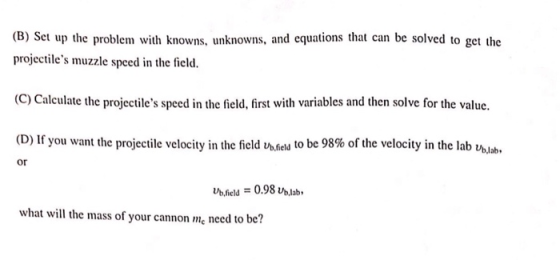
(B) Set up the problem with knowns, unknowns, and equations that can be solved to get the projectile's muzzle speed in the field. C) Calculate the projectile's speed in the field, first with variables and then solve for the value. (D) If you want the projectile velocity in the field Unield to be 98% of the velocity in the lab Unlab, or Up.field 0.98 Ub.lab, what will the mass of your cannon me need to be?
Homework Answers
Add Answer to:
You have an internship working for the National Park Service. They start you off in the laborator...
You work for the National Park Service testing a small cannon used to prevent avalanches by...
You work for the National Park Service testing a small cannon used to prevent avalanches by shooting down snow overhanging the sides of mountains. In order to determine the range of the cannon, it is necessary to know the speed with which the projectile leaves the cannon (muzzle speed), relative to the ground. The cannon you are testing has a weight of 517 kg and shoots a 21-kg projectile. During lab tests where the cannon is held and cannot move,...
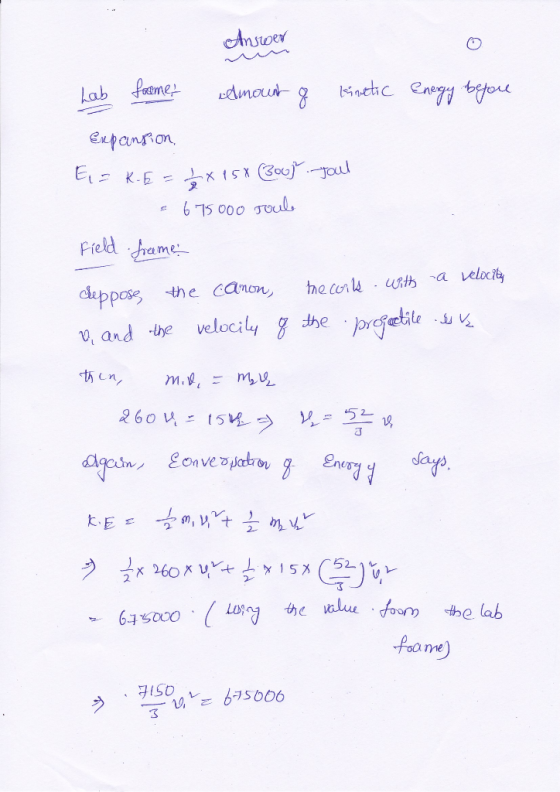
The cannon you are testing weighs 260 kg and shoots a 15 kg projectile. During the...
The cannon you are testing weighs 260 kg and shoots a 15 kg projectile. During the lab tests the cannon is held horizontal in a rigid support so that it cannot move. Under those conditions, you use video analysis of the projectile to determine that the muzzle speed is 300 m/s. When fired in the field, the cannon is not rigidly attached to the ground, but it is free to move (recoil) when it is fired. There are ropes attached...
A cannon of mass 5.93 x 10³ kg is rigidly bolted to the earth so it...
A cannon of mass 5.93 x 10³ kg is rigidly bolted to the earth so it can recolil only by a negligible amount. The cannon fires a 80.7kg shell horizontally with an initial velocity of 508 m/s. Suppose the cannon is then unbolted from the earth, and no external force hinders its recoil. What would be the velocity of a shell fired from this loose cannon? (Hint: In both cases assume that the burning gunpowder imparts the same kinetic energy...
A cannon of mass 5.60 ✕ 10^3 kg is rigidly bolted to the earth so it...
A cannon of mass 5.60 ✕ 10^3 kg is rigidly bolted to the earth so it can recoil only by a negligible amount. The cannon fires an 82.5-kg shell horizontally with an initial velocity of +550 m/s. Suppose the cannon is then unbolted from the earth, and no external force hinders its recoil. What would be the velocity of an identical shell fired by this loose cannon? (Hint: In both cases assume that the burning gunpowder imparts the same kinetic...
Need help With Analysis questions. Ballistic Pendulum Lab In this lab, you will explore conservat...
 Need help With Analysis questions.
Ballistic Pendulum Lab In this lab, you will explore
conservation of Energy and Momentum in an inelastic collision
between a projectile and a cardboard box suspended from a string.
In particular, you will see that the transfer of linear momentum is
easily accounted for in an inelastic collision, but the transfer of
kinetic energy is not easy to measure directly. This is because
Kinetic Energy in collisions transfers to vibrational, acoustic,
and potential energy. Once...
Need help With Analysis questions.
Ballistic Pendulum Lab In this lab, you will explore
conservation of Energy and Momentum in an inelastic collision
between a projectile and a cardboard box suspended from a string.
In particular, you will see that the transfer of linear momentum is
easily accounted for in an inelastic collision, but the transfer of
kinetic energy is not easy to measure directly. This is because
Kinetic Energy in collisions transfers to vibrational, acoustic,
and potential energy. Once...
4. Use Kepler's Second Law and the fact that L-fxp to determine at which points in...
 4. Use Kepler's Second Law and the fact that L-fxp to determine at which points in an elliptical orbit around the Sun a planet has maximum and minimum speeds. (Section 13.5 will help.) 5. At the end of example 13.10, there's an "Evaluate" blurb about how inside the surface of the Earth the force of gravity varies proportionally to the distance from the center, and it makes reference to the next chapter. which is about oscillation. Model the motion of...
was trying work on this homework but can’t seem to get it right the ball and...
 was
trying work on this homework but can’t seem to get it right
the ball and the pendulum cup have the same velocity after the collision. As is the case with any collision, total momentum is conserved (unchanged). Using conservation of momentum, write down an equation for Vealefore in terms of the velocity of the hall together with the pendmcu ( d the mass of the al and that of the cup (meup). ball before= Using conservation of energy between...
was
trying work on this homework but can’t seem to get it right
the ball and the pendulum cup have the same velocity after the collision. As is the case with any collision, total momentum is conserved (unchanged). Using conservation of momentum, write down an equation for Vealefore in terms of the velocity of the hall together with the pendmcu ( d the mass of the al and that of the cup (meup). ball before= Using conservation of energy between...
OAL Combine the concepts of conservation of energy and conservation of momentum in inelastic collisions. In...
OAL Combine the concepts of conservation of energy and conservation of momentum in inelastic collisions. In figure a, a bullet and a wooden block are shown in two configurations. In the first configuration, the block, labeled m2, hangs vertically from a ceiling. A bullet, labeled m1, approaches the block horizontally from the left. A rightward arrow points from the bullet and is labeled vector v1i. A rightward arrow, shorter than the first, points from the block and is labeled vector...
HELLO! Please answer all the questions! don't leave any of them out! Thanks! Answer all the...
 HELLO! Please answer all the questions! don't leave
any of them out! Thanks!
Answer all the questions asked please!
om 8. A ball of silly putty hits and sticks to a bowling ball that was initially at rest. After the collision, the total kinetic energy of the bowling ball and silly! putty is O (A) less than the kinetic energy of the silly putty before the collision O (B) more than the kinetic energy of the silly putty before the...
HELLO! Please answer all the questions! don't leave
any of them out! Thanks!
Answer all the questions asked please!
om 8. A ball of silly putty hits and sticks to a bowling ball that was initially at rest. After the collision, the total kinetic energy of the bowling ball and silly! putty is O (A) less than the kinetic energy of the silly putty before the collision O (B) more than the kinetic energy of the silly putty before the...
From University Physics, 5th edition. Please help clarify this problem, and show work if you can!...
 From University Physics, 5th edition.
Please help clarify this problem, and show work if you can!
:)
(18 points) A 2.00 kg block is moving mass 3.00 kg is moving to the left a 2.00 kg block is moving to the right with a speed of 1.50 m/s and a second block of U kg is moving to the left and towards the other block at a speed of 1.75 m/s. An ideal Spring is attached to the front of...
From University Physics, 5th edition.
Please help clarify this problem, and show work if you can!
:)
(18 points) A 2.00 kg block is moving mass 3.00 kg is moving to the left a 2.00 kg block is moving to the right with a speed of 1.50 m/s and a second block of U kg is moving to the left and towards the other block at a speed of 1.75 m/s. An ideal Spring is attached to the front of...
 Need help With Analysis questions.
Ballistic Pendulum Lab In this lab, you will explore
conservation of Energy and Momentum in an inelastic collision
between a projectile and a cardboard box suspended from a string.
In particular, you will see that the transfer of linear momentum is
easily accounted for in an inelastic collision, but the transfer of
kinetic energy is not easy to measure directly. This is because
Kinetic Energy in collisions transfers to vibrational, acoustic,
and potential energy. Once...
Need help With Analysis questions.
Ballistic Pendulum Lab In this lab, you will explore
conservation of Energy and Momentum in an inelastic collision
between a projectile and a cardboard box suspended from a string.
In particular, you will see that the transfer of linear momentum is
easily accounted for in an inelastic collision, but the transfer of
kinetic energy is not easy to measure directly. This is because
Kinetic Energy in collisions transfers to vibrational, acoustic,
and potential energy. Once...
 4. Use Kepler's Second Law and the fact that L-fxp to determine at which points in an elliptical orbit around the Sun a planet has maximum and minimum speeds. (Section 13.5 will help.) 5. At the end of example 13.10, there's an "Evaluate" blurb about how inside the surface of the Earth the force of gravity varies proportionally to the distance from the center, and it makes reference to the next chapter. which is about oscillation. Model the motion of...
 was
trying work on this homework but can’t seem to get it right
the ball and the pendulum cup have the same velocity after the collision. As is the case with any collision, total momentum is conserved (unchanged). Using conservation of momentum, write down an equation for Vealefore in terms of the velocity of the hall together with the pendmcu ( d the mass of the al and that of the cup (meup). ball before= Using conservation of energy between...
was
trying work on this homework but can’t seem to get it right
the ball and the pendulum cup have the same velocity after the collision. As is the case with any collision, total momentum is conserved (unchanged). Using conservation of momentum, write down an equation for Vealefore in terms of the velocity of the hall together with the pendmcu ( d the mass of the al and that of the cup (meup). ball before= Using conservation of energy between...
 HELLO! Please answer all the questions! don't leave
any of them out! Thanks!
Answer all the questions asked please!
om 8. A ball of silly putty hits and sticks to a bowling ball that was initially at rest. After the collision, the total kinetic energy of the bowling ball and silly! putty is O (A) less than the kinetic energy of the silly putty before the collision O (B) more than the kinetic energy of the silly putty before the...
HELLO! Please answer all the questions! don't leave
any of them out! Thanks!
Answer all the questions asked please!
om 8. A ball of silly putty hits and sticks to a bowling ball that was initially at rest. After the collision, the total kinetic energy of the bowling ball and silly! putty is O (A) less than the kinetic energy of the silly putty before the collision O (B) more than the kinetic energy of the silly putty before the...
 From University Physics, 5th edition.
Please help clarify this problem, and show work if you can!
:)
(18 points) A 2.00 kg block is moving mass 3.00 kg is moving to the left a 2.00 kg block is moving to the right with a speed of 1.50 m/s and a second block of U kg is moving to the left and towards the other block at a speed of 1.75 m/s. An ideal Spring is attached to the front of...
From University Physics, 5th edition.
Please help clarify this problem, and show work if you can!
:)
(18 points) A 2.00 kg block is moving mass 3.00 kg is moving to the left a 2.00 kg block is moving to the right with a speed of 1.50 m/s and a second block of U kg is moving to the left and towards the other block at a speed of 1.75 m/s. An ideal Spring is attached to the front of...
Most questions answered within 3 hours.
-
Where is the error in this code sequence?
String s1 = "Hello";
String s2 = "ello";...
asked 10 months ago -
Financial data for Joel de Paris, Inc., for last year
follow:
Joel de Paris, Inc.
Balance...
asked 10 months ago -
Consider this reaction:
Al2(SO4)3 (aq)+ BaCl3
(aq) Al2Cl6 (aq)- +
3BaSO4(s) . What is the...
asked 10 months ago -
Suppose that Savneet is considering increasing her
recent random sample from 20 car rentals to 40...
asked 10 months ago -
Trucks arrive at an unloading terminal at an average rate of 120
per hour.
Trucks arrive...
asked 10 months ago -
Why are methanol and ethanol completely soluble in water while
octanol is not very little soluble....
asked 10 months ago -
A facilities manager at a university reads in a research report
that the mean amount of...
asked 10 months ago -
When the CuSO4 is rehydrated by adding water to the anhydrous
compound, is this an endothermic...
asked 10 months ago -
A ray of sunlight is passing from diamond into crown glass; the
angle of incidence is...
asked 10 months ago -
A block of mass 0.249 kg is placed on top of a light, vertical
spring of...
asked 10 months ago -
how do the kidneys compensate in the presences of acidosis
a) trigger hyperventilate
b) reserve acid...
asked 10 months ago -
Question 501 pts
The rental rate of capital to the firm increases. Which of the
following...
asked 10 months ago