
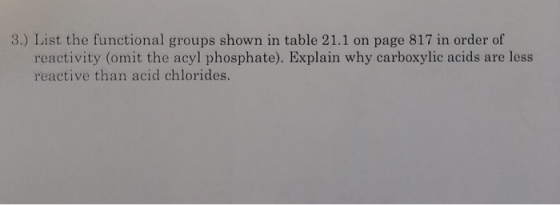
3.) List the functional groups shown in table 21.1 on page 817 in order of reactivity (omit the acyl phosphate). Explain why carboxylic acids are less reactive than acid chlorides.
Homework Answers
The Nucleophilic acyl substitution reaction:-
The fact that the atom adjacent to the carbonyl carbon in
carboxylic acid derivatives is an electronegative heteroatom –
rather than a carbon like in ketones or a hydrogen like in
aldehydes - is critical to understanding the reactivity of these
functional groups. The carboxylic acid derivatives are attacked
from one side of their trigonal planar carbonyl carbon by a
nucleophile, converting this carbon to tetrahedral (sp3) geometry.
In carboxylic acid derivatives, the acyl X group is a leaving
group. the tetrahedral product formed from attack of the
nucleophile on the carbonyl carbon is not the product: it is a
reactive intermediate. The tetrahedral intermediate
rapidly collapses: the carbon-oxygen double bond re-forms, and the
acyl X group is expelled. Carboxylic acids have
conjugation which makes them stable i.e. unreactive or less
reactive, whereas acid halides don't have such possibility and due
to electronegative nature of halide groups the carbon becomes more
electrophilic hence more reactive towards any nucleophilic attack.
So the overall reactivity order is:-
Carboxylic acids have
conjugation which makes them stable i.e. unreactive or less
reactive, whereas acid halides don't have such possibility and due
to electronegative nature of halide groups the carbon becomes more
electrophilic hence more reactive towards any nucleophilic attack.
So the overall reactivity order is:-  The acid chloride is most
reactive and the amide is least reactive.
The acid chloride is most
reactive and the amide is least reactive.
Add Answer to:
он он te Acetyl adenosyl phosphate A sum Table 21.1. nclature rules for carboxylic acid derivativ...
Provide three examples (both structure and name for each case) for the following carboxylic acid and...
 Provide three examples (both structure and name for each case) for the following carboxylic acid and its derivatives (a) Carboxylic acid (b) Acid halide (c) Acid anhydride (d) Ester (e) Thioester (0) Amide 1. 6x3-18 2. Write a preparation method for one compound from each category in question 1 . 6x2-12 The following two are the general reaction mechanisms for carbonyl group containing compounds. What is the difference between them? Write mechanism from a reaction describe in question 2. 3....
 Provide three examples (both structure and name for each case) for the following carboxylic acid and its derivatives (a) Carboxylic acid (b) Acid halide (c) Acid anhydride (d) Ester (e) Thioester (0) Amide 1. 6x3-18 2. Write a preparation method for one compound from each category in question 1 . 6x2-12 The following two are the general reaction mechanisms for carbonyl group containing compounds. What is the difference between them? Write mechanism from a reaction describe in question 2. 3....
Most questions answered within 3 hours.
-
Where is the error in this code sequence?
String s1 = "Hello";
String s2 = "ello";...
asked 10 months ago -
Financial data for Joel de Paris, Inc., for last year
follow:
Joel de Paris, Inc.
Balance...
asked 10 months ago -
Consider this reaction:
Al2(SO4)3 (aq)+ BaCl3
(aq) Al2Cl6 (aq)- +
3BaSO4(s) . What is the...
asked 10 months ago -
Suppose that Savneet is considering increasing her
recent random sample from 20 car rentals to 40...
asked 10 months ago -
Trucks arrive at an unloading terminal at an average rate of 120
per hour.
Trucks arrive...
asked 10 months ago -
Why are methanol and ethanol completely soluble in water while
octanol is not very little soluble....
asked 10 months ago -
A facilities manager at a university reads in a research report
that the mean amount of...
asked 10 months ago -
When the CuSO4 is rehydrated by adding water to the anhydrous
compound, is this an endothermic...
asked 10 months ago -
A ray of sunlight is passing from diamond into crown glass; the
angle of incidence is...
asked 10 months ago -
A block of mass 0.249 kg is placed on top of a light, vertical
spring of...
asked 10 months ago -
how do the kidneys compensate in the presences of acidosis
a) trigger hyperventilate
b) reserve acid...
asked 10 months ago -
Question 501 pts
The rental rate of capital to the firm increases. Which of the
following...
asked 10 months ago