
Homework Answers
Add Answer to:
Problem 1 (10 points). Consider a newly invented power cyclic device performing a power cycle whi...
A reversible power cycle whose thermal efficiency is 39% receives 50 kJ by heat transfer from a hot reservoir at 310oC...
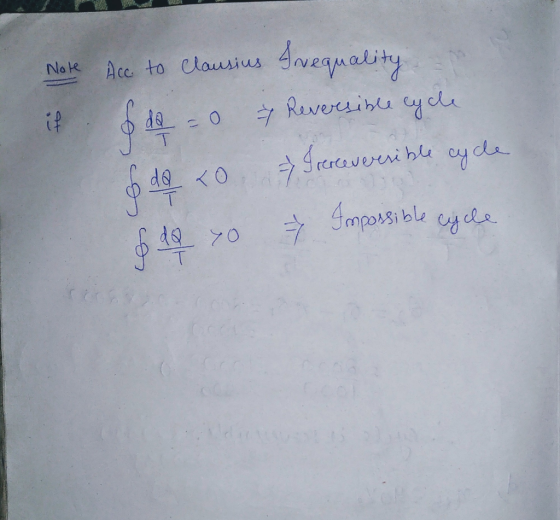
A reversible power cycle whose thermal efficiency is 39% receives 50 kJ by heat transfer from a hot reservoir at 310oC and rejects energy by heat transfer to a cold reservoir at temperature TC. Determine the energy rejected, in kJ, and TC, in oC. Determine the entropy production for the cycle, σcycle, in kJ/K.
A system executes a power cycle while receiving 1050 kJ by heat transfer at a temperature of 525 K and discharging 700 kJ by heat transfer at 350 K.
Problem 2.3 (Clausius Inequality Applications) A system executes a power cycle while receiving 1050 kJ by heat transfer at a temperature of 525 K and discharging 700 kJ by heat transfer at 350 K. There are no other heat transfers (a) Using eq.5.13, determine whether the cycle is internally reversible, irreversible, or impossible. (b) Determine the thermal efficiency using eq.5.4 and the given heat transfer data. Compare this value with the Carnot efficiency calculated using eq.5.9 and comment.
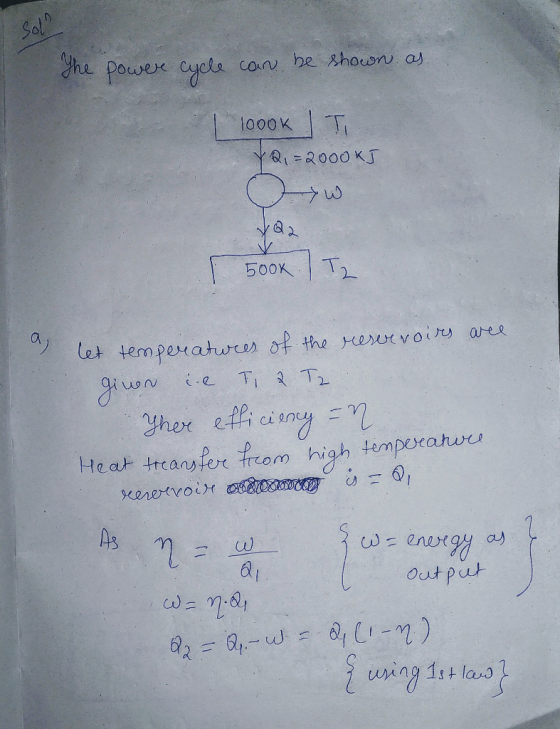
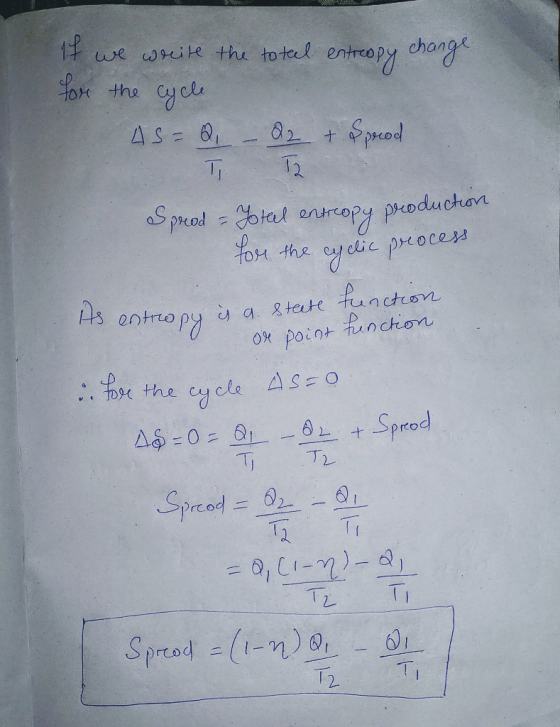
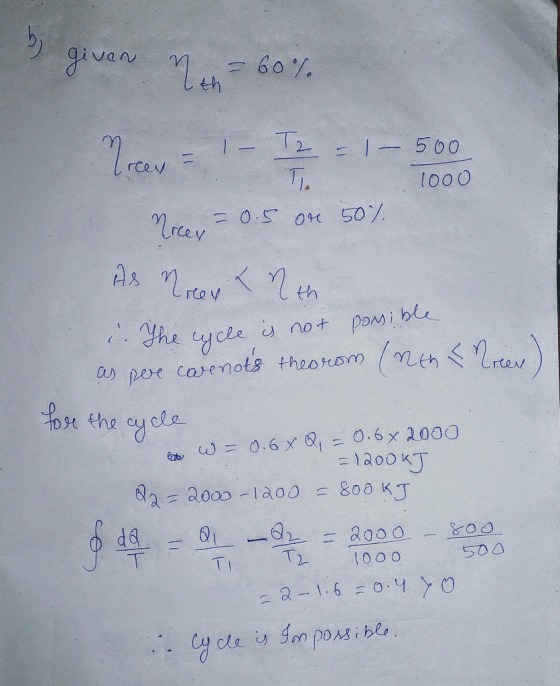
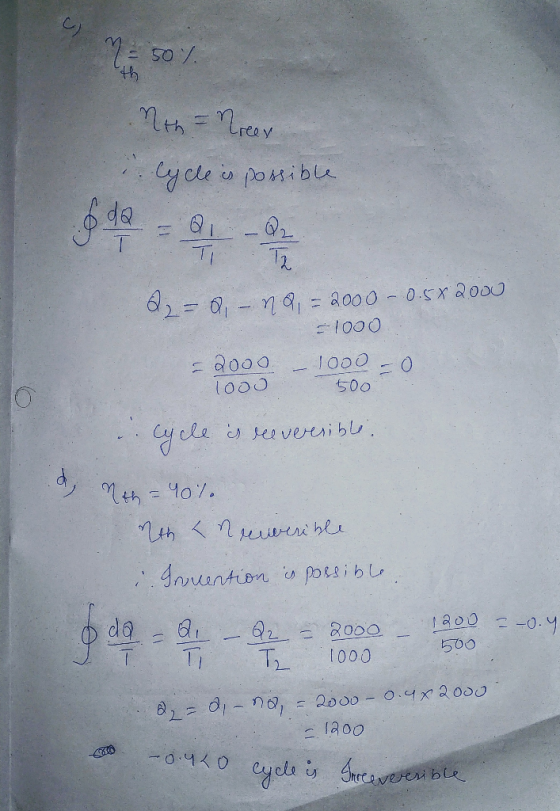
A system executes a power cycle while receiving heat transfer at a temperature of 1000 K...
 A system executes a power cycle while receiving heat transfer at a temperature of 1000 K and discharging 1000 kJ by heat transfer at a temperature of 450 K. There are ho other heat transfers. Appling the lausus Inequality, determine entropy generation, if the thermal efficiency is 50%. Also comment if the cycle is 15. Extra-credit (10 Pts.) reversible, irreversible, or impossible? Explain your reasoning. press entropy balance using heat engine efficiency in terms of O's. Remember this is not...
Please Solve all the parts. if you cannot. please leave for someone who can. Also please...
 Please Solve all the parts. if you cannot. please leave for
someone who can. Also please write everything clearly so I can
read. Thank you.
Task A heat pump delivers 8 kJ thermal energy to the high temperature reservoir (the inside of the house). Consider the following five cases for the power consumed in the heat pump: a) W 8 k] b) W 0 kJ c) W 1 kJ d) W 0.5 kJ e) W 0.87 kJ Using the Clausius...
Please Solve all the parts. if you cannot. please leave for
someone who can. Also please write everything clearly so I can
read. Thank you.
Task A heat pump delivers 8 kJ thermal energy to the high temperature reservoir (the inside of the house). Consider the following five cases for the power consumed in the heat pump: a) W 8 k] b) W 0 kJ c) W 1 kJ d) W 0.5 kJ e) W 0.87 kJ Using the Clausius...
3. (a) 10 kg/s of water flows through a simple steady-state vapor-power cycle as shown in...
 3. (a) 10 kg/s of water flows through a simple steady-state vapor-power cycle as shown in the figure. The four states are defined by the given properties in the table. Fill in the missing properties in the table (b) Find the power input to the pump and the rate of entropy change. (c) Find the rate of heat added to the boiler. (c) Find the power output of the turbine and the rate of entropy change. (d) Find the rate...
Consider a steam power plant which operates on the simple ideal Rankine cycle (shown in the...
 Consider a steam power plant which operates on the simple ideal
Rankine cycle (shown in the next page), where the boiler pressure
is 3 MPa and the condenser saturation temperature is 50°C. The
temperature at the exit of the boiler is 500°C. Water leaves the
condenser as a saturated liquid. The mass flow rate through each
component is 15 kg/s. Calculate:
1. The power output of the steam power plant
2. The thermal efficiency of the steam power plant
Now,...
Consider a steam power plant which operates on the simple ideal
Rankine cycle (shown in the next page), where the boiler pressure
is 3 MPa and the condenser saturation temperature is 50°C. The
temperature at the exit of the boiler is 500°C. Water leaves the
condenser as a saturated liquid. The mass flow rate through each
component is 15 kg/s. Calculate:
1. The power output of the steam power plant
2. The thermal efficiency of the steam power plant
Now,...
Problem 3. Rankine Cycle (90 points) A steam power plant operates with high pressure of 4 MPa and has a boiler exit at 600°C receiving heat from a 700° C reservoir. The ambient air at 20°C provid...
 Problem 3. Rankine Cycle (90 points) A steam power plant operates with high pressure of 4 MPa and has a boiler exit at 600°C receiving heat from a 700° C reservoir. The ambient air at 20°C provides cooling to maintain the water/vapor mixture in the condenser at 60°C. All components are ideal (i.e., reversible) except the turbine which has an efficiency 92% ofa reversible isentropic process. Other than the irreversibility of the turbine, the power plant can be considered as...
Problem 1 (40 pts): A power plant runs on a steam cycle that closely approximates a...
 Problem 1 (40 pts): A power plant runs on a steam cycle that closely approximates a Rankine cycle with one exception: the turbine is adiabatic but not isentropic, and has an isentropic efficiency of 85%. The cycle operates between 20 kPa and 20 MPa and steam achieves a maximum temperature of 600 °C. The cycle receives heat from a combustion chamber at 1500 K and rejects heat to the surrounding. a) Calculate the net work output and thermal efficiency of...
PROBLEM 2 Problem 1 (40 pts): A power plant runs on a steam cycle that closely...
 PROBLEM 2
Problem 1 (40 pts): A power plant runs on a steam cycle that closely approximates a Rankine cycle with one exception: the turbine is adiabatic but not isentropic, and has an isentropic efficiency of 85%. The cycle operates between 20 kPa and 20 MPa and steam achieves a maximum temperature of 600 °C. The cycle receives heat from a combustion chamber at 1500 K and rejects heat to the surrounding. a) Calculate the net work output and thermal...
PROBLEM 2
Problem 1 (40 pts): A power plant runs on a steam cycle that closely approximates a Rankine cycle with one exception: the turbine is adiabatic but not isentropic, and has an isentropic efficiency of 85%. The cycle operates between 20 kPa and 20 MPa and steam achieves a maximum temperature of 600 °C. The cycle receives heat from a combustion chamber at 1500 K and rejects heat to the surrounding. a) Calculate the net work output and thermal...
Problem 1 0/5 points (0%) Consider a combined gas-steam power plant that has a net power...
 Problem 1 0/5 points (0%) Consider a combined gas-steam power plant that has a net power output of 500 MW. The pressure ratio of the gas-turbine cycle is 12. Air enters the compressor at 308 K and the turbine at 1300 K. The combustion gases leaving the gas turbine are used to heat the steam at 9 MPa to 360°C in a heat exchanger. The combustion gases leave the heat exchanger at 460 K. An open feedwater heater incorporated with...
 A system executes a power cycle while receiving heat transfer at a temperature of 1000 K and discharging 1000 kJ by heat transfer at a temperature of 450 K. There are ho other heat transfers. Appling the lausus Inequality, determine entropy generation, if the thermal efficiency is 50%. Also comment if the cycle is 15. Extra-credit (10 Pts.) reversible, irreversible, or impossible? Explain your reasoning. press entropy balance using heat engine efficiency in terms of O's. Remember this is not...
 Please Solve all the parts. if you cannot. please leave for
someone who can. Also please write everything clearly so I can
read. Thank you.
Task A heat pump delivers 8 kJ thermal energy to the high temperature reservoir (the inside of the house). Consider the following five cases for the power consumed in the heat pump: a) W 8 k] b) W 0 kJ c) W 1 kJ d) W 0.5 kJ e) W 0.87 kJ Using the Clausius...
Please Solve all the parts. if you cannot. please leave for
someone who can. Also please write everything clearly so I can
read. Thank you.
Task A heat pump delivers 8 kJ thermal energy to the high temperature reservoir (the inside of the house). Consider the following five cases for the power consumed in the heat pump: a) W 8 k] b) W 0 kJ c) W 1 kJ d) W 0.5 kJ e) W 0.87 kJ Using the Clausius...
 3. (a) 10 kg/s of water flows through a simple steady-state vapor-power cycle as shown in the figure. The four states are defined by the given properties in the table. Fill in the missing properties in the table (b) Find the power input to the pump and the rate of entropy change. (c) Find the rate of heat added to the boiler. (c) Find the power output of the turbine and the rate of entropy change. (d) Find the rate...
 Consider a steam power plant which operates on the simple ideal
Rankine cycle (shown in the next page), where the boiler pressure
is 3 MPa and the condenser saturation temperature is 50°C. The
temperature at the exit of the boiler is 500°C. Water leaves the
condenser as a saturated liquid. The mass flow rate through each
component is 15 kg/s. Calculate:
1. The power output of the steam power plant
2. The thermal efficiency of the steam power plant
Now,...
Consider a steam power plant which operates on the simple ideal
Rankine cycle (shown in the next page), where the boiler pressure
is 3 MPa and the condenser saturation temperature is 50°C. The
temperature at the exit of the boiler is 500°C. Water leaves the
condenser as a saturated liquid. The mass flow rate through each
component is 15 kg/s. Calculate:
1. The power output of the steam power plant
2. The thermal efficiency of the steam power plant
Now,...
 Problem 3. Rankine Cycle (90 points) A steam power plant operates with high pressure of 4 MPa and has a boiler exit at 600°C receiving heat from a 700° C reservoir. The ambient air at 20°C provides cooling to maintain the water/vapor mixture in the condenser at 60°C. All components are ideal (i.e., reversible) except the turbine which has an efficiency 92% ofa reversible isentropic process. Other than the irreversibility of the turbine, the power plant can be considered as...
 Problem 1 (40 pts): A power plant runs on a steam cycle that closely approximates a Rankine cycle with one exception: the turbine is adiabatic but not isentropic, and has an isentropic efficiency of 85%. The cycle operates between 20 kPa and 20 MPa and steam achieves a maximum temperature of 600 °C. The cycle receives heat from a combustion chamber at 1500 K and rejects heat to the surrounding. a) Calculate the net work output and thermal efficiency of...
 PROBLEM 2
Problem 1 (40 pts): A power plant runs on a steam cycle that closely approximates a Rankine cycle with one exception: the turbine is adiabatic but not isentropic, and has an isentropic efficiency of 85%. The cycle operates between 20 kPa and 20 MPa and steam achieves a maximum temperature of 600 °C. The cycle receives heat from a combustion chamber at 1500 K and rejects heat to the surrounding. a) Calculate the net work output and thermal...
PROBLEM 2
Problem 1 (40 pts): A power plant runs on a steam cycle that closely approximates a Rankine cycle with one exception: the turbine is adiabatic but not isentropic, and has an isentropic efficiency of 85%. The cycle operates between 20 kPa and 20 MPa and steam achieves a maximum temperature of 600 °C. The cycle receives heat from a combustion chamber at 1500 K and rejects heat to the surrounding. a) Calculate the net work output and thermal...
 Problem 1 0/5 points (0%) Consider a combined gas-steam power plant that has a net power output of 500 MW. The pressure ratio of the gas-turbine cycle is 12. Air enters the compressor at 308 K and the turbine at 1300 K. The combustion gases leaving the gas turbine are used to heat the steam at 9 MPa to 360°C in a heat exchanger. The combustion gases leave the heat exchanger at 460 K. An open feedwater heater incorporated with...
Most questions answered within 3 hours.
-
Where is the error in this code sequence?
String s1 = "Hello";
String s2 = "ello";...
asked 11 months ago -
Financial data for Joel de Paris, Inc., for last year
follow:
Joel de Paris, Inc.
Balance...
asked 11 months ago -
Consider this reaction:
Al2(SO4)3 (aq)+ BaCl3
(aq) Al2Cl6 (aq)- +
3BaSO4(s) . What is the...
asked 11 months ago -
Suppose that Savneet is considering increasing her
recent random sample from 20 car rentals to 40...
asked 11 months ago -
Trucks arrive at an unloading terminal at an average rate of 120
per hour.
Trucks arrive...
asked 11 months ago -
Why are methanol and ethanol completely soluble in water while
octanol is not very little soluble....
asked 11 months ago -
A facilities manager at a university reads in a research report
that the mean amount of...
asked 11 months ago -
When the CuSO4 is rehydrated by adding water to the anhydrous
compound, is this an endothermic...
asked 11 months ago -
A ray of sunlight is passing from diamond into crown glass; the
angle of incidence is...
asked 11 months ago -
A block of mass 0.249 kg is placed on top of a light, vertical
spring of...
asked 11 months ago -
how do the kidneys compensate in the presences of acidosis
a) trigger hyperventilate
b) reserve acid...
asked 11 months ago -
Question 501 pts
The rental rate of capital to the firm increases. Which of the
following...
asked 11 months ago