
Homework Answers



Add Answer to:
Consider a rectangular plate with sides a and b and thickness t, as shown in the figure at left b...
62 (1%) Consider a rectangular plate with sides a and b and thickness t, as shown...
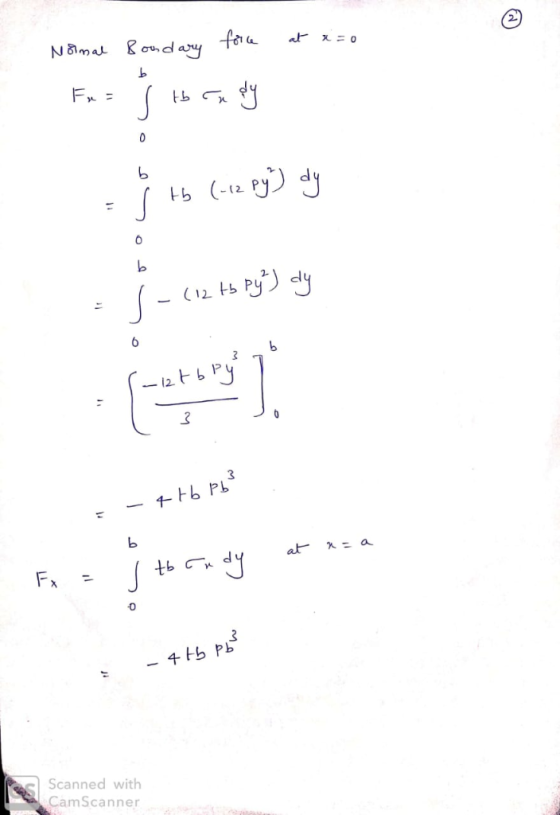
 62 (1%) Consider a rectangular plate with sides a and b and thickness t, as shown in the figure at left below. a. Biharmonic equation. If we assume an Airy's stress function: Ф(x,y)-p(x'-y'), where p is a constant, will the biharmonic equation be satisfied? Ignore the body forces. b. Stresses. Determine the stresses (σ.σ..). c. Resultant forces & moment. Apply the Saint-Venant's Principle to find the resultant normal and shearing boundary forces as well as resuitant bending moment along all...
2. A rectangular plate with sides 6 m and 4 m of thickness l 12 mm (Fig. 1) is subjected to the s...
 2. A rectangular plate with sides 6 m and 4 m of thickness l 12 mm (Fig. 1) is subjected to the stresses σο Ơy and Fry. An Airy stress function is proposed to be φ = 12x3y. (a) Is φ a possible valid Airy stress function? Prove your answer by a calculation. (b) If φ is valid, determine the values of stresses (Ox, σ, and τ, at point (xy,z) which satisfy the stress function. (c) Draw a sketch showing...
1. Consider a rectangular plate with sides a and b of thickness t, as showen in...
 1. Consider a rectangular plate with sides a and b of thickness t, as showen in Fig. P1, for the stress function 0 = px?y, where p is a constant, what will be the resultant normal bounday force Py allong the edge of the plate y = b? (a) 3pabt, (b) pat, (c) 2pabt, (d) 0, (e) none of above YA 3 4 6 4 25 6 51 MPa X a Fig. P1 Fig. P2
1. Consider a rectangular plate with sides a and b of thickness t, as showen in...
 1. Consider a rectangular plate with sides a and b of thickness t, as showen in Fig. P1, for the stress function Ø = px3y, where p is a constant, what will be the resultant normal bounday force Py allong the edge of the plate y = b? (a) 3pabt, (b) pa’t, (c) 2pa’bt, (d) 0, (e) none of above YA b 3 4 6 4 2 5 6 5 1 MPa X k a Fig. P1 Fig. P2
The rectangular plate shown in the figure below has the given loads uniformly distributed over the...
 The rectangular plate shown in the figure below has the given loads uniformly distributed over the edges. The plate is 50 mm thick, AB is 500 mm and BC is 400 mm (a) (b) (c) (d) (e) Determine the shear forces which must operate on the edges BC and DA to maintain the equilibrium of the plate Relative to the x,y reference axes, determine the state of stress at any point P in the interior of the plate For the...
7.7 A thin plate is rigidly fixed at its edges (see Figure Ex7.7). The plate has...
 7.7 A thin plate is rigidly fixed at its edges (see Figure Ex7.7). The plate has a height L and thickness t (normal to the plane of the figure). A crack moves from left to right through the plate. Every time the crack moves a distance Ax, two things happen: 1. Two new surfaces (with specific surface energy) are created. 2. The stress falls to zero behind the advancing crack front in a certain volume of the material. Obtain an...
Question 4: (25 marks) A hollow rectangular cross-section (Figure 4) is subject to the combined effect...
 Question 4: (25 marks) A hollow rectangular cross-section (Figure 4) is subject to the combined effect of A torque T (causing downward shear stress in the right wall and upward shear stress in the left wall): T= 60 kNm. A negative bending moment M about the horizontal centroidal x-axis (causing tension in the top part of the cross-section): M= 100 kNm. Given t 15 mm: i. Determine the maximum tensile stress at A on the x-axis on the left wall...
Question 4: (25 marks) A hollow rectangular cross-section (Figure 4) is subject to the combined effect...
 Question 4: (25 marks) A hollow rectangular cross-section (Figure 4) is subject to the combined effect of A torque T (causing downward shear stress in the right wall and upward shear stress in the left wall): T= 60 kNm. A negative bending moment M about the horizontal centroidal x-axis (causing tension in the top part of the cross-section): M= 100 kNm. Given t 15 mm: i. Determine the maximum tensile stress at A on the x-axis on the left wall...
Consider the simplified transmision sample problem shown in Figure 1 below. In this figure, matin...
 Consider the simplified transmision sample problem shown in Figure 1 below. In this figure, mating gears were shown to only exert tangential forces on each other. In reality, mating spur gear teeth will exert both tangential forces and radial forces2 due to the involute profile shape of the teeth (see Chapter 15, Figure 15.7). Let the diameters of gears B and D be 4.25 in while the diameters of gears A and C be 2.25 in. All other dimensions and...
The cantilever beam shown in the figure is subjected to a distributed shear stress oon the upper face. The following Airy stress function is proposed for this problem Determine the constants c and fi...
 The cantilever beam shown in the figure is subjected to a distributed shear stress oon the upper face. The following Airy stress function is proposed for this problem Determine the constants c and find the stress distribution in the beam. Use resultant force boundary conditions at the ends. (Answer: C1-ToC/12/, С2-Tp/201.c3- -to/24cl,...) TOXI Suggested process is as follows: (a) Write out the boundary conditions using St. Venant's principle for the semi-inverse (b) Write the stress field corresponding to the Airy...
 62 (1%) Consider a rectangular plate with sides a and b and thickness t, as shown in the figure at left below. a. Biharmonic equation. If we assume an Airy's stress function: Ф(x,y)-p(x'-y'), where p is a constant, will the biharmonic equation be satisfied? Ignore the body forces. b. Stresses. Determine the stresses (σ.σ..). c. Resultant forces & moment. Apply the Saint-Venant's Principle to find the resultant normal and shearing boundary forces as well as resuitant bending moment along all...
 2. A rectangular plate with sides 6 m and 4 m of thickness l 12 mm (Fig. 1) is subjected to the stresses σο Ơy and Fry. An Airy stress function is proposed to be φ = 12x3y. (a) Is φ a possible valid Airy stress function? Prove your answer by a calculation. (b) If φ is valid, determine the values of stresses (Ox, σ, and τ, at point (xy,z) which satisfy the stress function. (c) Draw a sketch showing...
 1. Consider a rectangular plate with sides a and b of thickness t, as showen in Fig. P1, for the stress function 0 = px?y, where p is a constant, what will be the resultant normal bounday force Py allong the edge of the plate y = b? (a) 3pabt, (b) pat, (c) 2pabt, (d) 0, (e) none of above YA 3 4 6 4 25 6 51 MPa X a Fig. P1 Fig. P2
 1. Consider a rectangular plate with sides a and b of thickness t, as showen in Fig. P1, for the stress function Ø = px3y, where p is a constant, what will be the resultant normal bounday force Py allong the edge of the plate y = b? (a) 3pabt, (b) pa’t, (c) 2pa’bt, (d) 0, (e) none of above YA b 3 4 6 4 2 5 6 5 1 MPa X k a Fig. P1 Fig. P2
 The rectangular plate shown in the figure below has the given loads uniformly distributed over the edges. The plate is 50 mm thick, AB is 500 mm and BC is 400 mm (a) (b) (c) (d) (e) Determine the shear forces which must operate on the edges BC and DA to maintain the equilibrium of the plate Relative to the x,y reference axes, determine the state of stress at any point P in the interior of the plate For the...
 7.7 A thin plate is rigidly fixed at its edges (see Figure Ex7.7). The plate has a height L and thickness t (normal to the plane of the figure). A crack moves from left to right through the plate. Every time the crack moves a distance Ax, two things happen: 1. Two new surfaces (with specific surface energy) are created. 2. The stress falls to zero behind the advancing crack front in a certain volume of the material. Obtain an...
 Question 4: (25 marks) A hollow rectangular cross-section (Figure 4) is subject to the combined effect of A torque T (causing downward shear stress in the right wall and upward shear stress in the left wall): T= 60 kNm. A negative bending moment M about the horizontal centroidal x-axis (causing tension in the top part of the cross-section): M= 100 kNm. Given t 15 mm: i. Determine the maximum tensile stress at A on the x-axis on the left wall...
 Question 4: (25 marks) A hollow rectangular cross-section (Figure 4) is subject to the combined effect of A torque T (causing downward shear stress in the right wall and upward shear stress in the left wall): T= 60 kNm. A negative bending moment M about the horizontal centroidal x-axis (causing tension in the top part of the cross-section): M= 100 kNm. Given t 15 mm: i. Determine the maximum tensile stress at A on the x-axis on the left wall...
 Consider the simplified transmision sample problem shown in Figure 1 below. In this figure, mating gears were shown to only exert tangential forces on each other. In reality, mating spur gear teeth will exert both tangential forces and radial forces2 due to the involute profile shape of the teeth (see Chapter 15, Figure 15.7). Let the diameters of gears B and D be 4.25 in while the diameters of gears A and C be 2.25 in. All other dimensions and...
 The cantilever beam shown in the figure is subjected to a distributed shear stress oon the upper face. The following Airy stress function is proposed for this problem Determine the constants c and find the stress distribution in the beam. Use resultant force boundary conditions at the ends. (Answer: C1-ToC/12/, С2-Tp/201.c3- -to/24cl,...) TOXI Suggested process is as follows: (a) Write out the boundary conditions using St. Venant's principle for the semi-inverse (b) Write the stress field corresponding to the Airy...
Most questions answered within 3 hours.
-
Where is the error in this code sequence?
String s1 = "Hello";
String s2 = "ello";...
asked 11 months ago -
Financial data for Joel de Paris, Inc., for last year
follow:
Joel de Paris, Inc.
Balance...
asked 11 months ago -
Consider this reaction:
Al2(SO4)3 (aq)+ BaCl3
(aq) Al2Cl6 (aq)- +
3BaSO4(s) . What is the...
asked 11 months ago -
Suppose that Savneet is considering increasing her
recent random sample from 20 car rentals to 40...
asked 11 months ago -
Trucks arrive at an unloading terminal at an average rate of 120
per hour.
Trucks arrive...
asked 11 months ago -
Why are methanol and ethanol completely soluble in water while
octanol is not very little soluble....
asked 11 months ago -
A facilities manager at a university reads in a research report
that the mean amount of...
asked 11 months ago -
When the CuSO4 is rehydrated by adding water to the anhydrous
compound, is this an endothermic...
asked 11 months ago -
A ray of sunlight is passing from diamond into crown glass; the
angle of incidence is...
asked 11 months ago -
A block of mass 0.249 kg is placed on top of a light, vertical
spring of...
asked 11 months ago -
how do the kidneys compensate in the presences of acidosis
a) trigger hyperventilate
b) reserve acid...
asked 11 months ago -
Question 501 pts
The rental rate of capital to the firm increases. Which of the
following...
asked 11 months ago