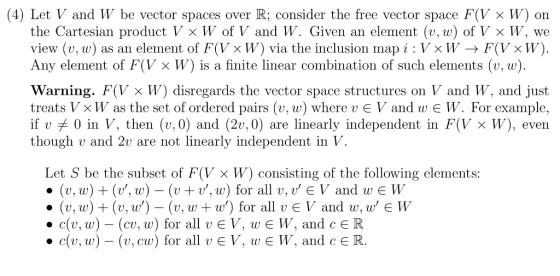

Definition. Define F(V × W) span(S) Given an element (v, w) of F(V x W), its class [(v, w)| in the quotient space V & W warning. In general, not every element of V W can be written as vⓧw for some element of VⓧW is a linear combination of pure tensors, but it might not be a pure will be denoted by v& w V and w E W. Elements like vⓧw are called "pure tensors." In general, an tensor itself. In quantum mechanics, impure tensors correspond to entangled states Recall that if V, W, Z are vector spaces over R, a map f :Vx W -Z is said to be bilinear if: Problem. Show that the map π : V × W → VⓧW sending (v,w) to v u is bilinear. Hint: To see that π(v ay, w) πίν, w) CT(v,,w), show that (v+ cv, ,w) (v, w) - c(v', w) is in the span of the set S. The other equation is similar (you don't need to write out the proof again)
Homework Answers

Add Answer to:
(4) Let V and W be vector spaces over R: consider the free vector space F(V × W) on the Cartesian...
Let V and W be vector spaces over F, and let f: V W be a...
 Let V and W be vector spaces over F, and let f: V W be a linear transformation. (a) Prove that f is one-to-one if and only if f carries linearly independent (b) Suppose that f is one-to-one and that S is a subset of V. Prove that subsets of V to linearlv independent subsets of W S is linearly independent if and only if (S) is linearly independent.
solution to 2 (ii) Show that the image of f is not a subspace of R 2. Let U, V, and W be vector spaces over the field k, and let f: Ux V- W be a bilinear map. Show that the image of f is a union o...
 solution to 2
(ii) Show that the image of f is not a subspace of R 2. Let U, V, and W be vector spaces over the field k, and let f: Ux V- W be a bilinear map. Show that the image of f is a union of subspaces of W. 3. Let k be a field, and let U, V, and W be vector spaces over k. Recall that
(ii) Show that the image of f is not...
solution to 2
(ii) Show that the image of f is not a subspace of R 2. Let U, V, and W be vector spaces over the field k, and let f: Ux V- W be a bilinear map. Show that the image of f is a union of subspaces of W. 3. Let k be a field, and let U, V, and W be vector spaces over k. Recall that
(ii) Show that the image of f is not...
Problem 4. Let n E N. We consider the vector space R” (a) Prove that for...
 Problem 4. Let n E N. We consider the vector space R” (a) Prove that for all X, Y CR”, if X IY then Span(X) 1 Span(Y). (b) Let X and Y be linearly independent subsets of R”. Prove that if X IY, then X UY is linearly independent. (C) Prove that every maximally pairwise orthogonal set of vectors in R” has n + 1 elements. Definition: Let V be a vector space and let U and W be subspaces...
2. Let V and W be vector spaces over F. Define the set v, w) |v...
 2. Let V and W be vector spaces over F. Define the set v, w) |v V andwEW This is called the product of V and W (a) Show that V x W is a vector space. (b) Define a map w : V → V × W by w (z) = (z,0). Show that w is an injective linear map. Note that we can define a similar map lw (c) If (d) Show that V x W. (V W...
Exercise 11.5.9 Let U and V be finite dimensional spaces over F and let θ : U linear map. v be a ...
 Vectors pure and applied
Exercise 11.5.9 Let U and V be finite dimensional spaces over F and let θ : U linear map. v be a (i) Show that o is injective if and only if, given any finite dimensional vector space W map : V W such that over F and given any linear map α : U-+ W, there is a linear (ii) Show that θ is surjective if and only if, given any finite dimensional vector space...
Vectors pure and applied
Exercise 11.5.9 Let U and V be finite dimensional spaces over F and let θ : U linear map. v be a (i) Show that o is injective if and only if, given any finite dimensional vector space W map : V W such that over F and given any linear map α : U-+ W, there is a linear (ii) Show that θ is surjective if and only if, given any finite dimensional vector space...
Let V and W be two vector spaces over R and T:V + W be a...
 Let V and W be two vector spaces over R and T:V + W be a linear transformation. We call a linear map S:W → V a generalized inverse of T if To SoT=T and SoToS = S. If V and W are finite dimensional, show that there exists a generalized inverse of T.
Let V and W be two vector spaces over R and T:V + W be a...
 Let V and W be two vector spaces over R and T:V + W be a linear transformation. We call a linear map S: W → V a generalized inverse of T if To SOT = T and SoTo S = S. If V and W are finite dimensional, show that there exists a generalized inverse of T.
Let V and W be two vector spaces over R and T:V + W be a...
 Let V and W be two vector spaces over R and T:V + W be a linear transformation. We call a linear map S: W → V a generalized inverse of T if To SOT = T and SoTo S = S. If T is an isomorphism, show that T-1 is the unique generalized inverse of T.
Problem 5: Let V and W be vector spaces and let B = {V1, V2, ...,...
 Problem 5: Let V and W be vector spaces and let B = {V1, V2, ..., Un} CV be a basis for V. Let L :V + W be a linear transformation, and let Ker L = {2 € V: L(x)=0}. (a) If Ker L = {0}, show that C = {L(v1), L(02), ..., L(vn) } CW is a linearly independent set in W. (b) If C = {L(01), L(V2),..., L(Un)} C W is a linearly independent set in W,...
Problem 6. Let V be a vector space (a) Let (--) : V x V --> R be an inner product. Prove that (-, -) is a bilinear f...
 Problem 6. Let V be a vector space (a) Let (--) : V x V --> R be an inner product. Prove that (-, -) is a bilinear form on V. (b) Let B = (1, ... ,T,) be a basis of V. Prove that there exists a unique inner product on V making Borthonormal. (c) Let (V) be the set of all inner products on V. By part (a), J(V) C B(V). Is J(V) a vector subspace of B(V)?...
 Let V and W be vector spaces over F, and let f: V W be a linear transformation. (a) Prove that f is one-to-one if and only if f carries linearly independent (b) Suppose that f is one-to-one and that S is a subset of V. Prove that subsets of V to linearlv independent subsets of W S is linearly independent if and only if (S) is linearly independent.
 solution to 2
(ii) Show that the image of f is not a subspace of R 2. Let U, V, and W be vector spaces over the field k, and let f: Ux V- W be a bilinear map. Show that the image of f is a union of subspaces of W. 3. Let k be a field, and let U, V, and W be vector spaces over k. Recall that
(ii) Show that the image of f is not...
solution to 2
(ii) Show that the image of f is not a subspace of R 2. Let U, V, and W be vector spaces over the field k, and let f: Ux V- W be a bilinear map. Show that the image of f is a union of subspaces of W. 3. Let k be a field, and let U, V, and W be vector spaces over k. Recall that
(ii) Show that the image of f is not...
 Problem 4. Let n E N. We consider the vector space R” (a) Prove that for all X, Y CR”, if X IY then Span(X) 1 Span(Y). (b) Let X and Y be linearly independent subsets of R”. Prove that if X IY, then X UY is linearly independent. (C) Prove that every maximally pairwise orthogonal set of vectors in R” has n + 1 elements. Definition: Let V be a vector space and let U and W be subspaces...
 2. Let V and W be vector spaces over F. Define the set v, w) |v V andwEW This is called the product of V and W (a) Show that V x W is a vector space. (b) Define a map w : V → V × W by w (z) = (z,0). Show that w is an injective linear map. Note that we can define a similar map lw (c) If (d) Show that V x W. (V W...
 Vectors pure and applied
Exercise 11.5.9 Let U and V be finite dimensional spaces over F and let θ : U linear map. v be a (i) Show that o is injective if and only if, given any finite dimensional vector space W map : V W such that over F and given any linear map α : U-+ W, there is a linear (ii) Show that θ is surjective if and only if, given any finite dimensional vector space...
Vectors pure and applied
Exercise 11.5.9 Let U and V be finite dimensional spaces over F and let θ : U linear map. v be a (i) Show that o is injective if and only if, given any finite dimensional vector space W map : V W such that over F and given any linear map α : U-+ W, there is a linear (ii) Show that θ is surjective if and only if, given any finite dimensional vector space...
 Let V and W be two vector spaces over R and T:V + W be a linear transformation. We call a linear map S:W → V a generalized inverse of T if To SoT=T and SoToS = S. If V and W are finite dimensional, show that there exists a generalized inverse of T.
 Let V and W be two vector spaces over R and T:V + W be a linear transformation. We call a linear map S: W → V a generalized inverse of T if To SOT = T and SoTo S = S. If V and W are finite dimensional, show that there exists a generalized inverse of T.
 Let V and W be two vector spaces over R and T:V + W be a linear transformation. We call a linear map S: W → V a generalized inverse of T if To SOT = T and SoTo S = S. If T is an isomorphism, show that T-1 is the unique generalized inverse of T.
 Problem 5: Let V and W be vector spaces and let B = {V1, V2, ..., Un} CV be a basis for V. Let L :V + W be a linear transformation, and let Ker L = {2 € V: L(x)=0}. (a) If Ker L = {0}, show that C = {L(v1), L(02), ..., L(vn) } CW is a linearly independent set in W. (b) If C = {L(01), L(V2),..., L(Un)} C W is a linearly independent set in W,...
 Problem 6. Let V be a vector space (a) Let (--) : V x V --> R be an inner product. Prove that (-, -) is a bilinear form on V. (b) Let B = (1, ... ,T,) be a basis of V. Prove that there exists a unique inner product on V making Borthonormal. (c) Let (V) be the set of all inner products on V. By part (a), J(V) C B(V). Is J(V) a vector subspace of B(V)?...
Most questions answered within 3 hours.
-
Where is the error in this code sequence?
String s1 = "Hello";
String s2 = "ello";...
asked 10 months ago -
Financial data for Joel de Paris, Inc., for last year
follow:
Joel de Paris, Inc.
Balance...
asked 10 months ago -
Consider this reaction:
Al2(SO4)3 (aq)+ BaCl3
(aq) Al2Cl6 (aq)- +
3BaSO4(s) . What is the...
asked 10 months ago -
Suppose that Savneet is considering increasing her
recent random sample from 20 car rentals to 40...
asked 10 months ago -
Trucks arrive at an unloading terminal at an average rate of 120
per hour.
Trucks arrive...
asked 10 months ago -
Why are methanol and ethanol completely soluble in water while
octanol is not very little soluble....
asked 10 months ago -
A facilities manager at a university reads in a research report
that the mean amount of...
asked 10 months ago -
When the CuSO4 is rehydrated by adding water to the anhydrous
compound, is this an endothermic...
asked 10 months ago -
A ray of sunlight is passing from diamond into crown glass; the
angle of incidence is...
asked 10 months ago -
A block of mass 0.249 kg is placed on top of a light, vertical
spring of...
asked 10 months ago -
how do the kidneys compensate in the presences of acidosis
a) trigger hyperventilate
b) reserve acid...
asked 10 months ago -
Question 501 pts
The rental rate of capital to the firm increases. Which of the
following...
asked 10 months ago