![a) [90 marks] Write a program that .Splits a list into two halves. The function split must modify the original list and retur](http://img.homeworklib.com/images/39597a04-6453-4a01-a9e8-40c8403f924b.png?x-oss-process=image/resize,w_560)
Homework Answers
#include<stdio.h>
#include<stdlib.h>
struct Node{
int data;
struct Node*next;
};
void insert_node(struct Node**,int);
void show_data(struct Node*);
struct Node* split(struct Node**);
struct Node* merge(struct Node**,struct Node**);
void insert_node(struct Node**root,int value){
struct Node*new_node=(struct Node*)malloc(sizeof(struct Node));
if(new_node)
{
new_node->data=value;
new_node->next=NULL;
if(*root==NULL){
*root=new_node;
}
else{
struct Node*temp=NULL;
temp=*root;
while(temp->next){
temp=temp->next;
}
temp->next=new_node;
}
}
else
{
printf("\n Memory overflow please try again..!");
}
}
void print_list_data(struct Node*temp){
if(temp==NULL){
}
else{
while(temp){
printf("%d ",temp->data);
temp=temp->next;
}
}
}
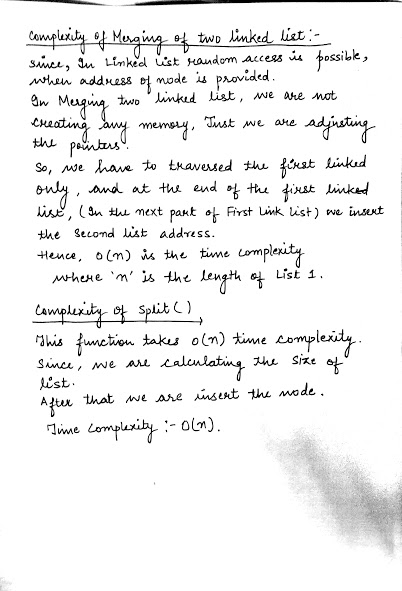
struct Node* split(struct Node**root){
if(*root==NULL){
printf("\n No element in this linked list ");
return NULL;
}
int size = 1;
struct Node*temp=*root;
while(temp->next!=NULL){
temp=temp->next;
++size;
}
if(size%2!=0){
insert_node(root,99);
++size;
}
temp=*root;
for (int i =0; i<size/2; i++){
temp=temp->next;
}
return temp;
}
struct Node* merge(struct Node**list1, struct
Node**list2){
if(*list1==NULL){
/* No element in first link list */
return *list2;
}
struct Node*temp=*list1;
while(temp->next!=NULL){
temp=temp->next;
}
temp->next = *list2;
return *list1;
}
int main(){
/* start program execution are here */
struct Node*root=NULL;
/* 34 ->234 ->334 ->NULL*/
insert_node(&root,34);
insert_node(&root,234);
insert_node(&root,334);
printf("\n\n Original Linked List:");
print_list_data(root);
struct Node*back = split(&root);
printf("\n\n Second Half Of Linked List: ");
/* 34 ->234 ->334 ->99 ->NULL*/
print_list_data(back);
struct Node*list1=NULL;
/* 1 ->2 ->3 ->NULL*/
insert_node(&list1,1);
insert_node(&list1,2);
insert_node(&list1,3);
struct Node*list2=NULL;
/* 4 ->5 ->5 ->NULL*/
insert_node(&list2,4);
insert_node(&list2,5);
insert_node(&list2,6);
struct Node*mergedlist = merge(&list1,&list2);
printf("\n\n Merged Linked List: ");
/* 34 ->234 ->334 ->99 ->NULL*/
print_list_data(mergedlist);
/*end execution*/
return 0;
}
Add Answer to:
A) [90 marks] Write a program that .Splits a list into two halves. The function split must modify...
Must be C++ 11 Write a function named insertinArray that takes the following parameters: list: an...
 Must be C++ 11
Write a function named insertinArray that takes the following parameters: list: an integer array index: index at which to insert the new item numitems: number of items currently in the array arrayCapacity: capacity of the array newVal: value to insert into the array If the array is at capacity then the function should return-1. Otherwise, insert newVal at index and return O for success int insertInArray(int listl 1, int index, int numItems, int arrayCapacity, int newVal)...
Must be C++ 11
Write a function named insertinArray that takes the following parameters: list: an integer array index: index at which to insert the new item numitems: number of items currently in the array arrayCapacity: capacity of the array newVal: value to insert into the array If the array is at capacity then the function should return-1. Otherwise, insert newVal at index and return O for success int insertInArray(int listl 1, int index, int numItems, int arrayCapacity, int newVal)...
I need this in C++. This is all one question Program 2: Linked List Class For...
 I need this in C++. This is all
one question
Program 2: Linked List Class For this problem, let us take the linked list we wrote in a functional manner in a previous assignment and convert it into a Linked List class. For extra practice with pointers we'll expand its functionality and make it a doubly linked list with the ability to traverse in both directions. Since the list is doubly linked, each node will have the following structure: struct...
I need this in C++. This is all
one question
Program 2: Linked List Class For this problem, let us take the linked list we wrote in a functional manner in a previous assignment and convert it into a Linked List class. For extra practice with pointers we'll expand its functionality and make it a doubly linked list with the ability to traverse in both directions. Since the list is doubly linked, each node will have the following structure: struct...
c++ only Program 2: Linked List Class For this problem, let us take the linked list...
c++ only Program 2: Linked List Class For this problem, let us take the linked list we wrote in a functional manner in a previous assignment and convert it into a Linked List class. For extra practice with pointers we’ll expand its functionality and make it a doubly linked list with the ability to traverse in both directions. Since the list is doubly linked, each node will have the following structure: struct Node { int number; Node * nextNode;...
Using Racket Recursion, tail-recursion, high-order functions and functional programming. 1. Modify our filter function so that...
Using Racket Recursion, tail-recursion, high-order functions and functional programming. 1. Modify our filter function so that it is tail-recursive. You may use the letrec form but do not use any additional forms and functions besides those we've talked about in class. (define filter (lambda (input-list func) (cond ((null? input-list) '()) ((func (car input-list)) (cons (car input-list) (filter (cdr input-list) func))) (else (filter (cdr input-list) func))))) 2. Test your filter function on '(25 -22 44 56...
starter code To write a program using the starter code which is TestLinkedList to see if...
 starter code
To write a program using the starter code which is
TestLinkedList to see if the LinkedList program has bugs. It will
produce ether a pass or fail.More information is in the first two
pictures.
LinkedList.java
/**
* @author someone
*
* Implements a double-linked list with four errors
*/
public class LinkedList<E>
{
// The first and last nodes in the list
private Node<E> head, tail;
// Number of items stored in the list
private int size;
//...
starter code
To write a program using the starter code which is
TestLinkedList to see if the LinkedList program has bugs. It will
produce ether a pass or fail.More information is in the first two
pictures.
LinkedList.java
/**
* @author someone
*
* Implements a double-linked list with four errors
*/
public class LinkedList<E>
{
// The first and last nodes in the list
private Node<E> head, tail;
// Number of items stored in the list
private int size;
//...
Requirements Print a range Write a bag member function with two parameters. The two parameters are...
Requirements Print a range Write a bag member function with two parameters. The two parameters are Items x and y. The function should write to the console all Items in the bag that are between the first occurrence of x and the first occurrence of y. You may assume that items can be compared for equality using ==. Use the following header for the function: void print_value_range(const Item& x, const Item& y); print_value_range can be interpreted in a number of...
Hi I need a fix in my program. The program needs to finish after serving the...
 Hi I need a fix in my program. The program needs to finish after
serving the customers from the queue list.
Requeriments:
Headers:
DynamicArray.h
#ifndef DynamicArray_h
#define DynamicArray_h
#include
using namespace std;
template
class DynamicArray
{
V* values;
int cap;
V dummy;
public:
DynamicArray(int = 2);
DynamicArray(const DynamicArray&);
~DynamicArray() { delete[] values; }
int capacity() const { return cap; }
void capacity(int);
V operator[](int) const;
V& operator[](int);
DynamicArray& operator=(const DynamicArray&);
};
template
DynamicArray::DynamicArray(int cap)
{
this->cap = cap;
values =...
Hi I need a fix in my program. The program needs to finish after
serving the customers from the queue list.
Requeriments:
Headers:
DynamicArray.h
#ifndef DynamicArray_h
#define DynamicArray_h
#include
using namespace std;
template
class DynamicArray
{
V* values;
int cap;
V dummy;
public:
DynamicArray(int = 2);
DynamicArray(const DynamicArray&);
~DynamicArray() { delete[] values; }
int capacity() const { return cap; }
void capacity(int);
V operator[](int) const;
V& operator[](int);
DynamicArray& operator=(const DynamicArray&);
};
template
DynamicArray::DynamicArray(int cap)
{
this->cap = cap;
values =...
How to write the insert, search, and remove functions for this hash table program? I'm stuck......
How to write the insert, search, and remove functions for this hash table program? I'm stuck... This program is written in C++ Hash Tables Hash Table Header File Copy and paste the following code into a header file named HashTable.h Please do not alter this file in any way or you may not receive credit for this lab For this lab, you will implement each of the hash table functions whose prototypes are in HashTable.h. Write these functions in a...
Creating linked list data structure Overview The purpose of this assignment is for you to write...
Creating linked list data structure Overview The purpose of this assignment is for you to write a data structure called a Linked List, which utilizes templates (similar to Java’s generics), in order to store any type of data. In addition, the nature of a Linked List will give you some experience dealing with non-contiguous memory organization. This will also give you more experience using pointers and memory management. Pointers, memory allocation, and understand how data is stored in memory will...
 Must be C++ 11
Write a function named insertinArray that takes the following parameters: list: an integer array index: index at which to insert the new item numitems: number of items currently in the array arrayCapacity: capacity of the array newVal: value to insert into the array If the array is at capacity then the function should return-1. Otherwise, insert newVal at index and return O for success int insertInArray(int listl 1, int index, int numItems, int arrayCapacity, int newVal)...
Must be C++ 11
Write a function named insertinArray that takes the following parameters: list: an integer array index: index at which to insert the new item numitems: number of items currently in the array arrayCapacity: capacity of the array newVal: value to insert into the array If the array is at capacity then the function should return-1. Otherwise, insert newVal at index and return O for success int insertInArray(int listl 1, int index, int numItems, int arrayCapacity, int newVal)...
 I need this in C++. This is all
one question
Program 2: Linked List Class For this problem, let us take the linked list we wrote in a functional manner in a previous assignment and convert it into a Linked List class. For extra practice with pointers we'll expand its functionality and make it a doubly linked list with the ability to traverse in both directions. Since the list is doubly linked, each node will have the following structure: struct...
I need this in C++. This is all
one question
Program 2: Linked List Class For this problem, let us take the linked list we wrote in a functional manner in a previous assignment and convert it into a Linked List class. For extra practice with pointers we'll expand its functionality and make it a doubly linked list with the ability to traverse in both directions. Since the list is doubly linked, each node will have the following structure: struct...
 starter code
To write a program using the starter code which is
TestLinkedList to see if the LinkedList program has bugs. It will
produce ether a pass or fail.More information is in the first two
pictures.
LinkedList.java
/**
* @author someone
*
* Implements a double-linked list with four errors
*/
public class LinkedList<E>
{
// The first and last nodes in the list
private Node<E> head, tail;
// Number of items stored in the list
private int size;
//...
starter code
To write a program using the starter code which is
TestLinkedList to see if the LinkedList program has bugs. It will
produce ether a pass or fail.More information is in the first two
pictures.
LinkedList.java
/**
* @author someone
*
* Implements a double-linked list with four errors
*/
public class LinkedList<E>
{
// The first and last nodes in the list
private Node<E> head, tail;
// Number of items stored in the list
private int size;
//...
 Hi I need a fix in my program. The program needs to finish after
serving the customers from the queue list.
Requeriments:
Headers:
DynamicArray.h
#ifndef DynamicArray_h
#define DynamicArray_h
#include
using namespace std;
template
class DynamicArray
{
V* values;
int cap;
V dummy;
public:
DynamicArray(int = 2);
DynamicArray(const DynamicArray&);
~DynamicArray() { delete[] values; }
int capacity() const { return cap; }
void capacity(int);
V operator[](int) const;
V& operator[](int);
DynamicArray& operator=(const DynamicArray&);
};
template
DynamicArray::DynamicArray(int cap)
{
this->cap = cap;
values =...
Hi I need a fix in my program. The program needs to finish after
serving the customers from the queue list.
Requeriments:
Headers:
DynamicArray.h
#ifndef DynamicArray_h
#define DynamicArray_h
#include
using namespace std;
template
class DynamicArray
{
V* values;
int cap;
V dummy;
public:
DynamicArray(int = 2);
DynamicArray(const DynamicArray&);
~DynamicArray() { delete[] values; }
int capacity() const { return cap; }
void capacity(int);
V operator[](int) const;
V& operator[](int);
DynamicArray& operator=(const DynamicArray&);
};
template
DynamicArray::DynamicArray(int cap)
{
this->cap = cap;
values =...
Most questions answered within 3 hours.
-
Where is the error in this code sequence?
String s1 = "Hello";
String s2 = "ello";...
asked 11 months ago -
Financial data for Joel de Paris, Inc., for last year
follow:
Joel de Paris, Inc.
Balance...
asked 11 months ago -
Consider this reaction:
Al2(SO4)3 (aq)+ BaCl3
(aq) Al2Cl6 (aq)- +
3BaSO4(s) . What is the...
asked 11 months ago -
Suppose that Savneet is considering increasing her
recent random sample from 20 car rentals to 40...
asked 11 months ago -
Trucks arrive at an unloading terminal at an average rate of 120
per hour.
Trucks arrive...
asked 11 months ago -
Why are methanol and ethanol completely soluble in water while
octanol is not very little soluble....
asked 11 months ago -
A facilities manager at a university reads in a research report
that the mean amount of...
asked 11 months ago -
When the CuSO4 is rehydrated by adding water to the anhydrous
compound, is this an endothermic...
asked 11 months ago -
A ray of sunlight is passing from diamond into crown glass; the
angle of incidence is...
asked 11 months ago -
A block of mass 0.249 kg is placed on top of a light, vertical
spring of...
asked 11 months ago -
how do the kidneys compensate in the presences of acidosis
a) trigger hyperventilate
b) reserve acid...
asked 11 months ago -
Question 501 pts
The rental rate of capital to the firm increases. Which of the
following...
asked 11 months ago