
Homework Answers

Add Answer to:
3) Two particles fly apart in opposite directions in a laboratory. Particle A travels to the left...
3. (10 pts) High energy particle accelerators convert part of the energy of colliding particles into...
 3. (10 pts) High energy particle accelerators convert part of the energy of colliding particles into the masses of particles produced in the collisions. Consider a collision of two protons that produces two charged kaons. The mass of the proton is mp- 938.3 MeV/c2, and the mass of each kaon is mK 493.7 MeV/c2. The reaction is a) The total energy (kinetic energy and rest energy) and total momentum is conserved. Suppose one of the protons is at rest in...
A particle a travelling along the positive x-axis of frame S with speed 0.5c decays into...
A particle a travelling along the positive x-axis of frame S with speed 0.5c decays into two identical particles ,a=b+b ,both of which continue to travel on the x-axis.(a)Given that ma=2.5mb,find the speed of either b particle in the rest of frame of particle a.(b)By making the necessary transformation on the result of part(a),find the velocity of the two b particles in the original frame S.
Consider 2 observers, S and S', who are observing each other and the motion of a...
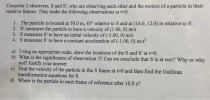 Consider 2 observers, S and S', who are observing each other and the motion of a particle in their relative frames. They make the following observations at t-0: 1. The particle is located at 50.0 m, 45° relative to S and at (16.0, 12.0) m relative to S'. 2. S' measures the particle to have a velocity of (1.00, 0) m/s 3. S measures S' to have an initial velocity of (-5.00, 0) m/s 4. S measures S' to have...
5. In a linear collider, two particles travel toward each other from opposite directions before colliding....
 5. In a linear collider, two particles travel toward each other from opposite directions before colliding. I, in the lab reference frame, an electron travels toward the collision point at 2/3 co and a positron travels at 3/4。, at what speed does the electron travel toward the positron in the positron's reference frame?
Modern Physics the Lorentz time Problem 4 Starting for the Lorentz coordinate transformation, derive and velocity...
 Modern Physics
the Lorentz time Problem 4 Starting for the Lorentz coordinate transformation, derive and velocity transformations. Show your steps and define your reference frames Problem 5 Two particles are created at CERN's accelerator and move off in opposite directions. The speed of particle A is measured in the laboratory, as 0.65c, and the speed of each particle relative to the other is 0.95c. What is the speed of particles B, as measured in the laboratory? Problem 6 A spacecraft...
Modern Physics
the Lorentz time Problem 4 Starting for the Lorentz coordinate transformation, derive and velocity transformations. Show your steps and define your reference frames Problem 5 Two particles are created at CERN's accelerator and move off in opposite directions. The speed of particle A is measured in the laboratory, as 0.65c, and the speed of each particle relative to the other is 0.95c. What is the speed of particles B, as measured in the laboratory? Problem 6 A spacecraft...
Problem (3) A particle of mass M is at rest in the laboratory when it decays into three identical...
 Problem (3) A particle of mass M is at rest in the laboratory when it decays into three identical particles, each of mass m. Two of the particles, labeled #1 and #2, have velocity magnitudes and perpendicular directions as shown, with e representing the speed of light. Please use conservation of relativistic momentum to compute the direction and speed, expressed in terms of c, of particle #3 with respect to the laboratory (a) (b) Please compute the ratio M/m.
Problem...
Problem (3) A particle of mass M is at rest in the laboratory when it decays into three identical particles, each of mass m. Two of the particles, labeled #1 and #2, have velocity magnitudes and perpendicular directions as shown, with e representing the speed of light. Please use conservation of relativistic momentum to compute the direction and speed, expressed in terms of c, of particle #3 with respect to the laboratory (a) (b) Please compute the ratio M/m.
Problem...
1) A particle has a 4-momentum of [2266, 1813, -1133, 453] kg-m-s with respect to the...
 1) A particle has a 4-momentum of [2266, 1813, -1133, 453] kg-m-s with respect to the Home frame a) What are the components of the particle's velocity, [vx, Vy, vz], in m/s? b) What is the particle's mass, in kg? c) W J? d) Calculate the particle's 4-momentum in an Other frame traveling with a relative velocity of u 0.9c hat are the particle's total energy and kinetic energy, in
Assume two particles are racing toward each other in an experiment. From the perspective of a...
Assume two particles are racing toward each other in an experiment. From the perspective of a stationary scientist, particle A is moving to the right at a velocity of 0.99c and particle B is moving to the left at a velocity 0.95c. What is the velocity of particle A relative to particle B? (note: at this velocity the Lorentz velocity transformation is necessary).
2) A particle of mass m at rest in the Home frame decays into two particles of mass that move apa...
 2) A particle of mass m at rest in the Home frame decays into two particles of mass that move apart in opposite directions at the same speed. Let event A be the detection of one of the particles at a distance of 10 m from the original particle, and event B be the detection of the second particle at a distance of 20 m from the original particle. a) What is the speed of each of the decay particles,...
An unstable high-energy particle is created in the laboratory, and it moves at a speed of...
An unstable high-energy particle is created in the laboratory, and it moves at a speed of 0.994c. Relative to a stationary reference frame fixed to the laboratory, the particle travels a distance of 1.84 × 10⁻³ m before disintegrating. What is (a) the proper distance and (b) the distance measured by a hypothetical person traveling with the particle? Determine the particle's (c) proper lifetime and (d) its dilated lifetime. Numerical answer is not important...a) I do not understand why 1.84...
 3. (10 pts) High energy particle accelerators convert part of the energy of colliding particles into the masses of particles produced in the collisions. Consider a collision of two protons that produces two charged kaons. The mass of the proton is mp- 938.3 MeV/c2, and the mass of each kaon is mK 493.7 MeV/c2. The reaction is a) The total energy (kinetic energy and rest energy) and total momentum is conserved. Suppose one of the protons is at rest in...
 Consider 2 observers, S and S', who are observing each other and the motion of a particle in their relative frames. They make the following observations at t-0: 1. The particle is located at 50.0 m, 45° relative to S and at (16.0, 12.0) m relative to S'. 2. S' measures the particle to have a velocity of (1.00, 0) m/s 3. S measures S' to have an initial velocity of (-5.00, 0) m/s 4. S measures S' to have...
 5. In a linear collider, two particles travel toward each other from opposite directions before colliding. I, in the lab reference frame, an electron travels toward the collision point at 2/3 co and a positron travels at 3/4。, at what speed does the electron travel toward the positron in the positron's reference frame?
 Modern Physics
the Lorentz time Problem 4 Starting for the Lorentz coordinate transformation, derive and velocity transformations. Show your steps and define your reference frames Problem 5 Two particles are created at CERN's accelerator and move off in opposite directions. The speed of particle A is measured in the laboratory, as 0.65c, and the speed of each particle relative to the other is 0.95c. What is the speed of particles B, as measured in the laboratory? Problem 6 A spacecraft...
Modern Physics
the Lorentz time Problem 4 Starting for the Lorentz coordinate transformation, derive and velocity transformations. Show your steps and define your reference frames Problem 5 Two particles are created at CERN's accelerator and move off in opposite directions. The speed of particle A is measured in the laboratory, as 0.65c, and the speed of each particle relative to the other is 0.95c. What is the speed of particles B, as measured in the laboratory? Problem 6 A spacecraft...
 Problem (3) A particle of mass M is at rest in the laboratory when it decays into three identical particles, each of mass m. Two of the particles, labeled #1 and #2, have velocity magnitudes and perpendicular directions as shown, with e representing the speed of light. Please use conservation of relativistic momentum to compute the direction and speed, expressed in terms of c, of particle #3 with respect to the laboratory (a) (b) Please compute the ratio M/m.
Problem...
Problem (3) A particle of mass M is at rest in the laboratory when it decays into three identical particles, each of mass m. Two of the particles, labeled #1 and #2, have velocity magnitudes and perpendicular directions as shown, with e representing the speed of light. Please use conservation of relativistic momentum to compute the direction and speed, expressed in terms of c, of particle #3 with respect to the laboratory (a) (b) Please compute the ratio M/m.
Problem...
 1) A particle has a 4-momentum of [2266, 1813, -1133, 453] kg-m-s with respect to the Home frame a) What are the components of the particle's velocity, [vx, Vy, vz], in m/s? b) What is the particle's mass, in kg? c) W J? d) Calculate the particle's 4-momentum in an Other frame traveling with a relative velocity of u 0.9c hat are the particle's total energy and kinetic energy, in
 2) A particle of mass m at rest in the Home frame decays into two particles of mass that move apart in opposite directions at the same speed. Let event A be the detection of one of the particles at a distance of 10 m from the original particle, and event B be the detection of the second particle at a distance of 20 m from the original particle. a) What is the speed of each of the decay particles,...
Most questions answered within 3 hours.
-
Where is the error in this code sequence?
String s1 = "Hello";
String s2 = "ello";...
asked 11 months ago -
Financial data for Joel de Paris, Inc., for last year
follow:
Joel de Paris, Inc.
Balance...
asked 11 months ago -
Consider this reaction:
Al2(SO4)3 (aq)+ BaCl3
(aq) Al2Cl6 (aq)- +
3BaSO4(s) . What is the...
asked 11 months ago -
Suppose that Savneet is considering increasing her
recent random sample from 20 car rentals to 40...
asked 11 months ago -
Trucks arrive at an unloading terminal at an average rate of 120
per hour.
Trucks arrive...
asked 11 months ago -
Why are methanol and ethanol completely soluble in water while
octanol is not very little soluble....
asked 11 months ago -
A facilities manager at a university reads in a research report
that the mean amount of...
asked 11 months ago -
When the CuSO4 is rehydrated by adding water to the anhydrous
compound, is this an endothermic...
asked 11 months ago -
A ray of sunlight is passing from diamond into crown glass; the
angle of incidence is...
asked 11 months ago -
A block of mass 0.249 kg is placed on top of a light, vertical
spring of...
asked 11 months ago -
how do the kidneys compensate in the presences of acidosis
a) trigger hyperventilate
b) reserve acid...
asked 11 months ago -
Question 501 pts
The rental rate of capital to the firm increases. Which of the
following...
asked 11 months ago