
![3. [10] Solve the IVP. Use any approach you like y(x) 6y(x) 25y(x))](http://img.homeworklib.com/images/5232ea0b-6d03-4804-9f70-2bb4173db33d.png?x-oss-process=image/resize,w_560)
3. [10] Solve the IVP. Use any approach you like y(x) 6y'(x) 25y(x))
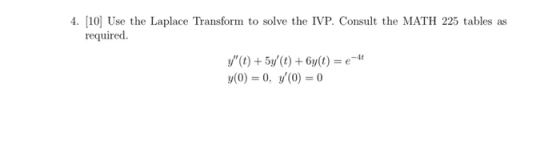
4. [10 Use the Laplace Transform to solve the IVP. Consult the MATH 225 tables as required. "(t) 5(t) 6y(t) y(0)= 0, y'(0)=0 e41 -4t
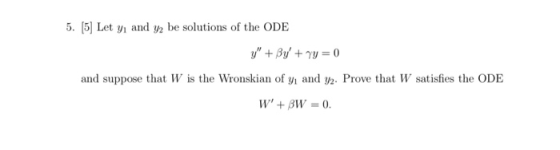
5. [5 Let y and y2 be solutions of the ODE ad suppose that W is the Wronskian of yi aid y2. Prove that W satisfies the ODE
Homework Answers
Add Answer to:
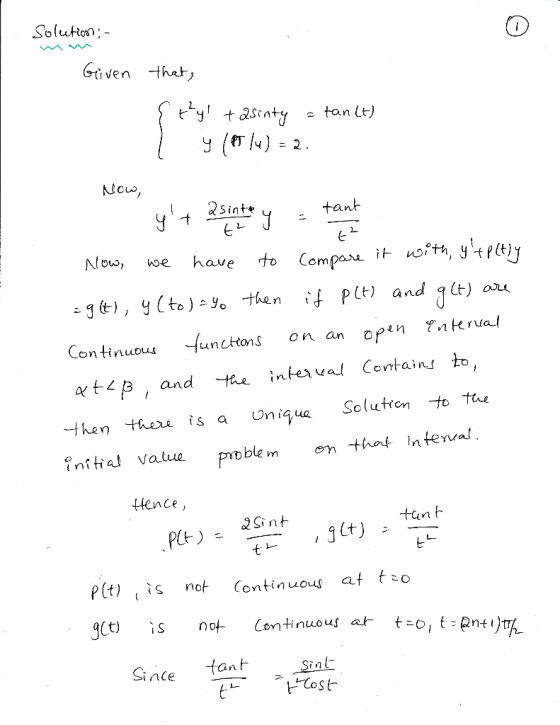
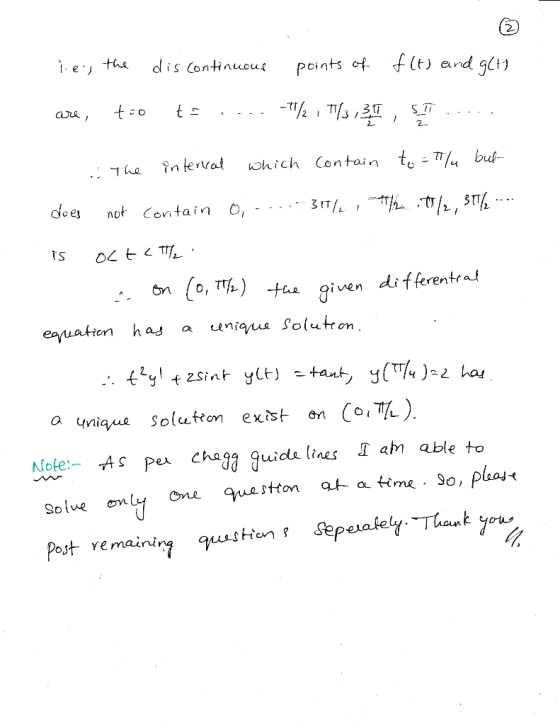
1. [5 Consider the IVP rty(t) + 2 sin(t)y(t) = tan(t) y(5)=2 Does a unique solution of the IVP ex...
Exercise 6 Solve the IVP y" +54 + 6y = u(t - 1) +(t – 2),...
 Exercise 6 Solve the IVP y" +54 + 6y = u(t - 1) +(t – 2), y(0) = 0, y'(0) = 1
(1 point) We consider the non-homogeneous problem y" – y'=1 – 10 cos(2x) First we consider...
 (1 point) We consider the non-homogeneous problem y" – y'=1 – 10 cos(2x) First we consider the homogeneous problem y" – y' = 0; 1) the auxiliary equation is ar? + br +c= = 0 2) The roots of the auxiliary equation are (enter answers as a comma separated list). (enter answers as a comma separated list). Using these we obtain the the complementary solution yc = Ciyi + C2y2 for arbitrary 3) A fundamental set of solutions is constants...
Problem #2: Consider the following statements. [6 marks) (1) The particular solution of the ODE)" -...
 Problem #2: Consider the following statements. [6 marks) (1) The particular solution of the ODE)" - 6y' + 9y = 5e3x is given by yp = Cre3x where C is an undetermined constant. (ii) The procedure of finding series solutions to a homogeneous linear second-order ODEs could be accurately described as the "method of undetermined series coefficients". (iii) Most of the material in Lecture Notes from Week 3 to Week 5, inclusive, can be extended or generalized to higher-order ODES...
Consider the solution to the IVP y' - xy = x; y(0) = 2 Find y'...
 Consider the solution to the IVP y' - xy = x; y(0) = 2 Find y' (0) Consider the solution to the IVP y' - xy = t; y(0) = 2 Find y" (0)
(1 point) We consider the non-homogeneous problem y" - y' = -4 cos(x) First we consider...
 (1 point) We consider the non-homogeneous problem y" - y' = -4 cos(x) First we consider the homogeneous problem y -y = 0 : = 0 1) the auxiliary equation is ar2 + br + c = 2) The roots of the auxiliary equation are (enter answers as a comma separated list) 3) A fundamental set of solutions is (enter answers as a comma separated list). Using these we obtain the the complementary solution ye = ciyı + c2y2 for...
[7] 1. Consider the initial value problem (IVP) y′(t) = −y(t), y(0) = 1 The solution to this IVP ...
[7] 1. Consider the initial value problem (IVP) y′(t) = −y(t), y(0) = 1 The solution to this IVP is y(t) = e−t [1] i) Implement Euler’s method and generate an approximate solution of this IVP over the interval [0,2], using stepsize h = 0.1. (The Google sheet posted on LEARN is set up to carry out precisely this task.) Report the resulting approximation of the value y(2). [1] ii) Repeat part (ii), but use stepsize h = 0.05. Describe...
Consider the IVP y'' + 3y' + 3y = (1 − u(t − 4)) with y'(0)...
Consider the IVP y'' + 3y' + 3y = (1 − u(t − 4)) with y'(0) = 0 and y(0) = 0. Solve the differential equation, and if possible, provide a graph
(1 point) We consider the non-homogeneous problem y" + 4y = -32(3x + 1) First we...
 (1 point) We consider the non-homogeneous problem y" + 4y = -32(3x + 1) First we consider the homogeneous problem y" + 4y = 0: 1) the auxiliary equation is ar? + br +c= r^2+4r = 0. 2) The roots of the auxiliary equation are 0,4 (enter answers as a comma separated list). (enter answers as a comma separated list). Using these we obtain the the complementary 3) A fundamental set of solutions is 1,e^(-4x) solution yc = cyı +...
We consider the non-homogeneous problem y" + 2y + 2y = 40 sin(2x) First we consider...
 We consider the non-homogeneous problem y" + 2y + 2y = 40 sin(2x) First we consider the homogeneous problem y" + 2y + 2y = 0: 1) the auxiliary equation is ar? + br +C = 242r42 = 0. 2) The roots of the auxiliary equation are 141-14 Center answers as a comma separated list). 3) A fundamental set of solutions is -1 .-1xco) Center answers as a comma separated list. Using these we obtain the the complementary solution y...
Consider the IVP: x = √2, 2(0) = 0 A) Is the function S 0, 0<t...
 Consider the IVP: x = √2, 2(0) = 0 A) Is the function S 0, 0<t < 5 X(t) = iſt - 5), t>5 a solution of the DE on I = 0,0), Justify your answer. (Hint: Verify the first two conditions for each interval (0,5) and (5,0).
 Exercise 6 Solve the IVP y" +54 + 6y = u(t - 1) +(t – 2), y(0) = 0, y'(0) = 1
 (1 point) We consider the non-homogeneous problem y" – y'=1 – 10 cos(2x) First we consider the homogeneous problem y" – y' = 0; 1) the auxiliary equation is ar? + br +c= = 0 2) The roots of the auxiliary equation are (enter answers as a comma separated list). (enter answers as a comma separated list). Using these we obtain the the complementary solution yc = Ciyi + C2y2 for arbitrary 3) A fundamental set of solutions is constants...
 Problem #2: Consider the following statements. [6 marks) (1) The particular solution of the ODE)" - 6y' + 9y = 5e3x is given by yp = Cre3x where C is an undetermined constant. (ii) The procedure of finding series solutions to a homogeneous linear second-order ODEs could be accurately described as the "method of undetermined series coefficients". (iii) Most of the material in Lecture Notes from Week 3 to Week 5, inclusive, can be extended or generalized to higher-order ODES...
 Consider the solution to the IVP y' - xy = x; y(0) = 2 Find y' (0) Consider the solution to the IVP y' - xy = t; y(0) = 2 Find y" (0)
 (1 point) We consider the non-homogeneous problem y" - y' = -4 cos(x) First we consider the homogeneous problem y -y = 0 : = 0 1) the auxiliary equation is ar2 + br + c = 2) The roots of the auxiliary equation are (enter answers as a comma separated list) 3) A fundamental set of solutions is (enter answers as a comma separated list). Using these we obtain the the complementary solution ye = ciyı + c2y2 for...
 (1 point) We consider the non-homogeneous problem y" + 4y = -32(3x + 1) First we consider the homogeneous problem y" + 4y = 0: 1) the auxiliary equation is ar? + br +c= r^2+4r = 0. 2) The roots of the auxiliary equation are 0,4 (enter answers as a comma separated list). (enter answers as a comma separated list). Using these we obtain the the complementary 3) A fundamental set of solutions is 1,e^(-4x) solution yc = cyı +...
 We consider the non-homogeneous problem y" + 2y + 2y = 40 sin(2x) First we consider the homogeneous problem y" + 2y + 2y = 0: 1) the auxiliary equation is ar? + br +C = 242r42 = 0. 2) The roots of the auxiliary equation are 141-14 Center answers as a comma separated list). 3) A fundamental set of solutions is -1 .-1xco) Center answers as a comma separated list. Using these we obtain the the complementary solution y...
 Consider the IVP: x = √2, 2(0) = 0 A) Is the function S 0, 0<t < 5 X(t) = iſt - 5), t>5 a solution of the DE on I = 0,0), Justify your answer. (Hint: Verify the first two conditions for each interval (0,5) and (5,0).
Most questions answered within 3 hours.
-
Where is the error in this code sequence?
String s1 = "Hello";
String s2 = "ello";...
asked 11 months ago -
Financial data for Joel de Paris, Inc., for last year
follow:
Joel de Paris, Inc.
Balance...
asked 11 months ago -
Consider this reaction:
Al2(SO4)3 (aq)+ BaCl3
(aq) Al2Cl6 (aq)- +
3BaSO4(s) . What is the...
asked 11 months ago -
Suppose that Savneet is considering increasing her
recent random sample from 20 car rentals to 40...
asked 11 months ago -
Trucks arrive at an unloading terminal at an average rate of 120
per hour.
Trucks arrive...
asked 11 months ago -
Why are methanol and ethanol completely soluble in water while
octanol is not very little soluble....
asked 11 months ago -
A facilities manager at a university reads in a research report
that the mean amount of...
asked 11 months ago -
When the CuSO4 is rehydrated by adding water to the anhydrous
compound, is this an endothermic...
asked 11 months ago -
A ray of sunlight is passing from diamond into crown glass; the
angle of incidence is...
asked 11 months ago -
A block of mass 0.249 kg is placed on top of a light, vertical
spring of...
asked 11 months ago -
how do the kidneys compensate in the presences of acidosis
a) trigger hyperventilate
b) reserve acid...
asked 11 months ago -
Question 501 pts
The rental rate of capital to the firm increases. Which of the
following...
asked 11 months ago