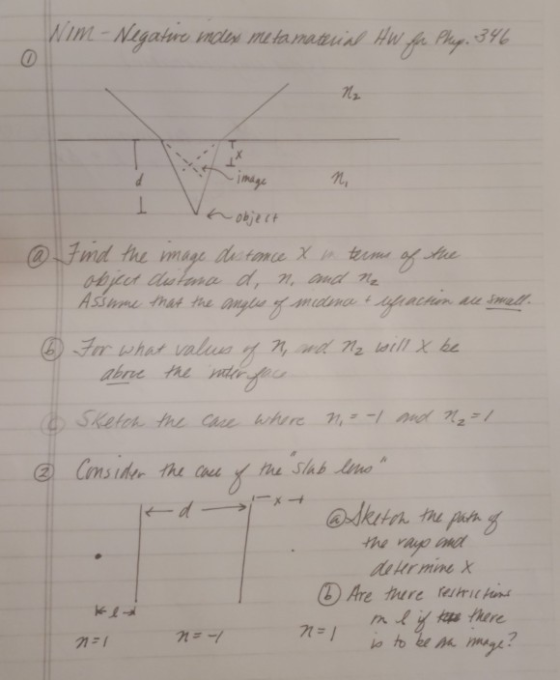
a)find the image distance x In terms of the object distance d n and nz. assume that the angles of incidence and refraction are small.
b)for what values of n1 and nw will x be above the interface?
c) sketch the case where n1=-1 and n2=1
Homework Answers


Add Answer to:
A)find the image distance x In terms of the object distance d n and nz. assume that the angles of...
a)find the image distance x In terms of the object distance d n and nz. assume...
 a)find the image distance x In terms of the object
distance d n and nz. assume that the angles of incidence and
refraction are small.
b)for what values of n1 and nw will x be above the
interface?
c) sketch the case where n1=-1 and n2=1
3F1 0 once Consider fhaau btuslab _ x → o(→ @dkiten tu ping ⓚAre there teitrithns
a)find the image distance x In terms of the object
distance d n and nz. assume that the angles of incidence and
refraction are small.
b)for what values of n1 and nw will x be above the
interface?
c) sketch the case where n1=-1 and n2=1
3F1 0 once Consider fhaau btuslab _ x → o(→ @dkiten tu ping ⓚAre there teitrithns
A lens with a focal length of 5 meters is used to look at an object this is x meters away, find the image distance, magn...
A lens with a focal length of 5 meters is used to look at an object this is x meters away, find the image distance, magnification, and whether the image is inverted or upright for the following values of x: a) x = 15 meters b) x = 2 meters c) if the object is placed at 5 meters away, find the image distance only. d) if the image distance is 5 meters away, find the object distance only.
Please answer all parts of the question (a,b,c,d,e) Consider the case of oblique incidence of electromagnetic plane waves going from medium 1 to a. Draw a diagram showing the wavevectors and the direc...
 Please answer all parts of the
question (a,b,c,d,e)
Consider the case of oblique incidence of electromagnetic plane waves going from medium 1 to a. Draw a diagram showing the wavevectors and the directions of the electric and magnetic b. Using the appropriate boundary conditions, obtain the Fresnel equations for the reflected 1. medium 2 with the polarization perpendicular to the plane of incidence. fields of the incident, reflected, and transmitted waves for an angle of incidence θ| and transmitted complex...
Please answer all parts of the
question (a,b,c,d,e)
Consider the case of oblique incidence of electromagnetic plane waves going from medium 1 to a. Draw a diagram showing the wavevectors and the directions of the electric and magnetic b. Using the appropriate boundary conditions, obtain the Fresnel equations for the reflected 1. medium 2 with the polarization perpendicular to the plane of incidence. fields of the incident, reflected, and transmitted waves for an angle of incidence θ| and transmitted complex...
water interface (the surface of the lake), it is partly reflected back into the air and...
 water interface (the surface of the lake), it is partly
reflected back into the air and partly refracted
or transmitted into the water. This explains why on the surface of
a lake sometimes you see the reflection of the surrounding
landscape and other times the underwater vegetation.
These effects on light propagation occur because light travels at
different speeds depending on the medium. The index of refraction
of a material, denoted by n, gives an indication of the speed of...
water interface (the surface of the lake), it is partly
reflected back into the air and partly refracted
or transmitted into the water. This explains why on the surface of
a lake sometimes you see the reflection of the surrounding
landscape and other times the underwater vegetation.
These effects on light propagation occur because light travels at
different speeds depending on the medium. The index of refraction
of a material, denoted by n, gives an indication of the speed of...
(a) Briefly explain what is meant by the following terms: refraction, refractive index, angle of incidence,...
 (a) Briefly explain what is meant by the following terms: refraction, refractive index, angle of incidence, angle of refraction. [4 marks] (b) The drawing shows four different situations in which a light ray is traveling from one medium into another. In some of the cases, the refraction is not shown correctly. For cases (i), (ii), and (iii), the angle of incidence is 55°; for case (iv), the angle of incidence is 0°. Identify which cases are incorrectly drawn and determine...
An object O stands at x = 0 on the x-axis. Lenses 1 and 2 are...
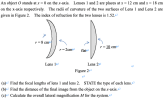 An object O stands at x = 0 on the x-axis. Lenses 1 and 2 are places at x = 12 cm and x = 18 cm on the x-axis respectively. The radii of curvature of the two surfaces of Lens 1 and Lens 2 are given in Figure 2. The index of refraction for the two lenses is 1.52. r=8 cm r=10 cm r=2cm flat Lens 1 Lens 2 Figure 22 (a) Find the focal lengths of lens 1...
questions 1, 2, 3, 4, and 5 with data below. Lenses and Mirrors: Insight into Eyesight- our eyes and car mirrors. Part 1. Measure the object and image distances to find the focal distance and m...
 questions 1, 2, 3, 4, and 5 with data below.
Lenses and Mirrors: Insight into Eyesight- our eyes and car mirrors. Part 1. Measure the object and image distances to find the focal distance and magnification for two convex lenses and 1 convex mirror. Table 12-1a. Measure the object and image distance to find the principal foaal distance and magnification. Lens 1 Object Distance Image DistancePrincipal Fo Magnification Length f(m) M-dvd N/A- 9./2 O.IS O-lo 4 0-4 0.2 o.1o 023...
questions 1, 2, 3, 4, and 5 with data below.
Lenses and Mirrors: Insight into Eyesight- our eyes and car mirrors. Part 1. Measure the object and image distances to find the focal distance and magnification for two convex lenses and 1 convex mirror. Table 12-1a. Measure the object and image distance to find the principal foaal distance and magnification. Lens 1 Object Distance Image DistancePrincipal Fo Magnification Length f(m) M-dvd N/A- 9./2 O.IS O-lo 4 0-4 0.2 o.1o 023...
(6%) Problem ll: An object with height 0.95 cm is placed a distance 21 cm in...
 (6%) Problem ll: An object with height 0.95 cm is placed a distance 21 cm in front of a thin converging lens with focal length 6.75 cm, as shown The focal point locations are indicated by the small black circles. A 20% Part (a) Calculate and enter a value for the distance between the image and the lens given the values in problem statement. di = cm Grade Summary Deductions 0% Potential 100% п 7 8 9 HOME E TA...
Partner: Date Name 11 Snell's Law Introduction When light passes from one material to another it ...
 Partner: Date Name 11 Snell's Law Introduction When light passes from one material to another it is always bent away from its original path. This process is known as refraction and the change in direction depends on the change in optical density (or refractive index) of the two materials. A larger change in refractive index results in a larger change in angle between incoming and outgoing light beams. A light beam bends closer to the normal in the material with...
Consider the potential energy described in problem 1.14. For low amplitudes, the motion of the object...
 Consider the potential energy described in problem 1.14. For low
amplitudes, the motion of the object is well described by simple
harmonic motion, so that the period is independent of amplitude.
However, once the amplitude gets high enough this is no longer
true. As the amplitude increase, does the period increase or
decrease? Explain your reasoning thoroughly, and assume that the
amplitude is always less than pi/B.
(You do not need to answer question 1.14)
1.13 In research-level theel pnysles,...
Consider the potential energy described in problem 1.14. For low
amplitudes, the motion of the object is well described by simple
harmonic motion, so that the period is independent of amplitude.
However, once the amplitude gets high enough this is no longer
true. As the amplitude increase, does the period increase or
decrease? Explain your reasoning thoroughly, and assume that the
amplitude is always less than pi/B.
(You do not need to answer question 1.14)
1.13 In research-level theel pnysles,...
 a)find the image distance x In terms of the object
distance d n and nz. assume that the angles of incidence and
refraction are small.
b)for what values of n1 and nw will x be above the
interface?
c) sketch the case where n1=-1 and n2=1
3F1 0 once Consider fhaau btuslab _ x → o(→ @dkiten tu ping ⓚAre there teitrithns
a)find the image distance x In terms of the object
distance d n and nz. assume that the angles of incidence and
refraction are small.
b)for what values of n1 and nw will x be above the
interface?
c) sketch the case where n1=-1 and n2=1
3F1 0 once Consider fhaau btuslab _ x → o(→ @dkiten tu ping ⓚAre there teitrithns
 Please answer all parts of the
question (a,b,c,d,e)
Consider the case of oblique incidence of electromagnetic plane waves going from medium 1 to a. Draw a diagram showing the wavevectors and the directions of the electric and magnetic b. Using the appropriate boundary conditions, obtain the Fresnel equations for the reflected 1. medium 2 with the polarization perpendicular to the plane of incidence. fields of the incident, reflected, and transmitted waves for an angle of incidence θ| and transmitted complex...
Please answer all parts of the
question (a,b,c,d,e)
Consider the case of oblique incidence of electromagnetic plane waves going from medium 1 to a. Draw a diagram showing the wavevectors and the directions of the electric and magnetic b. Using the appropriate boundary conditions, obtain the Fresnel equations for the reflected 1. medium 2 with the polarization perpendicular to the plane of incidence. fields of the incident, reflected, and transmitted waves for an angle of incidence θ| and transmitted complex...
 water interface (the surface of the lake), it is partly
reflected back into the air and partly refracted
or transmitted into the water. This explains why on the surface of
a lake sometimes you see the reflection of the surrounding
landscape and other times the underwater vegetation.
These effects on light propagation occur because light travels at
different speeds depending on the medium. The index of refraction
of a material, denoted by n, gives an indication of the speed of...
water interface (the surface of the lake), it is partly
reflected back into the air and partly refracted
or transmitted into the water. This explains why on the surface of
a lake sometimes you see the reflection of the surrounding
landscape and other times the underwater vegetation.
These effects on light propagation occur because light travels at
different speeds depending on the medium. The index of refraction
of a material, denoted by n, gives an indication of the speed of...
 (a) Briefly explain what is meant by the following terms: refraction, refractive index, angle of incidence, angle of refraction. [4 marks] (b) The drawing shows four different situations in which a light ray is traveling from one medium into another. In some of the cases, the refraction is not shown correctly. For cases (i), (ii), and (iii), the angle of incidence is 55°; for case (iv), the angle of incidence is 0°. Identify which cases are incorrectly drawn and determine...
 An object O stands at x = 0 on the x-axis. Lenses 1 and 2 are places at x = 12 cm and x = 18 cm on the x-axis respectively. The radii of curvature of the two surfaces of Lens 1 and Lens 2 are given in Figure 2. The index of refraction for the two lenses is 1.52. r=8 cm r=10 cm r=2cm flat Lens 1 Lens 2 Figure 22 (a) Find the focal lengths of lens 1...
 questions 1, 2, 3, 4, and 5 with data below.
Lenses and Mirrors: Insight into Eyesight- our eyes and car mirrors. Part 1. Measure the object and image distances to find the focal distance and magnification for two convex lenses and 1 convex mirror. Table 12-1a. Measure the object and image distance to find the principal foaal distance and magnification. Lens 1 Object Distance Image DistancePrincipal Fo Magnification Length f(m) M-dvd N/A- 9./2 O.IS O-lo 4 0-4 0.2 o.1o 023...
questions 1, 2, 3, 4, and 5 with data below.
Lenses and Mirrors: Insight into Eyesight- our eyes and car mirrors. Part 1. Measure the object and image distances to find the focal distance and magnification for two convex lenses and 1 convex mirror. Table 12-1a. Measure the object and image distance to find the principal foaal distance and magnification. Lens 1 Object Distance Image DistancePrincipal Fo Magnification Length f(m) M-dvd N/A- 9./2 O.IS O-lo 4 0-4 0.2 o.1o 023...
 (6%) Problem ll: An object with height 0.95 cm is placed a distance 21 cm in front of a thin converging lens with focal length 6.75 cm, as shown The focal point locations are indicated by the small black circles. A 20% Part (a) Calculate and enter a value for the distance between the image and the lens given the values in problem statement. di = cm Grade Summary Deductions 0% Potential 100% п 7 8 9 HOME E TA...
 Partner: Date Name 11 Snell's Law Introduction When light passes from one material to another it is always bent away from its original path. This process is known as refraction and the change in direction depends on the change in optical density (or refractive index) of the two materials. A larger change in refractive index results in a larger change in angle between incoming and outgoing light beams. A light beam bends closer to the normal in the material with...
 Consider the potential energy described in problem 1.14. For low
amplitudes, the motion of the object is well described by simple
harmonic motion, so that the period is independent of amplitude.
However, once the amplitude gets high enough this is no longer
true. As the amplitude increase, does the period increase or
decrease? Explain your reasoning thoroughly, and assume that the
amplitude is always less than pi/B.
(You do not need to answer question 1.14)
1.13 In research-level theel pnysles,...
Consider the potential energy described in problem 1.14. For low
amplitudes, the motion of the object is well described by simple
harmonic motion, so that the period is independent of amplitude.
However, once the amplitude gets high enough this is no longer
true. As the amplitude increase, does the period increase or
decrease? Explain your reasoning thoroughly, and assume that the
amplitude is always less than pi/B.
(You do not need to answer question 1.14)
1.13 In research-level theel pnysles,...
Most questions answered within 3 hours.
-
Where is the error in this code sequence?
String s1 = "Hello";
String s2 = "ello";...
asked 11 months ago -
Financial data for Joel de Paris, Inc., for last year
follow:
Joel de Paris, Inc.
Balance...
asked 11 months ago -
Consider this reaction:
Al2(SO4)3 (aq)+ BaCl3
(aq) Al2Cl6 (aq)- +
3BaSO4(s) . What is the...
asked 11 months ago -
Suppose that Savneet is considering increasing her
recent random sample from 20 car rentals to 40...
asked 11 months ago -
Trucks arrive at an unloading terminal at an average rate of 120
per hour.
Trucks arrive...
asked 11 months ago -
Why are methanol and ethanol completely soluble in water while
octanol is not very little soluble....
asked 11 months ago -
A facilities manager at a university reads in a research report
that the mean amount of...
asked 11 months ago -
When the CuSO4 is rehydrated by adding water to the anhydrous
compound, is this an endothermic...
asked 11 months ago -
A ray of sunlight is passing from diamond into crown glass; the
angle of incidence is...
asked 11 months ago -
A block of mass 0.249 kg is placed on top of a light, vertical
spring of...
asked 11 months ago -
how do the kidneys compensate in the presences of acidosis
a) trigger hyperventilate
b) reserve acid...
asked 11 months ago -
Question 501 pts
The rental rate of capital to the firm increases. Which of the
following...
asked 11 months ago