Part B - Automata Construction
- Draw a DFA which accepts the following language over the
alphabet of {0,1}: the set of all strings such that the number of
0s is divisible by 2 and the number of 1s is divisible by 5. Your
DFA must handle all intput strings in {0,1}*.
Here is a methodical way to do this:- Figure out all the final states and label each with the shortest string it accepts,
- work backwards from these states to the starting state, labelling each state you create with the shortest string accepted so far,
- add the missing transitions.
- Draw a DFA which accepts the following language over the
alphabet of {0,1}: the set of all strings such that the number of
0s is not divisible by 2 or the number of 1s is not divisible by 5.
Your DFA must handle all intput strings in {0,1}*.
(Hint: look at solution of previous question) - Draw the simplest possible (i.e. with fewest number of states) NFA which accepts the following language over the alphabet of {a, e, i, o, u, b, p, r, s, t}: the set of strings which start with a vowel, then two consonants, then 0 or more vowels, followed by the first vowel.
- Assuming that you have the following three automata,
A1, A2, A3 recognizing the
languages L1, L2, L3 respectively,
shown here as black boxes:
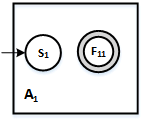
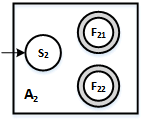

- Draw an NFA called A which recognizes the language L2 (L1 | L3) L2*
- What is the starting state of A?
- What are A's final states?

· F32 4 鈴
Homework Answers

Third part:
Draw the simplest possible (i.e. with fewest number of states) NFA which accepts the following language over the alphabet of {a, e, i, o, u, b, p, r, s, t}: the set of strings which start with a vowel, then two consonants, then 0 or more vowels, followed by the first vowel.
Here the part ‘followed by first vowel’ is not clear? If it is the first vowel (from where the string is started), then DFA/ NFA is not possible as some additional memory required to remember it and we have to go for Pushdown automata.
Last part:
(b) starting state of A is S2
(c) All states of A1 and A3 are final states
Add Answer to:
Part B - Automata Construction Draw a DFA which accepts the following language over the alphabet...
Draw a DFA which accepts the following language over the alphabet of {0,1}: the set of...
Draw a DFA which accepts the following language over the alphabet of {0,1}: the set of all strings such that there are two consecutive 0s or the number of 1s is not divisible by 5. Your DFA must handle all intput strings in {0,1}*. (Hint: look at solution of previous question)
Draw a DFA which accepts the following language over the alphabet of {0,1}: the set of...
Draw a DFA which accepts the following language over the alphabet of {0,1}: the set of all strings such that there are no consecutive 0s, and the number of 1s is divisible by 5. Your DFA must handle all intput strings in {0,1}*. Here is a way to approach the problem: First focus only building the DFA which accepts the language: As you build your DFA, label your states with an explanation of what the state actually represents in terms...
Automata Question. Over the alphabet Σ = {0, 1}: 1) Give a DFA, M1, that accepts...
Automata Question. Over the alphabet Σ = {0, 1}: 1) Give a DFA, M1, that accepts a Language L1 = {all strings that contain 00} 2) Give a DFA, M2, that accepts a Language L2 = {all strings that end with 01} 3) Give acceptor for L1 intersection L2 4) Give acceptor for L1 - L2
1(a)Draw the state diagram for a DFA for accepting the following language over alphabet {0,1}: {w...
1(a)Draw the state diagram for a DFA for accepting the following language over alphabet {0,1}: {w | the length of w is at least 2 and has the same symbol in its 2nd and last positions} (b)Draw the state diagram for an NFA for accepting the following language over alphabet {0,1} (Use as few states as possible): {w | w is of the form 1*(01 ∪ 10*)*} (c)If A is a language with alphabet Σ, the complement of A is...
1. Construct a Finite Automata over Σ={0,1} that recognizes the language {w | w ∈ {0,1}*...
1. Construct a Finite Automata over Σ={0,1} that recognizes the language {w | w ∈ {0,1}* contains a number of 0s divisible by four and exactly three 1s} 2. Construct a Finite Automata that recognizes telephone numbers from strings in the alphabet Σ={1,2,3,4,5,6,7,8,9, ,-,(,),*,#,}. Allow the 1 and area code prefixing a phone number to be optional. Allow for the segments of a number to be separated by spaces (denote with a _ character), no separation, or – symbols.
Build deterministic finite automata that accepts the following language over the alphabet Σ = {a, b}...
Build deterministic finite automata that accepts the following language over the alphabet Σ = {a, b} L= {all strings that end with b}
Languages to NFA / ε-NFA A) Make an ε-NFA (An Epsilon NFA) for the language L3...
Languages to NFA / ε-NFA A) Make an ε-NFA (An Epsilon NFA) for the language L3 = L1L2. Where: L1 = all strings over Σ= {0,1} that end in…001 and L2 = all strings over Σ= {0,1} that contain 010 anywhere in the string...(beginning, middle or end) B) Convert the ε-NFA (Epsilon NFA) from Part A into a regular NFA. C) Convert the NFA From Part B into a DFA.
Question 1: Design a DFA with at most 5 states for the language L1 = {w...
Question 1: Design a DFA with at most 5 states for the language L1 = {w ∈ {0, 1}∗ | w contains at most one 1 and |w| is odd}. Provide a state diagram for your DFA. Approaching the Solution --since we haven’t really practiced this type of assignment (i.e. had to define our machine based on only having the language given; not the formal 5 tuples), I am providing the steps for how to work through this; you are...
thank you Design an NFA over the alphabet <={0,1,2,3,4,5,6,7,8,9} such that it accepts strings which correspond...
 thank you
Design an NFA over the alphabet <={0,1,2,3,4,5,6,7,8,9} such that it accepts strings which correspond to a number divisible by 3. Hint: String can be of any length. Look up the rule for divisibility by 3 if you need. Give the formal definition of the automaton and draw its transition diagram.
thank you
Design an NFA over the alphabet <={0,1,2,3,4,5,6,7,8,9} such that it accepts strings which correspond to a number divisible by 3. Hint: String can be of any length. Look up the rule for divisibility by 3 if you need. Give the formal definition of the automaton and draw its transition diagram.
Draw the simplest possible (i.e. with fewest number of states) NFA which accepts the following language...
Draw the simplest possible (i.e. with fewest number of states) NFA which accepts the following language over the alphabet of {a, e, i, o, u, d, m, n, s, t}: the set of strings which start with a consonent, then a vowel, then another consonant, then 1 or 2 vowels, followed by the second consonent (which means that the last letter will be the same as the third letter).
 thank you
Design an NFA over the alphabet <={0,1,2,3,4,5,6,7,8,9} such that it accepts strings which correspond to a number divisible by 3. Hint: String can be of any length. Look up the rule for divisibility by 3 if you need. Give the formal definition of the automaton and draw its transition diagram.
thank you
Design an NFA over the alphabet <={0,1,2,3,4,5,6,7,8,9} such that it accepts strings which correspond to a number divisible by 3. Hint: String can be of any length. Look up the rule for divisibility by 3 if you need. Give the formal definition of the automaton and draw its transition diagram.
Most questions answered within 3 hours.
-
Where is the error in this code sequence?
String s1 = "Hello";
String s2 = "ello";...
asked 10 months ago -
Financial data for Joel de Paris, Inc., for last year
follow:
Joel de Paris, Inc.
Balance...
asked 10 months ago -
Consider this reaction:
Al2(SO4)3 (aq)+ BaCl3
(aq) Al2Cl6 (aq)- +
3BaSO4(s) . What is the...
asked 10 months ago -
Suppose that Savneet is considering increasing her
recent random sample from 20 car rentals to 40...
asked 10 months ago -
Trucks arrive at an unloading terminal at an average rate of 120
per hour.
Trucks arrive...
asked 10 months ago -
Why are methanol and ethanol completely soluble in water while
octanol is not very little soluble....
asked 10 months ago -
A facilities manager at a university reads in a research report
that the mean amount of...
asked 10 months ago -
When the CuSO4 is rehydrated by adding water to the anhydrous
compound, is this an endothermic...
asked 10 months ago -
A ray of sunlight is passing from diamond into crown glass; the
angle of incidence is...
asked 10 months ago -
A block of mass 0.249 kg is placed on top of a light, vertical
spring of...
asked 10 months ago -
how do the kidneys compensate in the presences of acidosis
a) trigger hyperventilate
b) reserve acid...
asked 10 months ago -
Question 501 pts
The rental rate of capital to the firm increases. Which of the
following...
asked 10 months ago