Mathematical Economics:

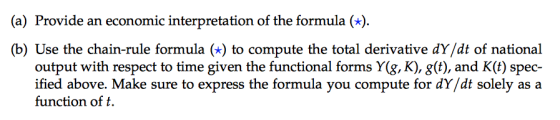
(a) Provide an economic interpretation of the formula (*) (b) Use the chain-rule formula) to compute the total derivative dY/dt of national output with respect to time given the functional forms Y(g, K), g(t), and K(t) spec- ified above. Make sure to express the formula you compute for dY/dt solely as a function of t.
Homework Answers
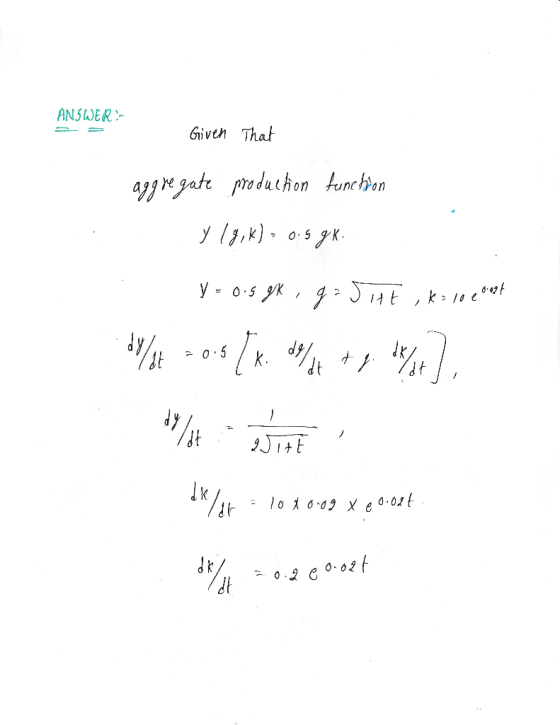


Add Answer to:
Suppose that the growth of the national economic output of a country Y depends on how much capita...
(Growth Accounting) Suppose that the representitive firm's production function is Cobb- Douglas: (a) Show that the...
 (Growth Accounting) Suppose that the representitive firm's production function is Cobb- Douglas: (a) Show that the growth rate of total output can be decomposited as (Hint: You may take logarithm to equation (4) on both sides, then use chain rule to take derivative with repect to time t) (b) Suppose in the year 2016, compared to 2015 the total output increases by 3%, and the technology keeps the same (no change in A). Also the labor force inceases by 0.05%...
Economic Growth II — Work It Out Question 2 In the nation of Wooknam, the capital...
 Economic Growth II — Work It Out Question 2 In the nation of Wooknam, the capital share of GDP is 35 percent, the average growth in output is 3.0 percent per year, the depreciation rate is 5.0 percent per year, and the capital-output ratio is 4.5. Suppose that the production function is Cobb- Douglas and that Wooknam has been in a steady state. Round answers to two places after the decimal when necessary. a. In the initial steady state, what...
5. Government Spending and Long Run Economic Performance Consider the following variant of the basic growth...
 5. Government Spending and Long Run Economic Performance Consider the following variant of the basic growth model: We will include a government that consumes output (G) and pays for it by imposing lump sum taxes (T). The government balances its budget every period. With these modifications the model becomes: Y = A-. K.N.- N =1 Y = C, +1, +G I, =s.(Y, -T) T, = G, K,+1=K,:(1-5)+1, Suppose government spending is proportional to output. As the country grows, the government...
3 Growth Model Suppose that output (Y) in an economy is given by the following aggregate...
 3 Growth Model Suppose that output (Y) in an economy is given by the following aggregate production function: Y = K + NE where Kt is capital and Nt is the population. Furthermore, assume that capital depreciates at rate 8 and that savings is a constant proportion s of income. You may assume that 8 > S. 1. Suppose that the population remains constant. Solve for the steady-state level of capital per worker. 2. Now suppose that the population grows...
0.5 , where y is output per worker and k Suppose that an economy has the...
 0.5 , where y is output per worker and k Suppose that an economy has the per-worker production function given as: Y = 5k is capital per worker. In addition, national savings is given as: S = 0.1074, where S is national savings and Y is total output. The depreciation rate is d = 0.10 and the population growth rate is n = 0.10 The steady-state value of the capital-labor ratio, k is 6.25. The steady-state value of output per...
Consider the Solow growth model that we developed in class. Output at time t is given...
 Consider the Solow growth model that we developed in class. Output at time t is given by the production function Y AK Lt, where A is total factor productivity, Kt is total capital at timet and L is the labour force. Total factor productivity A and labour force L are constant over time. There is no government or foreign trade and Y, + 1, where Ct is consumption and I is investment at tim. Every agent saves s share of...
only full solution for c and d In a simplified model of tumour growth, the size y(t) of the tumour at time t is given by...
 only
full solution for c and d
In a simplified model of tumour growth, the size y(t) of the tumour at time t is given by the equation dy y dt (1-2) is the proliferation rate of the tumour where r and k are positive constants and dy versus y, clearly labelling any equilibrium solutions dt (a) Draw the phase plot (b) Sketch y(t) for sufficiently many initial conditions to display all different basic shapes for the tumour size vs....
only
full solution for c and d
In a simplified model of tumour growth, the size y(t) of the tumour at time t is given by the equation dy y dt (1-2) is the proliferation rate of the tumour where r and k are positive constants and dy versus y, clearly labelling any equilibrium solutions dt (a) Draw the phase plot (b) Sketch y(t) for sufficiently many initial conditions to display all different basic shapes for the tumour size vs....
pls solve parts g,h,i, j Suppose Country X's production function is given by F(K, A,N) =...
 pls solve parts g,h,i, j
Suppose Country X's production function is given by F(K, A,N) = 206,05(A, N,905 where K, is the capital and A, N, is the effective worker. The evolution of the capital stock is given by K +1 = 0.74K, +1 where the depreciation rate is 26%. Additionally, the saving rate is 36%, the population growth rate is 4% and the technological growth rate is 10% (a) Derive and show that in the Solow growth model, the...
pls solve parts g,h,i, j
Suppose Country X's production function is given by F(K, A,N) = 206,05(A, N,905 where K, is the capital and A, N, is the effective worker. The evolution of the capital stock is given by K +1 = 0.74K, +1 where the depreciation rate is 26%. Additionally, the saving rate is 36%, the population growth rate is 4% and the technological growth rate is 10% (a) Derive and show that in the Solow growth model, the...
78. Suppose both that the amount of capital at time t, K-K(t), and that the efficiency...
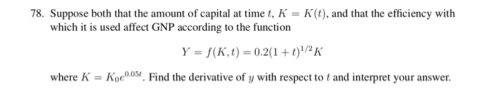 78. Suppose both that the amount of capital at time t, K-K(t), and that the efficiency with which it is used affect GNP according to the function where K Koe005. Find the derivative of y with respect to t and interpret your answer.
Consider the Solow growth model. Output at time t is given by the production function Y-AK3...
 Consider the Solow growth model. Output at time t is given by the production function Y-AK3 Lš where K, is total capital at time t, L is the labour force and A is total factor productivity. The labour force and total factor productivity are constant over time and capital evolves according the transition equation KH = (1-d) * Kit It: where d is the depreciation rate. Every person saves share s of his income and, therefore, aggregate saving is St-s...
 (Growth Accounting) Suppose that the representitive firm's production function is Cobb- Douglas: (a) Show that the growth rate of total output can be decomposited as (Hint: You may take logarithm to equation (4) on both sides, then use chain rule to take derivative with repect to time t) (b) Suppose in the year 2016, compared to 2015 the total output increases by 3%, and the technology keeps the same (no change in A). Also the labor force inceases by 0.05%...
 Economic Growth II — Work It Out Question 2 In the nation of Wooknam, the capital share of GDP is 35 percent, the average growth in output is 3.0 percent per year, the depreciation rate is 5.0 percent per year, and the capital-output ratio is 4.5. Suppose that the production function is Cobb- Douglas and that Wooknam has been in a steady state. Round answers to two places after the decimal when necessary. a. In the initial steady state, what...
 5. Government Spending and Long Run Economic Performance Consider the following variant of the basic growth model: We will include a government that consumes output (G) and pays for it by imposing lump sum taxes (T). The government balances its budget every period. With these modifications the model becomes: Y = A-. K.N.- N =1 Y = C, +1, +G I, =s.(Y, -T) T, = G, K,+1=K,:(1-5)+1, Suppose government spending is proportional to output. As the country grows, the government...
 3 Growth Model Suppose that output (Y) in an economy is given by the following aggregate production function: Y = K + NE where Kt is capital and Nt is the population. Furthermore, assume that capital depreciates at rate 8 and that savings is a constant proportion s of income. You may assume that 8 > S. 1. Suppose that the population remains constant. Solve for the steady-state level of capital per worker. 2. Now suppose that the population grows...
 0.5 , where y is output per worker and k Suppose that an economy has the per-worker production function given as: Y = 5k is capital per worker. In addition, national savings is given as: S = 0.1074, where S is national savings and Y is total output. The depreciation rate is d = 0.10 and the population growth rate is n = 0.10 The steady-state value of the capital-labor ratio, k is 6.25. The steady-state value of output per...
 Consider the Solow growth model that we developed in class. Output at time t is given by the production function Y AK Lt, where A is total factor productivity, Kt is total capital at timet and L is the labour force. Total factor productivity A and labour force L are constant over time. There is no government or foreign trade and Y, + 1, where Ct is consumption and I is investment at tim. Every agent saves s share of...
 only
full solution for c and d
In a simplified model of tumour growth, the size y(t) of the tumour at time t is given by the equation dy y dt (1-2) is the proliferation rate of the tumour where r and k are positive constants and dy versus y, clearly labelling any equilibrium solutions dt (a) Draw the phase plot (b) Sketch y(t) for sufficiently many initial conditions to display all different basic shapes for the tumour size vs....
only
full solution for c and d
In a simplified model of tumour growth, the size y(t) of the tumour at time t is given by the equation dy y dt (1-2) is the proliferation rate of the tumour where r and k are positive constants and dy versus y, clearly labelling any equilibrium solutions dt (a) Draw the phase plot (b) Sketch y(t) for sufficiently many initial conditions to display all different basic shapes for the tumour size vs....
 pls solve parts g,h,i, j
Suppose Country X's production function is given by F(K, A,N) = 206,05(A, N,905 where K, is the capital and A, N, is the effective worker. The evolution of the capital stock is given by K +1 = 0.74K, +1 where the depreciation rate is 26%. Additionally, the saving rate is 36%, the population growth rate is 4% and the technological growth rate is 10% (a) Derive and show that in the Solow growth model, the...
pls solve parts g,h,i, j
Suppose Country X's production function is given by F(K, A,N) = 206,05(A, N,905 where K, is the capital and A, N, is the effective worker. The evolution of the capital stock is given by K +1 = 0.74K, +1 where the depreciation rate is 26%. Additionally, the saving rate is 36%, the population growth rate is 4% and the technological growth rate is 10% (a) Derive and show that in the Solow growth model, the...
 78. Suppose both that the amount of capital at time t, K-K(t), and that the efficiency with which it is used affect GNP according to the function where K Koe005. Find the derivative of y with respect to t and interpret your answer.
 Consider the Solow growth model. Output at time t is given by the production function Y-AK3 Lš where K, is total capital at time t, L is the labour force and A is total factor productivity. The labour force and total factor productivity are constant over time and capital evolves according the transition equation KH = (1-d) * Kit It: where d is the depreciation rate. Every person saves share s of his income and, therefore, aggregate saving is St-s...
Most questions answered within 3 hours.
-
Where is the error in this code sequence?
String s1 = "Hello";
String s2 = "ello";...
asked 11 months ago -
Financial data for Joel de Paris, Inc., for last year
follow:
Joel de Paris, Inc.
Balance...
asked 11 months ago -
Consider this reaction:
Al2(SO4)3 (aq)+ BaCl3
(aq) Al2Cl6 (aq)- +
3BaSO4(s) . What is the...
asked 11 months ago -
Suppose that Savneet is considering increasing her
recent random sample from 20 car rentals to 40...
asked 11 months ago -
Trucks arrive at an unloading terminal at an average rate of 120
per hour.
Trucks arrive...
asked 11 months ago -
Why are methanol and ethanol completely soluble in water while
octanol is not very little soluble....
asked 11 months ago -
A facilities manager at a university reads in a research report
that the mean amount of...
asked 11 months ago -
When the CuSO4 is rehydrated by adding water to the anhydrous
compound, is this an endothermic...
asked 11 months ago -
A ray of sunlight is passing from diamond into crown glass; the
angle of incidence is...
asked 11 months ago -
A block of mass 0.249 kg is placed on top of a light, vertical
spring of...
asked 11 months ago -
how do the kidneys compensate in the presences of acidosis
a) trigger hyperventilate
b) reserve acid...
asked 11 months ago -
Question 501 pts
The rental rate of capital to the firm increases. Which of the
following...
asked 11 months ago