A new business requires $100,000 investment. The project can either be entirely equity financed, ...
A new business requires $100,000 investment. The project can either be entirely equity financed, or 70% of the investment can be funded by a bank loan at 10%. Assume no tax. EBIT is expected to be $25,000, but it could be as low as $3,000.
b) At what level of EBIT the shareholders receive the same return on equity regardless the percentage of debt financing?
Homework Answers
Solution:
Given data,
A new business requires $100,000 investment. The project can either be entirely equity financed, or 70% of the investment can be funded by a bank loan at 10%. EBIT is expected to be $25,000, but it could be as low as $3,000.
Now solution:
Return on Equity = Earnings for Equity / Equity Funds
Take EBIT as A.
Then
A / 100,000 = (A - 7,000) / 30,000
0.3A = A - 7,000
A = $10,000.
When EBIT = 30,000,The shareholders will receive the same return on equity regardless of the percentage of debt financing.
Add Answer to:
A new business requires $100,000 investment. The project can either be entirely equity financed, ...
A new business requires $100,000 investment. The project can either be entirely equity financed, or 70%...
A new business requires $100,000 investment. The project can either be entirely equity financed, or 70% of the investment can be funded by a bank loan at 10%. Assume no tax. EBIT is expected to be $25,000, but it could be as low as $3,000. (a) calculate ROE for all 4 scenarios (unlevered low EBIT, unlevered high EBIT, levered low EBIT, unlevered high EBIT).
Your company, which is financed entirely with common equity, plans to manufacture a new product, a...
Your company, which is financed entirely with common equity, plans to manufacture a new product, a cell phone that can be worn like a wristwatch. Two robotic machines are available to make the phone, Machine A and Machine B. The price per phone will be $260.00 regardless of which machine is used to make it. The fixed and variable costs associated with the two machines are shown below, along with the capital (all equity) that must be invested to purchase...
A new business requires a $20,000 investment today and will generate a one-time cash flow of...
 A new business requires a $20,000 investment today and will generate a one-time cash flow of $25,000 after one year. The business will be financed with 20% equity and 80% debt. If the firm can borrow at 4%, what is the return on levered equity? O A. 125% OB. 25% O C. 109% OD. 33% O E. 21%
A firm is planning to take a project that if funded entirely with equity has net...
A firm is planning to take a project that if funded entirely with equity has net after tax cash flows as indicated in the table below. Year Cash flow 0 -13000000 1 1500000 2 1500000 3 1500000 4 1500000 5 1500000 6 2000000 7 2000000 8 2000000 9 2000000 10 2000000 11 2500000 12 2500000 13 2500000 14 2500000 15 2500000 16 3000000 17 3000000 18 3000000 19 3000000 20 9000000 The firm estimates that the asset beta (i.e., when...
A firm is planning to take a project that if funded entirely with equity has net...
A firm is planning to take a project that if funded entirely with equity has net after tax cash flows as indicated in the table below. Year Cash flow 0 -13000000 1 1500000 2 1500000 3 1500000 4 1500000 5 1500000 6 2000000 7 2000000 8 2000000 9 2000000 10 2000000 11 2500000 12 2500000 13 2500000 14 2500000 15 2500000 16 3000000 17 3000000 18 3000000 19 3000000 20 9000000 The firm estimates that the asset beta (i.e., when...
9. Business and financial risk The impact of financial leverage on return on equity and earnings...
9. Business and financial risk The impact of financial leverage on return on equity and earnings per share Consider the following case of Free Spirit Industries Inc.: Suppose Free Spirit Industries Inc. is considering a project that will require $250,000 in assets. • The company is small, so it is exempt from the interest deduction limitation under the new tax law. • The project is expected to produce earnings before interest and taxes (EBIT) of $50,000. • Common equity outstanding...
Business and financial risk The impact of financial leverage on return on equity and earnings per...
Business and financial risk The impact of financial leverage on return on equity and earnings per share Consider the following case of Happy Turtle Transportation Company: Suppose Happy Turtle Transportation Company is considering a project that will require $300,000 in assets. • The company is small, so it is exempt from the interest deduction limitation under the new tax law. • The project is expected to produce earnings before interest and taxes (EBIT) of $55,000. • Common equity outstanding will...
If the project is financed using 100% equity capital, then Happy Turtle Transportation Company’s return on...
 If the project is financed using 100% equity capital, then Happy
Turtle Transportation Company’s return on equity (ROE) on the
project will be 18.00% / 21.60% / 17.10% / 20.70%.
In addition, Happy Turtle’s earnings per share (EPS) will
be$ 4.95 / $ 3.60 / $ 4.50 / $3.83 / $ 4.73.
2. Alternatively, Happy Turtle Transportation Company’s CFO is
also considering financing the project with 50% debt and 50% equity
capital. The interest rate on the company’s debt will...
If the project is financed using 100% equity capital, then Happy
Turtle Transportation Company’s return on equity (ROE) on the
project will be 18.00% / 21.60% / 17.10% / 20.70%.
In addition, Happy Turtle’s earnings per share (EPS) will
be$ 4.95 / $ 3.60 / $ 4.50 / $3.83 / $ 4.73.
2. Alternatively, Happy Turtle Transportation Company’s CFO is
also considering financing the project with 50% debt and 50% equity
capital. The interest rate on the company’s debt will...
determine suitable discount rate for the new investment if directors were to finance the new project...
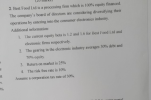 determine suitable discount rate for the new
investment if directors were to finance the new project as
follows;
1) 30% debt and 70%equity
2)Entirely by equity
3)40% debt and 60% equity
(20 ml) 2. Best Food Ltd is a processing firm which is 100% equity financed. The company's board of directors are considering diversifying their operations by entering into the consumer electronics industry. Additional information: 1. The current equity beta is 1.2 and 1.6 for Best Food Ltd and electronic...
determine suitable discount rate for the new
investment if directors were to finance the new project as
follows;
1) 30% debt and 70%equity
2)Entirely by equity
3)40% debt and 60% equity
(20 ml) 2. Best Food Ltd is a processing firm which is 100% equity financed. The company's board of directors are considering diversifying their operations by entering into the consumer electronics industry. Additional information: 1. The current equity beta is 1.2 and 1.6 for Best Food Ltd and electronic...
Problem 6-15 Project NPV and IRR A project requires an initial investment of $100,000 and is...
 Problem 6-15 Project NPV and IRR A project requires an initial investment of $100,000 and is expected to produce a cash inflow before tax of $26,700 per year for five years. Company A has substantial accumulated tax losses and is unlikely to pay taxes in the foreseeable future. Company B pays corporate taxes at a rate of 21% and can claim 100% bonus depreciation on the investment. Suppose the opportunity cost of capital is 9%. Ignore inflation. a. Calculate project...
 A new business requires a $20,000 investment today and will generate a one-time cash flow of $25,000 after one year. The business will be financed with 20% equity and 80% debt. If the firm can borrow at 4%, what is the return on levered equity? O A. 125% OB. 25% O C. 109% OD. 33% O E. 21%
 If the project is financed using 100% equity capital, then Happy
Turtle Transportation Company’s return on equity (ROE) on the
project will be 18.00% / 21.60% / 17.10% / 20.70%.
In addition, Happy Turtle’s earnings per share (EPS) will
be$ 4.95 / $ 3.60 / $ 4.50 / $3.83 / $ 4.73.
2. Alternatively, Happy Turtle Transportation Company’s CFO is
also considering financing the project with 50% debt and 50% equity
capital. The interest rate on the company’s debt will...
If the project is financed using 100% equity capital, then Happy
Turtle Transportation Company’s return on equity (ROE) on the
project will be 18.00% / 21.60% / 17.10% / 20.70%.
In addition, Happy Turtle’s earnings per share (EPS) will
be$ 4.95 / $ 3.60 / $ 4.50 / $3.83 / $ 4.73.
2. Alternatively, Happy Turtle Transportation Company’s CFO is
also considering financing the project with 50% debt and 50% equity
capital. The interest rate on the company’s debt will...
 determine suitable discount rate for the new
investment if directors were to finance the new project as
follows;
1) 30% debt and 70%equity
2)Entirely by equity
3)40% debt and 60% equity
(20 ml) 2. Best Food Ltd is a processing firm which is 100% equity financed. The company's board of directors are considering diversifying their operations by entering into the consumer electronics industry. Additional information: 1. The current equity beta is 1.2 and 1.6 for Best Food Ltd and electronic...
determine suitable discount rate for the new
investment if directors were to finance the new project as
follows;
1) 30% debt and 70%equity
2)Entirely by equity
3)40% debt and 60% equity
(20 ml) 2. Best Food Ltd is a processing firm which is 100% equity financed. The company's board of directors are considering diversifying their operations by entering into the consumer electronics industry. Additional information: 1. The current equity beta is 1.2 and 1.6 for Best Food Ltd and electronic...
 Problem 6-15 Project NPV and IRR A project requires an initial investment of $100,000 and is expected to produce a cash inflow before tax of $26,700 per year for five years. Company A has substantial accumulated tax losses and is unlikely to pay taxes in the foreseeable future. Company B pays corporate taxes at a rate of 21% and can claim 100% bonus depreciation on the investment. Suppose the opportunity cost of capital is 9%. Ignore inflation. a. Calculate project...
Most questions answered within 3 hours.
-
Where is the error in this code sequence?
String s1 = "Hello";
String s2 = "ello";...
asked 11 months ago -
Financial data for Joel de Paris, Inc., for last year
follow:
Joel de Paris, Inc.
Balance...
asked 11 months ago -
Consider this reaction:
Al2(SO4)3 (aq)+ BaCl3
(aq) Al2Cl6 (aq)- +
3BaSO4(s) . What is the...
asked 11 months ago -
Suppose that Savneet is considering increasing her
recent random sample from 20 car rentals to 40...
asked 11 months ago -
Trucks arrive at an unloading terminal at an average rate of 120
per hour.
Trucks arrive...
asked 11 months ago -
Why are methanol and ethanol completely soluble in water while
octanol is not very little soluble....
asked 11 months ago -
A facilities manager at a university reads in a research report
that the mean amount of...
asked 11 months ago -
When the CuSO4 is rehydrated by adding water to the anhydrous
compound, is this an endothermic...
asked 11 months ago -
A ray of sunlight is passing from diamond into crown glass; the
angle of incidence is...
asked 11 months ago -
A block of mass 0.249 kg is placed on top of a light, vertical
spring of...
asked 11 months ago -
how do the kidneys compensate in the presences of acidosis
a) trigger hyperventilate
b) reserve acid...
asked 11 months ago -
Question 501 pts
The rental rate of capital to the firm increases. Which of the
following...
asked 11 months ago