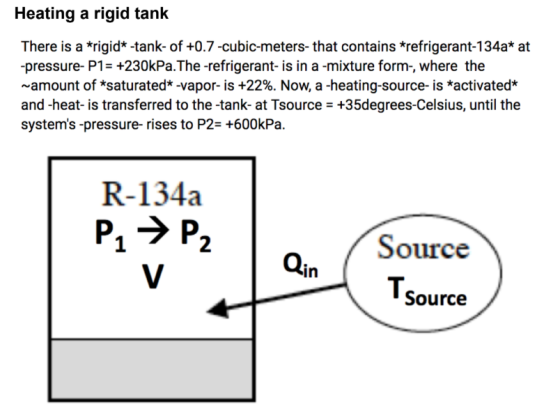
3. D. Since the pressure of the system finally increases beyond
the initial saturation pressure,
the tank is rigid and the mass of the refrigerant does not change,
what does this imply for the
refrigerant?
A) Finally, the refrigerant is in the saturated vapor
state.
B) Finally, the refrigerant is in the compressed liquid
state.
C) Finally, the refrigerant is in the superheated vapor
state.
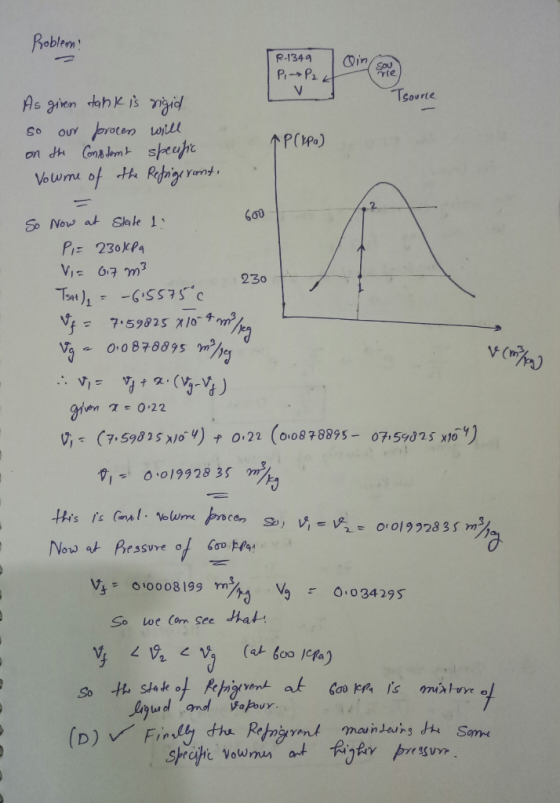
D) Finally, the refrigerant maintains the same specific volume but
at a higher pressure.
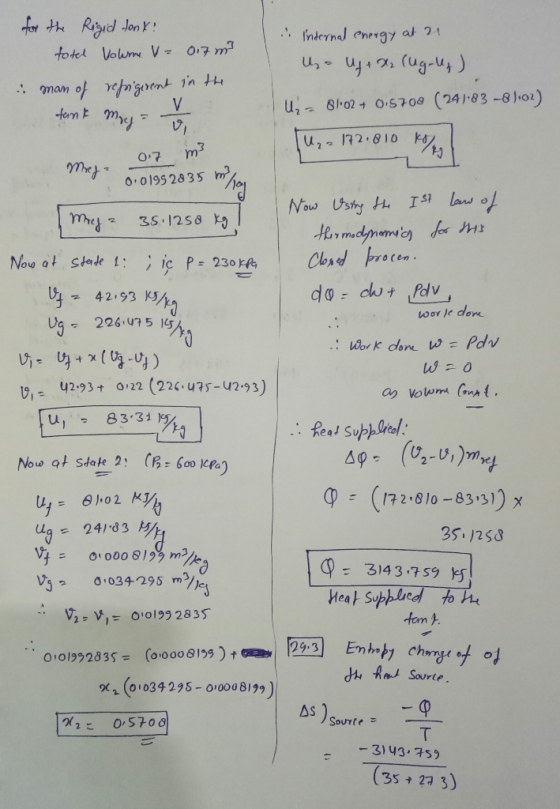
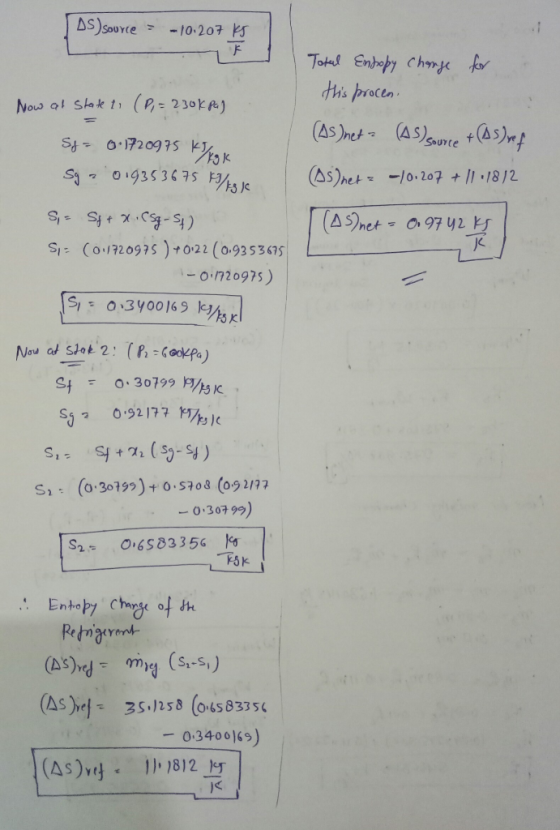
3. F. Determine the entropy change of the
refrigerant. (kJ/K units) *
29. 3. G. Determine the entropy change of the
activated heating source. (kJ/K units) *
30. 3. H. Determine the total entropy change for
this process (kJ/K units) *
Homework Answers
Add Answer to:
3. D. Since the pressure of the system finally increases beyond the initial saturation pressure, ...
NOTE: This is a multi-part question. Once an answer is submitted, you will be unable to...
 NOTE: This is a multi-part question. Once an answer is submitted, you will be unable to return to this part A 1-m3 rigid tank contains refrigerant-134a initially at 200 kPa and 40 percent quality. Heat is transferred now to the refrigerant from a source at 35°C until the pressure rises to 400 kPa. Determine the entropy change of the refrigerant. Use the tables for R-134a. (You must provide an answer before moving on to the next part.) The entropy change...
i need The entropy change of the refrigerant and also the amount of heat transfered Required...
 i
need
The entropy change of the refrigerant
and also the amount of heat transfered
Required information NOTE: This is a multi-part question. Once an answer is submitted, you will be unable to return to this part. A 1.2 m3 rigid tank contains refrigerant-134a Initially at 200 kPa and 40 percent quality. Heat is transferred now to the refrigerant from a source at 35°C until the pressure rises to 400 kPa. Determine the entropy change of the refrigerant. Use the...
i
need
The entropy change of the refrigerant
and also the amount of heat transfered
Required information NOTE: This is a multi-part question. Once an answer is submitted, you will be unable to return to this part. A 1.2 m3 rigid tank contains refrigerant-134a Initially at 200 kPa and 40 percent quality. Heat is transferred now to the refrigerant from a source at 35°C until the pressure rises to 400 kPa. Determine the entropy change of the refrigerant. Use the...
1) First, the script prompts user to input the volume of the rigid container in cubic meters 2) S...
1) First, the script prompts user to input the volume of the rigid container in cubic meters 2) Second, the script prompts user to input the total mass of the water (in any phase) in the tank 3) Third, the script prompts user to input the initial temperature 4) Fourth, the script prompts user to input the initial mixture quality Thereafter, the script computes the state at which all of the water is transformed to saturated vapor, and the energy...
1.Water vapor contained in a piston–cylinder assembly undergoes an isothermal expansion at 277°C from a pressure...
1.Water vapor contained in a piston–cylinder assembly undergoes an isothermal expansion at 277°C from a pressure of 5.1 bar to a pressure of 2.7 bar. Evaluate the work, in kJ/kg. 2.Nitrogen (N2) contained in a piston–cylinder arrangement, initially at 9.3 bar and 437 K, undergoes an expansion to a final temperature of 300 K, during which the pressure–volume relationship is pV1.1 = constant. Assuming the ideal gas model for the N2, determine the heat transfer in kJ/kg. 3.Argon contained in...
PLEASE ANSWER QUICKLY!! I WILL THUMBS UP! Thank you so much in advance!! Neatly sketch the...
 PLEASE ANSWER QUICKLY!! I WILL THUMBS UP! Thank you so much in
advance!!
Neatly sketch the complete heat-pump cycle from Question 1 on a P-h diagram, showing clearly all six processes (1) - (2) - (3) - (4) - (5) - (6)-(1). If you have a printer available, you may print this PDF file of the R134a P-h diagram. Otherwise, draw a very neat scale copy of the P-h diagram shown below. You do not have to type any response...
PLEASE ANSWER QUICKLY!! I WILL THUMBS UP! Thank you so much in
advance!!
Neatly sketch the complete heat-pump cycle from Question 1 on a P-h diagram, showing clearly all six processes (1) - (2) - (3) - (4) - (5) - (6)-(1). If you have a printer available, you may print this PDF file of the R134a P-h diagram. Otherwise, draw a very neat scale copy of the P-h diagram shown below. You do not have to type any response...
QUESTIONS 1. Refrigerant-134a is cooled by water in a condenser. The refrigerant enters the condenser at...
 QUESTIONS 1. Refrigerant-134a is cooled by water in a condenser. The refrigerant enters the condenser at a pressure of 1 MPa and a temperature of 70°C at a flow rate of 6 kg / min and exits at a temperature of 35 °C. Cooling water enters the condenser at 300 kPa pressure and 15 °C temperature and exits at 25 °C temperature. By neglecting pressure losses, Calculate; a) mass flow of cooling water b) the heat transfer from the refrigerant...
System Model: Automotive Air Conditioning System Outside Air Temp: 45 oC Car Interior Air Temp: 22...
System Model: Automotive Air Conditioning System Outside Air Temp: 45 oC Car Interior Air Temp: 22 oC Heat Load = 4.2 kJ/sec rate at which heat must go in to the air conditioner to be removed from the car’s interior Refrigerant: R134a HINT: Heat enters an air conditioning system where? Refrigerant 134a … - leaves the evaporator coil and enters the compressor as a saturated vapor at the evaporator pressure of 2.8 bars. - It leaves the compressor at...
HW Assignmnts Gocgle LEcture Slides Google Dr xG change in pressure and te Ghow to find work oonstanty X C Gat Homawork...
 HW Assignmnts Gocgle LEcture Slides Google Dr xG change in pressure and te Ghow to find work oonstanty X C Gat Homawork Halp With x X ENGR 217 Google Drive + X _ https://drive.google.com/drive/folders/1t KvlbiuW1- Mh_fBB-Wzcy7INI j BMc C Apps Blaukboard Raidlerlirk IiyP KE YuuTube DIRECTV NOW MY JCU ENCR 217 - Guugle.. Sy Synbula JCU Homework Assignment #8 Drive (Problem 1) HW Assignments ENGR 217 SCARICA TUTTO Rome can get pretty hot in the mid-summer! Most of the Nome...
fOne question but divided into sub connected questions * Question Completion Status: QUESTION 1 20 points...
 fOne question but divided into sub connected
questions
* Question Completion Status: QUESTION 1 20 points Save Ans The heat-pump system shown is designed to provide water-heating and space-cooling. The system includes a heat exchanger to subcool the R134a refrigerant at the outlet of the water heater while heating the refrigerant at the outlet of the evaporator. Given the following data, determine the enthalpy at each station, 1 through 6, using the R134a property tables (click here). Type your answers...
fOne question but divided into sub connected
questions
* Question Completion Status: QUESTION 1 20 points Save Ans The heat-pump system shown is designed to provide water-heating and space-cooling. The system includes a heat exchanger to subcool the R134a refrigerant at the outlet of the water heater while heating the refrigerant at the outlet of the evaporator. Given the following data, determine the enthalpy at each station, 1 through 6, using the R134a property tables (click here). Type your answers...
I need your help solving this thermodynamics problem please: Question Completion Status: QUESTION 1 20 points...
 I
need your help solving this thermodynamics problem please:
Question Completion Status: QUESTION 1 20 points Save Ans The heat-pump system shown is designed to provide water-heating and space-cooling. The system includes a heat exchanger to subcool the R134a refrigerant at the outlet of the water heater while heating the refrigerant at the outlet of the evaporator. Given the following data, determine the enthalpy at each station, 1 through 6, using the R134a property tables (click here). Type your answers...
I
need your help solving this thermodynamics problem please:
Question Completion Status: QUESTION 1 20 points Save Ans The heat-pump system shown is designed to provide water-heating and space-cooling. The system includes a heat exchanger to subcool the R134a refrigerant at the outlet of the water heater while heating the refrigerant at the outlet of the evaporator. Given the following data, determine the enthalpy at each station, 1 through 6, using the R134a property tables (click here). Type your answers...
 NOTE: This is a multi-part question. Once an answer is submitted, you will be unable to return to this part A 1-m3 rigid tank contains refrigerant-134a initially at 200 kPa and 40 percent quality. Heat is transferred now to the refrigerant from a source at 35°C until the pressure rises to 400 kPa. Determine the entropy change of the refrigerant. Use the tables for R-134a. (You must provide an answer before moving on to the next part.) The entropy change...
 i
need
The entropy change of the refrigerant
and also the amount of heat transfered
Required information NOTE: This is a multi-part question. Once an answer is submitted, you will be unable to return to this part. A 1.2 m3 rigid tank contains refrigerant-134a Initially at 200 kPa and 40 percent quality. Heat is transferred now to the refrigerant from a source at 35°C until the pressure rises to 400 kPa. Determine the entropy change of the refrigerant. Use the...
i
need
The entropy change of the refrigerant
and also the amount of heat transfered
Required information NOTE: This is a multi-part question. Once an answer is submitted, you will be unable to return to this part. A 1.2 m3 rigid tank contains refrigerant-134a Initially at 200 kPa and 40 percent quality. Heat is transferred now to the refrigerant from a source at 35°C until the pressure rises to 400 kPa. Determine the entropy change of the refrigerant. Use the...
 PLEASE ANSWER QUICKLY!! I WILL THUMBS UP! Thank you so much in
advance!!
Neatly sketch the complete heat-pump cycle from Question 1 on a P-h diagram, showing clearly all six processes (1) - (2) - (3) - (4) - (5) - (6)-(1). If you have a printer available, you may print this PDF file of the R134a P-h diagram. Otherwise, draw a very neat scale copy of the P-h diagram shown below. You do not have to type any response...
PLEASE ANSWER QUICKLY!! I WILL THUMBS UP! Thank you so much in
advance!!
Neatly sketch the complete heat-pump cycle from Question 1 on a P-h diagram, showing clearly all six processes (1) - (2) - (3) - (4) - (5) - (6)-(1). If you have a printer available, you may print this PDF file of the R134a P-h diagram. Otherwise, draw a very neat scale copy of the P-h diagram shown below. You do not have to type any response...
 QUESTIONS 1. Refrigerant-134a is cooled by water in a condenser. The refrigerant enters the condenser at a pressure of 1 MPa and a temperature of 70°C at a flow rate of 6 kg / min and exits at a temperature of 35 °C. Cooling water enters the condenser at 300 kPa pressure and 15 °C temperature and exits at 25 °C temperature. By neglecting pressure losses, Calculate; a) mass flow of cooling water b) the heat transfer from the refrigerant...
 HW Assignmnts Gocgle LEcture Slides Google Dr xG change in pressure and te Ghow to find work oonstanty X C Gat Homawork Halp With x X ENGR 217 Google Drive + X _ https://drive.google.com/drive/folders/1t KvlbiuW1- Mh_fBB-Wzcy7INI j BMc C Apps Blaukboard Raidlerlirk IiyP KE YuuTube DIRECTV NOW MY JCU ENCR 217 - Guugle.. Sy Synbula JCU Homework Assignment #8 Drive (Problem 1) HW Assignments ENGR 217 SCARICA TUTTO Rome can get pretty hot in the mid-summer! Most of the Nome...
 fOne question but divided into sub connected
questions
* Question Completion Status: QUESTION 1 20 points Save Ans The heat-pump system shown is designed to provide water-heating and space-cooling. The system includes a heat exchanger to subcool the R134a refrigerant at the outlet of the water heater while heating the refrigerant at the outlet of the evaporator. Given the following data, determine the enthalpy at each station, 1 through 6, using the R134a property tables (click here). Type your answers...
fOne question but divided into sub connected
questions
* Question Completion Status: QUESTION 1 20 points Save Ans The heat-pump system shown is designed to provide water-heating and space-cooling. The system includes a heat exchanger to subcool the R134a refrigerant at the outlet of the water heater while heating the refrigerant at the outlet of the evaporator. Given the following data, determine the enthalpy at each station, 1 through 6, using the R134a property tables (click here). Type your answers...
 I
need your help solving this thermodynamics problem please:
Question Completion Status: QUESTION 1 20 points Save Ans The heat-pump system shown is designed to provide water-heating and space-cooling. The system includes a heat exchanger to subcool the R134a refrigerant at the outlet of the water heater while heating the refrigerant at the outlet of the evaporator. Given the following data, determine the enthalpy at each station, 1 through 6, using the R134a property tables (click here). Type your answers...
I
need your help solving this thermodynamics problem please:
Question Completion Status: QUESTION 1 20 points Save Ans The heat-pump system shown is designed to provide water-heating and space-cooling. The system includes a heat exchanger to subcool the R134a refrigerant at the outlet of the water heater while heating the refrigerant at the outlet of the evaporator. Given the following data, determine the enthalpy at each station, 1 through 6, using the R134a property tables (click here). Type your answers...
Most questions answered within 3 hours.
-
Where is the error in this code sequence?
String s1 = "Hello";
String s2 = "ello";...
asked 11 months ago -
Financial data for Joel de Paris, Inc., for last year
follow:
Joel de Paris, Inc.
Balance...
asked 11 months ago -
Consider this reaction:
Al2(SO4)3 (aq)+ BaCl3
(aq) Al2Cl6 (aq)- +
3BaSO4(s) . What is the...
asked 11 months ago -
Suppose that Savneet is considering increasing her
recent random sample from 20 car rentals to 40...
asked 11 months ago -
Trucks arrive at an unloading terminal at an average rate of 120
per hour.
Trucks arrive...
asked 11 months ago -
Why are methanol and ethanol completely soluble in water while
octanol is not very little soluble....
asked 11 months ago -
A facilities manager at a university reads in a research report
that the mean amount of...
asked 11 months ago -
When the CuSO4 is rehydrated by adding water to the anhydrous
compound, is this an endothermic...
asked 11 months ago -
A ray of sunlight is passing from diamond into crown glass; the
angle of incidence is...
asked 11 months ago -
A block of mass 0.249 kg is placed on top of a light, vertical
spring of...
asked 11 months ago -
how do the kidneys compensate in the presences of acidosis
a) trigger hyperventilate
b) reserve acid...
asked 11 months ago -
Question 501 pts
The rental rate of capital to the firm increases. Which of the
following...
asked 11 months ago