

วา , ゴウr. IEC 겨e 2 0 07쿠 2 っ7 (
Homework Answers


Add Answer to:
The final answer is on the bottom of the loose leaf, i just dont know how to get to it. Vo= -35.2...
Loose leaf was just scratch work i did, the main problem is on the printed sheet (didnt think i h...
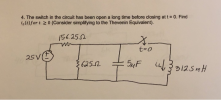 loose leaf was just scratch work i did, the main problem is on
the printed sheet (didnt think i had to explain this, but aparently
i do)
4. The switch in the circuit has been open a long time before closing at t (t)fort 2 0 (Consider simplifying to the Thevenin Equivalent). 0, Find 156.2552 jas do そ
4. The switch in the circuit has been open a long time before closing at t (t)fort 2 0 (Consider simplifying to...
loose leaf was just scratch work i did, the main problem is on
the printed sheet (didnt think i had to explain this, but aparently
i do)
4. The switch in the circuit has been open a long time before closing at t (t)fort 2 0 (Consider simplifying to the Thevenin Equivalent). 0, Find 156.2552 jas do そ
4. The switch in the circuit has been open a long time before closing at t (t)fort 2 0 (Consider simplifying to...
2. The switch in the circuit shown in Figure 1 has been in position 'a' for...
 2. The switch in the circuit shown in Figure 1 has been in position 'a' for a long time. At t=0, the switch moves instantaneously to position b. a) Find the numerical expression for io(t) when t > 0. b) Find the numerical expression for volt) fort > 0 1 = 0 b! 51 602 45 A 2150 vo 20 10 mH 240 V 1
Problem #1 The switch in the circuit shown has been in position “a” for a long...
 Problem #1 The switch in the circuit shown has been in position “a” for a long time. Att= 0, the switch moves instantaneously to position “b”. Construct an s-domain equivalent circuit for t>0. Find V. (s). Find v. (t). b 2k12 b) t=0 15 ma 15 mA o 2 ke 3 2 kn> 0.8 1.25 uF Vo
Problem 3: The switch in the following circuit has been in position a for a long...
 Problem 3: The switch in the following circuit has been in position a for a long time. At t = 0 the switch moves instantaneously to position b. Find the voltage vo(t) for t 2 0. t =0 10ih 6 ΚΩ а 50 V4 k vo3 51.2 mH 8 μF 150 Q 60 0
4. The switch in the circuit in the figure below has been in position 'a' for...
 4. The switch in the circuit in the figure below has been in position 'a' for a long time. At t = 0, the switch moves instantaneously to position b. For t> 0*, find a) vo(t) b) io(t). 5k12 b 10 k 12 11 = 0 + 10 kn} 1,040nF 40 kN 75 V 100 V
The loose leaf paper was just my initial guess and brain storm. looking for how to do it
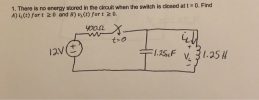 the loose leaf paper was just my initial guess and brain
storm. looking for how to do it
1. There is no energy stored in the circuit when the switch is closed at t A) 4(t) for t 0 and B) VL(t) for t 0. 0. Find 노 キ[.ス5.,F Vh31.25H t-o L. 120心 RLC
1. There is no energy stored in the circuit when the switch is closed at t A) 4(t) for t 0 and B) VL(t) for t...
the loose leaf paper was just my initial guess and brain
storm. looking for how to do it
1. There is no energy stored in the circuit when the switch is closed at t A) 4(t) for t 0 and B) VL(t) for t 0. 0. Find 노 キ[.ス5.,F Vh31.25H t-o L. 120心 RLC
1. There is no energy stored in the circuit when the switch is closed at t A) 4(t) for t 0 and B) VL(t) for t...
USE differential Approach in your analysis The switch in the circuit has been in position 1...
 USE differential Approach in your analysis The switch in the circuit has been in position 1 for a long time. At t = 0 it moves instantaneously to position 2. (Figure 1) 10 12 50 VO 331 31.5 HŽ 402 How many milliseconds after the switch operates does v, equal 160 V ?
Circuit 1 Transient response of a series RLC circuit The two switches in the circuit in...
 Circuit 1 Transient response of a series RLC circuit The two switches in the circuit in Figure 8 operate synchronously. When switch 1 is in position "a", switch 2 is closed. When switch 1 is in position "b", switch 2 is open. Switch 1 has been in position "a" for a very long time. At 1-0, it moves instantaneously to position 4Ω t=0 2 8Ω 100mH 150V| 2Ω 60 V Figure 8: Circuit for Tasks 3 and 4 TASK 3...
The switch in the circuit has been in position 1 for a longtime. At t=0...
 The switch in the circuit has been in position 1 for a long
time. At t=0 the switch moves to position 2. Find a) vo(t) for
t>=0 and b) io(t) for t>=0
The switch in the circuit has been in position 1 for a long
time. At t=0 the switch moves to position 2. Find a) vo(t) for
t>=0 and b) io(t) for t>=0
Question 2. The switch in the circuit below has been in position a for a long...
 Question 2. The switch in the circuit below has been in position a for a long time. At t = 0, the switch moves instantaneously to position b. Find (a) i(0) (b) v.(0) di(0+) (c) dt (d) S1, S2 (e) i(t) fort 20 9 k ao obam 6 802 5 mH + i=0 315L0 ( 80V 100 V v2uF
 loose leaf was just scratch work i did, the main problem is on
the printed sheet (didnt think i had to explain this, but aparently
i do)
4. The switch in the circuit has been open a long time before closing at t (t)fort 2 0 (Consider simplifying to the Thevenin Equivalent). 0, Find 156.2552 jas do そ
4. The switch in the circuit has been open a long time before closing at t (t)fort 2 0 (Consider simplifying to...
loose leaf was just scratch work i did, the main problem is on
the printed sheet (didnt think i had to explain this, but aparently
i do)
4. The switch in the circuit has been open a long time before closing at t (t)fort 2 0 (Consider simplifying to the Thevenin Equivalent). 0, Find 156.2552 jas do そ
4. The switch in the circuit has been open a long time before closing at t (t)fort 2 0 (Consider simplifying to...
 2. The switch in the circuit shown in Figure 1 has been in position 'a' for a long time. At t=0, the switch moves instantaneously to position b. a) Find the numerical expression for io(t) when t > 0. b) Find the numerical expression for volt) fort > 0 1 = 0 b! 51 602 45 A 2150 vo 20 10 mH 240 V 1
 Problem #1 The switch in the circuit shown has been in position “a” for a long time. Att= 0, the switch moves instantaneously to position “b”. Construct an s-domain equivalent circuit for t>0. Find V. (s). Find v. (t). b 2k12 b) t=0 15 ma 15 mA o 2 ke 3 2 kn> 0.8 1.25 uF Vo
 Problem 3: The switch in the following circuit has been in position a for a long time. At t = 0 the switch moves instantaneously to position b. Find the voltage vo(t) for t 2 0. t =0 10ih 6 ΚΩ а 50 V4 k vo3 51.2 mH 8 μF 150 Q 60 0
 4. The switch in the circuit in the figure below has been in position 'a' for a long time. At t = 0, the switch moves instantaneously to position b. For t> 0*, find a) vo(t) b) io(t). 5k12 b 10 k 12 11 = 0 + 10 kn} 1,040nF 40 kN 75 V 100 V
 the loose leaf paper was just my initial guess and brain
storm. looking for how to do it
1. There is no energy stored in the circuit when the switch is closed at t A) 4(t) for t 0 and B) VL(t) for t 0. 0. Find 노 キ[.ス5.,F Vh31.25H t-o L. 120心 RLC
1. There is no energy stored in the circuit when the switch is closed at t A) 4(t) for t 0 and B) VL(t) for t...
the loose leaf paper was just my initial guess and brain
storm. looking for how to do it
1. There is no energy stored in the circuit when the switch is closed at t A) 4(t) for t 0 and B) VL(t) for t 0. 0. Find 노 キ[.ス5.,F Vh31.25H t-o L. 120心 RLC
1. There is no energy stored in the circuit when the switch is closed at t A) 4(t) for t 0 and B) VL(t) for t...
 USE differential Approach in your analysis The switch in the circuit has been in position 1 for a long time. At t = 0 it moves instantaneously to position 2. (Figure 1) 10 12 50 VO 331 31.5 HŽ 402 How many milliseconds after the switch operates does v, equal 160 V ?
 Circuit 1 Transient response of a series RLC circuit The two switches in the circuit in Figure 8 operate synchronously. When switch 1 is in position "a", switch 2 is closed. When switch 1 is in position "b", switch 2 is open. Switch 1 has been in position "a" for a very long time. At 1-0, it moves instantaneously to position 4Ω t=0 2 8Ω 100mH 150V| 2Ω 60 V Figure 8: Circuit for Tasks 3 and 4 TASK 3...
 The switch in the circuit has been in position 1 for a long
time. At t=0 the switch moves to position 2. Find a) vo(t) for
t>=0 and b) io(t) for t>=0
The switch in the circuit has been in position 1 for a long
time. At t=0 the switch moves to position 2. Find a) vo(t) for
t>=0 and b) io(t) for t>=0
 Question 2. The switch in the circuit below has been in position a for a long time. At t = 0, the switch moves instantaneously to position b. Find (a) i(0) (b) v.(0) di(0+) (c) dt (d) S1, S2 (e) i(t) fort 20 9 k ao obam 6 802 5 mH + i=0 315L0 ( 80V 100 V v2uF
Most questions answered within 3 hours.
-
Where is the error in this code sequence?
String s1 = "Hello";
String s2 = "ello";...
asked 11 months ago -
Financial data for Joel de Paris, Inc., for last year
follow:
Joel de Paris, Inc.
Balance...
asked 11 months ago -
Consider this reaction:
Al2(SO4)3 (aq)+ BaCl3
(aq) Al2Cl6 (aq)- +
3BaSO4(s) . What is the...
asked 11 months ago -
Suppose that Savneet is considering increasing her
recent random sample from 20 car rentals to 40...
asked 11 months ago -
Trucks arrive at an unloading terminal at an average rate of 120
per hour.
Trucks arrive...
asked 11 months ago -
Why are methanol and ethanol completely soluble in water while
octanol is not very little soluble....
asked 11 months ago -
A facilities manager at a university reads in a research report
that the mean amount of...
asked 11 months ago -
When the CuSO4 is rehydrated by adding water to the anhydrous
compound, is this an endothermic...
asked 11 months ago -
A ray of sunlight is passing from diamond into crown glass; the
angle of incidence is...
asked 11 months ago -
A block of mass 0.249 kg is placed on top of a light, vertical
spring of...
asked 11 months ago -
how do the kidneys compensate in the presences of acidosis
a) trigger hyperventilate
b) reserve acid...
asked 11 months ago -
Question 501 pts
The rental rate of capital to the firm increases. Which of the
following...
asked 11 months ago