
Homework Answers


Add Answer to:
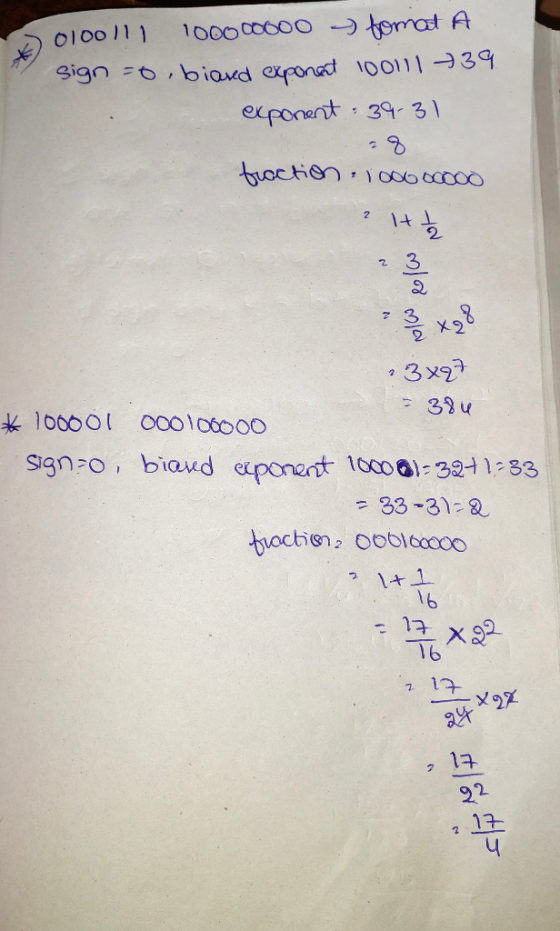
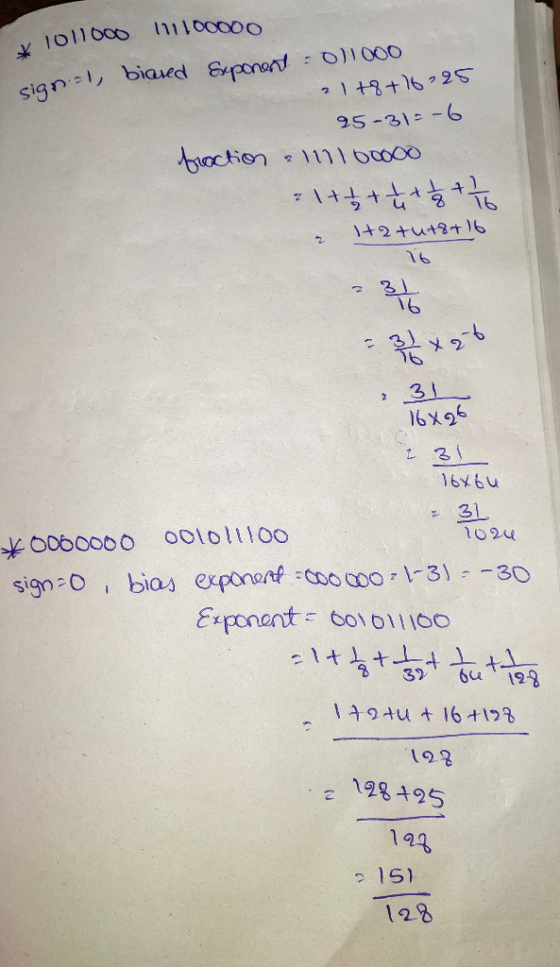
Consider the following two 16-bit floating-point representations 1. Format A. There is one sign b...
I would like a step by step explanation as to how the 7-bit floating point representations from Format A were converted...
I would like a step by step explanation as to how the 7-bit floating point representations from Format A were converted to Format B. Thanks. Consider the following two 7-bit floating point representations based on the IEEE floating point format. Neither has a sign bit - they can only represent non-negative numbers. i). Format A. There are k=3 exponent bits. The exponent bias is 3. There are n=4 fraction bits. ii). Format B. There are k=4 exponent bits. The exponent...
I would like a step by step explanation as to how the 7-bit floating point representations...
I would like a step by step explanation as to how the 7-bit floating point representations from Format A were converted to Format B. Thanks. Consider the following two 7-bit floating point representations based on the IEEE floating point format. Neither has a sign bit - they can only represent non-negative numbers. i). Format A. There are k=3 exponent bits. The exponent bias is 3. There are n=4 fraction bits. ii). Format B. There are k=4 exponent bits. The exponent...
Consider the following floating point format: 1 sign bit, 4 mantissa bits, and 3 exponent bits...
 Consider the following floating point format: 1 sign bit, 4 mantissa bits, and 3 exponent bits in excess 4 format. Add 1 1111 110 0 0110 010 Multiply 1 1011 111 0 0100 010
Consider a 9-bit floating-point representation based on the IEEE floating-point format, with one sign bit, four...
 Consider a 9-bit floating-point representation based on the IEEE floating-point format, with one sign bit, four exponent bits (k = 4), and four fraction bits (n = 4). The exponent bias is 24-1-1-7. The table that follows enumerates some of the values for this 9-bit floating-point representation. Fill in the blank table entries using the following directions: e : The value represented by considering the exponent field to be an unsigned integer (as a decimal value) E: The value of...
2. Represent 25.28255 in 32 bit IEEE-754 floating point format as shown in the following format...
 2. Represent 25.28255 in 32 bit IEEE-754 floating point format as shown in the following format discussed in class. Sign Bit BIT 31 Exponent BITS 30:23 Mantissa BITS 22:0 BYTE 3+1 bit 7 Bits BYTE 1 BYTE O
Assume the following representation for a floating point number 1 sign bit
Assume the following representation for a floating point number 1 sign bit, 4 bits exponent, 5 bits for the significand, and a bias of 7 for the exponent (there is no implied 1 as in IEEE). a) What is the largest number (in binary) that can be stored? Estimate it in decimal. b) What is the smallest positive number( closest to 0 ) that can be stored in binary? Estimate it in decimal.c) Describe the steps for adding two floating point numbers. d)...
Convert the following numbers to excess-16 floating point “tiny IEEE format”. Assume one bit for sign,...
Convert the following numbers to excess-16 floating point “tiny IEEE format”. Assume one bit for sign, 5 for the exponent and 8 for the significant. Add them up and normalize the result. a.) 127 b.) 39
 Consider the following floating point format: 1 sign bit, 4 mantissa bits, and 3 exponent bits in excess 4 format. Add 1 1111 110 0 0110 010 Multiply 1 1011 111 0 0100 010
 Consider a 9-bit floating-point representation based on the IEEE floating-point format, with one sign bit, four exponent bits (k = 4), and four fraction bits (n = 4). The exponent bias is 24-1-1-7. The table that follows enumerates some of the values for this 9-bit floating-point representation. Fill in the blank table entries using the following directions: e : The value represented by considering the exponent field to be an unsigned integer (as a decimal value) E: The value of...
 2. Represent 25.28255 in 32 bit IEEE-754 floating point format as shown in the following format discussed in class. Sign Bit BIT 31 Exponent BITS 30:23 Mantissa BITS 22:0 BYTE 3+1 bit 7 Bits BYTE 1 BYTE O
Most questions answered within 3 hours.
-
Where is the error in this code sequence?
String s1 = "Hello";
String s2 = "ello";...
asked 11 months ago -
Financial data for Joel de Paris, Inc., for last year
follow:
Joel de Paris, Inc.
Balance...
asked 11 months ago -
Consider this reaction:
Al2(SO4)3 (aq)+ BaCl3
(aq) Al2Cl6 (aq)- +
3BaSO4(s) . What is the...
asked 11 months ago -
Suppose that Savneet is considering increasing her
recent random sample from 20 car rentals to 40...
asked 11 months ago -
Trucks arrive at an unloading terminal at an average rate of 120
per hour.
Trucks arrive...
asked 11 months ago -
Why are methanol and ethanol completely soluble in water while
octanol is not very little soluble....
asked 11 months ago -
A facilities manager at a university reads in a research report
that the mean amount of...
asked 11 months ago -
When the CuSO4 is rehydrated by adding water to the anhydrous
compound, is this an endothermic...
asked 11 months ago -
A ray of sunlight is passing from diamond into crown glass; the
angle of incidence is...
asked 11 months ago -
A block of mass 0.249 kg is placed on top of a light, vertical
spring of...
asked 11 months ago -
how do the kidneys compensate in the presences of acidosis
a) trigger hyperventilate
b) reserve acid...
asked 11 months ago -
Question 501 pts
The rental rate of capital to the firm increases. Which of the
following...
asked 11 months ago