
Homework Answers

Add Answer to:
Use the equipartition theorem to determine the value of êv for a mixture containing half water an...
a.) Use the equipartition theorem to estimate C_v (in terms of nR/2) of water vapor at...
a.) Use the equipartition theorem to estimate C_v (in terms of nR/2) of water vapor at room temperature. Compare this to the literature value: 25.3 J/(mol K). Explain your answer in terms of the relative contributions from translation, rotation, and vibration considering the following spectroscopic constants: v_1 = 3650 cm^-1 v_2 =3760 cm^-1 v_3 = 1600 cm^-1 B_rot(ave) = 16 cm^-1 b.) Calculate the value of C_v using the full statistical theory at 3000 K.
700 grams of an ammonia-water liquid mixture containing 50 wt% ammonia is placed in a close...
700 grams of an ammonia-water liquid mixture containing 50 wt% ammonia is placed in a close container and heated to 100 °F. A liquid-vapor equilibrium mixture forms at this temperature. Use the lever rule to find the weight fraction of ammonia in the liquid and vapor phases. Find the mass of ammonia and water in each phase.
Q3. (7.5 marks) A gas mixture containing 88.0 mol% N2 and 12.0 mol% ethanol vapor, flows...
 Q3. (7.5 marks) A gas mixture containing 88.0 mol% N2 and 12.0 mol% ethanol vapor, flows through a pipe at a rate of 100 m/h. The pressure is 760 mmHg absolute and the temperature is 50°C. a) What is the partial pressure of ethanol vapor in the gas mixture? b) What is the molar flowrate of the gas mixture in kmol/h c) Is the gas mixture saturated? if not, to what temperature (in °C) would it be cooled at constant...
Problem 3 G1-1.665 kmol/h of a binary gas mixture containing ammonia (vi-35%, molar basis) and air enter an absorpt...
 Problem 3 G1-1.665 kmol/h of a binary gas mixture containing ammonia (vi-35%, molar basis) and air enter an absorption column operating at 1 atm and 20 °C, where a liquid mixture of water and ammonia (x-2.11%, molar basis) is used to remove 90% of the ammonia from the gas stream. Equilibrium data for this system is given in the table below: (kg NH;) / (100 kg Partial pressure of NH H2O) Mole fraction of NHs in Mole fraction of NHs...
Question 3 A rigid tank, of 0.5 m volume, contains an ideal-gas mixture at 300 K....
 Question 3 A rigid tank, of 0.5 m volume, contains an ideal-gas mixture at 300 K. The mixture is made up of 2.4 kg of gas A and 1.4 kg of gas B, the molecular weights of which are MA = 32.0 kg/kmole and M 28.0 kg/kmole, respectively. i. Determine the mass fraction of A and B. (3 marks] ii. Determine the mole fraction of A and B. [5 marks] iii. Determine the molecular weight of the mixture. [2 marks]...
You are experimenting with an ethanol and water mixture with a mole fraction of ethanol equal...
 You are experimenting with an ethanol and water mixture with a mole fraction of ethanol equal to 0.61. See graph.t AHL (k J/mol) A Hwa versus Xethanol 42.5 42.0 41.5 41.0 40.5 y --3.7052 x 42.516 40.0 0.9663 39.5 39.0 0.6 0.8 0.2 0.4 1.0 Mole Fraction of Ethanol Based on the equation above, what is the value of the correct AHvap to use in this experiment? 402 kJ/m You measure the starting pressure and temperature of your system as...
Q3 A binary vapor mixture contains 65.00% ethanol (1) in water (2) at 50 oC. Determine...
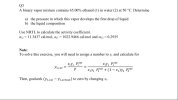 Q3 A binary vapor mixture contains 65.00% ethanol (1) in water (2) at 50 oC. Determine the pressure in which this vapor develops the first drop of liquid b) a) the liquid composition Use NRTL to calculate the activity coefficient a12 3437 cal/mol, a2 1022.9466 cal/mol and a12-0.2935 Note: To solve this exercise, you will need to assign a number to x and calculate for psat XY Psat y1.cal =-iriri sat Then, goalseek 이.cal-y,actual) to zero by changing xỉ.
2. Use the CRC Handbook to determine the vapor pressure of water between 20 °C and 120 C. including one point at the temperature of your water in the flask.Then complete the rest of the table and...
 2. Use the CRC Handbook to determine the vapor pressure of water between 20 °C and 120 C. including one point at the temperature of your water in the flask.Then complete the rest of the table and draw the graphs Graph 1: Vapor pressure vs. temperature (Don't forget to use a French curve.) Graph 2: Log of vapor pressure vs. reciprocal Kelvin temperature. a. b. TABLE 11.13 Complete the ollowing table to help you make your graphs. Temperature Temperature T...
Use of Extraction to Isolate a Neutral Compound from a Mixture Containing an Acid or Base...
 Use
of Extraction to Isolate a Neutral Compound from a Mixture
Containing an Acid or Base Impurity.
Part 4D
Hi guys I had a question about this lab. I am not sure how to
create a flow chart for it as well as what chemical equations it
needs. please let me know if you need more information.
layer. In the Optional Exercise, the sample contains a neutrum base impurity; however, a detailed procedure is not given. If you are assigned...
Use
of Extraction to Isolate a Neutral Compound from a Mixture
Containing an Acid or Base Impurity.
Part 4D
Hi guys I had a question about this lab. I am not sure how to
create a flow chart for it as well as what chemical equations it
needs. please let me know if you need more information.
layer. In the Optional Exercise, the sample contains a neutrum base impurity; however, a detailed procedure is not given. If you are assigned...
Ethanol is often used as a fuel additive, but to function in most engines, the ethanol...
 Ethanol is often used as a fuel additive, but to function in
most engines, the ethanol must be very pure and contain little
water. It is difficult to distill ethanol and water above 90 mole %
ethanol because at this concentration the vapor and the liquid
phases of this mixture have the same composition. To get around
this effect, benzene is often added to the mixture. The
distillation column then separates the mixture into a very nearly
pure ethanol stream,...
Ethanol is often used as a fuel additive, but to function in
most engines, the ethanol must be very pure and contain little
water. It is difficult to distill ethanol and water above 90 mole %
ethanol because at this concentration the vapor and the liquid
phases of this mixture have the same composition. To get around
this effect, benzene is often added to the mixture. The
distillation column then separates the mixture into a very nearly
pure ethanol stream,...
 Q3. (7.5 marks) A gas mixture containing 88.0 mol% N2 and 12.0 mol% ethanol vapor, flows through a pipe at a rate of 100 m/h. The pressure is 760 mmHg absolute and the temperature is 50°C. a) What is the partial pressure of ethanol vapor in the gas mixture? b) What is the molar flowrate of the gas mixture in kmol/h c) Is the gas mixture saturated? if not, to what temperature (in °C) would it be cooled at constant...
 Problem 3 G1-1.665 kmol/h of a binary gas mixture containing ammonia (vi-35%, molar basis) and air enter an absorption column operating at 1 atm and 20 °C, where a liquid mixture of water and ammonia (x-2.11%, molar basis) is used to remove 90% of the ammonia from the gas stream. Equilibrium data for this system is given in the table below: (kg NH;) / (100 kg Partial pressure of NH H2O) Mole fraction of NHs in Mole fraction of NHs...
 Question 3 A rigid tank, of 0.5 m volume, contains an ideal-gas mixture at 300 K. The mixture is made up of 2.4 kg of gas A and 1.4 kg of gas B, the molecular weights of which are MA = 32.0 kg/kmole and M 28.0 kg/kmole, respectively. i. Determine the mass fraction of A and B. (3 marks] ii. Determine the mole fraction of A and B. [5 marks] iii. Determine the molecular weight of the mixture. [2 marks]...
 You are experimenting with an ethanol and water mixture with a mole fraction of ethanol equal to 0.61. See graph.t AHL (k J/mol) A Hwa versus Xethanol 42.5 42.0 41.5 41.0 40.5 y --3.7052 x 42.516 40.0 0.9663 39.5 39.0 0.6 0.8 0.2 0.4 1.0 Mole Fraction of Ethanol Based on the equation above, what is the value of the correct AHvap to use in this experiment? 402 kJ/m You measure the starting pressure and temperature of your system as...
 Q3 A binary vapor mixture contains 65.00% ethanol (1) in water (2) at 50 oC. Determine the pressure in which this vapor develops the first drop of liquid b) a) the liquid composition Use NRTL to calculate the activity coefficient a12 3437 cal/mol, a2 1022.9466 cal/mol and a12-0.2935 Note: To solve this exercise, you will need to assign a number to x and calculate for psat XY Psat y1.cal =-iriri sat Then, goalseek 이.cal-y,actual) to zero by changing xỉ.
 2. Use the CRC Handbook to determine the vapor pressure of water between 20 °C and 120 C. including one point at the temperature of your water in the flask.Then complete the rest of the table and draw the graphs Graph 1: Vapor pressure vs. temperature (Don't forget to use a French curve.) Graph 2: Log of vapor pressure vs. reciprocal Kelvin temperature. a. b. TABLE 11.13 Complete the ollowing table to help you make your graphs. Temperature Temperature T...
 Use
of Extraction to Isolate a Neutral Compound from a Mixture
Containing an Acid or Base Impurity.
Part 4D
Hi guys I had a question about this lab. I am not sure how to
create a flow chart for it as well as what chemical equations it
needs. please let me know if you need more information.
layer. In the Optional Exercise, the sample contains a neutrum base impurity; however, a detailed procedure is not given. If you are assigned...
Use
of Extraction to Isolate a Neutral Compound from a Mixture
Containing an Acid or Base Impurity.
Part 4D
Hi guys I had a question about this lab. I am not sure how to
create a flow chart for it as well as what chemical equations it
needs. please let me know if you need more information.
layer. In the Optional Exercise, the sample contains a neutrum base impurity; however, a detailed procedure is not given. If you are assigned...
 Ethanol is often used as a fuel additive, but to function in
most engines, the ethanol must be very pure and contain little
water. It is difficult to distill ethanol and water above 90 mole %
ethanol because at this concentration the vapor and the liquid
phases of this mixture have the same composition. To get around
this effect, benzene is often added to the mixture. The
distillation column then separates the mixture into a very nearly
pure ethanol stream,...
Ethanol is often used as a fuel additive, but to function in
most engines, the ethanol must be very pure and contain little
water. It is difficult to distill ethanol and water above 90 mole %
ethanol because at this concentration the vapor and the liquid
phases of this mixture have the same composition. To get around
this effect, benzene is often added to the mixture. The
distillation column then separates the mixture into a very nearly
pure ethanol stream,...
Most questions answered within 3 hours.
-
Where is the error in this code sequence?
String s1 = "Hello";
String s2 = "ello";...
asked 10 months ago -
Financial data for Joel de Paris, Inc., for last year
follow:
Joel de Paris, Inc.
Balance...
asked 10 months ago -
Consider this reaction:
Al2(SO4)3 (aq)+ BaCl3
(aq) Al2Cl6 (aq)- +
3BaSO4(s) . What is the...
asked 10 months ago -
Suppose that Savneet is considering increasing her
recent random sample from 20 car rentals to 40...
asked 10 months ago -
Trucks arrive at an unloading terminal at an average rate of 120
per hour.
Trucks arrive...
asked 10 months ago -
Why are methanol and ethanol completely soluble in water while
octanol is not very little soluble....
asked 10 months ago -
A facilities manager at a university reads in a research report
that the mean amount of...
asked 10 months ago -
When the CuSO4 is rehydrated by adding water to the anhydrous
compound, is this an endothermic...
asked 10 months ago -
A ray of sunlight is passing from diamond into crown glass; the
angle of incidence is...
asked 10 months ago -
A block of mass 0.249 kg is placed on top of a light, vertical
spring of...
asked 10 months ago -
how do the kidneys compensate in the presences of acidosis
a) trigger hyperventilate
b) reserve acid...
asked 10 months ago -
Question 501 pts
The rental rate of capital to the firm increases. Which of the
following...
asked 10 months ago