1. Consider an electron initially moving in the positive x-direction along the negative x-axis wi...
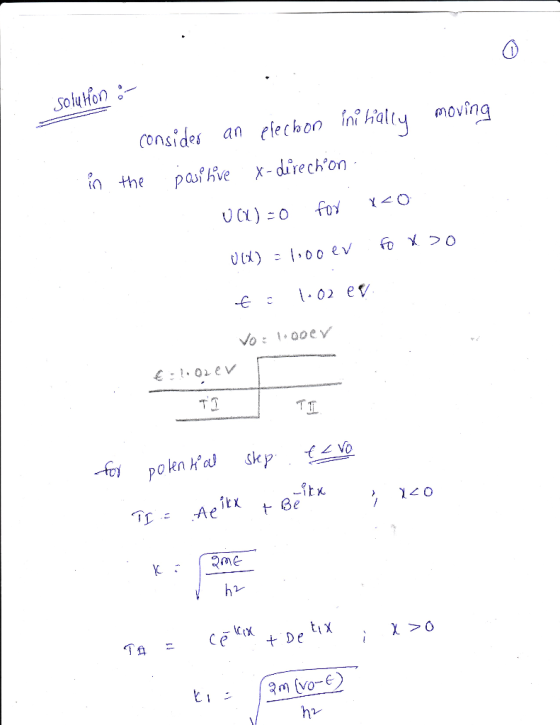
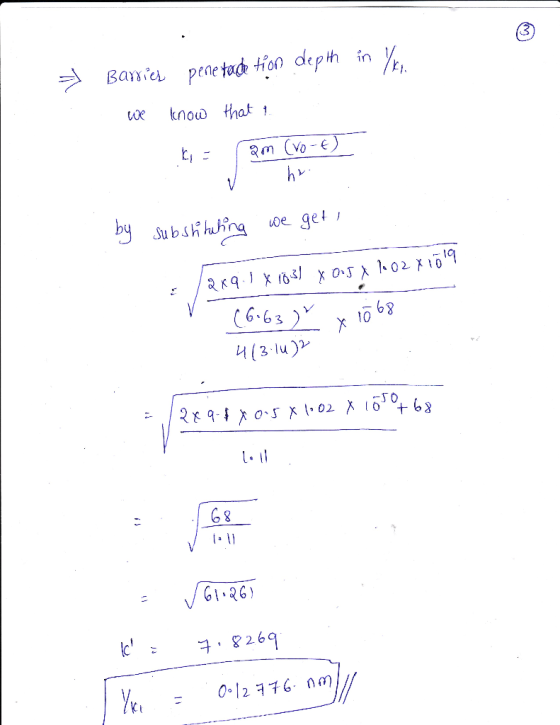
1. Consider an electron initially moving in the positive x-direction along the negative x-axis with an energy E. At the origin the potential energy U (x) changes abruptly, from U(x) = 0 for x < 0, to U(x) = 1.00 eV for x > 0. If E=1.02 eV, just higher than the barrier by 2%, what is the barrier penetration length? What is the reflectance? What is the transmittance?
2. Consider an electron initially moving in the positive
x-direction along the negative x-axis with an energy of 1.0 eV. At
the origin the electron encounters a square barrier; the potential
energy U(x) changes abruptly, from U (x) for x < 0, to U(x) = V
for 0 < x < a, and back to U(x) = 0 for x > a, where the
barrier width 
Homework Answers

Add Answer to:
1. Consider an electron initially moving in the positive x-direction along the negative x-axis wi...
Imagine a proton moving at 2.1 x 10m/s in the positive direction of the x-axis. It...
 Imagine a proton moving at 2.1 x 10m/s in the positive direction of the x-axis. It moves in a field-free space until it passes by the origin, x = 0, where it encounters an electric field directed along the x-axis. (The y and z components of the field are zero everywhere). The electric potential, V(x), associated with this field is shown in the graph below. 200 Hlectrical (V) 100 50 0 0 10 20 30 40 50 60 70 Position...
A free electron moving in the positive x-direction encountering a potential energy barrier in the region...
 A free electron moving in the positive x-direction encountering a potential energy barrier in the region x 0 is described by W(x) Aexp(-i2ax/A1) Bexp(-12x/A1) x< 0 (zone I) WI(X) Cexp(i27ox/A) x 20 (zone II) with A 0.80 m-1/2, B 0.20 m-1/2 and C 1.00 m-12. a) Show that the wave function is continaous at x 0. b) Is the electron showing barrier-penetration behavior? Or barrier-transmission behavior? Justify your answer. c) Calculate the probability the electron is reflected at x 0.
Electron An electron moving in the positive x direction experiences a magnetic force in the negative...
 Electron An electron moving in the positive x direction experiences a magnetic force in the negative z direction. if Bx = 0, what is the direction of the magnetic field? (electron: m = 9.11 x 10⁻³¹ kg, q = -1.6 x 10⁻¹⁹C) negative y direction O positive y direction o negative z direction positive z direction negative x direction
Consider an electron moving along the positive x-axis in empty space (V(x) = 0), described by...
Consider an electron moving along the positive x-axis in empty space (V(x) = 0), described by the wave function ?(?) = sin(??) − ?cos(??) Show that the following wave function is a solution to the Schrödinger Equation. (− ℏ^2/2? ?^2/??2 + ?(?)) ?(?) = ??(?)
Ball B, moving in the positive direction of an x axis at speed v, collides with...
Ball B, moving in the positive direction of an x axis at speed v, collides with stationary ball A at the origin. A and B have different masses. After the collision, B moves in the negative direction of the y axis at speed v/5. In what direction does A move, as an angle with respect to the x axis?
Ball B, moving in the positive direction of an x axis at speed v, collides with...
Ball B, moving in the positive direction of an x axis at speed v, collides with stationary ball A at the origin. A and B have different masses. After the collision, B moves in the negative direction of the y axis at speed v/2. In what direction does A move, as an angle with respect to the x axis?
Score: E-peild Imagine a proton moving initially at 2.1x 10 m/s in the positive direction of...
 Score: E-peild Imagine a proton moving initially at 2.1x 10 m/s in the positive direction of the x-axis. It moves in a field-free space until it passes by the origin, x-0, where it encounters an electric field directed along the x-axis. (The y and z components of the field are zero everywhere.) The electric potential, vto), associated with this field is shown i the left graph for 0x70 cm. 250 200 E 150 100 8 50 0 10 20 30...
An electron is traveling along the x-axis in the positive x-direction. What is the direction of...
An electron is traveling along the x-axis in the positive x-direction. What is the direction of this electron’s magnetic field at the position r = 3 cm i + 4 cm j?
At time t_1 an electron is sent along the positive direction of an x axis, through...
 At time t_1 an electron is sent along the positive direction of an x axis, through both an electric field E and a magnetic field B, with E directed parallel to the y axis. The figure gives the y component F_net, y of the net force on the electron due to the two fields, as a function of the electron's speed v at time t_1. The scale of the velocity axis is set by v_s = 95 m/s. The x...
5. (a) Assume that an electron is moving along an x-axis with a speed of u...
 5. (a) Assume that an electron is moving along an x-axis with a speed of u = 3.080 x 10-m/s measured to a precision of 0.6%. What is the minimum uncertainty (as allowed by the uncertainty principle in quantum theory) with which you can simultaneously mea- sure the position of the electron along the c-axis? Note that the electron mass is m = 9.110 x 10⁻³¹ kg. (b) The speed of a bullet is known to a precision of 0.43%....
 Imagine a proton moving at 2.1 x 10m/s in the positive direction of the x-axis. It moves in a field-free space until it passes by the origin, x = 0, where it encounters an electric field directed along the x-axis. (The y and z components of the field are zero everywhere). The electric potential, V(x), associated with this field is shown in the graph below. 200 Hlectrical (V) 100 50 0 0 10 20 30 40 50 60 70 Position...
 A free electron moving in the positive x-direction encountering a potential energy barrier in the region x 0 is described by W(x) Aexp(-i2ax/A1) Bexp(-12x/A1) x< 0 (zone I) WI(X) Cexp(i27ox/A) x 20 (zone II) with A 0.80 m-1/2, B 0.20 m-1/2 and C 1.00 m-12. a) Show that the wave function is continaous at x 0. b) Is the electron showing barrier-penetration behavior? Or barrier-transmission behavior? Justify your answer. c) Calculate the probability the electron is reflected at x 0.
 Electron An electron moving in the positive x direction experiences a magnetic force in the negative z direction. if Bx = 0, what is the direction of the magnetic field? (electron: m = 9.11 x 10⁻³¹ kg, q = -1.6 x 10⁻¹⁹C) negative y direction O positive y direction o negative z direction positive z direction negative x direction
 Score: E-peild Imagine a proton moving initially at 2.1x 10 m/s in the positive direction of the x-axis. It moves in a field-free space until it passes by the origin, x-0, where it encounters an electric field directed along the x-axis. (The y and z components of the field are zero everywhere.) The electric potential, vto), associated with this field is shown i the left graph for 0x70 cm. 250 200 E 150 100 8 50 0 10 20 30...
 At time t_1 an electron is sent along the positive direction of an x axis, through both an electric field E and a magnetic field B, with E directed parallel to the y axis. The figure gives the y component F_net, y of the net force on the electron due to the two fields, as a function of the electron's speed v at time t_1. The scale of the velocity axis is set by v_s = 95 m/s. The x...
 5. (a) Assume that an electron is moving along an x-axis with a speed of u = 3.080 x 10-m/s measured to a precision of 0.6%. What is the minimum uncertainty (as allowed by the uncertainty principle in quantum theory) with which you can simultaneously mea- sure the position of the electron along the c-axis? Note that the electron mass is m = 9.110 x 10⁻³¹ kg. (b) The speed of a bullet is known to a precision of 0.43%....
Most questions answered within 3 hours.
-
Where is the error in this code sequence?
String s1 = "Hello";
String s2 = "ello";...
asked 11 months ago -
Financial data for Joel de Paris, Inc., for last year
follow:
Joel de Paris, Inc.
Balance...
asked 11 months ago -
Consider this reaction:
Al2(SO4)3 (aq)+ BaCl3
(aq) Al2Cl6 (aq)- +
3BaSO4(s) . What is the...
asked 11 months ago -
Suppose that Savneet is considering increasing her
recent random sample from 20 car rentals to 40...
asked 11 months ago -
Trucks arrive at an unloading terminal at an average rate of 120
per hour.
Trucks arrive...
asked 11 months ago -
Why are methanol and ethanol completely soluble in water while
octanol is not very little soluble....
asked 11 months ago -
A facilities manager at a university reads in a research report
that the mean amount of...
asked 11 months ago -
When the CuSO4 is rehydrated by adding water to the anhydrous
compound, is this an endothermic...
asked 11 months ago -
A ray of sunlight is passing from diamond into crown glass; the
angle of incidence is...
asked 11 months ago -
A block of mass 0.249 kg is placed on top of a light, vertical
spring of...
asked 11 months ago -
how do the kidneys compensate in the presences of acidosis
a) trigger hyperventilate
b) reserve acid...
asked 11 months ago -
Question 501 pts
The rental rate of capital to the firm increases. Which of the
following...
asked 11 months ago